What Is a Chapter-Based Organisation? A Plain Guide

A chapter-based organisation is a body made up of local or specialist groups, called chapters, that share one mission, one name and a common set of rules, while running their own events, volunteers and local activity. The national (or international) body sets direction and standards. The chapters bring the organisation close to members where they live, work or study.
That is the short answer. The longer one matters, because the word “chapter” hides very different legal and operational set-ups. This guide explains how chapter organisations work, the structures behind them, the main types, the benefits and the traps, and what to look for when you need to manage them.
TL;DR
- A chapter-based organisation is a parent body plus local or interest-based groups that share its mission, brand and rules but organise their own activity.
- Chapters are either part of the parent’s legal entity or separately incorporated. That choice drives liability, tax and how much control the parent has.
- The hard part is balancing local freedom with national consistency. Tools and clear documents work better than policing.
- Chapters earn their keep by lowering the barrier to taking part: a smaller, more familiar setting turns passive members into active ones.
- Shared data, communications and payments across HQ and chapters are what stop a chapter network fragmenting into silos.
Table of Contents
- What a chapter-based organisation actually is
- How chapter organisations work
- Chapter membership structure: who belongs to what
- Legal structure: part of the parent or separate?
- Types of chapter organisations
- Benefits of chapter-based groups
- The challenges to plan for
- Our view: what chapter networks need from technology
- How to set up a chapter model that lasts
- Managing chapters on one platform
- FAQ
- Sources
What a chapter-based organisation actually is
Think of a professional institute with a branch in Leeds, another in Glasgow and a third in Cardiff. Or an alumni association with a group in every major city, or a charity with local fundraising groups. Each group carries the parent’s name, follows its constitution and recruits members locally. That is a chapter-based model.
You will see the same idea under other names: branches, sections, regions, districts, affiliates, components. The words are not always interchangeable. One 2026 industry guide to multi-unit structures notes that the term often signals the legal arrangement, and that usage varies by country and sector. In the UK, “branch” is the more common word for local arms of charities and membership bodies, while “chapter” is more common in US-origin associations, fraternal groups and international professional bodies. If you are searching in either vocabulary, you are asking about the same family of structures.
A chapter can be organised around:
- Geography: a town, city, county, region or country.
- Profession or specialism: for example a technical chapter for one discipline.
- Interest or demographic: early-career members, a particular industry, a language group.
- Institution: a university or workplace group.
How chapter organisations work
The tiers
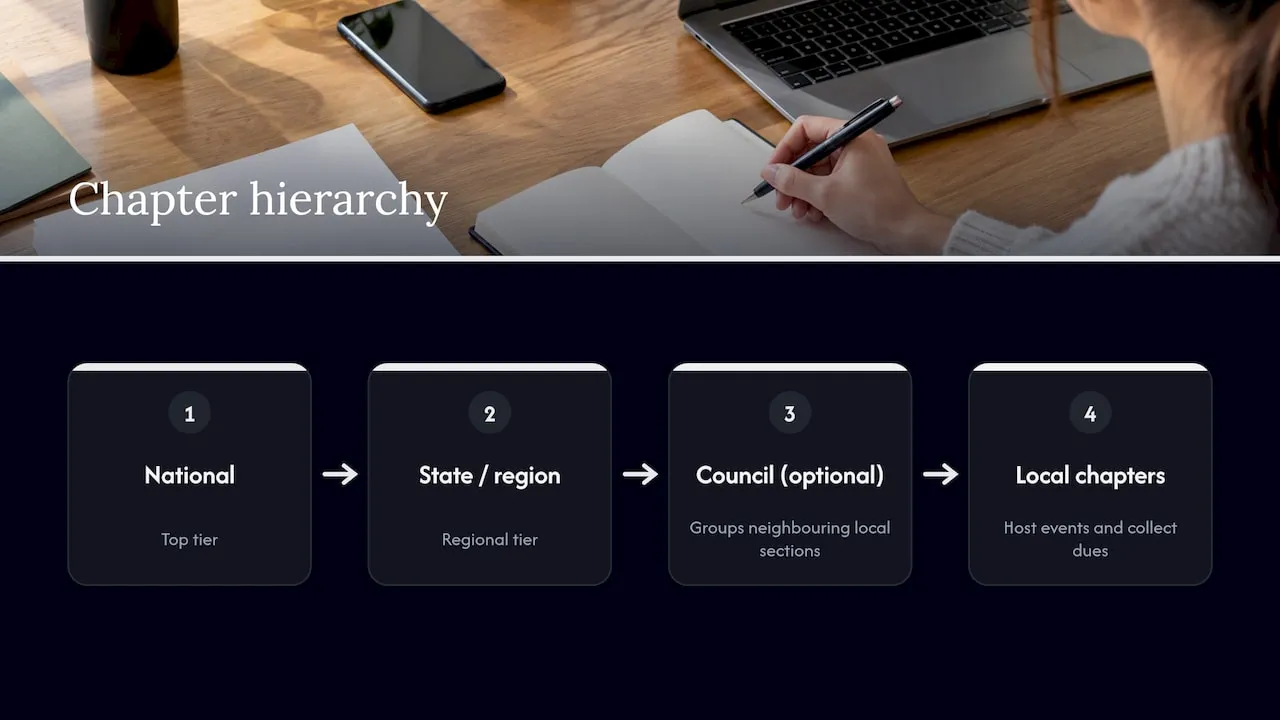
Most chapter organisations have layers. Industry guidance summarised in ASAE’s association management material describes a three-tier hierarchy of national, state or regional, and local chapter, covering everything from event hosting to local dues collection and financial reporting. In the UK you might translate that to national, nation or region, and local branch.
Some organisations add a layer in the middle. The IEEE, for example, uses councils: the San Francisco Bay Area Council brings neighbouring sections together under one umbrella, which lets thinly spread members across contiguous areas support technical chapters that would not be viable in a single section.
Who does what
In a healthy model the split is clear:
| Responsibility | Parent body | Chapter |
|---|---|---|
| Mission, strategy, brand | Sets and protects | Applies locally |
| Membership standards and categories | Defines | Recruits and welcomes |
| Events and programmes | Provides frameworks and flagship events | Runs local events |
| Finance | Sets policy, consolidates reporting | Manages local budget, may collect local dues |
| Governance | Writes bylaws and charter terms | Elects its own committee |
| Data and communications | Holds the central record | Uses it within permissions |
The paperwork that holds it together
The relationship is formalised in documents: bylaws, chapter charter agreements and affiliation agreements. According to the ASAE guidance summarised in our research, clear, documented lines of authority beat informal understandings for managing risk and financial accountability. A procedures or governance manual helps volunteers follow national policy without needing to read a constitution. The Emergency Nurses Association’s policies and procedures are one public example: each state council and separately incorporated chapter is chartered as an official component, and charter status depends on complying with requirements.
Chapter membership structure: who belongs to what
Members usually join the organisation as a whole, then attach to a chapter. There are three common patterns:
- Join national, assigned to a chapter. One membership fee goes to the parent, which passes an agreed share to the chapter. Members are placed by postcode or employer.
- Join the chapter, which is affiliated. The member pays the local group, and the chapter pays an affiliation fee upward.
- Dual or optional membership. The member holds national membership and may choose to add one or more chapters, such as a regional and a special-interest group.
The choice affects your data. If chapters hold their own member lists in spreadsheets, the national body cannot see who belongs, who lapsed or who attended what. If national holds everything and chapters have no access, volunteers cannot do their job. The sensible answer is one shared record with permissions by chapter.
Legal structure: part of the parent or separate?
This is the question most guides skip, and it matters most. Federated associations typically comprise a national or international entity and affiliated regional or local components. As ASAE explains, these may be separately incorporated bodies. Broadly there are two models:
- Unincorporated arm of the parent. The chapter shares the parent’s legal identity and tax-exempt status, and the parent carries the liability.
- Separately incorporated chapter. The chapter is its own legal entity, often with its own tax filings, and the parent gets a degree of liability protection.
The Charity Lawyer Blog sets out how federated nonprofits link a central office to local chapters through structures such as a single corporation or separate subsidiary corporations, with the parent keeping its name and status. Note that both sources are written from a US perspective. Tax-exempt status and filing rules differ by country. If you run a UK charity or association with branches, take advice from a solicitor or your regulator on whether your branches are part of the main charity or separate charities, because that determines who is responsible for accounts, insurance and trustee duties. Failing to define this in an affiliation agreement is the classic source of later disputes.
Types of chapter organisations
You will find chapter models across many sectors:
- Professional associations and institutes. Local or specialist groups run CPD events, networking and mentoring.
- Charities and nonprofits. Local fundraising and service groups carry the cause into communities. Our guide to fundraising ideas for nonprofits is useful for chapter leaders planning local campaigns.
- Alumni networks. City or year-group chapters that keep graduates connected.
- Trade and industry groups. Regional bodies representing local employers.
- Fraternal, civic and student organisations. Local groups with their own officers and rituals.
- Corporate or enterprise communities. Brands build local chapters to scale customer or developer communities, a model described in Bevy’s guide to local chapters.
By structure, they fall into a spectrum from tightly controlled (chapters are branches with no independent finances) to loose (independent affiliates that license the name). Most organisations sit somewhere in the middle, and many are moving along that spectrum as they grow.
Benefits of chapter-based groups
Why bother with the complexity? Because chapters do things a central office cannot.
Participation. A smaller group is a more comfortable place to speak up, host an event or stand for a committee. Experts describe chapters as engines for engagement rather than administrative subdivisions: they lower the barrier to contribution and help passive members feel connected to the mission. We cover the wider topic in our guide to improving member engagement.
Local relevance. A chapter knows its venues, employers, regulators and local issues. National programmes rarely do.
Scale without a bigger head office. Volunteers carry local workload, so growth does not require headcount at HQ in step.
Structure for large communities. As one community-building piece puts it, growing communities become hard to manage, and chapters give a framework for that growth.
Leadership pipeline. Chapter committees are where future trustees and board members learn the ropes. See our practical guide to improving board engagement.
Volunteer-run local groups also depend on running sustainably. If you want a wider view of how clubs keep their volunteers and resources going, this German-language guide to sustainability in clubs offers a starting point for local committees.
The challenges to plan for
Autonomy versus alignment
Association management experts name this as the biggest tension. According to ASAE’s analysis of federated structures, policing chapters too hard creates friction. The better route is giving local volunteers the tools, frameworks and digital platforms, such as a central CRM and marketing portal, so they can be independent and consistent at once.
Brand consistency
Sending chapters a 60-page style manual rarely works. ASAE’s piece on brand consistency for components argues for treating it as empowerment: a short marketing toolkit with tone cheat sheets and core messages, held in a central leadership portal, makes it easy for volunteers to stay on brand.
Shared context
Chapters often fail because HQ and volunteers do not see the same information. ASAE’s July 2026 article on AI productivity in associations stresses that transformation depends on redesigning workflows across teams, chapters and volunteers, with goals, owners and status held in a searchable, permissioned system that spans both.
Volunteer turnover
Chapter officers change every year or two. If processes live in someone’s inbox, they leave with them. Documented procedures and a system that keeps the member record, event history and finances at the centre solve most of this.
Our view: what chapter networks need from technology
We work with membership organisations, associations and nonprofits, and the same pattern appears whenever a chapter network starts to strain. The structure is rarely the problem. The problem is that every chapter has built its own spreadsheet, mailing list and payment link, so the centre cannot see the whole membership and the chapters cannot reach the tools they need.
Our view is that chapters should be given the centre’s tools, not the centre’s rules alone. In practice that means:
- One member record, with chapter-level permissions, so a chapter secretary sees their members and nothing more.
- Event registration and payment that chapters can set up themselves but that report back to a single place.
- Email and campaigns that local volunteers can send from approved templates.
- Member portals where chapter leaders find the toolkit, policies and reports in one location.
- Reporting that lets HQ spot a struggling chapter early, before a lapse becomes a closure.
We built Colossus Systems around this idea of one platform for membership, events, CRM, email, e-commerce and portals, with workflows that can be tailored to each organisation. If your chapters currently run on a patchwork, consolidating comes before anything clever. Start by agreeing what data the centre owns, what chapters can see and who approves what, then configure the system to match.
— Rob
How to set up a chapter model that lasts
- Decide the legal model first. Part of the parent, or separately incorporated? Get professional advice and write it into an affiliation agreement.
- Define the chapter unit. Geography, interest or both, with a minimum viable size.
- Write a short chapter charter. Purpose, officer roles, finances, reporting, and what happens if a chapter goes dormant.
- Agree the money flow. Who collects fees, what share goes where, and how often chapters report.
- Build a leadership toolkit. Templates, brand guidance, event checklists, safeguarding and data protection basics.
- Put members, events and payments on one system. This is where shared context is created.
- Review annually. Look at activity, attendance, renewals and volunteer health by chapter, and adjust the model rather than defending it.
Our article on mastering membership management basics covers the foundations, and community building ideas for member organisations gives chapter leaders things to run once the structure is in place. If you are weighing up systems for your central records, our guide to the best CRM for nonprofits explains what to look for.
Managing chapters on one platform
If you run a chapter network and want members, events, CRM and payments in one place, our membership management software is built for that job, and our event management software lets local teams run registrations that report to the centre. Plans are published openly on our pricing page: Core is £349 per month, Growth is £699 per month, Scale is £1,299 per month and Enterprise is from £2,500 per month. Contributor licences start from £29 per month. You can also browse the full feature list to see what applies to your chapters.
FAQ
What is a chapter organisation?
It is an organisation made up of a parent body and local or specialist groups that share its mission and name. The parent sets standards and the chapters run local activity such as meetings, events and recruitment.
What is the difference between a chapter and a branch?
In everyday use they often mean the same thing, with “branch” more common in the UK and “chapter” more common in US-origin bodies. What matters more is the legal arrangement: whether the local group is part of the parent or a separate incorporated body. Check your own governing documents rather than relying on the label.
Do chapters need their own legal entity?
Not necessarily. Some chapters are unincorporated arms of the parent and share its status and liability, while others are separately incorporated, as ASAE describes. The right choice depends on your risk, your country’s rules and the independence you want chapters to have, so take legal advice.
How do chapters stay consistent with the national body?
Mostly through a clear charter, a simple toolkit and shared systems, not constant checking. Giving volunteers approved templates, a common member database and clear reporting lines keeps chapters aligned while leaving local decisions with local people.
What are the main benefits of chapters?
They make participation easier, keep activity relevant locally, spread workload across volunteers and build a pipeline of future leaders. The trade-off is the need for clear governance and shared data, which is where most of the effort goes.
Sources
- Are Federated Association Structures Becoming Obsolete? (ASAE, 2016)
- CAE Exam Content Outline, chapters and affiliate relations (ASAE)
- Brand Consistency for Components: Stop Policing, Start Empowering (ASAE, 2026)
- The Mirage of AI Productivity for Associations (ASAE, 2026)
- Creating Nonprofit Chapters and Affiliates (Charity Lawyer Blog)
- Policies and Procedures (Emergency Nurses Association)
- San Francisco Bay Area Council (IEEE Technology Navigator)
- Focused interest groups (Tchop)
- The Power of Chapter-Based Communities (CMX)
- How to Scale Enterprise Communities with Local Chapters (Bevy)
- Chapter vs Branch vs Affiliate (TidyHQ)
- Nachhaltigkeit im Verein