Improving board engagement: a practical guide for nonprofits

TL;DR:
- Effective board engagement depends on clear roles, well-designed meetings, and accountability systems that foster participation. Small, intentional adjustments, like early material distribution and structured agendas, significantly improve involvement and collaboration. Continuous evaluation and a strong governance culture sustain engagement over time, supported by technology that amplifies effective practices.
Board engagement is defined as the active, meaningful participation of directors across the full governance lifecycle, not just attendance at meetings. Disengaged boards cost nonprofits and associations dearly: weaker oversight, missed strategic opportunities, and a mission that drifts without strong direction. The good news is that improving board engagement is a systems problem, not a people problem. When you build clear expectations, well-designed meetings, and genuine accountability into your governance structure, participation follows naturally. This guide gives board leaders and organisational directors the practical tools to make that happen.
What are the prerequisites for improving board engagement?
Board disengagement is often a symptom of unclear roles, weak meeting design, and insufficient accountability systems rather than a lack of motivation. That finding changes everything. It means you do not need to recruit more enthusiastic people. You need to build a system that makes engagement the natural default.

The foundation starts with role clarity. Every board member should receive a written role description before they join, covering attendance requirements, preparation expectations, and committee responsibilities. Ambiguity about what is expected breeds disengagement faster than almost anything else.
Structured onboarding is equally critical. A formal induction programme should include:
- A written governance handbook covering bylaws, financials, and strategic priorities
- A scheduled orientation session with the chair and chief executive
- Assignment of a board buddy system pairing new members with experienced directors
- A 90-day check-in to address early questions and concerns
The board buddy approach deserves particular attention. Experienced directors provide unspoken organisational context, including cultural norms, historical decisions, and informal protocols, that no handbook can fully capture. New members who receive this support report higher confidence and contribute more quickly.
Technology also plays a foundational role. A board portal gives members instant access to meeting packs, governance documents, and secure messaging. When materials are easy to find and communications are centralised, the friction that discourages preparation disappears.
Pro Tip: Set attendance and preparation expectations in writing during recruitment, not after a problem arises. Proactive clarity prevents the awkward conversation later.
How to design board meetings that maximise participation
Meeting design is where most boards lose their members. Agendas packed with status reports and informational updates leave directors feeling like passive observers rather than active governors. The fix is structural.
Board materials should be distributed 5–7 days before meetings to allow adequate preparation and enable strategic discussions. Sending a 200-page pack two days before a meeting correlates directly with poor preparation and passive attendance. Concise, decision-focused packs sent well in advance change that dynamic entirely.
Structure your agenda around decisions, not updates
A well-designed agenda allocates at least one-third of meeting time to strategic issues rather than status reports. Routine approvals belong on a consent agenda, which members review in advance and approve as a block without discussion. This frees the meeting for the conversations that actually require a room full of experienced directors.
- Open with a consent agenda covering minutes, routine financials, and standard approvals
- Move to strategic items requiring genuine discussion and collective decision-making
- Assign a time allocation to each agenda item and publish it in advance
- Close with an executive session to capture real-time feedback and align on priorities
- Confirm action items before the meeting ends, with named owners and deadlines
Pre-recorded video briefings from management are another underused technique. Shifting to discussion-focused meetings by replacing live presentations with pre-recorded walkthroughs is identified as a key driver against disengagement. Members watch the briefing before the meeting and arrive ready for Q&A, not passive listening.
| Meeting element | Poor practice | Better practice |
|---|---|---|
| Materials timing | Sent 1–2 days before | Sent 5–7 days before |
| Agenda focus | Status reports | Decisions and discussion |
| Routine approvals | Discussed individually | Consent agenda |
| Management updates | Live presentations | Pre-recorded briefings |
| Meeting close | No formal wrap-up | Executive session with action items |
Pro Tip: Publish the time allocation for each agenda item. It signals respect for members’ time and keeps discussion focused on what matters most.
What accountability systems sustain board engagement between meetings?
Engagement does not maintain itself between meetings. Without deliberate accountability structures, momentum fades and members drift. Regular board evaluations and culture assessments create the feedback loops that sustain commitment and clarify expectations over time.
Accountability works best when it is normalised rather than punitive. The goal is to make follow-through the expected standard, not to catch people failing. Practical systems that achieve this include:
- Action item tracking: Document every commitment made in a meeting, with a named owner and a deadline, in real time. Circulate the list within 24 hours of the meeting.
- Attendance monitoring: Define a minimum attendance threshold in your governance documents. Chair interventions after two consecutive missed meetings are recommended by governance experts as a proactive, not reactive, measure.
- Scheduled check-ins: Brief one-to-one calls between the chair and individual members between meetings normalise accountability and surface concerns before they become disengagement.
- Progress updates: Send written progress reports on key decisions between meetings. Members who see their contributions producing results stay invested.
- Executive sessions: Brief sessions at the start and end of each meeting give the board space to calibrate priorities and provide candid feedback without staff present.
Directors report that improving information flow and meeting culture impacts engagement more than increasing meeting frequency or length. That is a critical insight. More meetings are not the answer. Better systems are.
Pro Tip: Treat the post-meeting action list as a governance document, not an afterthought. Circulate it promptly, track it at the next meeting, and make completion the norm.
How does board culture affect collaboration and engagement?
Culture is the invisible governance layer that either amplifies or undermines everything else you build. A board where certain voices dominate and others stay quiet will underperform regardless of how well-designed its agendas are.
A culture that translates values into observable behaviours, such as “every voice is heard” and “no informal inner circle,” produces higher participation and more candid discussion. The chair sets this tone, but every member reinforces it. Practical steps to build this culture include:
- Rotate facilitation roles for specific agenda items. Rotating meeting facilitation and explicitly inviting quieter members to lead discussion increases their sense of contribution and value.
- Invest in informal time. Informal social interactions such as dinners before meetings, site visits, and social events build the trust that makes constructive challenge possible during governance discussions.
- Connect members to the mission. Directors who have direct contact with the people or communities the organisation serves are intrinsically motivated. Arrange site visits, beneficiary presentations, or field trips as part of the board calendar.
- Challenge assumptions constructively. Invite dissenting views explicitly. A board that only agrees is not governing; it is rubber-stamping.
Effective nonprofit board collaboration also depends on members feeling that their specific expertise is valued and used. Assign committee roles that match individual skills and make those contributions visible to the full board.
Key takeaways
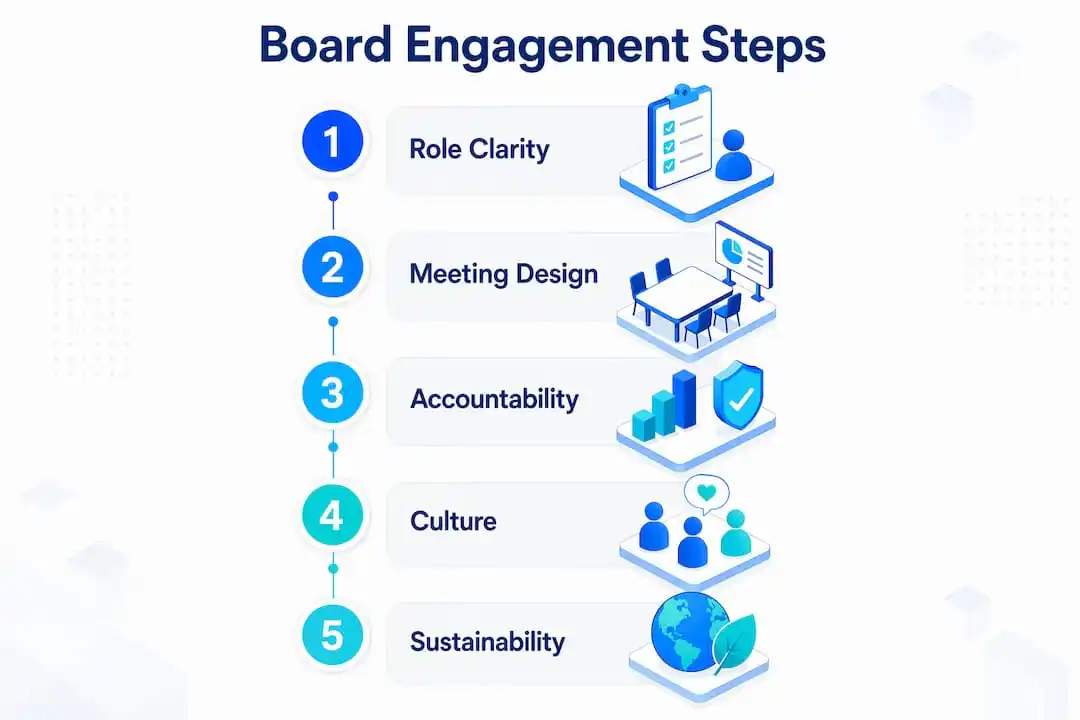
Improving board engagement requires aligning clarity, meeting design, accountability, and culture into one coherent system rather than applying isolated fixes.
| Point | Details |
|---|---|
| Start with role clarity | Define attendance, preparation, and participation expectations in writing before members join. |
| Design meetings for decisions | Send materials 5–7 days early and structure agendas around discussion, not status reports. |
| Build accountability into governance | Track action items in real time and intervene proactively after two missed meetings. |
| Invest in board culture | Rotate facilitation roles and create informal time together to build trust and candid dialogue. |
| Use technology as an enabler | Board portals and pre-recorded briefings reduce friction and free meeting time for strategic work. |
What I have learned about sustainable board engagement
The most common mistake I see boards make is treating disengagement as a personality problem. A director goes quiet, misses a meeting, or stops contributing, and the instinct is to blame them. The real question is always: what did the system fail to provide?
Engagement thrives when boards view it as a system issue with clear expectations and structures. That framing is not just more accurate. It is more productive. You can redesign a system. You cannot redesign a person.
What I have also found is that small adjustments produce disproportionate results. Sending materials a week early instead of two days before a meeting. Adding a consent agenda. Assigning a board buddy to every new member. None of these require significant resources. All of them signal to directors that their time and contribution are respected.
Technology is a genuine enabler here, but only when the fundamentals are in place. A board portal does not fix a dysfunctional culture. Clear agendas and genuine accountability do. Once those are working, technology amplifies the gains rather than substituting for them.
The boards I have seen sustain high engagement over years share one trait: they treat governance improvement as an ongoing practice, not a one-time project. They evaluate themselves annually, act on the feedback, and keep the conversation about how they work together open and honest. That commitment to continuous improvement is what separates boards that thrive from those that merely function.
— Rob
How Colossus supports your board engagement goals
Colossus gives nonprofit and association leaders the tools to put these strategies into practice without adding administrative burden.
Our platform centralises board pack distribution, tracks which members have reviewed materials, and supports secure messaging between meetings to keep communication consistent. Agenda building tools help chairs structure discussions around decisions rather than updates, and action item tracking ensures commitments are visible and followed through. For organisations looking to connect board governance with broader member management, our membership management features bring CRM, event coordination, and communication into one place. You can also explore our CRM software to manage board member relationships and track engagement over time.
FAQ
What does board engagement actually mean?
Board engagement means active, meaningful participation by directors across the full governance lifecycle, including preparation, meeting contribution, and follow-through on commitments. It goes well beyond simply attending meetings.
Why do board members become disengaged?
Disengagement is often caused by information overload, unclear role expectations, and poor meeting design rather than a lack of motivation. Fixing the system addresses the root cause.
How far in advance should board materials be sent?
Best practice calls for distributing board packs 5–7 days before meetings. This gives members adequate time to prepare and arrive ready for strategic discussion rather than passive listening.
What is a consent agenda and why does it matter?
A consent agenda groups routine approvals, such as minutes and standard financials, into a single block that members approve without discussion. It frees meeting time for the strategic conversations that genuinely require the board’s collective input.
How often should boards evaluate their own performance?
Annual board evaluations are the recognised standard, supported by culture assessments that create ongoing feedback loops. Boards that evaluate regularly report stronger commitment and clearer expectations among members.