Strategic Planning for Nonprofits: Driving Engagement and Impact

More than 60 percent of British and North American nonprofits struggle to maintain consistent member engagement after major organisational changes. This challenge impacts everything from fundraising to daily operations, pushing executive directors to explore better planning strategies. Strategic planning goes beyond basic management, offering nonprofit decision makers a clear way to enhance member participation and operational efficiency using proven models designed for real impact.
Table of Contents
- Defining Strategic Planning For Nonprofits
- Key Models And Planning Frameworks
- Essential Characteristics Of Effective Plans
- Stakeholder Roles And Board Engagement
- Mitigating Risks And Overcoming Common Challenges
Key Takeaways
| Point | Details |
|---|---|
| Importance of Strategic Planning | Nonprofit strategic planning is essential for transforming goals into actionable strategies that align with mission objectives. |
| Stakeholder Engagement | Effective plans require collaboration among stakeholders, including board members and programme staff, to ensure comprehensive insights and buy-in. |
| Framework Utilisation | Utilising frameworks such as the Theory of Change and Balanced Scorecard enhances strategic clarity and organisational performance assessment. |
| Risk Mitigation | A robust risk management strategy is crucial for navigating challenges and ensuring organisational sustainability through proactive planning. |
Defining Strategic Planning for Nonprofits
Strategic planning for nonprofits represents a deliberate, systematic approach to organisational development and mission advancement. At its core, it provides a comprehensive roadmap that transforms abstract goals into actionable strategies, enabling organisations to navigate complex operational landscapes with clarity and purpose. Comprehensive strategic planning processes help nonprofits identify precise pathways towards achieving their fundamental social objectives.
The strategic planning process involves multiple critical dimensions beyond traditional business planning. Nonprofits must specifically focus on mission alignment, stakeholder engagement, and impact measurement. Unlike corporate strategic plans, these frameworks prioritise social value creation over financial performance, requiring nuanced approaches that balance resource constraints with ambitious programmatic goals. Organisations develop strategic plans by conducting thorough environmental scans, analysing internal capabilities, and mapping potential intervention strategies that directly support their core mission.
Successful nonprofit strategic planning demands collaborative engagement across organisational levels. Board members, executive leadership, programme staff, and key stakeholders must collectively contribute insights, ensuring comprehensive perspective and organisational buy-in. Strategic roadmaps for nonprofits typically include detailed analysis of current organisational capacity, projected resource requirements, programmatic priorities, and measurable impact indicators.
Pro tip: Schedule quarterly strategic alignment sessions to review progress, adjust objectives, and maintain organisational momentum towards your mission-critical goals.
Key Models and Planning Frameworks
Nonprofit strategic planning incorporates diverse frameworks that enable organisations to transform mission-driven objectives into measurable, actionable strategies. Structured evaluation models provide systematic approaches for defining organisational impact, mapping programmatic interventions, and managing resource allocation effectively.
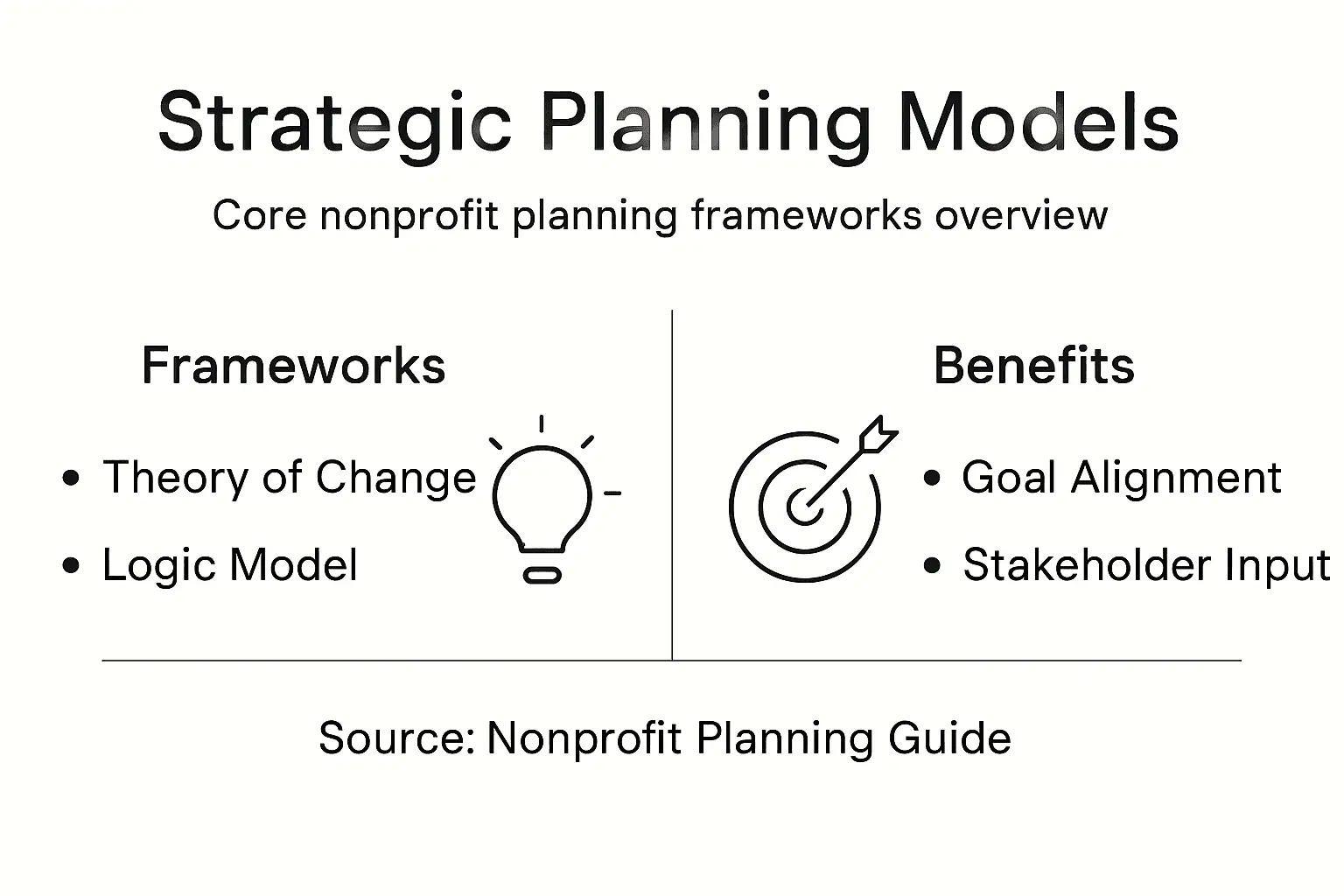
Three prominent strategic planning frameworks stand out for nonprofits: the Theory of Change, Logic Model, and Balanced Scorecard. The Theory of Change enables organisations to articulate comprehensive pathways between activities and desired long-term outcomes, helping leaders visualise complex intervention strategies. The Logic Model offers a detailed framework for connecting inputs, activities, outputs, and ultimate impacts, allowing nonprofits to demonstrate clear causal relationships between programme investments and social transformation.
The Balanced Scorecard approach provides a multidimensional perspective by examining organisational performance across four critical dimensions: financial sustainability, internal processes, learning and growth, and stakeholder impact. Evaluation frameworks for nonprofits help organisations move beyond simplistic measurement approaches, encouraging holistic assessment of programmatic effectiveness and strategic alignment.
Here is a comparison of the leading strategic planning frameworks for nonprofits:
| Framework | Main Purpose | Advantages | Typical Use Case |
|---|---|---|---|
| Theory of Change | Map activities to outcomes | Guides long-term vision | Complex social change projects |
| Logic Model | Link resources to impacts | Clarifies programme relationships | Funders seeking direct evidence |
| Balanced Scorecard | Assess performance areas | Encourages holistic evaluation | Ongoing organisational tracking |
Pro tip: Adopt a flexible strategic framework that allows periodic reassessment and adaptation, ensuring your nonprofit remains responsive to evolving community needs and emerging challenges.
Essential Characteristics of Effective Plans
Effective nonprofit strategic plans transcend traditional documentation, serving as dynamic roadmaps that guide organisational transformation. Measurable strategic planning requires creating concise, adaptable frameworks that connect ambitious goals with practical implementation strategies, ensuring continuous alignment with the organisation’s core mission.
Key characteristics of robust strategic plans include precise goal articulation, stakeholder engagement, and built-in flexibility for adaptive management. Successful plans incorporate comprehensive environmental scanning to understand external context, develop clear performance indicators, and establish mechanisms for regular review and adjustment. These plans must balance aspirational objectives with realistic resource constraints, creating a pragmatic yet inspiring blueprint for organisational growth and social impact.

The most effective strategic plans integrate multiple perspectives, ensuring comprehensive representation across organisational levels. Board members, executive leadership, programme staff, and external stakeholders should contribute insights, creating a holistic approach that generates shared commitment. This collaborative development process helps transform strategic documents from static reports into living instruments of organisational change, fostering transparency, accountability, and collective ownership of the nonprofit’s strategic direction.
Pro tip: Conduct annual strategic plan reviews with your entire team, treating the document as a collaborative, evolving tool rather than a rigid, unchangeable mandate.
Stakeholder Roles and Board Engagement
Stakeholder engagement strategies are fundamental to nonprofit strategic planning, transforming organisational decision-making from isolated processes to collaborative frameworks. Each stakeholder group brings unique perspectives and critical contributions that shape the organisation’s strategic direction, ensuring comprehensive and inclusive planning approaches.
Board members play a pivotal governance role, providing strategic oversight, financial stewardship, and mission alignment. Their responsibilities extend beyond traditional monitoring, encompassing active leadership in strategic visioning, resource mobilisation, and organisational accountability. Effective board engagement requires creating clear communication channels, establishing meaningful performance metrics, and developing robust mechanisms for continuous learning and strategic adaptation.
Diverse stakeholder representation—including staff, volunteers, donors, and community beneficiaries—enriches strategic planning by introducing multifaceted insights. These groups contribute distinct perspectives that challenge assumptions, identify potential blind spots, and generate innovative solutions. By developing structured engagement processes like stakeholder analysis matrices, workshops, and collaborative planning sessions, nonprofits can create more resilient, responsive, and impactful strategic frameworks that genuinely reflect community needs and organisational capabilities.
To summarise, below are core stakeholder groups and their key contributions to nonprofit strategic planning:
| Stakeholder Group | Key Contribution | Typical Engagement Method |
|---|---|---|
| Board Members | Strategic oversight, accountability | Governance meetings |
| Programme Staff | Programme design, operational insight | Collaborative workshops |
| Donors | Financial support, mission feedback | Consultations, surveys |
| Beneficiaries | Needs assessment, idea generation | Community forums |
Pro tip: Implement a rotating stakeholder advisory panel to ensure continuous, dynamic input into your strategic planning process, promoting genuine organisational transparency and collaborative decision-making.
Mitigating Risks and Overcoming Common Challenges
Risk management frameworks are essential for nonprofits to navigate complex operational landscapes, ensuring organisational resilience and mission sustainability. Understanding potential threats requires a comprehensive approach that addresses operational, financial, legal, and reputational vulnerabilities through systematic identification, assessment, and strategic mitigation.
Nonprofits typically encounter multifaceted risks including financial instability, compliance challenges, governance gaps, and programmatic uncertainties. Strategic risk management involves developing nuanced approaches that balance organisational protection with mission-driven objectives. This requires creating adaptive strategies such as establishing robust internal control mechanisms, maintaining diverse funding streams, implementing comprehensive insurance coverage, and developing contingency plans that enable rapid response to emerging challenges.
Effective risk mitigation demands a holistic approach integrating governance, leadership, and stakeholder engagement. Organisations must cultivate a proactive risk culture that encourages transparency, continuous learning, and collaborative problem-solving. This involves regular risk assessments, developing clear communication protocols, training staff and board members in risk identification, and creating flexible decision-making frameworks that can rapidly adapt to changing environmental conditions.
Pro tip: Develop a comprehensive risk register that categorises potential threats by likelihood and potential impact, enabling systematic prioritisation and targeted mitigation strategies.
Streamline Your Nonprofit’s Strategic Planning and Stakeholder Engagement
Nonprofit organisations face unique challenges in aligning mission-driven goals with effective stakeholder engagement and adaptive management. When navigating complex strategic frameworks such as the Theory of Change or Balanced Scorecard, the need for a unified platform to coordinate member management, event planning, and communications becomes critical. Colossus Systems understands these pain points by offering a seamless solution that integrates CRM, email marketing, event registration, and analytics to keep your board, staff, donors, and beneficiaries actively engaged and accountable.
Maximise your nonprofit’s potential by adopting a flexible system designed to support strategic plan reviews, stakeholder collaboration, and risk mitigation in one place. Discover how customisable tools for managing your membership and virtual events amplify your mission impact through increased engagement and efficient operations. Don’t wait to transform your strategic vision into tangible results. Reach out today via our Contact Us page to learn how Colossus Systems can help you execute measurable plans and foster dynamic organisational growth.
Frequently Asked Questions
What is strategic planning for nonprofits?
Strategic planning for nonprofits involves creating a systematic approach to organisational development and mission advancement. It provides a roadmap to turn abstract goals into actionable strategies, helping organisations navigate complex operational landscapes.
Why is stakeholder engagement important in nonprofit strategic planning?
Stakeholder engagement is crucial as it brings diverse perspectives and insights that shape the organisation’s strategic direction. Involving board members, staff, donors, and beneficiaries ensures a more comprehensive and inclusive planning process.
What are some common frameworks used in nonprofit strategic planning?
Common frameworks include the Theory of Change, Logic Model, and Balanced Scorecard. These models help nonprofits articulate their objectives, connect resources to impacts, and assess performance across various dimensions.
How can nonprofits mitigate risks during the strategic planning process?
Nonprofits can mitigate risks by developing a comprehensive risk management strategy that includes regular risk assessments, clear communication protocols, and adaptive strategies that allow for rapid response to emerging challenges.