Boardroom Management Software: Driving Nonprofit Growth

Faced with the demands of leading a nonprofit board, many Executive Directors in North America struggle to keep member engagement high and administrative tasks under control. Effective boardroom management is about more than meeting agendas and documents—it is about creating a space where collaboration and governance are seamless. By adopting advanced SaaS solutions, organisations can centralise communications, facilitate decision making, and ensure compliance, giving directors the tools to focus on meaningful leadership and strategic growth.
Table of Contents
- Boardroom Management Software Defined and Debunked
- Types and Core Capabilities Explained
- How Software Facilitates Governance and Engagement
- Legal, Security, and Compliance Essentials
- Costs, Common Pitfalls, and Comparing Alternatives
Key Takeaways
| Point | Details |
|---|---|
| Enhanced Governance | Boardroom management software streamlines board operations by centralising communication and decision-making processes for nonprofits. |
| Types of Software | There are three main types of boardroom software: general board portals, nonprofit-specific solutions, and hybrid systems tailored to various organisational needs. |
| Legal and Security Focus | These platforms must comply with stringent data protection regulations and implement robust security measures to safeguard sensitive information. |
| Cost Considerations | Nonprofits should carefully assess implementation costs, integration complexities, and long-term pricing models when selecting boardroom management software. |
Boardroom Management Software Defined and Debunked
Boardroom management software represents a pivotal technological advancement for nonprofit organisations seeking enhanced governance and strategic alignment. These sophisticated digital platforms transform traditional board operations by centralising critical communication, documentation, and decision-making processes.
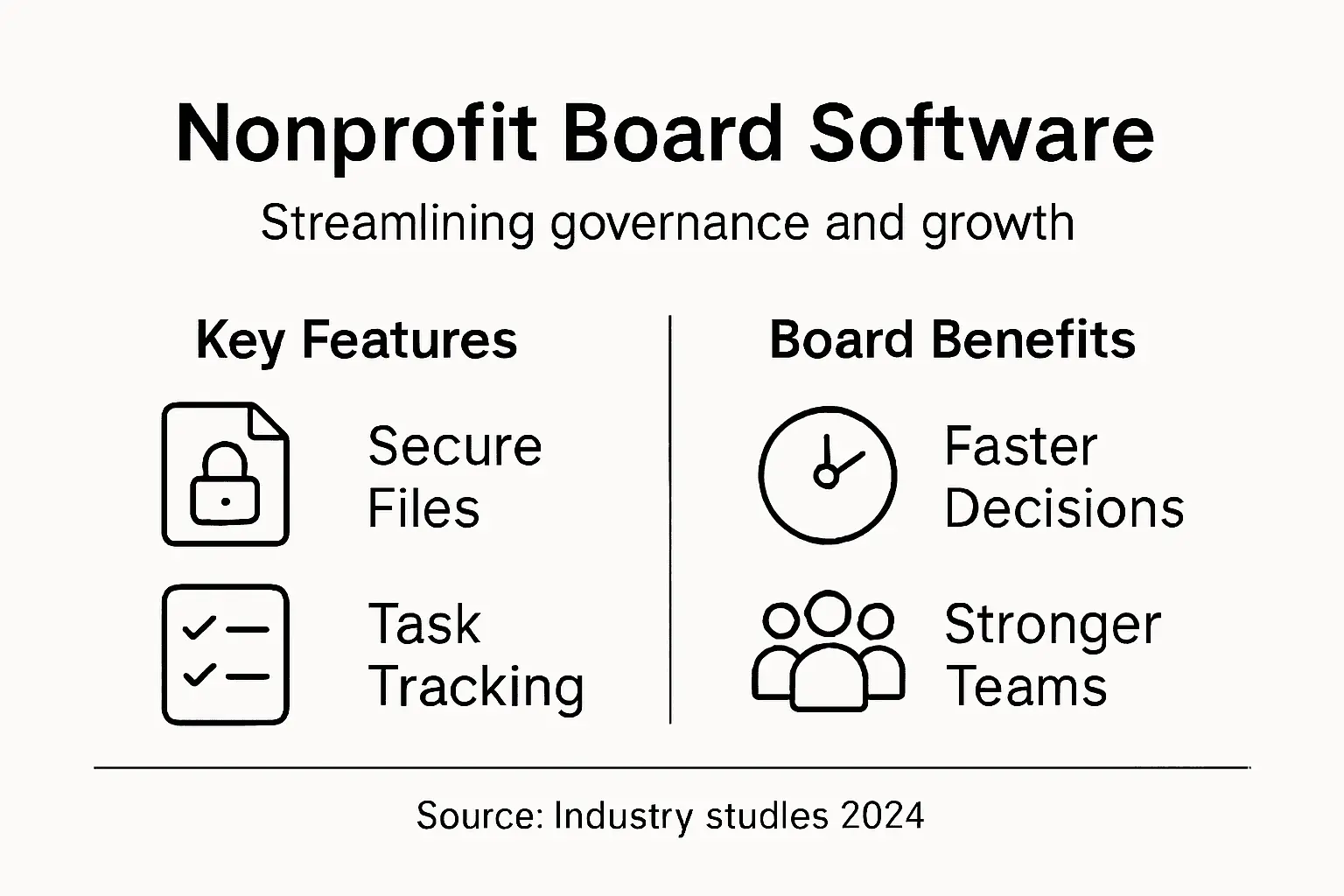
At its core, boardroom management software provides nonprofits with comprehensive tools designed to streamline complex administrative tasks. Nonprofit board governance resources highlight several key functionalities that distinguish these platforms:
- Centralised document storage and secure sharing
- Real-time collaboration capabilities
- Meeting scheduling and agenda management
- Comprehensive member communication channels
- Voting and decision-tracking mechanisms
- Compliance and reporting dashboards
Contrary to common misconceptions, these digital solutions are not intended to replace human interaction but to enhance board member engagement and effectiveness. The software acts as an intelligent platform that facilitates more meaningful discussions, ensures transparency, and enables data-driven governance strategies.
Nonprofit boards often face significant challenges in managing complex information and maintaining consistent communication. Boardroom management software addresses these pain points by providing a unified digital environment where board members can collaborate seamlessly, regardless of geographical constraints. By digitising traditionally manual processes, organisations can reduce administrative overhead and allocate more resources towards mission-critical objectives.
Pro tip: When evaluating boardroom management software, prioritise platforms offering robust security features, intuitive user interfaces, and flexible integration capabilities with existing organisational systems.
Types and Core Capabilities Explained
Boardroom management software has evolved into a nuanced ecosystem of digital solutions, strategically designed to address the unique governance challenges faced by nonprofit organisations. Comprehensive board management platforms typically fall into three distinct categories, each offering specialised functionality for different organisational needs.
The primary types of boardroom management software include:
- General Board Portals: Versatile platforms suitable for multiple sectors
- Nonprofit-Specific Solutions: Tailored exclusively for charitable and mission-driven organisations
- Hybrid Software: Flexible systems adaptable to various governance structures
Core capabilities of these platforms are extensive and transformative. Nonprofit governance technologies typically encompass several critical functionalities:
To clarify the main categories and their typical audiences, see this comparison below:
| Software Type | Typical Audience | Distinctive Characteristics |
|---|---|---|
| General Board Portals | Corporates, government, nonprofits | Versatile, sector-agnostic, broad features |
| Nonprofit-Specific Solutions | Charities, associations | Tailored for fundraising, volunteer management |
| Hybrid Software | Large or complex organisations | Flexible, scalable, adapts to mixed needs |
- Secure document management and archiving
- Real-time collaborative communication tools
- Digital meeting scheduling and agenda creation
- Electronic voting and decision-tracking mechanisms
- Compliance monitoring and reporting systems
- Performance analytics and board assessment tools
Nonprofit boards require sophisticated yet intuitive software that supports their complex operational requirements. Strategic governance platforms enable organisations to streamline administrative processes, enhance member engagement, and maintain rigorous compliance standards. By digitising traditionally manual workflows, these solutions create more efficient, transparent, and data-driven governance ecosystems.
The technological sophistication of modern boardroom management software represents a significant leap forward in nonprofit administration. These platforms are not merely technological tools but strategic enablers that empower board members to focus on high-impact mission-critical objectives, rather than getting bogged down in administrative complexities.
Pro tip: Conduct a comprehensive needs assessment before selecting boardroom management software, evaluating your organisation’s specific governance requirements, technological infrastructure, and long-term strategic goals.
How Software Facilitates Governance and Engagement
Boardroom management software fundamentally transforms nonprofit governance by creating dynamic, interactive environments that transcend traditional administrative limitations. Member engagement strategies now leverage sophisticated digital tools to reinvigorate board participation and organisational effectiveness.
The key mechanisms of governance facilitation include:
- Transparent decision-tracking systems
- Comprehensive communication channels
- Real-time collaborative document management
- Secure voting and approval workflows
- Performance monitoring and reporting
- Strategic alignment visualisation
Board engagement technologies represent more than mere administrative tools. They function as strategic platforms that democratise information, enabling board members to contribute meaningfully regardless of geographical constraints. By providing intuitive interfaces and comprehensive dashboards, these solutions reduce administrative friction and allow leaders to focus on mission-critical objectives.

Nonprofit organisations increasingly recognise that effective governance requires more than periodic meetings and static reports. Modern boardroom management software creates continuous engagement ecosystems where board members can interact, review documents, provide insights, and make informed decisions collaboratively. This approach transforms traditional hierarchical structures into adaptive, responsive governance frameworks that can rapidly address emerging challenges and opportunities.
Pro tip: Implement a quarterly digital governance audit to ensure your boardroom management software continues to meet evolving organisational needs and technological capabilities.
Legal, Security, and Compliance Essentials
Boardroom management software must navigate complex legal landscapes while maintaining rigorous security standards critical to nonprofit governance. Compliance management systems represent a sophisticated framework for addressing the multifaceted regulatory requirements facing modern organisations.
Key legal and security considerations include:
- Data protection and privacy regulations
- Secure access control mechanisms
- Comprehensive audit trail documentation
- Encryption of sensitive organisational information
- Regulatory reporting and disclosure protocols
- Cybersecurity risk mitigation strategies
Nonprofit governance technologies must implement robust security measures that protect sensitive board information while ensuring transparency and accountability. The legal landscape demands comprehensive solutions that address multiple layers of regulatory compliance, from financial reporting to data protection standards.
Cybersecurity risks pose significant challenges for nonprofit boards, requiring sophisticated digital infrastructure that can withstand potential technological vulnerabilities. Board oversight in cybersecurity demands proactive approach to risk management, with boardroom management software serving as a critical line of defence against potential data breaches and regulatory violations.
Pro tip: Conduct an annual comprehensive security and compliance audit of your boardroom management software to ensure ongoing alignment with evolving regulatory requirements and technological standards.
Costs, Common Pitfalls, and Comparing Alternatives
Navigating the complex landscape of boardroom management software requires a strategic approach to evaluating costs, capabilities, and potential implementation challenges. Nonprofit software comparisons reveal nuanced considerations that extend far beyond initial pricing structures.
Typical cost considerations and potential pitfalls include:
- Initial implementation expenses
- User licensing and subscription models
- Training and onboarding costs
- Integration complexity with existing systems
- Scalability and future upgrade expenses
- Potential hidden configuration charges
Pricing models for boardroom management software typically range from tiered subscription approaches to enterprise-level custom solutions. Small nonprofits might encounter challenges with platforms designed for larger organisations, while larger entities risk over-investing in unnecessarily complex systems.
Here is an overview of key cost factors relative to organisation size:
| Cost Aspect | Small Nonprofit | Large Nonprofit | Impact |
|---|---|---|---|
| Implementation Expense | Usually low | Often high | Determines initial feasibility |
| Integration Complexity | Minimal | Major | Affects time and disruption |
| Subscription Charges | Fixed, capped | Variable, tiered | Influences recurring finances |
| Training Requirement | Basic staff | Multiple departments | Drives onboarding speed |
Successful software selection demands comprehensive due diligence, considering not just immediate functional requirements but long-term organisational strategy. Nonprofits must carefully assess potential solutions against their specific governance needs, technological infrastructure, and budgetary constraints, recognising that the least expensive option is rarely the most cost-effective in the long term.
Pro tip: Conduct a thorough needs assessment and request multiple demonstration periods before committing to any boardroom management software solution, ensuring alignment with your organisation’s unique operational requirements.
Elevate Your Nonprofit Governance with Seamless Member Engagement
Boardroom management software is essential for nonprofits striving to overcome challenges in communication, secure document management, and dynamic decision-making. This article highlights the critical need for tools that provide transparency, real-time collaboration, and strategic alignment to drive effective governance. If your organisation faces difficulties managing complex workflows or engaging board members consistently, integrating a comprehensive platform becomes vital.
Colossus Systems offers an all-in-one SaaS solution designed specifically for membership-based organisations like yours. Our platform streamlines not only governance tasks but also event planning, CRM, and targeted communications—helping you foster stronger connections and grow your nonprofit effortlessly. Discover how tailored features can reduce administrative overhead and enhance board effectiveness in a secure, user-friendly environment.
Transform your boardroom experience today by embracing technology that supports your mission. Connect with us at Colossus Systems Contact to explore how our engagement and management tools align perfectly with the needs outlined in Board Engagement Strategies and can help you scale efficiently. Don’t let governance complexities hold back your impact—take the next step towards streamlined success.
Frequently Asked Questions
What features should I look for in boardroom management software for a nonprofit?
When evaluating boardroom management software, prioritize features such as secure document storage, real-time collaboration tools, meeting scheduling, and voting mechanisms to streamline governance processes.
How can boardroom management software enhance member engagement in nonprofits?
Boardroom management software creates a dynamic environment that fosters continuous engagement by offering comprehensive communication channels and collaborative tools, enabling board members to participate actively in decision-making regardless of location.
What are the key differences between general board portals and nonprofit-specific solutions?
General board portals cater to multiple sectors with broad features, while nonprofit-specific solutions are tailored to meet the unique needs of charitable organisations, focusing on functionalities like fundraising and volunteer management.
How can nonprofits ensure the security and compliance of boardroom management software?
Nonprofits should implement robust security measures, such as data encryption, secure access controls, and regular audits, to maintain compliance with legal standards and protect sensitive board information.