Understanding membership tiers: a 2026 guide

TL;DR:
- Effective membership tiers should be limited to three to five, strategically designed with cumulative benefits to encourage upgrades. Clear communication of benefits and aligned engagement strategies are essential for member retention and growth. Utilizing data-driven insights and automated management tools enhances tier effectiveness and supports sustainable organization development.
Many membership organisations pour significant effort into attracting new members, only to lose them within the first year because their tier structure fails to communicate clear value. Understanding membership tiers is not just an administrative exercise. It is a strategic decision that directly affects your revenue, your retention rates, and how engaged your members feel month after month. This guide breaks down how different membership tiers work, how to design them well, and how to use them as a genuine engine for organisational growth.
Table of Contents
- Key takeaways
- Understanding membership tiers and their purpose
- Designing tiers that members actually want to upgrade to
- Aligning tiers with engagement and retention
- Implementing or optimising your tier structure
- Membership tier models across industries
- My perspective on membership tiers
- How Colossus can support your tier strategy
- FAQ
Key takeaways
| Point | Details |
|---|---|
| Aim for 3 to 5 tiers | A structured range of tiers balances member choice with organisational clarity and upgrade potential. |
| Stack benefits cumulatively | Higher tiers should include all lower-tier benefits to simplify communication and motivate upgrades. |
| Use pricing psychology | Positioning your middle tier as the best-value option nudges the majority of members towards it. |
| Align tiers with engagement | Each tier should reflect a distinct engagement level, with clear incentives to progress upward. |
| Automate tier management | Software-driven billing, analytics, and benefit assignment reduce admin and support retention at scale. |
Understanding membership tiers and their purpose
Membership tiers are structured levels within a membership programme, each offering a different combination of benefits, access, and price points. They exist to serve one core purpose: matching what your organisation offers to the diverse needs, budgets, and engagement levels of your membership base.
Think of tiers as your organisation’s way of speaking to different audiences simultaneously. A sole trader joining a regional trade association has different expectations from a large enterprise paying for premium access. Without tiers, you are either overcharging one group or underdelivering to another.
Industry best practice in 2026 supports a structure of 3 to 5 tiers as the standard for membership organisations. Fewer than three tiers limits flexibility and revenue potential. More than five creates decision fatigue and makes benefit communication unnecessarily complex.
The most common tier structures follow a straightforward progression:
- Entry or associate tier: Low cost, limited access, ideal for new or cost-conscious members
- Standard or professional tier: Core benefits, most popular with the majority of members
- Premium or fellow tier: Full access, exclusive perks, suited to highly engaged members
- Corporate or organisational tier: Bundled access for teams or companies, often priced separately
- Patron or benefactor tier: High-value supporters, often with recognition and governance input
Each tier should serve a distinct segment. When you design them with that clarity, tiers stop being a pricing table and become a member engagement framework.
Designing tiers that members actually want to upgrade to
The single biggest mistake organisations make with membership levels explained poorly is treating each tier as an isolated product rather than a step on a ladder. Effective tier design is cumulative. Stacking benefits so higher tiers include all lower-tier offerings simplifies your marketing message and gives members a concrete reason to upgrade rather than switch.
Pricing strategy is equally important. Three principles tend to produce the best results:
- Anchor your premium tier high. The top tier’s price sets the reference point. When members compare tiers, a clearly defined premium makes your standard tier feel like genuine value rather than a compromise.
- Apply the decoy effect. Positioning your middle tier as best value by pricing it reasonably above basic but well below premium nudges the majority of members towards it. This is not manipulation. It is clear communication of relative value.
- Offer multi-year discounts. AARP’s 5-year membership saves 45% annually compared to a one-year subscription. Multi-year pricing increases lifetime member value and reduces annual churn from members who simply forget to renew.
Targeted discounts are another underused tool. A 20% start-up discount on entry-level tiers actively draws in new market segments that would otherwise wait to join. Demographic-specific pricing is not discounting. It is growth strategy.
Pro Tip: When designing your tier benefits, ask yourself whether a member at each level can clearly articulate what they get and why the next tier up is worth paying for. If they cannot, your value communication needs work before your pricing does.
Avoid these common design pitfalls:
- Benefits that feel arbitrary rather than purposeful at each level
- Overlapping access between adjacent tiers that makes differentiation unclear
- Adding too many micro-perks that inflate the benefits list without adding real utility
- Premium tiers that fail to justify their fees, leading directly to churn when members feel the cost is not offset by usage
The strongest tier structures are built around a clear value proposition at each level. Members should feel the step up is obvious.
Aligning tiers with engagement and retention
Tier design creates the structure. Engagement strategy fills it with life. The two must work together if you want members to stay, upgrade, and actively participate in your organisation.

A useful starting point is mapping your tiers to engagement levels rather than just to features. Ask which behaviours define an active member at each level, and then build your benefits around supporting those behaviours.
Building education and continuing professional development credits into tiers is one of the most effective retention mechanisms available to associations. When members access learning through their membership, their renewal decision becomes simpler. Letting that learning lapse means losing progress, not just losing access.
The following elements should be part of your engagement framework:
- Upgrade pathways: Members should see exactly what they gain by moving to the next tier, communicated proactively, not only at renewal
- Tracking periods: Defined 12-month tracking periods for tier status create urgency and give members a tangible goal to work towards throughout the year
- Personalised communications: Messages to a standard-tier member should look different from those sent to a premium member. Tier-specific content signals that your organisation sees them as individuals
- Renewal incentives: Early renewal rewards and loyalty bonuses for long-standing members reduce the risk of passive churn
| Tier level | Engagement focus | Retention lever |
|---|---|---|
| Entry | Onboarding and quick wins | Welcome sequence, discounted event access |
| Standard | Regular participation | Monthly content, member community access |
| Premium | Deep engagement and advocacy | Exclusive events, CPD credits, recognition |
| Corporate | Team utilisation | Group reporting, account management support |
Technology plays a decisive role here. Data-driven membership management software enables automated billing, benefit assignment, and tier analytics that would take hours to manage manually. When your system tracks tier activity and sends triggered communications based on behaviour, your engagement programme scales without scaling your admin burden.
Implementing or optimising your tier structure
Whether you are launching a new tier model or refining what you already have, the process follows a consistent pattern. Starting with data rather than assumptions is what separates organisations that get this right from those that redesign their tiers every 18 months.
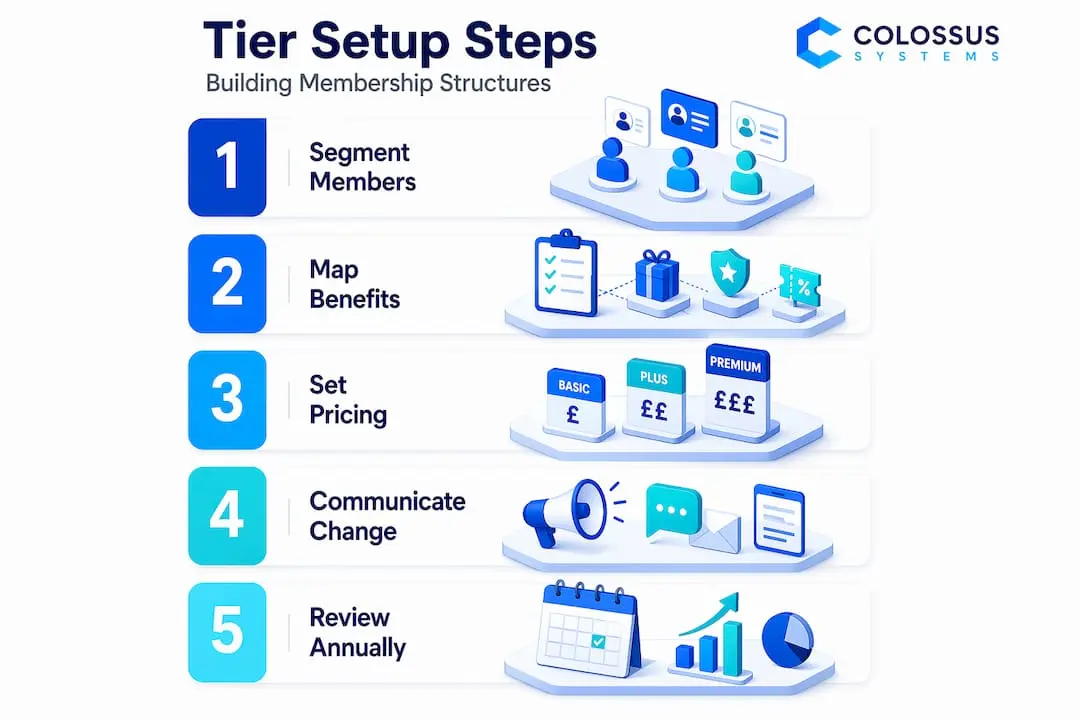
Start with member segmentation. Pull your membership data and segment by tenure, engagement frequency, event attendance, and revenue contribution. Patterns will emerge that tell you which benefits are actually being used and where members drop off.
Pro Tip: Run a short survey to your most active members before finalising any tier changes. Ask them directly what benefits they value most and what would make them consider upgrading. The answers are often surprising and consistently more useful than internal assumptions.
From there, map benefits and pricing to your identified segments. A membership tier comparison exercise at this stage is worthwhile: plot your current structure against what your segments actually need and look for mismatches.
| Action | What to measure | Why it matters |
|---|---|---|
| Launch new tier structure | Upgrade conversion rate | Confirms whether new tiers are compelling |
| Revise benefit bundles | Member satisfaction score | Shows whether perceived value has improved |
| Introduce multi-year pricing | Renewal rate and LTV | Measures long-term retention impact |
| Implement automated communications | Engagement rate by tier | Tracks whether personalisation is working |
Communicate changes to members before they happen. Members who are surprised by changes to their tier feel managed rather than valued. A simple pre-launch communication explaining what is changing, why, and what they gain is enough to neutralise most negative reactions.
Finally, treat your tier structure as a living framework. Review it annually with fresh data, and be willing to collapse a tier that is not performing or add one where a genuine gap exists. Learning how to choose membership tier structures that fit your organisation’s growth stage is an ongoing process, not a one-time decision.
Membership tier models across industries
Different sectors approach their tier structures in ways that offer transferable lessons.
- Professional associations typically use three to four tiers tied to career stage, with benefits built around CPD access, networking events, and sector publications. Progression is tied to experience or qualification level.
- Clubs and leisure organisations often use two or three tiers focused on physical access and booking priority. Membership tier comparison across club models shows that early booking windows and guest privileges are the most valued premium benefits.
- Creator and content platforms frequently use four to five tiers with segmented benefit bundles at each level, such as exclusive content, direct access to creators, and merchandise. The decoy effect is used aggressively here.
- Regional trade groups use tiers tied to business size or sector, with targeted entry-level pricing for start-ups and premium tiers offering advocacy and profile-raising opportunities.
The consistent lesson across all of these is that members make upgrade decisions based on perceived relevance, not just price. Benefits need to feel designed for people at that specific stage, not assembled as an afterthought.
My perspective on membership tiers
I have worked with enough membership organisations to say this clearly: the ones that struggle most with retention are almost never the ones with the wrong price points. They are the ones where members cannot explain what their tier actually includes.
In my experience, simplicity is consistently underrated. An organisation with three tiers and a crisp value statement at each level will outperform one with six tiers and a sprawling benefits catalogue every single time. Complexity signals indecision to your members, even when you intend it as generosity.
What I have found actually works is treating your tier structure as a communication tool first and a revenue tool second. When members understand what they have and can see what they are working towards, upgrades happen naturally. When they cannot, no amount of email campaigns will move the needle.
The organisations I have seen get this right also share one other trait: they review their tiers with data, not instinct. They track which benefits are used, which tiers have the highest churn, and which upgrade paths are converting. They adjust accordingly without ego. That willingness to iterate, supported by the right member engagement tools, is what separates high-retention organisations from ones that are perpetually reacquiring members they should never have lost.
— Rob
How Colossus can support your tier strategy
If you are ready to put better tier management into practice, Colossus is built specifically for membership organisations like yours.
Our platform handles automated billing, benefit assignment, and tier-level communications from a single dashboard. You can segment your members by tier, track engagement metrics in real time, and trigger personalised renewal communications without manual effort. Whether you are launching your first structured tier model or refining an existing one, the membership management features within Colossus are designed to give you the control and visibility you need to grow and retain your membership base confidently. Request a demo to see how it works in practice.
FAQ
What are membership tiers?
Membership tiers are structured levels within a membership programme, each offering a different set of benefits and access at a corresponding price point. They exist to serve members at different stages of engagement and budget.
How many membership tiers should an organisation have?
Industry best practice in 2026 recommends 3 to 5 tiers. Fewer than three limits flexibility, while more than five creates confusion and complicates member communications.
How do I choose the right membership tier structure?
Start by segmenting your current members by engagement, tenure, and revenue. Map benefits to what each segment actually uses, then price tiers to reflect the genuine value delivered at each level.
What makes members upgrade their membership tier?
Members upgrade when the next tier offers clearly relevant benefits they can see themselves using. Cumulative benefit stacking, defined tracking periods, and proactive upgrade communications all drive conversion.
How do membership tiers support retention?
Well-designed tiers create clear upgrade paths and renewal incentives, making it easier for members to see the value of staying. Embedding education, exclusive content, and community access into tiers gives members tangible reasons to renew.