Master membership management basics for nonprofit success

Many membership organisations set ambitious growth targets yet face flat or declining retention rates. You might invest heavily in recruitment campaigns, only to watch members quietly slip away at renewal time. The disconnect often lies not in your efforts but in how you balance technology with genuine human connection. This guide reveals practical strategies that blend automated systems with personalised engagement, helping you transform membership management from a numbers game into a sustainable relationship-building process that drives real organisational growth.
Table of Contents
- Key takeaways
- Understanding membership management fundamentals
- Balancing technology and personal engagement in membership management
- Adapting to member needs and generational shifts
- Streamlining membership management with software tools
- Discover membership management solutions designed for you
- Frequently asked questions
Key Takeaways
| Point | Details |
|---|---|
| Balanced technology and engagement | A combination of automated systems and personalised human contact boosts retention beyond recruitment activity alone. |
| Show value beyond dues | Members are more likely to stay when the benefits and outcomes of membership are clear rather than payment alone. |
| Feedback informs relevance | Actively listening to member needs through feedback helps tailor services and improve retention. |
| Generational retention strategies | Retention approaches must adapt to changing expectations across age groups and life stages. |
Understanding membership management fundamentals
Membership management encompasses the entire lifecycle of your member relationships. It includes enrolment processes, ongoing engagement activities, retention strategies, and renewal campaigns. Yet 55% of associations report flat or declining retention despite 63% expecting growth, revealing a critical gap between aspirations and execution.
The problem often starts with misplaced priorities. Many organisations pour resources into recruitment whilst treating retention as an afterthought. You might celebrate each new member sign-up but lack systematic approaches to nurture those relationships over time. This creates a leaky bucket scenario where you constantly replace departing members rather than building a stable, engaged community.
Common pitfalls compound these challenges:
- Overreliance on membership dues as the primary value proposition
- Volume-focused strategies that prioritise quantity over engagement quality
- Underinvestment in member experience throughout the journey
- Inadequate feedback mechanisms to understand changing needs
- Technology implementations that automate without personalising
The distinction between growth by numbers versus growth by engagement depth matters enormously. Adding 100 minimally engaged members creates administrative burden without organisational strength. Building 50 deeply connected advocates generates referrals, volunteer leadership, and sustainable revenue. Membership software for nonprofits can support either approach, but your strategic choices determine outcomes.
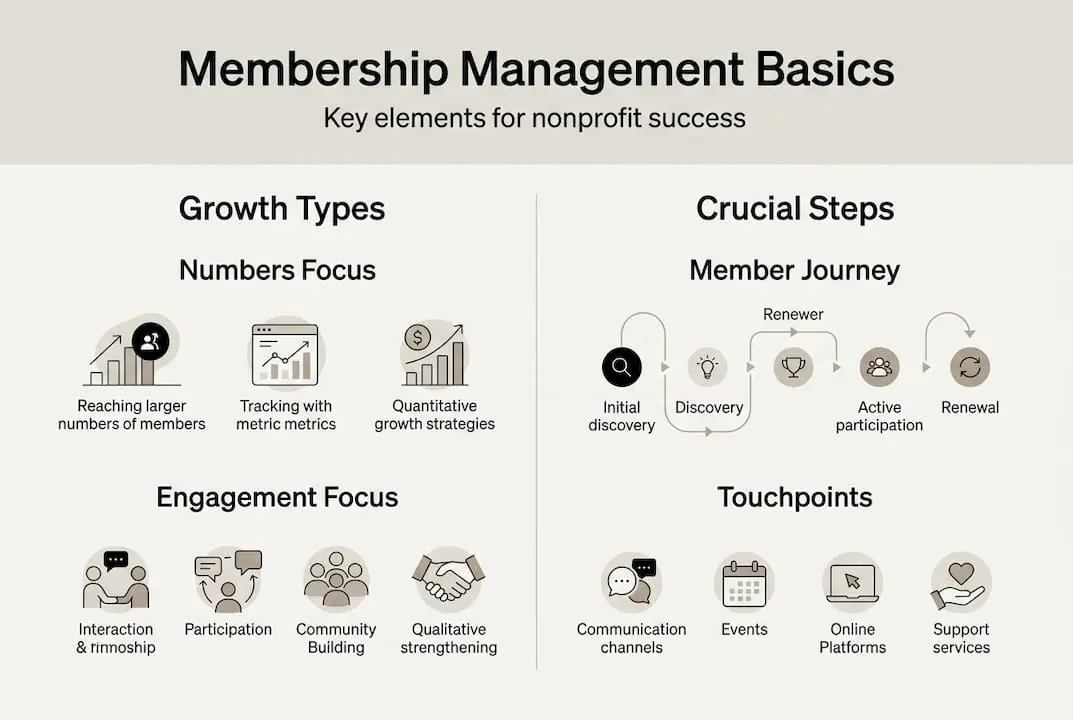
Pro Tip: Map your entire member journey from initial inquiry through renewal, identifying specific touchpoints where you can add personalised value. This exercise reveals gaps in your current approach and opportunities to strengthen retention before problems emerge.
Balancing technology and personal engagement in membership management
Effective membership management requires strategic integration of automated systems with human connection. Association Management Systems and Customer Relationship Management platforms handle data organisation, payment processing, and communication workflows. These tools excel at tasks requiring consistency and scale, freeing your team from repetitive administrative work.
Key software capabilities include:
- Centralised contact databases with searchable member profiles
- Automated renewal reminders and payment processing
- Event registration and attendance tracking
- Email campaign management with segmentation options
- Reporting dashboards for engagement metrics
Yet technology alone creates sterile member experiences. Automated emails lack the warmth of personal recognition. Digital portals cannot replicate the connection formed through face-to-face conversations. When organisations rely exclusively on software solutions, members become data points rather than valued individuals. Engagement metrics may look healthy whilst actual relationships deteriorate.
Blending automated tech with personal touches balances scale and connection effectively. Your membership management software features should handle routine tasks whilst your team focuses on high-value interactions. Phone calls to long-standing members, handwritten thank-you notes, and small group listening sessions create emotional bonds that automated systems cannot replicate.

| Approach | Strengths | Weaknesses | Ideal Balance |
|---|---|---|---|
| Tech-heavy | Efficient scaling, consistent processes, data insights | Impersonal, reduced human connection, member dissatisfaction | Use for routine administration and data management |
| Human-centric | Strong relationships, personalised service, loyalty | Time-intensive, inconsistent, limited scale | Reserve for high-value touchpoints and strategic engagement |
| Integrated | Operational efficiency plus meaningful connection | Requires thoughtful coordination | Automate routine tasks, personalise key interactions |
Committees and volunteer leadership programmes provide structured ways to deepen member involvement. Member advisory boards give your most engaged supporters direct influence over organisational direction. Regional listening tours demonstrate that leadership values member perspectives. Recognition programmes celebrating member achievements build community pride. These initiatives require human facilitation but generate loyalty that transcends transactional relationships.
Association membership software becomes most powerful when it enables rather than replaces personal engagement. Use your system to identify members who haven’t attended recent events, then have a real person reach out with a genuine invitation. Let automation handle payment reminders whilst your team personally thanks major donors. Technology should amplify your capacity for connection, not substitute for it.
Pro Tip: Implement feedback collection systems within your membership platform, but ensure actual humans review responses and take visible action. Members need to see that their input creates tangible changes, transforming surveys from data collection exercises into genuine dialogue.
Adapting to member needs and generational shifts
Your membership base spans multiple generations with distinct communication preferences and value expectations. Baby Boomers may prioritise printed newsletters and in-person networking events. Millennials often prefer digital resources and flexible engagement options. Generation Z expects mobile-first experiences and social impact alignment. Addressing generational shifts and evolving needs prevents your organisation from becoming obsolete.
Static value propositions inevitably lose relevance as member circumstances change. The young professional who joined for career development may now need leadership training. The mid-career member who valued networking might now seek work-life balance resources. Continuous adaptation keeps your offerings aligned with actual needs rather than assumptions.
Follow this sequential process for sustainable adaptation:
- Conduct regular surveys and feedback sessions across member segments to identify emerging needs and satisfaction gaps
- Analyse collected data to spot patterns, prioritise opportunities, and understand demographic differences in preferences
- Develop relevant programmes and benefits that address identified needs whilst aligning with organisational mission and capacity
- Communicate changes clearly to members, explaining how their feedback directly influenced new offerings
- Monitor engagement metrics for effectiveness, tracking participation rates and satisfaction scores to validate improvements
This cycle should repeat annually at minimum, with more frequent pulse checks for rapidly changing environments. Your membership recruitment and retention strategies must evolve alongside member expectations to maintain competitive relevance.
Demographic analysis reveals valuable insights about communication channel preferences. Younger members may engage primarily through social media and mobile apps, whilst older segments respond better to email and phone outreach. Offering multiple communication options ensures you reach each member through their preferred channel rather than forcing everyone into a single mould.
Value perception varies significantly across generations as well. Traditional benefits like industry publications may matter less to digital natives who expect on-demand video content and interactive learning. Professional development increasingly means micro-credentials and practical skills rather than lengthy certification programmes. Your membership tiers should reflect these diverse preferences, allowing members to customise their experience.
Adaptation benefits extend beyond retention. Members who see their feedback implemented become organisational advocates. Relevant programming attracts new members from previously untapped demographics. Satisfaction scores improve when people feel heard and valued. The investment in continuous adaptation pays dividends through stronger engagement and sustainable growth.
Streamlining membership management with software tools
Selecting appropriate membership management software dramatically improves administrative efficiency whilst enhancing member experience. Modern platforms consolidate previously scattered functions into unified systems, reducing duplicate data entry and coordination overhead. Your team spends less time on manual processes and more time building relationships.
Typical software features address core operational needs:
- Comprehensive contact databases with customisable fields for member information
- Integrated payment processing for dues, event fees, and donations
- Automated renewal workflows with configurable reminder sequences
- Event management tools for registration, ticketing, and attendance tracking
- Email marketing capabilities with segmentation and personalisation options
- Reporting dashboards showing membership trends and engagement metrics
| Feature Category | Key Considerations | Impact on Operations |
|---|---|---|
| Database Management | Search functionality, custom fields, data import/export | Centralises member information, eliminates duplicate records |
| Payment Processing | Gateway integrations, recurring billing, receipt automation | Reduces manual transaction handling, improves cash flow |
| Communication Tools | Email templates, segmentation options, delivery tracking | Enables targeted outreach, measures engagement effectiveness |
| Event Integration | Registration forms, capacity management, attendee check-in | Streamlines event administration, captures participation data |
| Reporting Capabilities | Pre-built reports, custom report builder, data visualisation | Provides actionable insights, supports strategic decisions |
Software reduces errors inherent in manual processes. Automated renewals ensure no member slips through administrative cracks. Payment processing eliminates cheque handling and reconciliation headaches. Integrated systems prevent the data inconsistencies that plague organisations using multiple disconnected tools. These improvements free staff capacity for higher-value activities that directly strengthen member relationships.
Successful implementation requires thoughtful integration with existing systems. Your membership management software benefits multiply when the platform connects with your accounting software, email service, and website. Single sign-on capabilities improve member experience by eliminating multiple login credentials. Data synchronisation ensures information consistency across all touchpoints.
Team training determines whether software delivers promised value. Invest time in comprehensive onboarding that covers not just technical operation but strategic use cases. Help staff understand how to leverage reporting features for insights, not just data dumps. Demonstrate how automation features can personalise rather than depersonalise member communications. Membership software streamlines administration and supports engagement when people understand its full capabilities.
Pro Tip: Choose platforms with scalable features that grow with your organisation. Today’s 500-member association may become tomorrow’s 5,000-member network. Software that accommodates expansion prevents costly migrations and maintains operational continuity through growth phases.
Discover membership management solutions designed for you
Transforming membership management theory into practice requires tools purpose-built for association needs. Colossus Systems offers integrated solutions that streamline operations whilst deepening member relationships. Our membership management software features handle administrative complexity, freeing your team to focus on engagement activities that drive retention and growth.
Whether you need comprehensive membership platforms, specialised event management software for seamless programme delivery, or CRM software to nurture relationships, our solutions adapt to your unique requirements. We understand that every organisation faces distinct challenges, which is why our platforms offer customisation options that align with your specific workflows and member expectations. Explore our product features or book a personalised demo to discover how we can support your membership management success.
Frequently asked questions
What is the most effective way to retain members in an association?
The most effective retention approach combines personalised engagement with clear value demonstration and regular feedback mechanisms. Use technology to identify at-risk members whilst maintaining human touchpoints for meaningful connection. Sustain relevance through adaptive programmes that evolve with member needs rather than remaining static. For detailed implementation ideas, explore proven membership retention ideas that organisations successfully use.
How can technology improve membership management?
Technology automates time-consuming administrative tasks like payment processing, renewal reminders, and data organisation. It enables data-driven decisions through reporting dashboards that reveal engagement patterns and retention risks. However, technology proves most effective when paired with human interaction rather than replacing it entirely. Software should handle routine operations whilst your team focuses on relationship-building activities that create emotional connection. Learn more about association membership software capabilities and implementation strategies.
What role does member feedback play in membership management?
Member feedback identifies evolving needs before they cause dissatisfaction and departures. It ensures your services remain relevant as demographics shift and preferences change. Regular feedback collection demonstrates that you value member perspectives, strengthening loyalty through inclusive decision-making. The key lies not just in gathering feedback but visibly acting on it, showing members their input creates tangible improvements. Establish routine collection processes and communicate how feedback influences organisational direction. Effective membership recruitment strategies incorporate continuous feedback loops.
How often should membership management strategies be reviewed?
Review your membership management strategies annually at minimum, with quarterly assessments of key metrics like retention rates and engagement levels. Major environmental shifts such as economic changes, competitive threats, or demographic transitions warrant immediate strategy evaluation. Continuous monitoring through your membership software provides early warning signs of declining engagement, allowing proactive intervention before problems escalate. Balance structured annual reviews with agile responsiveness to emerging trends and member feedback.
What metrics matter most for measuring membership management success?
Retention rate serves as the primary indicator of membership management effectiveness, revealing whether your strategies create lasting value. Engagement metrics like event attendance, resource usage, and communication open rates show how actively members participate. Member lifetime value calculates the total revenue a typical member generates, informing acquisition cost decisions. Satisfaction scores from regular surveys provide qualitative insights that quantitative metrics miss. Track these metrics consistently to identify trends and validate whether changes improve outcomes.