Virtual training for associations: boost member engagement

TL;DR:
- Virtual training boosts engagement, reduces costs, and generates revenue beyond membership dues.
- Combining methodologies like microlearning, gamification, and AI creates effective, personalized learning programs.
- Leadership support and community-building are crucial for ensuring long-term virtual training adoption.
Most associations invest heavily in annual conferences and in-person events, yet struggle to keep members engaged in between. Virtual training offers a proven alternative, with ROI reaching up to 467% when implemented strategically. The challenge is that many organisations treat it as an afterthought rather than a core engagement tool. This guide walks you through the strategic case, the right methodologies, practical engagement tactics, and the metrics that prove business value, so your association can move from occasional digital experiments to a sustainable, high-impact virtual learning programme.
Table of Contents
- Why virtual training matters for associations
- Essential methodologies: Building effective virtual training programmes
- Engagement drivers: Maximising participation and retention
- Measuring success: ROI, risk, and revenue for associations
- What most association leaders overlook in virtual training adoption
- Get started with seamless virtual training solutions
- Frequently asked questions
Key Takeaways
| Point | Details |
|---|---|
| Hybrid learning boosts reach | Offering virtual and face-to-face options appeals to 82 percent of members and extends accessibility. |
| Engagement relies on interaction | Learning paths, social tools and real-time analytics are proven to increase member activity. |
| Measure what matters | Tracking both ROI and member satisfaction reveals real business value and improvement areas. |
| Revenue isn’t just dues | Virtual certifications, micro-credentials and paid content can unlock new funding for associations. |
Why virtual training matters for associations
Traditional event-based engagement is losing its grip. Members expect flexibility, relevance, and value delivered on their schedule, not just at annual gatherings. The shift is not simply about convenience; it reflects a fundamental change in how professionals consume knowledge and maintain their credentials.
“Associations must move away from event-dependent models and build year-round engagement ecosystems. Hybrid and virtual formats expand reach significantly, but they must complement rather than simply replace in-person experiences.” Report urges associations to update their strategy
This shift carries real commercial weight. Virtual training enables your organisation to reach members across geographies, time zones, and career stages without the logistical overhead of physical venues. It also creates consistent touchpoints throughout the year, keeping your association relevant long after the conference badges have been filed away.
The benefits are well documented across the sector:
- Increased participation rates through on-demand access and flexible scheduling
- Reduced operational costs by eliminating venue, travel, and accommodation expenses
- Non-dues revenue generation through paid courses, certifications, and learning bundles
- Broader reach to members who cannot attend in-person events due to geography or budget
- Year-round engagement that sustains member value between flagship events
Following virtual training best practices from the outset helps your organisation avoid the common pitfall of replicating in-person formats online without adapting the content or delivery. Virtual learning is a different medium, and it rewards associations that treat it as such.
Pro Tip: Before launching any virtual training programme, survey your members on their preferred learning formats, time availability, and skill gaps. This data shapes a programme that members actually use, rather than one that looks impressive on paper.
To boost member engagement online, associations need to think beyond webinars. Structured learning pathways, peer interaction, and credentialled outcomes are what transform passive viewers into active, loyal members.
Essential methodologies: Building effective virtual training programmes
With the strategic value clear, the next question is how innovative associations actually structure their virtual learning. The answer lies in combining several proven methodologies rather than relying on a single approach.
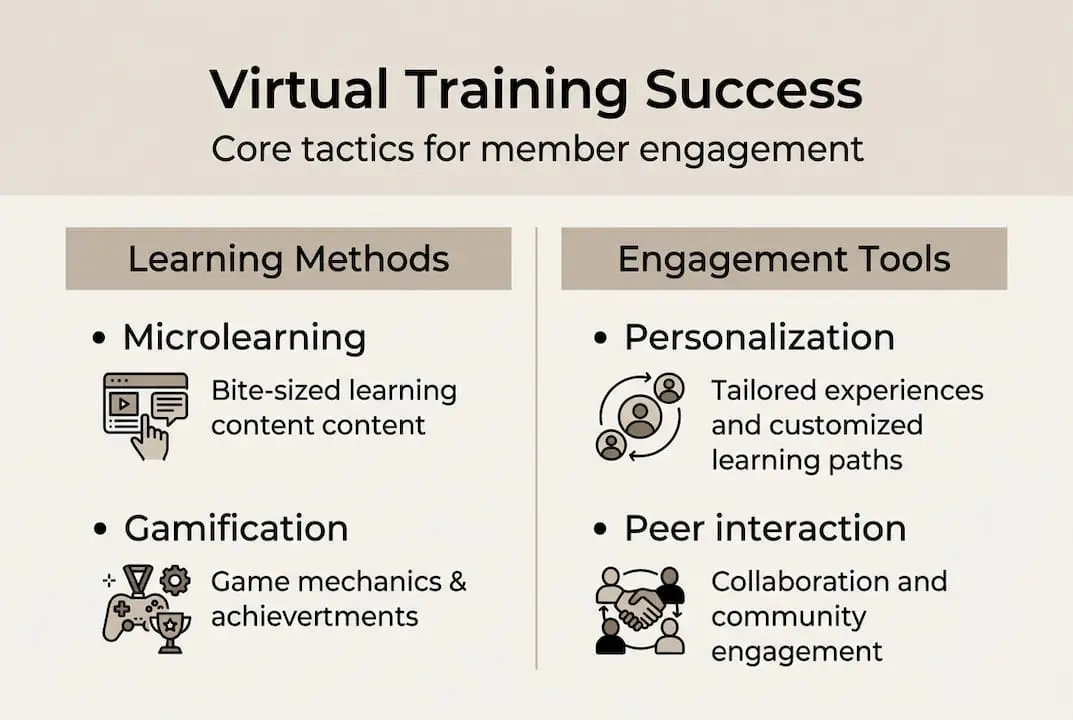
Key methodologies that consistently improve outcomes include personalised learning paths, gamification, microlearning, interactive elements, blended learning, and AI-driven recommendations and analytics. Each plays a distinct role in keeping members engaged and progressing.
| Methodology | Primary benefit | Best suited for |
|---|---|---|
| Microlearning | Higher retention, lower fatigue | Busy professionals, CPD modules |
| Gamification | Increased participation | Certification tracks, onboarding |
| Blended learning | Deeper understanding | Complex skills, leadership development |
| AI-driven analytics | Personalised pathways | Large, diverse member bases |
| Interactive elements | Real-time engagement | Live sessions, workshops |
Building an effective programme follows a logical sequence:
- Assess member needs through surveys, focus groups, and existing engagement data
- Define learning outcomes that align with member career goals and your association’s mission
- Select delivery formats appropriate to the content, whether microlearning modules, live webinars, or blended cohorts
- Integrate gamification such as badges, leaderboards, and completion certificates to sustain motivation
- Apply AI tools to recommend relevant content based on individual member behaviour and progress
- Review and iterate using analytics to identify where members drop off and adjust accordingly
Exploring virtual training strategies that combine these elements gives your programme a significant advantage over single-format delivery. Blended models, which pair instructor-led training (ILT) with self-paced eLearning, consistently outperform either approach used alone.
Accessibility is also non-negotiable. Captions, screen-reader compatibility, and mobile-optimised content ensure that your training reaches every member, regardless of ability or device. Reviewing virtual training session structures from established guides helps you build sessions that are both inclusive and effective.
Pro Tip: Keep individual learning modules to 10 to 15 minutes wherever possible. Microlearning dramatically reduces cognitive overload and fits naturally into a professional’s working day, which means higher completion rates and better knowledge retention.
When you engage and develop members through structured, varied learning experiences, you are not just delivering content. You are building the habit of returning to your association as the primary source of professional development.
Engagement drivers: Maximising participation and retention
Turning methodology into measurable engagement gains requires deliberate action at the platform, content, and community levels. Theory only carries an organisation so far.
Integration is the single most powerful lever available. When virtual training connects seamlessly with your member management platform, members access courses without creating new accounts or navigating separate systems. Integrations can increase logins by 124%, transforming passive members into active learners simply by removing friction.

| Engagement tactic | Reported impact |
|---|---|
| Platform integration | 124% increase in logins |
| Coaching and mentoring | Sustained long-term engagement |
| CE reporting automation | 70% reduction in admin time |
| Structured learning paths | Up to 45% higher completion rates |
Analytics play an equally important role. Tracking where members drop out of a course, which modules receive the lowest completion rates, and which formats generate the most interaction gives your team actionable data rather than assumptions. Reviewing FIRE Report findings reveals that community engagement typically averages around 15% active users, but targeted interventions push that figure considerably higher.
Key tactics to sustain participation include:
- Micro-format content to combat online fatigue and fit into busy schedules
- Peer cohorts and discussion forums to build community around learning
- Coaching and mentoring integration to provide human touchpoints alongside digital content
- Automated reminders and progress nudges to keep members on track
- Recognition and certification to reward completion and incentivise continued learning
Building virtual learning websites that house these features in one place removes the operational complexity that often derails well-intentioned programmes. When members can find, start, and complete training within a single environment, engagement climbs.
Pairing virtual training with strong event hosting for associations creates a connected experience where live events feed into ongoing learning pathways, and training outcomes feed back into event content. This loop keeps your association central to your members’ professional lives throughout the year.
Measuring success: ROI, risk, and revenue for associations
Every investment needs a business case, and virtual training is no exception. The good news is that the evidence is compelling. Virtual training delivers up to 467% ROI and can generate significant non-dues income through certifications and paid learning products.
Calculating that return requires a structured approach:
- Identify direct costs including platform licences, content development, and staff time
- Track direct benefits such as reduced event costs, increased membership renewals, and course revenue
- Measure indirect benefits including improved member satisfaction scores and reduced churn
- Apply the Phillips ROI model extended with a risk overlay to account for implementation variables
- Review quarterly to identify underperforming content and reallocate resources accordingly
“The Phillips model, when extended with risk assessment, gives training leaders a realistic picture of both the upside and the downside of their learning investments, enabling more confident decision-making.”
Non-dues revenue deserves particular attention. Associations that offer paid certification programmes, premium learning bundles, or sponsored training content create income streams that are not dependent on membership fees or event ticket sales. This financial resilience is increasingly valuable in an uncertain funding environment.
Pro Tip: Start your ROI measurement with one pilot programme rather than attempting to track everything at once. A focused pilot gives you clean data, a clear narrative for your board, and a replicable model for future rollouts.
With 60% of the workforce expected to require significant reskilling by 2027, associations that position themselves as credible learning providers now will capture both the engagement and the revenue that comes with that demand. Helping your members engage, retain, and grow through structured virtual learning is not just a service. It is a competitive advantage.
What most association leaders overlook in virtual training adoption
Here is an uncomfortable truth: most virtual training programmes fail not because of technology, but because of culture. Associations invest in platforms, build course libraries, and then wonder why uptake is low. The missing ingredient is almost always leadership buy-in and genuine community design.
Treating virtual training as a box-ticking exercise, something to launch and leave running, produces exactly the results you would expect. Members complete one module out of obligation and never return. The platform gathers digital dust.
What actually drives long-term adoption is the sense that learning is a shared journey, not a solo activity. Discussion forums, peer accountability groups, and live Q&A sessions with subject matter experts transform a content library into a community. Exploring virtual networking tips alongside your training design helps you build that social layer deliberately.
Cultural readiness matters as much as technical readiness. When your leadership team actively participates in and champions virtual learning, members follow. When they treat it as an IT project, members treat it as optional.
Get started with seamless virtual training solutions
If this article has clarified the opportunity, the next step is finding a platform that makes implementation straightforward rather than overwhelming.

At Colossus Systems, we built our platform specifically for membership organisations that need virtual training, member management, and event tools to work together without friction. Our membership management features integrate directly with your training environment, so members access learning from within the same portal they use every day. For organisations running live virtual events alongside self-paced courses, our event management software connects both experiences seamlessly. We offer scalable, secure solutions with dedicated support at every stage of your rollout. Book a demo and see how we can help your organisation launch with confidence.
Frequently asked questions
What are the main benefits of virtual training for associations?
Virtual training enables year-round engagement and increased participation while cutting operational costs. It also creates new revenue streams through scalable certification courses and paid learning bundles.
How can associations measure the ROI of virtual training?
Track direct participation numbers, cost savings, and member retention metrics, then apply a structured framework such as the Phillips ROI model extended with risk assessment, which can reveal returns of up to 467%.
What features should be prioritised in a virtual training platform?
Prioritise personalisation, microlearning, and gamification alongside AI-driven analytics and seamless integration with your existing member management tools.
How can virtual training help generate non-dues revenue?
Associations can monetise learning content by offering paid certification courses or premium learning bundles to both members and non-members, creating income independent of membership fees.
Recommended
- Virtual training strategies to boost member engagement|CS
- Virtual Training Best Practices for Membership Groups 2025|CS
- Virtual Event Companies: Boosting Member Engagement|CS
- Virtual training for members: engage, retain, and grow efficiently|CS
- Facilitate group learning games for fun and stronger bonds - The World Game