Virtual Learning: Boost Member Engagement 40% in 2026

Many membership leaders assume virtual learning cannot match the energy of in-person sessions. Yet interactive virtual learning sessions can increase member engagement by over 40%, proving that online training, when designed with strategic tools and techniques, rivals and often surpasses traditional formats. This article equips you with actionable strategies, technology insights, and proven frameworks to transform your organization’s virtual learning experiences.
Table of Contents
- Understanding Virtual Learning In Membership Organizations
- Key Technologies That Shape Effective Virtual Learning
- Strategies To Enhance Member Engagement And Knowledge Retention
- Common Misconceptions About Virtual Learning
- Comparison Of Virtual Learning Models: Synchronous, Asynchronous, And Blended
- Measurement, Continuous Improvement, And Integration
- Case Studies: Successful Virtual Learning In Membership Organizations
- Implementing Virtual Learning: Practical Steps For Membership Organizations
- Explore Colossus Systems’ Membership Solutions For Virtual Learning Success
- Frequently Asked Questions
Key Takeaways
| Point | Details |
|---|---|
| Flexible Training | Virtual learning offers scalable, accessible training that meets diverse member schedules and learning preferences. |
| AI Personalization | Adaptive platforms increase engagement by tailoring content to individual progress and ability. |
| Microlearning Works | Short modules and gamification dramatically boost knowledge retention and motivation. |
| Data-Driven Improvement | Analytics track engagement, completion, and ROI to refine training continuously. |
| Model Selection Matters | Choosing synchronous, asynchronous, or blended formats enhances satisfaction and outcomes. |
Understanding Virtual Learning in Membership Organizations
Virtual learning has rapidly transformed how membership organizations deliver professional development and training. Organizations across sectors now prioritize digital learning to reach geographically dispersed members efficiently.
Three primary delivery models serve different organizational needs:
- Synchronous learning provides real-time, instructor-led sessions that foster immediate interaction and community building
- Asynchronous learning allows members to access pre-recorded content at their own pace, maximizing scheduling flexibility
- Blended learning combines both approaches to balance engagement with accessibility
The benefits of online training extend beyond convenience. Virtual formats reduce travel costs, eliminate venue expenses, and scale effortlessly as membership grows. Members appreciate the ability to revisit complex topics and learn during hours that fit their schedules.
Flexibility stands as the most compelling advantage. Working professionals can complete training modules during lunch breaks or evenings. Parents balance family responsibilities with professional development. International members access the same quality training without prohibitive travel requirements.
Accessibility features built into modern platforms ensure inclusive learning experiences. Closed captions support hearing-impaired members. Screen reader compatibility assists visually impaired learners. Mobile-responsive designs enable learning on any device.
Cost efficiency makes virtual training particularly attractive for growing organizations. You eliminate recurring venue rentals, catering expenses, and printed materials. A single recorded session serves hundreds or thousands of members, dramatically improving your training ROI.
Key Technologies That Shape Effective Virtual Learning
Technology transforms virtual learning from passive video watching into dynamic, personalized experiences. Understanding these tools helps you select platforms that genuinely enhance member outcomes.

Adaptive learning platforms can increase engagement by up to 50% and retention by 30% through AI-driven personalization. These systems analyze individual performance in real time, adjusting content difficulty and pacing automatically. Struggling members receive additional support and practice. Advanced learners skip redundant material and tackle challenging content immediately.
Gamification introduces competition and achievement recognition that motivate continued participation:
- Leaderboards create friendly competition among cohorts
- Badges and certificates provide tangible recognition of skill mastery
- Point systems reward consistent engagement and course completion
- Progress bars offer visual feedback that encourages members to finish modules
Interactive features distinguish engaging virtual sessions from monotonous lectures. Live polls gather instant feedback and maintain attention. Breakout rooms facilitate small-group discussions and peer learning. Real-time Q&A sessions address confusion immediately rather than letting questions fester.
Mobile optimization ensures members can learn anywhere. Commuters complete modules during transit. Field professionals access training between client appointments. The flexibility to learn on smartphones and tablets removes barriers to consistent engagement.
Accessibility compliance matters for legal and ethical reasons. Platforms meeting WCAG standards ensure all members can participate fully, regardless of physical abilities.
Pro Tip: Prioritize platforms that integrate AI personalization, robust interactivity tools, and comprehensive analytics dashboards. This combination delivers engaging experiences while providing the data needed to prove ROI and refine content continuously.
Explore modern virtual learning technologies and adaptive learning and AI personalization to understand how these innovations reshape member training.
Strategies to Enhance Member Engagement and Knowledge Retention
Effective virtual learning requires deliberate design choices that maintain attention and promote long-term retention. Research-backed strategies dramatically improve training outcomes.
Microlearning breaks complex topics into digestible 5-10 minute modules. This approach aligns with how adults actually learn and retain information. Short bursts prevent cognitive overload. Members complete modules during brief windows of availability. Spaced repetition across multiple short sessions strengthens memory formation better than marathon courses.
Using gamification elements can boost engagement rates by 30% on average. Competition motivates participation. Achievement recognition satisfies psychological needs for accomplishment. Point systems encourage members to explore supplementary resources they might otherwise skip.
Interactive formats transform passive observers into active participants:
- Launch sessions with polls to gauge prior knowledge and set context
- Use breakout rooms for peer discussions that deepen understanding through teaching
- Schedule regular Q&A segments that address confusion before it derails learning
- Incorporate knowledge checks that provide immediate feedback on comprehension
Follow these steps to design engaging member training:
- Audit existing content to identify dense sections suitable for microlearning conversion
- Map learning objectives to specific, measurable outcomes for each module
- Build interactive elements into every 3-5 minutes of content delivery
- Implement gamification through points, badges, or certificates tied to completion milestones
- Test with pilot groups and gather feedback before full rollout
- Monitor analytics to identify drop-off points and engagement patterns
- Iterate based on data by refining content, pacing, and interactive elements
Review best practices for virtual training and virtual networking tips for additional engagement strategies. Learn more about gamification and engagement strategies to maximize participation.
Pro Tip: Balance session length and interaction frequency carefully. Even well-designed content causes fatigue beyond 45 minutes. Schedule 5-minute breaks in longer sessions. Alternate between presentation, interaction, and reflection activities to maintain energy.
Common Misconceptions About Virtual Learning
Several persistent myths prevent organizations from fully embracing virtual learning. Evidence contradicts these widespread beliefs.
Myth: Virtual learning inherently engages members less than in-person training. Reality: Interactive virtual sessions increase engagement by over 40% when designed with polls, breakout discussions, and real-time feedback. Poor engagement results from poor design, not the virtual format itself.
Myth: Longer courses improve retention compared to brief modules. Reality: Microlearning’s focused approach produces superior retention. The brain consolidates information more effectively through spaced repetition of short lessons than through marathon sessions.
Myth: Technology alone guarantees learning success. Reality: Effective virtual learning requires balanced instructional design, skilled facilitation, and strategic technology integration. Platforms provide tools, but pedagogical expertise transforms those tools into learning outcomes.
Key misconceptions corrected:
- Virtual formats reduce engagement (False: interactive tools boost participation significantly)
- In-person training always produces better outcomes (False: virtual microlearning often exceeds in-person retention)
- Technology replaces good teaching (False: technology amplifies effective instructional design)
- Virtual learning suits only certain topics (False: nearly all subjects adapt successfully with proper design)
- Members prefer in-person training universally (False: flexibility and accessibility make virtual learning highly popular)
Understanding these facts helps you make confident decisions about virtual training investments. Explore debunking virtual learning myths for additional evidence challenging common assumptions.
Comparison of Virtual Learning Models: Synchronous, Asynchronous, and Blended
Selecting the right delivery model depends on your organizational context, member preferences, and training objectives. Each approach offers distinct advantages.
| Model | Pros | Cons | Best For |
|---|---|---|---|
| Synchronous | Real-time interaction builds community; immediate Q&A clarifies confusion; scheduled sessions create accountability | Requires coordination across time zones; limits flexibility for busy professionals; technical issues disrupt entire group | Skills requiring immediate feedback, team-based learning, networking opportunities |
| Asynchronous | Members learn at their own pace; content accessible 24/7; easily scalable without scheduling constraints | Reduced social interaction; potential for procrastination; delayed answers to questions | Self-directed learners, geographically dispersed members, foundational knowledge delivery |
| Blended | Combines flexibility with community; accommodates diverse learning preferences; maximizes engagement and retention | Requires more planning and resource coordination; some members may prefer purely synchronous or asynchronous | Comprehensive training programs, organizations with diverse member needs, complex topics |
Synchronous sessions work exceptionally well for skill-based training requiring practice and immediate correction. Live demonstrations allow instructors to model techniques, observe member attempts, and provide instant feedback.
Asynchronous formats excel for delivering foundational knowledge that members need to absorb before applying. Recorded lectures, reading materials, and self-paced assessments allow members to build understanding at comfortable speeds.
Blended approaches often deliver optimal results by leveraging each model’s strengths. Members complete asynchronous modules covering core concepts, then gather for synchronous sessions focused on application, discussion, and collaborative problem solving.
Organization size influences model selection. Small organizations may prefer synchronous sessions that foster tight-knit communities. Large, geographically dispersed memberships often require asynchronous content with optional synchronous elements.
Member demographics matter significantly. Younger, tech-savvy members often prefer flexible asynchronous options. Members in traditional industries may initially feel more comfortable with scheduled synchronous sessions that mirror in-person experiences.
Measurement, Continuous Improvement, and Integration
Data-driven decision making separates effective virtual learning programs from mediocre ones. Analytics reveal what works, what fails, and where to invest improvement efforts.
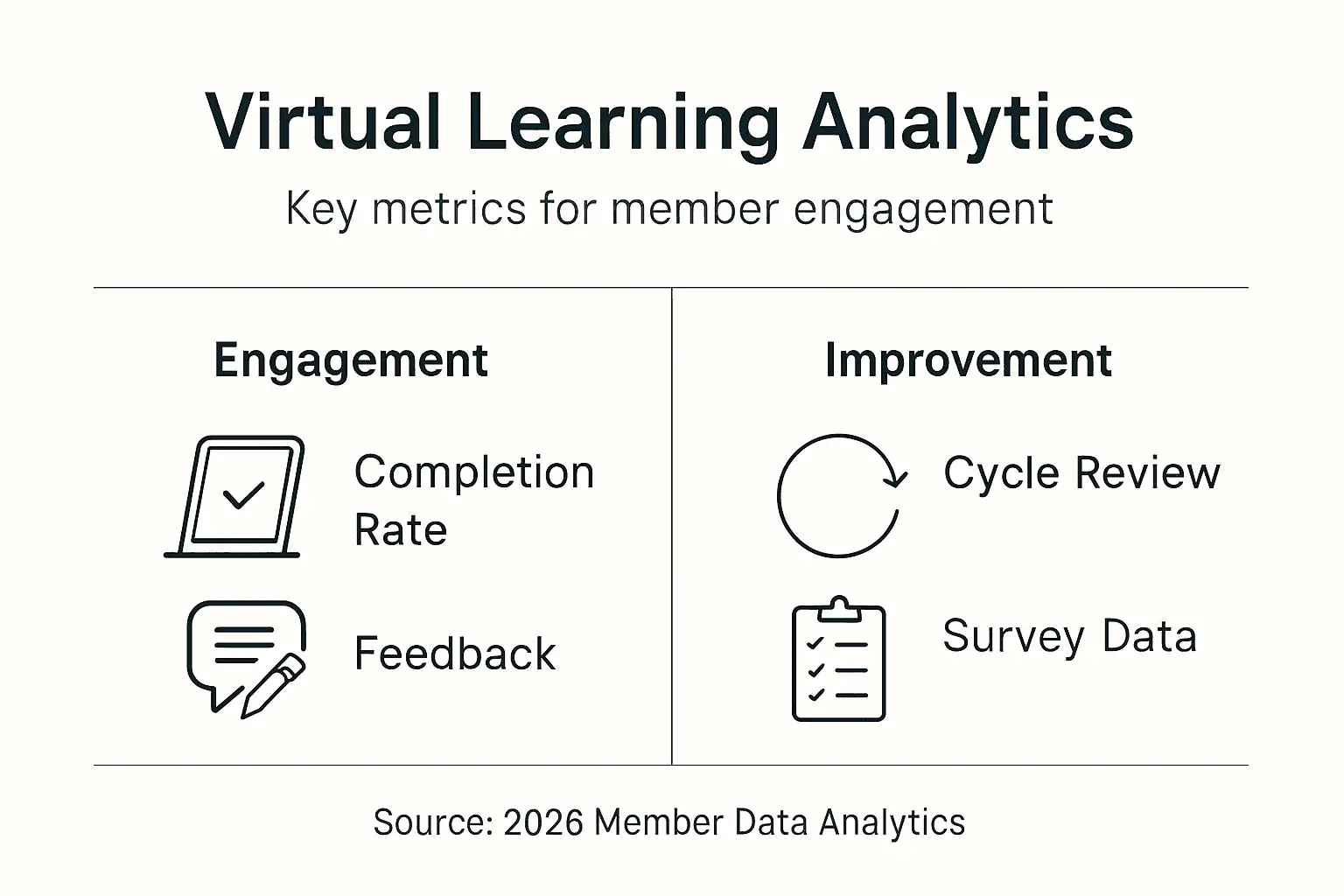
Learning analytics track multiple dimensions of program effectiveness. Engagement metrics show which modules members complete enthusiastically versus reluctantly. Completion rates identify where members drop off. Assessment scores measure actual knowledge acquisition. Time-on-task data reveals whether content length matches optimal learning windows.
Integrating virtual learning platforms with membership management systems creates operational efficiencies. Single sign-on eliminates password frustration. Automatic enrollment based on membership tier streamlines administration. Training completion data flows directly into member profiles, enabling personalized communication and recognition.
ROI measurement justifies continued investment in virtual learning infrastructure. Track these key metrics:
- Member satisfaction scores comparing virtual versus previous in-person training
- Cost per trained member across different delivery formats
- Knowledge retention rates measured through follow-up assessments
- Behavioral change indicators showing skill application in professional contexts
- Membership renewal rates among trained versus untrained cohorts
| Metric | Tools | Impact |
|---|---|---|
| Engagement Rate | Platform analytics, heatmaps | Identifies compelling versus boring content |
| Completion Rate | LMS dashboards | Reveals barriers to finishing courses |
| Assessment Scores | Quiz and test results | Measures actual knowledge acquisition |
| Member Satisfaction | Post-training surveys | Gauges perceived value and experience quality |
| Application Rate | Follow-up surveys, case studies | Demonstrates real-world skill transfer |
Establish regular improvement cycles. Review analytics monthly to spot trends. Gather qualitative feedback through surveys and focus groups. Test content variations to identify what resonates. Refine based on evidence rather than assumptions.
Learn about the importance of data analytics in virtual learning to leverage measurement for continuous program enhancement.
Case Studies: Successful Virtual Learning in Membership Organizations
Real-world examples demonstrate how membership organizations achieve measurable success through strategic virtual learning implementation.
A healthcare association achieved over 70% member completion and high satisfaction with scalable virtual EHR training. The organization transitioned complex electronic health record training from expensive in-person workshops to virtual modules combining asynchronous content with live practice sessions. Members appreciated the ability to review procedures multiple times. The association reduced training costs by 60% while reaching three times more members.
A professional association serving financial advisors implemented gamified compliance training. Leaderboards ranking top performers created friendly competition. Members earned digital badges for completing mandatory ethics modules. Completion rates jumped from 55% to 89% within one year. Member feedback highlighted the engaging format as significantly more enjoyable than previous text-heavy courses.
An engineering society integrated its virtual learning platform with its membership management system. Automatic enrollment in relevant courses based on specialization increased participation. Members received personalized recommendations for advanced certifications. The seamless experience reduced administrative overhead by 40% while improving member engagement with continuing education requirements.
Key lessons from successful implementations:
- Start with pilot programs to test content and gather feedback before full-scale rollout
- Invest in quality production for recorded content; poor audio or video undermines credibility
- Train facilitators specifically on virtual engagement techniques, not just subject matter
- Provide technical support channels to resolve member issues quickly
- Celebrate early adopters and completion milestones to build momentum
- Iterate based on data; the first version rarely achieves optimal results
Explore the healthcare association virtual training case study for detailed insights into implementation strategies and outcomes.
Implementing Virtual Learning: Practical Steps for Membership Organizations
Successful virtual learning implementation requires systematic planning and execution. Follow these steps to build effective programs.
- Assess organizational needs and member preferences through surveys identifying training priorities, preferred learning formats, and technology comfort levels.
- Select platforms offering AI personalization, interactivity, and analytics that align with your technical capabilities and budget constraints.
- Design engaging microlearning content breaking complex topics into 5-10 minute modules with clear learning objectives.
- Incorporate gamification elements such as points, badges, leaderboards, and certificates to motivate consistent participation.
- Train facilitators on virtual engagement techniques including breakout room management, poll deployment, and maintaining energy in online sessions.
- Implement blended delivery combining self-paced asynchronous content with scheduled synchronous sessions for application and discussion.
- Establish analytics dashboards and feedback mechanisms to monitor engagement, completion, and satisfaction continuously.
- Create member support resources including tutorial videos, FAQs, and responsive help channels addressing technical issues.
- Launch pilot programs with volunteer member groups to identify issues before organization-wide rollout.
- Iterate based on data and feedback by refining content, adjusting pacing, and enhancing interactive elements.
Pro Tip: Avoid the common failure of overwhelming members with excessively long sessions or courses. Even excellent content causes fatigue beyond 45-60 minutes. Break training into manageable segments. Ensure accessibility compliance from day one rather than retrofitting later. Test on multiple devices and connection speeds before launch.
Review virtual training implementation best practices for additional guidance on building effective programs.
Explore Colossus Systems’ Membership Solutions for Virtual Learning Success
Transforming your virtual learning strategy requires tools purpose-built for membership organizations. Colossus Systems integrates comprehensive features supporting engaging, effective training programs.
Our platform combines virtual learning delivery with membership management, creating seamless experiences for your members and administrators. 
AI-powered personalization adapts content to individual member progress. Built-in engagement tools including polls, breakouts, and gamification boost participation. Robust analytics dashboards track completion, satisfaction, and ROI, providing the insights needed to refine your training continuously.
Discover how membership management software features streamline virtual training administration. Explore virtual training best practices and virtual learning websites solutions to enhance your organization’s training effectiveness.
Frequently Asked Questions
What are the key benefits of virtual learning for membership organizations?
Virtual learning provides flexible access allowing members to train anytime, anywhere, accommodating diverse schedules and time zones. The format delivers cost-effective, scalable training by eliminating venue rentals, travel expenses, and printed materials. Interactive and personalized content improves engagement beyond traditional formats. Analytics enable tracking member progress, identifying knowledge gaps, and measuring training effectiveness objectively.
How can AI personalization improve online member training?
AI adapts content difficulty and pacing based on individual member performance, ensuring each learner receives appropriately challenging material. The technology creates customized learning pathways that keep members motivated by avoiding frustration from content that is too difficult or boredom from material that is too simple. Adaptive systems analyze assessment results in real time, automatically adjusting subsequent modules to optimize learning outcomes.
What strategies best increase member engagement in virtual sessions?
Use microlearning modules lasting 5-10 minutes to maintain attention and accommodate busy schedules. Incorporate gamification elements like badges, points, and leaderboards to create motivation through achievement recognition and friendly competition. Include live polls gathering instant feedback, breakout groups facilitating peer discussion, and Q&A sessions addressing questions immediately to boost active participation.
Which virtual learning model suits a growing membership organization?
Blended models combining asynchronous and synchronous elements often balance flexibility with engagement most effectively for growing organizations. New organizations may start with asynchronous foundational content plus scheduled live Q&A sessions, then expand as resources allow. Consider member preferences surveyed directly, training complexity requiring different approaches, and geographical distribution affecting scheduling feasibility when selecting your model.