Virtual Learning Websites 2026: Cut Overhead by 40%

Many leaders assume virtual learning can entirely replace live member events. Data tells a different story. Hybrid models combining virtual and in-person elements achieve 20-30% higher member satisfaction and retention than purely digital approaches. This guide clarifies how membership organizations can select, implement, and measure effective virtual learning websites. You will discover key features, compare leading platforms, debunk common myths, and apply evaluation criteria. We focus on your unique needs: integration with CRM systems, customization for diverse audiences, and analytics that prove ROI.
Table of Contents
- Understanding Virtual Learning Websites in Membership Organizations
- Key Features of Effective Virtual Learning Platforms
- Comparison Framework of Leading Virtual Learning Platforms
- Addressing Common Misconceptions About Virtual Learning Websites
- Evaluation Criteria for Selecting the Right Platform
- Implementation Best Practices for Membership Organizations
- Measuring Success and Impact of Virtual Learning Systems
- Summary and Next Steps for Membership Leaders
- Discover Colossus Systems: Integrated Virtual Learning for Membership Organizations
- Frequently Asked Questions
Key Takeaways
| Point | Details |
|---|---|
| Virtual learning boosts engagement and cuts costs | Integrated platforms reduce administrative overhead by approximately 40% compared to disconnected tools. |
| Customization drives course completion | Tailored learning paths and personalized content increase completion rates by 25-40%. |
| Hybrid models outperform virtual-only approaches | Combining live and digital learning improves member satisfaction and renewal rates significantly. |
| All-in-one platforms simplify operations | Unified systems for training, CRM, and events eliminate duplication and streamline workflows. |
| Data analytics enable continuous improvement | Tracking engagement metrics and member feedback supports ongoing refinement of learning programs. |
Understanding Virtual Learning Websites in Membership Organizations
Virtual learning websites are digital platforms designed to deliver training, professional development, and educational content specifically tailored for membership organizations. Unlike generic e-learning tools, these systems integrate with member databases, event calendars, and communication channels to create cohesive engagement experiences. They enable associations and nonprofits to scale training without the geographic and logistical constraints of traditional workshops.
The strategic role extends beyond content delivery. These platforms enhance member value by offering on-demand access to certifications, skill-building courses, and industry updates. Organizations that adopt virtual learning report stronger member loyalty because training becomes a core membership benefit rather than an optional add-on.
Demand for membership-focused e-learning has surged as organizations recognize the competitive advantage of continuous education. Members expect flexible, high-quality learning that fits their schedules. Platforms that fail to integrate with existing management systems create frustration and adoption barriers.
Without integrated virtual learning, membership organizations face several challenges:
- Fragmented data across separate tools for training, events, and member management
- Higher administrative costs from manual coordination between systems
- Limited visibility into which training programs drive member retention
- Difficulty scaling professional development offerings as membership grows
The online learning platforms landscape has evolved to address these pain points. Modern solutions combine learning management with CRM and analytics, enabling organizations to treat education as a strategic engagement lever.
Key Features of Effective Virtual Learning Platforms
Integration capabilities sit at the foundation of effective platforms. Your virtual learning system must connect seamlessly with membership management tools to sync member data, track participation, and automate enrollment. When training records flow directly into your CRM, you gain complete visibility into each member’s engagement journey. This eliminates duplicate data entry and ensures accurate reporting.
Customization options separate adequate platforms from exceptional ones. Tailored sales pipelines and event registration within virtual learning platforms enhance training relevance, leading to 25-40% higher completion rates. Organizations with diverse member segments need the flexibility to create specialized learning paths for different roles, experience levels, or certification tracks. Generic, one-size-fits-all courses fail to address specific member needs.
Embedded analytics transform raw participation data into actionable insights. Look for dashboards that reveal which courses drive the highest engagement, where members abandon training, and how learning correlates with renewal rates. This intelligence enables you to refine content continuously and justify training investments to your board.
Support for hybrid learning models proves essential in 2026. Members want both virtual convenience and live interaction opportunities. Platforms that facilitate blended experiences, combining on-demand modules with scheduled webinars or in-person workshops, deliver superior outcomes. This flexibility accommodates different learning preferences within your membership base.
Scalability and security cannot be overlooked. As your organization grows, your platform must handle increased user loads without performance degradation. Robust security features protect member data and ensure compliance with privacy regulations. Cloud-based SaaS solutions typically offer better scalability than on-premise alternatives.

Pro Tip: Prioritize platforms offering white-label customization so your training portal matches your organization’s branding. Members perceive branded learning environments as more professional and trustworthy, increasing adoption rates.
Comparison Framework of Leading Virtual Learning Platforms
Selecting the right platform requires understanding how major solutions stack up against membership organization needs. Each option brings distinct strengths and tradeoffs.
| Platform | Strengths | Weaknesses | Best For |
|---|---|---|---|
| Udemy Business | Extensive course library, recognized certificates, cost-effective for large teams | Limited CRM integration, minimal customization, generic content | Organizations seeking broad professional development catalog |
| LinkedIn Learning | Professional network integration, career-focused courses, strong mobile experience | No membership-specific features, limited analytics depth, separate from CRM | Associations emphasizing career advancement |
| Coursera | Academic partnerships, university-backed certificates, rigorous content | Higher cost per learner, complex admin interface, slow customization | Organizations requiring accredited certification programs |
| Colossus Systems | Integrated management suite, deep customization, unified analytics | Smaller course library (requires content creation), industry-specific focus | Membership organizations needing all-in-one engagement platform |
Udemy Business excels at providing ready-made content across thousands of topics. Organizations can deploy training quickly without creating courses from scratch. However, the platform operates independently from membership systems, requiring manual tracking and reporting.
LinkedIn Learning leverages its professional network to offer career-oriented content that members value. The mobile app provides excellent on-the-go learning. Yet it lacks tools to integrate training with member events or CRM workflows, limiting its utility for comprehensive engagement strategies.
Coursera partners with universities to deliver academically rigorous programs and recognized certificates. This credibility appeals to organizations whose members seek formal credentials. The tradeoff comes in higher licensing costs and limited flexibility to tailor content to niche industry needs.
Colossus Systems takes a different approach by embedding virtual learning within a broader membership management ecosystem. Training data flows automatically into member profiles, event attendance links to course prerequisites, and virtual training best practices inform platform design. Organizations must invest more effort creating custom content but gain tighter integration and control.
Pricing models vary significantly. Udemy and LinkedIn charge per active user annually, making costs predictable but potentially expensive at scale. Coursera uses tiered licensing based on learner volume. Colossus Systems bundles training with membership management, event planning, and CRM in unified pricing, often reducing total cost compared to separate tools for each function.
Certification capabilities matter for professional associations. Udemy and Coursera offer widely recognized certificates. LinkedIn provides completion badges. Colossus Systems enables organizations to issue branded certificates tied to their own accreditation standards.
Addressing Common Misconceptions About Virtual Learning Websites
Three persistent myths prevent organizations from maximizing virtual learning value. Understanding the reality behind each misconception helps you set appropriate expectations and strategies.
Myth 1: Virtual Learning Can Fully Replace Live Member Engagement
Many leaders believe online courses eliminate the need for in-person events and workshops. Reality proves more nuanced. Hybrid models combining virtual and live elements achieve higher satisfaction and retention because they leverage the strengths of each format. Virtual learning excels at delivering structured content members can consume at their own pace. Live events create networking opportunities and hands-on experiences that deepen relationships.
Successful organizations use virtual learning to scale foundational training while reserving live events for advanced topics, peer collaboration, and community building. This approach reduces event costs without sacrificing the human connection members crave.
Myth 2: Customization Options Have Minimal Impact on Outcomes
Some organizations view platform customization as unnecessary complexity. They assume generic courses serve all members equally. Data contradicts this assumption. When platforms allow tailored learning paths based on member roles, industries, or experience levels, course completion rates increase by 25-40%. Relevant content keeps members engaged. Generic material feels like busywork.
Customization extends beyond course selection. Branded portals, personalized dashboards, and automated recommendations based on member profiles all contribute to higher perceived value. Members who feel training addresses their specific needs are more likely to renew.
Myth 3: Using Multiple Specialized Tools Beats Integrated Platforms
The “best of breed” approach argues that selecting the top tool for each function delivers superior results. In practice, this strategy creates integration headaches and data silos. All-in-one platforms reduce administrative overhead by approximately 40% compared to managing separate systems for training, CRM, events, and communications.
Integrated platforms eliminate duplicate data entry, ensure consistent reporting, and provide a unified member experience. Staff spend less time on technical coordination and more time on strategic initiatives. The modest compromise in specialized features is usually offset by efficiency gains.
“Organizations that consolidated their engagement tools into integrated platforms reported not only reduced overhead but also improved member satisfaction because the experience felt cohesive rather than fragmented across multiple logins and interfaces.”
Evaluation Criteria for Selecting the Right Platform
Applying structured criteria transforms platform selection from overwhelming to manageable. Focus on six key dimensions aligned with membership organization priorities.
Integration capabilities deserve top priority. Your virtual learning platform must connect with existing member databases, payment processors, and communication tools. Evaluate whether the platform offers native integrations, robust APIs, or requires custom development. Platforms that integrate training with CRM enable automated workflows like enrolling new members in orientation courses or triggering renewal reminders based on training completion.
Customization and flexibility determine whether the platform adapts to your unique needs. Assess the ability to:
- Create branded learning portals matching your organization’s visual identity
- Design custom learning paths for different member segments
- Develop proprietary content or upload existing training materials
- Configure certification requirements and credential issuance
- Tailor reporting dashboards to track metrics that matter to your leadership
Analytics depth reveals how well you can measure and improve learning outcomes. Look for platforms that track individual progress, cohort performance, content effectiveness, and correlations between training and member behaviors like event attendance or renewal. Superficial metrics like login counts provide limited value. Actionable insights require granular data on engagement patterns and learning outcomes.
Scalability ensures the platform grows with your organization. Consider current member count, projected growth over three to five years, and seasonal usage spikes around certification periods or annual conferences. Cloud-based solutions typically scale more smoothly than on-premise systems. All-in-one platforms combining virtual training, CRM, and event planning reduce administrative overhead by approximately 40%, making them inherently more scalable than fragmented toolsets.
Security and compliance protect member data and meet regulatory requirements. Verify the platform offers encrypted data transmission, regular security audits, granular access controls, and compliance with relevant standards like GDPR or industry-specific regulations. Organizations handling sensitive member information cannot compromise on security.
Cost effectiveness balances initial investment against long-term value. Compare total cost of ownership including licensing fees, implementation services, ongoing support, content development, and staff training. Cheaper platforms often require expensive customization or create hidden costs through inefficient workflows. Calculate ROI based on projected improvements in member retention, reduced event costs, and administrative time savings.
Pro Tip: Request pilot programs or trial periods to test platforms with a small member segment before committing to organization-wide rollout. Real-world usage reveals integration challenges and user experience issues that demos cannot surface.
Implementation Best Practices for Membership Organizations
Successful platform adoption requires methodical planning and execution. Follow these steps to maximize your virtual learning investment.
-
Assess organizational needs and goals. Document specific training gaps, member feedback on current offerings, and strategic objectives like improving certification completion or reducing live event costs. Clear goals guide platform selection and content development.
-
Choose customizable SaaS platforms. Cloud-based solutions offer faster deployment and lower upfront costs than on-premise alternatives. Customizable platforms like Colossus Systems reduce integration issues by 50% by providing pre-built connectors for common membership management tools.
-
Develop a phased rollout plan. Start with a pilot program targeting a specific member segment or training topic. Gather feedback, refine processes, and address technical issues before expanding organization-wide. Phased approaches reduce risk and build staff confidence.
-
Train staff and members thoroughly. Invest in comprehensive onboarding for administrative staff who will manage the platform. Create member-facing tutorials, quick start guides, and FAQs. Schedule live orientation sessions to demonstrate key features and answer questions.
-
Leverage analytics for continuous improvement. Establish baseline metrics before launch, then monitor engagement patterns, completion rates, and member feedback. Use these insights to refine content, adjust learning paths, and optimize the user experience iteratively.
A mid-sized professional association implemented Colossus Systems to consolidate their fragmented training, events, and membership management. By integrating virtual training best practices with their virtual event planning, they achieved 35% higher course completion and reduced administrative overhead by 42% within six months.
Measuring Success and Impact of Virtual Learning Systems
Quantifying platform effectiveness requires tracking metrics that connect learning activities to organizational outcomes. Focus on five measurement categories.
Member engagement rates reveal how actively your audience uses the platform. Track metrics like:
- Percentage of members who log in at least monthly
- Average courses completed per member annually
- Time spent in learning modules relative to available content
- Participation in discussion forums or peer learning features
Course completion rates indicate content relevance and quality. Low completion suggests courses are too long, poorly structured, or misaligned with member needs. Benchmark your rates against industry standards and investigate significant variations across different courses.
Membership retention influenced by training provides the most critical success indicator. Integrated platforms combining engagement tools and virtual learning can increase membership renewal rates by up to 15%. Compare renewal rates between members who complete training versus those who do not. This correlation justifies training investments to leadership.
Data dashboards enable real-time monitoring of program health. Effective analytics for membership organizations surface patterns like which courses drive the highest engagement, demographic differences in learning preferences, and optimal content lengths.
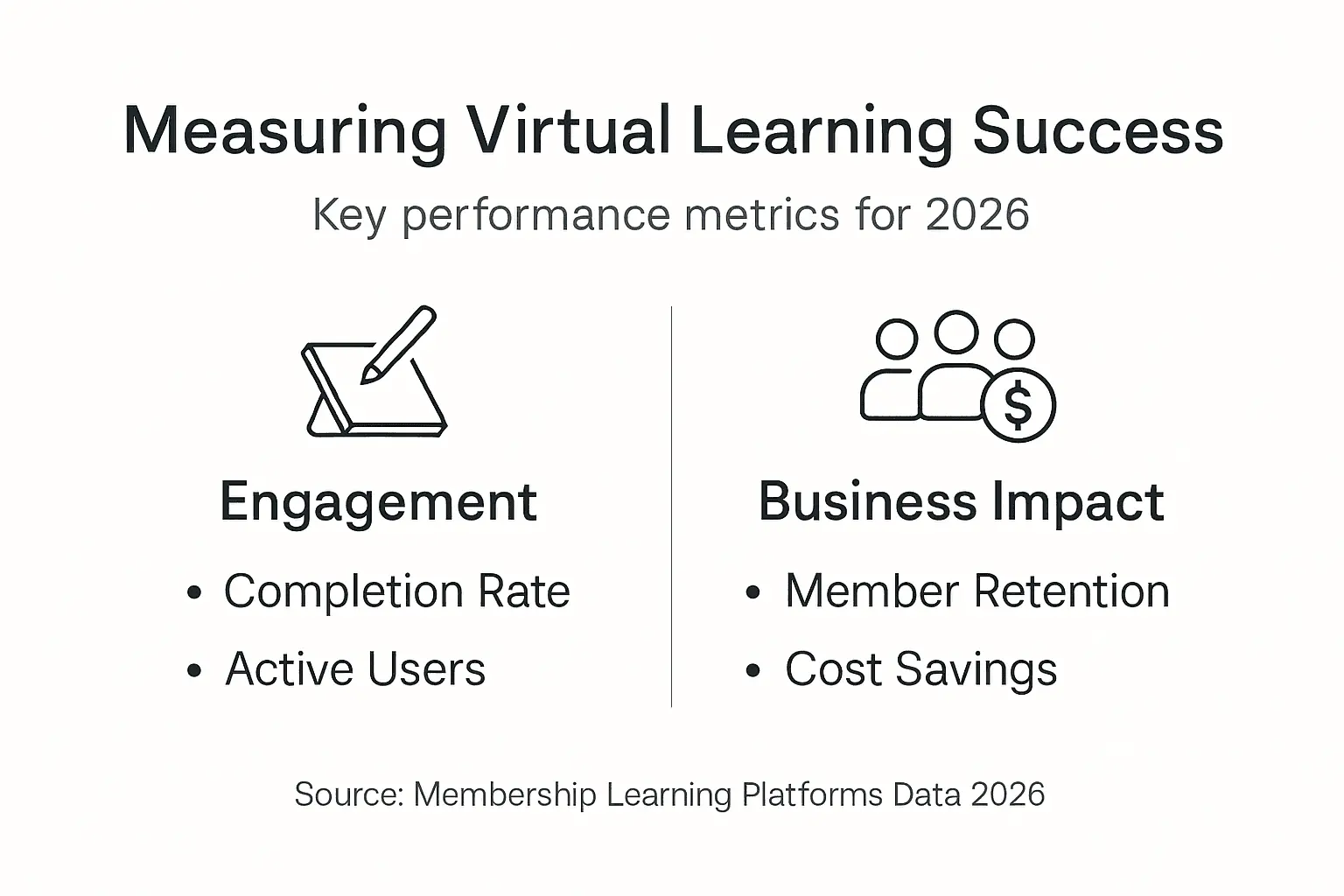
| Metric Category | Key Indicators | Target Benchmark |
|---|---|---|
| Engagement | Monthly active users, logins per member | 60-70% monthly active rate |
| Completion | Course finish rates, average completion time | 70-80% completion for required courses |
| Retention | Renewal rates for trained vs. untrained members | 10-15% higher renewal among trained |
| Revenue Impact | Training revenue, reduced event costs | 20-30% reduction in per-member training costs |
Feedback mechanisms provide qualitative insights that numbers alone cannot capture. Implement:
- Post-course surveys asking about relevance, clarity, and applicability
- Regular focus groups with diverse member segments
- One-on-one interviews with highly engaged and disengaged members
- Suggestion boxes for course topics and platform improvements
Correlating analytics with business outcomes proves ROI. Connect training data to member lifetime value, event attendance, volunteer participation, and referral rates. These connections demonstrate how virtual learning contributes to organizational health beyond just education delivery.
Summary and Next Steps for Membership Leaders
Virtual learning platforms offer membership organizations powerful tools to boost engagement, reduce costs, and scale training efficiently. Key insights include recognizing that hybrid models outperform purely virtual approaches, customization drives significantly higher completion rates, and integrated platforms reduce administrative overhead by approximately 40% compared to separate tools.
Selection success depends on prioritizing integration with existing CRM and event systems, ensuring deep customization capabilities, and demanding robust analytics that connect learning to business outcomes. Security, scalability, and total cost of ownership matter as much as feature lists.
Implementation requires methodical planning through phased rollouts, comprehensive staff and member training, and commitment to data-driven continuous improvement. Organizations that treat virtual learning as a strategic engagement lever rather than a technology project achieve the strongest results.
Explore all-in-one solutions like Colossus Systems that embed training within broader membership management ecosystems. This integration delivers the efficiency gains and unified member experiences that drive retention and growth.
Your next steps: audit current training delivery costs and member satisfaction, define specific goals for a virtual learning initiative, and schedule platform demos focused on your unique requirements. Start with a pilot program to validate the approach before organization-wide deployment.
Discover Colossus Systems: Integrated Virtual Learning for Membership Organizations
Your search for a comprehensive solution ends with Colossus Systems. We built our platform specifically for membership organizations seeking to unify virtual learning with CRM, event management, and member communications.
Colossus Systems eliminates the inefficiency of managing separate tools. Our integrated membership management features enable seamless data flow between training modules, member profiles, event registrations, and marketing campaigns. Organizations using our platform report 40% reductions in administrative overhead and 15% improvements in member retention.
Implement proven virtual training best practices through our customizable learning paths, branded portals, and embedded analytics dashboards. Track which courses drive engagement, automate enrollment based on member segments, and issue certificates that enhance your organization’s credibility.
Ready to transform member engagement through integrated virtual learning? Contact our team for a personalized demo and discover how Colossus Systems can streamline your operations while boosting member value.
Frequently Asked Questions
What Are Virtual Learning Websites for Membership Organizations?
Virtual learning websites are specialized digital platforms that deliver training, professional development, and educational content tailored for membership organizations. Unlike generic e-learning tools, these systems integrate with member databases and event calendars to create cohesive engagement experiences. They enable associations and nonprofits to scale training without geographic constraints while tracking participation as part of overall member engagement strategies.
How Do Hybrid Learning Models Improve Member Engagement?
Hybrid approaches combine the convenience of on-demand virtual content with the relationship-building power of live interactions. Hybrid models achieve 20-30% higher member satisfaction and retention compared to purely digital programs. Virtual modules deliver foundational knowledge efficiently while live workshops facilitate networking, hands-on practice, and deeper community connections that members value.
What Should I Look for When Choosing a Virtual Learning Platform?
Prioritize integration capabilities with your existing CRM and event management systems to ensure seamless data flow. Demand robust customization options that allow tailored learning paths for different member segments. Evaluate analytics depth to track engagement patterns and correlations with retention. Consider scalability for future growth, security features to protect member data, and total cost of ownership including implementation and ongoing support. Choosing the right integrated platform eliminates inefficiencies from managing disconnected tools.
How Can I Measure the Success of My Virtual Learning Program?
Track member engagement rates including monthly active users and average courses completed per member. Monitor course completion percentages to assess content relevance and quality. Analyze membership renewal rates comparing trained versus untrained members to quantify retention impact. Use analytics dashboards to identify patterns in learning behaviors and correlate training with business outcomes like event attendance and volunteer participation. Implement regular member feedback surveys to capture qualitative insights that complement quantitative metrics.