Online Conference Management for Membership Organisations

Managing conferences for a global membership has shifted from packed hotel rooms to interactive digital platforms almost overnight. This change challenges event planners at nonprofit organisations to rethink every detail, from registration to real-time engagement. With formats ranging from fully virtual to hybrid and even immersive environments, the right tools can mean the difference between overwhelmed staff and a conference that truly connects members. Discover why online conference management now requires a dedicated, member-focused approach—where technology supports both participation and meaningful experiences.
Table of Contents
- Defining Online Conference Management Today
- Variations in Virtual Event Formats
- Key Features of Modern Management Platforms
- Delivering Engagement and Member Value
- Challenges, Costs, and Common Mistakes
Key Takeaways
| Point | Details |
|---|---|
| Transition to Online Management | Online conference management is now essential for membership organisations, requiring a comprehensive approach to virtual and hybrid events. |
| Engagement and Accessibility | Successful online conferences prioritize attendee engagement and accessibility, ensuring seamless participation for diverse audiences. |
| Platform Selection is Crucial | Choosing the right management platform is vital as it impacts registration, engagement, and data management throughout the conference lifecycle. |
| Intentional Design for Value | Deliberately designed interactions and high-quality content are key to delivering genuine value that enhances member relationships and retention. |
Defining Online Conference Management Today
Online conference management is no longer a temporary solution. It’s the way membership organisations conduct large-scale gatherings in a globalised world. The shift from in-person-only events to hybrid and fully digital formats has created entirely new operational demands that require specialised approaches.
At its core, online conference management refers to the complete orchestration of virtual or hybrid conferences using digital platforms and tools. This includes everything from planning and promotion through to live delivery, attendee engagement, and post-event analysis. Unlike traditional in-person conferences, online formats demand careful attention to technology, scheduling across time zones, and participant accessibility.
The transformation has been driven by genuine necessity. Research on participant engagement in remote conferences shows that organisations must rethink how they structure sessions, facilitate networking, and maintain attendee focus throughout the event. What worked brilliantly for 500 people in a hotel ballroom requires completely different strategies for participants scattered across continents.
Online conference management encompasses several key dimensions:
- Technical infrastructure: Selecting robust platforms, testing audio and video quality, and ensuring reliable connectivity
- Accessibility and inclusion: Accommodating different time zones, providing recordings, and offering captions for diverse audiences
- Engagement strategies: Creating interactive elements that replicate the value of in-person networking and knowledge-sharing
- Registration and data management: Streamlining how members register, receive updates, and access materials
- Analytics and follow-up: Measuring success through attendance patterns, engagement metrics, and member feedback
For membership organisations specifically, this demands a different mindset. You’re not just hosting a conference; you’re strengthening member relationships, demonstrating value, and creating opportunities for continued engagement. Members expect seamless experiences across registration, attendance, and post-event follow-up.
Planning large-scale conferences requires clear objectives before selecting any platform or technology. Without this foundation, even the best tools become distractions rather than solutions.
What separates modern online conference management from simply “putting a meeting on Zoom” is intentional design. You need defined goals, careful participant consideration, and a platform that integrates with your existing member data systems. Generic video conferencing tools often leave organisations scrambling with spreadsheets, manual follow-ups, and incomplete attendance records.
Membership organisations are discovering that online conferences, when properly managed, can actually expand reach beyond geographic boundaries and create more inclusive experiences. A member in Singapore gains equal access to speakers and content as someone attending from London.
Your conference’s success now depends less on the venue and more on thoughtful planning, accessible technology, and genuine member-focused design.
The definition of online conference management today reflects a reality: it’s a comprehensive discipline that bridges technology, strategy, and member experience. It requires systems that connect registration data to attendee engagement, track participation, and enable meaningful follow-up conversations.
Pro tip: Start by mapping your current conference workflow—registration, reminder emails, session attendance, networking, and follow-up—to identify which steps would benefit most from digital tools before selecting a platform.
Variations in Virtual Event Formats
Membership organisations now have genuine flexibility in how they deliver conferences. The days of choosing between a single in-person format are gone. Understanding the distinct characteristics of each virtual event format helps you select the approach that best serves your members’ needs and your organisation’s goals.
Fully virtual conferences are held entirely online. Attendees join from their own locations using a digital platform, with no physical venue involved. This format removes geographical barriers completely, allowing members from anywhere in the world to participate without travel costs or time constraints. It’s particularly powerful for organisations with dispersed membership bases.
The appeal is straightforward: lower operational costs, wider accessibility, and the ability to reach members who cannot travel. Recording sessions is simpler, and attendees can review content at their own pace after the event concludes.
Hybrid events blend in-person and virtual attendance simultaneously. Some members attend physically at a venue while others join remotely. This format attempts to offer choice—members decide whether to travel based on their circumstances, budget, and preferences.

Hybrid requires careful orchestration. You’re essentially running two events in parallel, which demands more technical infrastructure, trained staff managing both spaces, and thoughtful session design that engages both audiences equally.
The third emerging option is metaverse or immersive virtual events. These use 3D environments where participants create avatars and navigate digital spaces together. While still relatively niche for most membership organisations, they offer novel networking experiences and can create memorable engagement moments.
Research on event format selection and attendee value shows that virtual conferences deliver comparable satisfaction to in-person formats when organisers prioritise social interaction and relevant content. The format itself matters less than how well you execute it.
Here’s how each format compares:
- Fully virtual: Most accessible, lowest cost, easiest to scale globally, simplest to record
- Hybrid: Offers choice to attendees, maintains community at venue, requires more technical complexity
- Immersive virtual: Creates novel experiences, appeals to tech-forward members, demands higher production investment
When selecting a format, consider these practical factors:
- Member demographics and location distribution
- Your technical capabilities and budget constraints
- Whether you need a physical gathering component for relationship-building
- Time zone coverage requirements
- Accessibility requirements for disabled members
Planning event logistics across formats involves detailed feasibility analysis, clear objective-setting, and risk management adapted to your chosen format.
The best format is whichever one aligns with your members’ preferences and your organisation’s capacity to deliver quality experiences.
Many organisations find that hybrid works best for annual conferences—it maintains your in-person tradition whilst accommodating members who cannot travel. Fully virtual works exceptionally well for quarterly professional development sessions where flexibility matters more than community building.
The table below compares the main virtual conference formats by their typical use-cases, complexity, and value:
| Format Type | Best Suited For | Organisational Complexity | Member Value Focus |
|---|---|---|---|
| Fully virtual | Global reach events | Lower technical demand | Content accessibility |
| Hybrid | Annual flagship conferences | High coordination effort | Flexible participation |
| Immersive/Metaverse | Innovation-focused gatherings | Largest technical investment | Novel engagement styles |
Pro tip: Survey your membership about format preferences before your next conference announcement; ask specifically about location constraints, budget limitations, and which interaction types matter most to them, then match the format to these insights.
Key Features of Modern Management Platforms
Modern conference management platforms have evolved far beyond basic video hosting. They integrate registration, engagement, analytics, and member communication into unified systems designed specifically for membership organisations. Understanding what separates effective platforms from generic tools helps you select the right solution for your needs.
A comprehensive management platform handles the entire conference lifecycle. It begins before the event launches with member registration and promotional tools. During the conference, it delivers seamless session delivery, networking opportunities, and real-time engagement tracking. After the event concludes, it provides analytics, automated follow-up sequences, and attendance records integrated with your membership database.
This integrated approach eliminates the frustration of juggling spreadsheets, separate email tools, and disconnected registration systems. Your member data flows continuously through the system without manual transfers or duplicate data entry.
Core features that matter for membership organisations include:
- Unified registration: Members register once; their data automatically links to their member profile
- Session scheduling: Create multiple concurrent sessions with automatic time zone conversion for global audiences
- Attendee tracking: Real-time visibility into who attended which sessions and for how long
- Interactive features: Live polls, Q&A tools, chat functions, and virtual networking spaces
- Content management: Upload slides, handouts, and speaker materials in one centralised location
- Automated communications: Reminder emails, post-event follow-ups, and personalised recommendations triggered automatically
- Reporting and analytics: Attendance metrics, engagement scores, and member satisfaction data
Platforms built for membership organisations specifically integrate with your existing member databases and CRM systems. This means attendee data enriches your member records rather than existing in isolation. You can segment members by conference participation, tailor future communications based on session attendance, and identify engagement patterns.
Secure access controls are essential. Role-based permissions ensure that staff members access only the data and functions they need. Organisers manage speakers and sessions, whilst administrators control user access and billing. Speakers access only their own content and session information.
Here’s what distinguishes modern platforms from basic webinar tools:
- Integrated member data rather than isolated attendee lists
- Customisable workflows adapted to your organisation’s processes
- Advanced reporting that answers strategic questions, not just attendance counts
- Scalability to handle thousands of concurrent participants across time zones
- Security and compliance features appropriate for member data
The best platform feels invisible to your members—registration is frictionless, sessions load instantly, and follow-up communication feels personalised rather than generic.
Payment integration is increasingly important. Modern platforms accept registrations, process payments, and automatically update member records and reporting systems. This eliminates manual reconciliation and reduces revenue leakage from abandoned registrations.
Accessibility features are non-negotiable. Closed captions, transcript downloads, audio descriptions, and keyboard navigation ensure members with disabilities can participate fully. Platforms that offer these as standard features, not add-ons, demonstrate genuine commitment to inclusion.
The following table highlights how specific platform features contribute to membership organisation outcomes:
| Platform Feature | Practical Benefit | Member Impact |
|---|---|---|
| Unified registration | Simplifies event sign-up | Seamless onboarding experience |
| Session scheduling | Automates time zone handling | Reduces confusion for attendees |
| Real-time analytics | Informs organiser decisions | Sessions better match interests |
| Payment integration | Streamlines fee collection | Reduces registration friction |
| Accessibility tools | Ensures inclusive access | Members with disabilities engage |
Pro tip: Before selecting a platform, list your five most pressing operational challenges from your last conference—whether registration data chaos, speaker coordination headaches, or attendance tracking nightmares—then verify that your shortlisted platform addresses each one specifically.
Delivering Engagement and Member Value
The most successful online conferences don’t simply broadcast content—they create genuine value that members remember and discuss long afterwards. This distinction separates conferences that boost membership retention from those that feel like obligations members endure.
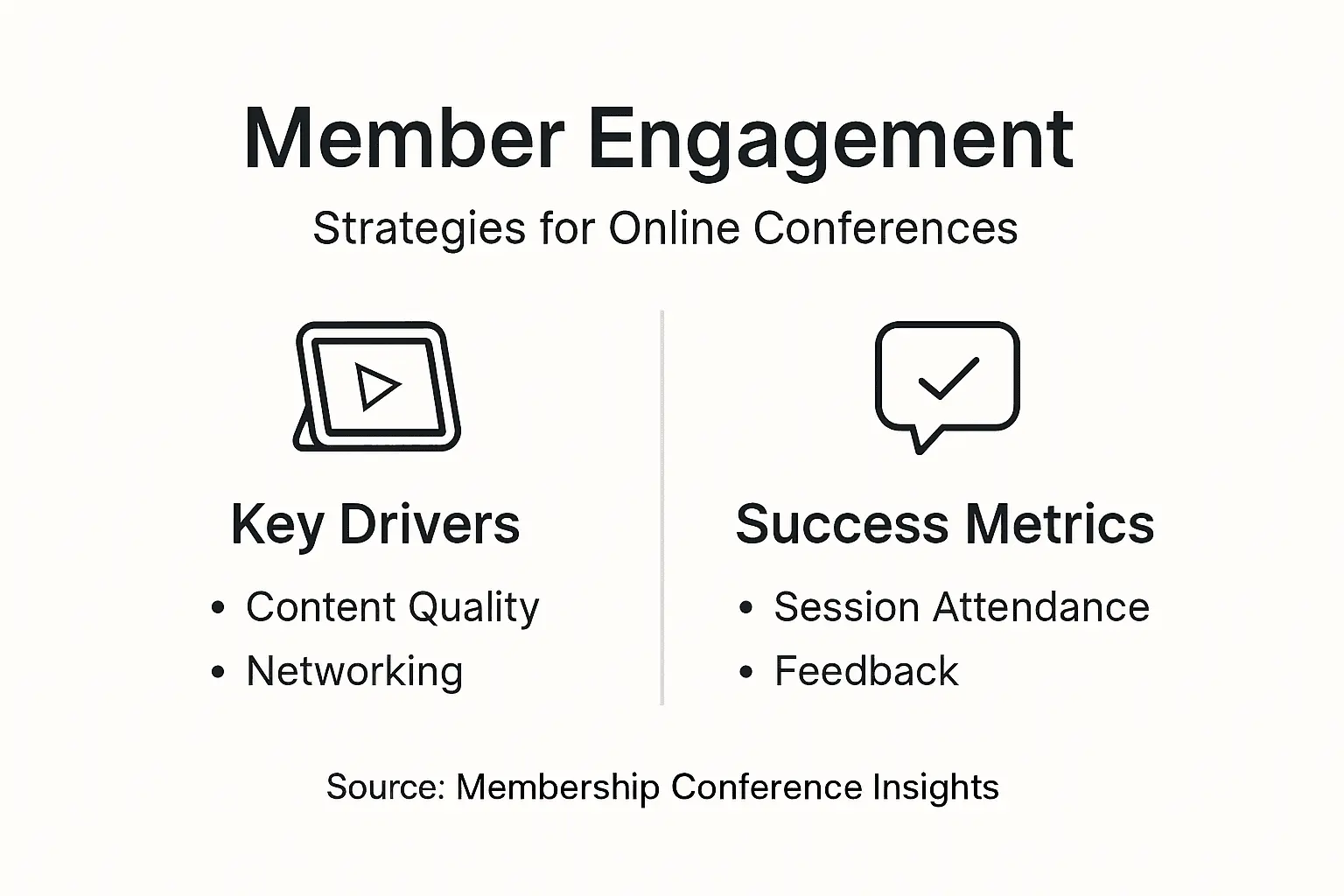
Member value in online conferences flows from two sources: quality content that members cannot find elsewhere, and meaningful social interaction that strengthens professional relationships. Research on virtual conference value perception confirms these are the primary drivers of attendee satisfaction, sometimes delivering value equivalent to in-person formats when executed thoughtfully.
Quality content means relevance. Members attend because sessions address their specific professional challenges, not because attendance is required. This demands careful speaker selection, transparent session descriptions, and honest curation rather than attempting to fill the agenda with anyone willing to present.
Social interaction requires intentional design. Online formats don’t naturally create the hallway conversations that happen at physical venues. You must build these interactions deliberately through:
- Structured networking sessions with guided discussion prompts
- Breakout rooms where smaller groups can discuss specific topics deeply
- Virtual exhibition spaces where members connect with vendors and sponsors
- Chat channels organised by interest area or industry sector
- One-on-one scheduling tools that facilitate peer connections
Personalisation transforms generic content delivery into member-focused experiences. When your platform knows each member’s interests, prior attendance, and role within their organisation, you can recommend relevant sessions, connect them with peers in similar roles, and suggest speakers addressing their specific challenges.
Post-conference engagement is where most organisations fail. The conference ends, members disappear, and the relationship grows cold until next year’s event. Effective platforms enable continuous engagement through recorded session access, ongoing discussion forums, and peer networking opportunities that extend beyond the event itself.
Member value also includes tangible professional development. Certificates of completion, downloadable resources, speaker contact information, and access to presentation slides provide lasting value that members reference in their work. These become concrete evidence that conference attendance advanced their careers.
True member value isn’t measured by attendance numbers—it’s measured by whether members make decisions, advance their careers, or strengthen their professional networks because of your conference.
Measuring engagement during the conference matters. Real-time analytics help you identify which sessions generate energy and which sessions lose attendance halfway through. This feedback informs speaker selection for future events and helps you understand what your members truly value.
Post-conference surveys asking directly about value—“Did this conference help you solve a work problem?” rather than “How would you rate the conference?”—reveal whether you’re delivering genuine impact. Members who solve problems through conference attendance become advocates who encourage colleague participation.
Improving member engagement strategies should extend beyond individual events. Conferences become more valuable when they connect to your broader member engagement programmes, positioning them as hubs within a larger ecosystem of learning and professional development.
Pro tip: Ask three members from your last conference specifically what problem the event helped them solve, then use their answers as testimonials when promoting your next conference—authenticity about outcomes attracts more engaged participants than generic praise.
Challenges, Costs, and Common Mistakes
Online conferences promise efficiency, but they introduce distinct challenges that catch many organisations unprepared. Understanding these pitfalls beforehand helps you avoid costly mistakes and delivers better experiences for your members.
Time zone complexity is the first significant challenge. When your membership spans multiple continents, scheduling a single session time satisfies no one. A session at 10am London time becomes 2am in Sydney and 5pm in Los Angeles. Managing time zones across international conferences requires thoughtful scheduling decisions—whether to repeat sessions across multiple times, record everything for asynchronous viewing, or accept that some members will attend at inconvenient hours.
The practical cost is staff time. Running sessions at multiple times doubles preparation requirements. Recording, editing, and uploading content demands production resources that in-person conferences avoid. Your initial cost estimates should account for these labour-intensive requirements.
Participant engagement drops without intentional design. Online audiences lose focus more easily than in-person attendees. Without a speaker visible on screen, without table-mates, without the social pressure of physical presence, members multitask, mute video, and mentally check out. Combating this requires interactive elements—polls, Q&A sessions, breakout discussions—rather than passive lecture formats.
Common mistakes include:
- Running sessions too long without breaks (45 minutes maximum works better than 90)
- Expecting speakers to engage without training on virtual delivery techniques
- Offering too many concurrent sessions (choice overload reduces satisfaction)
- Ignoring accessibility features (captions, transcripts, audio descriptions)
- Failing to test technology before going live (creating embarrassing delays and lost credibility)
- Under-promoting the conference (assuming members will simply show up)
Budget uncertainties plague many organisations. Video conferencing platforms offer free tiers, creating false expectations about total costs. The reality is considerably different. Professional platforms, support staff, speaker incentives, marketing, and technical troubleshooting add up quickly. Many organisations underfund their first online conference, then scramble when costs exceed expectations.
Secondary costs often surprise planners: platform licensing scaled to your member base, IT support during live events, speaker honorariums, video production for promotional materials, and contingency budgets for technical emergencies.
The organisations that succeed with online conferences plan for 30–50% higher costs than their initial estimates account for, then deliver experiences that justify the investment.
Socialisation failure is perhaps the most damaging mistake. Membership organisations exist partly to build community. Online formats eliminate casual networking unless you design it deliberately. Members don’t naturally connect when they’re anonymous faces on a video call. Without structured networking activities, virtual conferences feel transactional rather than community-building.
Technical failures damage credibility disproportionately. An audio dropout at an in-person conference is forgotten within minutes. The same failure during a virtual event gets discussed in group chats and colours the entire experience negatively. Investing in platform reliability, backup systems, and skilled technical support prevents these reputational risks.
Pro tip: Build a detailed post-mortem checklist after your first virtual conference, documenting every technical hiccup, timing issue, and engagement gap—use this real experience to inform your budget and planning for subsequent events rather than guessing at costs.
Streamline Your Online Conference Management with Colossus Systems
Managing fully virtual or hybrid conferences presents unique challenges like time zone coordination, attendee engagement, and seamless data integration. If you are striving to deliver truly member-focused experiences that combine effective registration, interactive sessions, and smooth follow-up communications, our platform offers a powerful solution. Colossus Systems unifies your entire event lifecycle within one system, eliminating manual headaches and enabling richer insights through advanced analytics.
Transform your online conferences into dynamic, accessible events that deepen member value and expand your global reach. Start solving your operational challenges today by exploring how our specialised SaaS platform supports registration, scheduling, real-time engagement tracking, and payment processing—all tailored for membership organisations. Connect with our team now at Colossus Systems Contact Us to schedule a personalised demo and take the first step towards scaling your member engagement efficiently.
Frequently Asked Questions
What is online conference management?
Online conference management involves the planning, execution, and analysis of virtual or hybrid conferences using digital platforms and tools. It encompasses technical infrastructure, attendee engagement, registration management, and post-event analysis.
How can I enhance participant engagement during online conferences?
To enhance participant engagement, incorporate interactive elements such as live polls, Q&A sessions, breakout rooms, and structured networking activities to foster meaningful interactions and retain attendees’ focus.
What are the advantages of hybrid events compared to fully virtual conferences?
Hybrid events offer the flexibility of both in-person and virtual attendance, accommodating varied member preferences. They help maintain community connections at physical venues while also expanding reach to remote participants.
What key features should I look for in a modern conference management platform?
Key features to consider include unified registration systems, real-time attendee tracking, interactive features, automated communications, and robust reporting and analytics that seamlessly integrate with existing member databases.
Recommended
- Online Event Platforms: Boosting Membership Engagement|CS
- Membership Management Software Features | Colossus Systems
- How to Set Up Webinars for Membership Organisations|CS
- Event Management System Website: Empowering Member Engagement|CS
- Master the Music Booking Workflow for Corporate Events
- Enterprise Project Planning How To Optimize Operations Easily
- Online Training Benefits for Canadian Restaurants and Schools 2025 - Probe IT