Virtual event hosting: boost member engagement in 2026

Virtual events are no longer a fallback option. Higher engagement per attendee of 21% and a 17% higher ROI compared to in-person events suggest that digital formats are outperforming traditional gatherings on several key metrics. For membership organisations and nonprofits, this represents a significant opportunity to reach more members, reduce costs, and deliver genuine value year-round. This article explains exactly what virtual event hosting involves, why it matters for your organisation, the core components and tools you need, the challenges to anticipate, and the emerging trends shaping 2026 and beyond.
Table of Contents
- Defining virtual event hosting: more than just webinars
- How virtual events drive member engagement and value
- Choosing and using the right virtual event tools and platforms
- Navigating challenges: making virtual worth attending
- Virtual events in 2026: lessons the experts have learnt
- Take your virtual events further with the right technology
- Frequently asked questions
Key Takeaways
| Point | Details |
|---|---|
| Virtual events enhance engagement | Members participate more actively and rate experiences higher in well-designed virtual events. |
| Right tools are essential | Choosing integrated, reliable event platforms avoids common pitfalls and increases success. |
| Content strategy matters | Repurposing event content and focusing on ongoing engagement delivers greater value for nonprofits. |
| Prepare for challenges | Addressing technical and networking issues early ensures a positive attendee experience. |
Defining virtual event hosting: more than just webinars
There is a common misconception that virtual event hosting simply means scheduling a video call or broadcasting a single webinar. In reality, it is far more structured and purposeful than that. Virtual event hosting involves using online platforms to organise, broadcast, and manage events such as conferences, webinars, workshops, and networking sessions entirely in a digital format. The distinction matters because the scope of activity is fundamentally different from a routine online meeting.
For nonprofits and membership bodies specifically, virtual event hosting covers a wide range of formats:
- Annual general meetings (AGMs) conducted with full voting, Q&A, and governance features
- Multi-track conferences with breakout sessions and sponsor exhibition spaces
- Member training days and professional development workshops
- Virtual expos with exhibitor booths and live product demonstrations
- Town hall meetings for transparent communication with members or donors
Each of these formats requires dedicated planning, platform selection, registration management, and post-event follow-up. That is what separates genuine virtual event hosting from simply going live on a video platform.
For membership organisations, the advantages go well beyond convenience. Virtual events remove geographic barriers, meaning a member in Edinburgh and one in Auckland can attend the same session without travel costs. Attendance data, session replays, and engagement analytics become assets your team can act on. Costs associated with venue hire, catering, and printed materials are largely eliminated.
“The real power of virtual event hosting is not just the live moment. It is the data, the accessibility, and the ability to serve members who would never have attended in person.”
Understanding the virtual event hosting basics is essential before selecting platforms or designing your programme. Getting the foundations right shapes everything that follows.
How virtual events drive member engagement and value
With a clear understanding of what virtual event hosting covers, it is worth exploring how it delivers real, measurable engagement improvement for membership organisations.
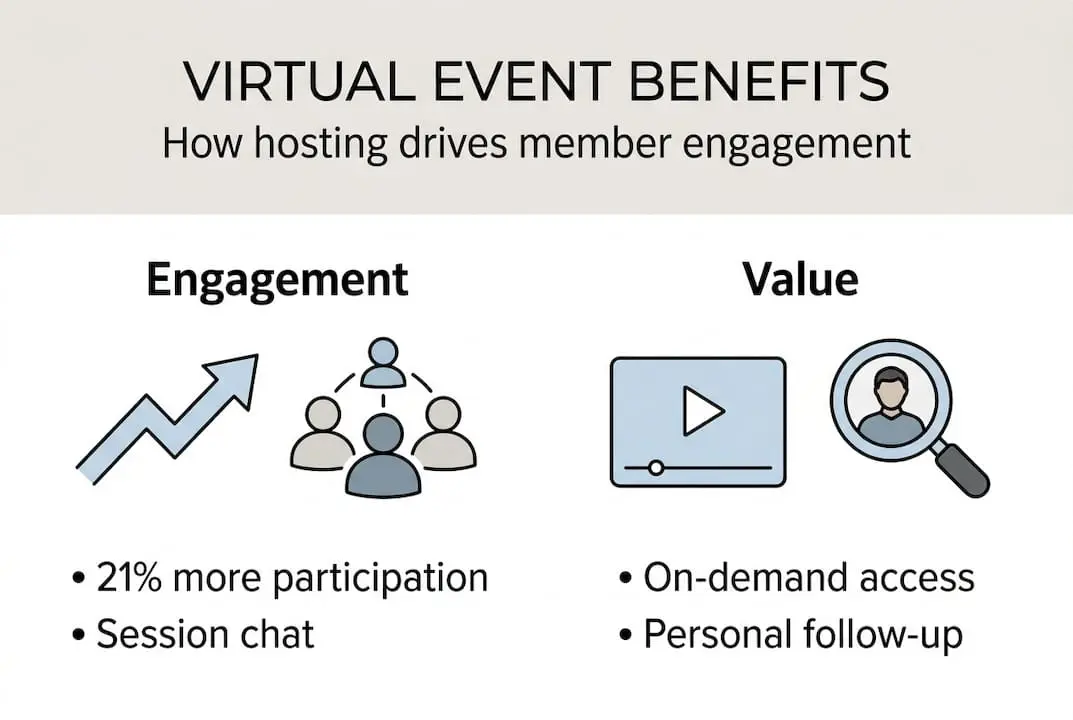
The numbers are striking. Virtual events achieve 21% higher engagement per attendee, 73% attendee satisfaction from on-demand access, and attendees spend 27% more time on virtual platforms compared to in-person equivalents. These figures are not accidental. They reflect deliberate design choices that make digital participation more accessible and interactive.
| Engagement metric | Virtual events | In-person events |
|---|---|---|
| Engagement per attendee | 21% higher | Baseline |
| Attendee satisfaction (on-demand) | 73% | Not applicable |
| Time spent per session | 27% more | Baseline |
| Geographic reach | Global | Local/regional |
Access and convenience are the primary drivers. Members who travel long distances, have caring responsibilities, or work irregular hours are far more likely to participate when the event is online. This is particularly relevant for international associations or nonprofits with dispersed memberships.

Personalisation is increasingly shaping outcomes too. AI-powered tools now allow platforms to recommend sessions based on a member’s profile, past attendance, and stated interests. This level of tailoring increases perceived value and directly supports renewal rates.
Pro Tip: Design your virtual event programme with at least three interactive touchpoints per session. Live polls, moderated Q&A, and collaborative whiteboards keep attention high and give you rich engagement data to act on afterwards.
To maximise engagement, follow these practical steps:
- Open registration early and send personalised reminders based on member segment
- Offer live and on-demand access so members can engage on their own schedule
- Build in breakout rooms for peer networking between sessions
- Use gamified elements such as leaderboards or session challenges to sustain attention
- Follow up within 48 hours with session recordings and a feedback survey
Exploring virtual fundraising strategies alongside your event planning can further strengthen member value. Equally, promoting nonprofit events online effectively ensures your registration numbers reflect the quality of your programme. For organisations running mixed formats, hybrid meeting engagement tips provide additional guidance.
Choosing and using the right virtual event tools and platforms
Knowing the engagement potential is one thing. Choosing the right tools to deliver it is another matter entirely, and the wrong platform choice can undermine even the most carefully planned programme.
When evaluating virtual event platforms, prioritise these core features:
- Registration and ticketing: Automated, branded registration pages with payment integration save significant administrative time
- Audience analytics: Real-time and post-event data on attendance, session drop-off, and engagement rates
- Networking tools: Structured networking lounges, one-to-one meeting scheduling, and group discussion spaces
- Content management: The ability to host live sessions, pre-recorded content, and on-demand replays in one place
- CRM integration: Seamless connection to your member database so event data enriches member profiles automatically
Data unification for CRM integration is now considered essential for nonprofits, with post-event content curation identified as a priority trend for 2026. Platforms that treat live delivery and content management as separate problems are falling behind.
| Platform feature | Essential for nonprofits | Nice to have |
|---|---|---|
| CRM integration | Yes | |
| On-demand content hosting | Yes | |
| Sponsor management tools | Yes | |
| AI session recommendations | Yes | |
| Branded registration pages | Yes |
Common pitfalls to avoid include selecting platforms with overly complicated attendee interfaces, underestimating the technical support your team will need on event day, and failing to test integrations with your existing CRM or donor management tools before going live.
Pro Tip: Run a full technical rehearsal at least 72 hours before your event. Test every session transition, speaker connection, and interactive feature with a small internal group. Issues discovered in rehearsal are far easier to resolve than those discovered live.
Reviewing dedicated virtual planning platforms can help you identify the right fit for your organisation’s scale and budget. If your team needs to build capability, event coordinator online courses offer structured pathways to develop platform confidence.
Navigating challenges: making virtual worth attending
Having covered the tools and what to look for, it is important to be clear-eyed about the unavoidable hurdles in virtual event hosting. Awareness of these challenges is what separates organisations that run memorable events from those that lose members mid-session.
Technical glitches cause 46% drop-off among virtual attendees, platform fatigue reduces focus during longer events, and networking satisfaction consistently lags behind in-person equivalents. These are not minor inconveniences. They are the primary reasons members disengage and choose not to return.
The most common challenges your team will face include:
- Technical drop-off: Unstable connections, audio failures, or platform crashes that interrupt the attendee experience
- Short attention spans: Digital environments compete with email, social media, and other distractions in ways a physical room does not
- Weak networking: Spontaneous hallway conversations are difficult to replicate online without deliberate design
- Sponsor revenue gaps: Sponsors accustomed to physical booths and branded spaces may perceive lower value in virtual formats
Addressing these challenges requires deliberate planning. Keep individual sessions to 45 minutes or less. Prepare backup streaming options and have a technical support contact available throughout the event. Prioritise structured networking activities rather than leaving members in open video rooms. For sponsors, offer branded session naming rights, logo placement in on-demand content, and post-event email mentions.
“The organisations that consistently run successful virtual events are not the ones with the biggest budgets. They are the ones that obsess over the attendee experience from first registration email to post-event follow-up.”
For certain audiences, particularly those where relationship-building is the primary value of attendance, a hybrid format may serve members better. Reviewing hybrid event best practices and learning how to master hybrid event hosting can help you decide when a blended approach is the right call.
Virtual events in 2026: lessons the experts have learnt
Here is a perspective that many event coordinators are slow to accept: the live event is no longer the primary product. In 2026, the shift is towards always-on content ecosystems, where AI handles personalisation and content repurposing at scale. The live session is now the content capture moment, not the end goal.
This changes how you should measure success. A session attended live by 200 members but viewed on demand by 800 more over the following month is not a partial success. It is a stronger result. The organisations winning at member engagement in 2026 are those building content libraries from their events and using AI tools to surface the right content to the right member at the right time.
Post-event nurture is where retention is actually won. Members who receive personalised follow-up content, curated session highlights, and relevant resources based on what they attended are significantly more likely to renew. Connecting event data to your CRM is the mechanism that makes this possible. If your event platform and member database are not talking to each other, you are leaving your most valuable engagement data unused.
Take your virtual events further with the right technology
Effective virtual event hosting requires more than a video platform. It requires a connected system that manages registration, tracks member engagement, automates follow-up, and feeds data back into your member records.
Colossus Systems brings all of this together in one place. Our event management software handles registration, ticketing, and session management, while our CRM solutions for nonprofits ensure every interaction enriches your member profiles automatically. Explore the full range of membership software features to see how we support your organisation from first registration to post-event follow-up. Contact us today for a tailored demonstration and discover how Colossus Systems can power your virtual event strategy.
Frequently asked questions
What is the difference between a webinar and virtual event hosting?
A webinar is a single online session, while virtual event hosting manages multi-session, interactive events with features like networking, sponsor integration, and on-demand content libraries.
Do virtual events really increase engagement for nonprofits?
Yes. Virtual events show 21% higher engagement per attendee and 73% attendee satisfaction from on-demand content, making them highly effective for dispersed memberships.
What technical pitfalls should be avoided with virtual events?
Avoid complicated attendee interfaces and untested platform integrations. Technical glitches lead to a 46% drop-off rate, so rehearsal and reliable infrastructure are non-negotiable.
How are virtual events evolving for 2026?
The focus is shifting to always-on, AI-powered content ecosystems that nurture member engagement well beyond the live event itself.