Virtual training strategies to boost member engagement

Most membership organisations have embraced virtual training, yet the results rarely match the ambition. 73% of organisations now use virtual instructor-led training (VILT), but only 27% describe it as highly effective. That gap is not a technology problem. It is an engagement problem. This guide offers proven, practical strategies to help membership organisation leaders and event coordinators close that gap, transform their virtual programmes, and deliver training that members genuinely value and return to.
Table of Contents
- Why virtual training falls short for member engagement
- Core pillars of effective virtual training
- Designing engaging virtual training: Practical strategies for membership success
- Overcoming common obstacles and adapting for special cases
- Measuring impact and refining your virtual training approach
- Streamline your virtual training with integrated solutions
- Frequently asked questions
Key Takeaways
| Point | Details |
|---|---|
| Active approaches outperform passive | Active, learner-driven sessions, not just lectures, drive higher engagement and results. |
| Community features build ongoing value | Forums, networking, and social learning increase engagement and retention. |
| Adapt for different learner needs | Tailor formats, pace, and tech support for varied digital skills and member segments. |
| Measure and refine KPIs | Track completion and participation to improve training effectiveness over time. |
Why virtual training falls short for member engagement
The numbers tell a clear story. Just 27% of organisations with virtual training find it highly effective, and poor engagement is reported by 72% as the primary barrier. Yet investment in virtual platforms continues to grow. This is the engagement paradox: organisations are confident in their tools, but participants remain passive.
The root cause is often the format itself. Most virtual sessions replicate the classroom lecture online, with one presenter, a slide deck, and a chat box that goes largely ignored. There is no social connection, no collaborative challenge, and no reason for members to stay switched on.
Learner preference data reinforces this. 80% of learners still prefer in-person training, compared to just 56% who are satisfied with VILT. That preference gap exists because in-person environments naturally create interaction, accountability, and energy. Virtual formats must be deliberately designed to replicate those qualities.
Common issues that undermine virtual training include:
- One-way presentations with no participant interaction
- Technical friction that discourages less confident members
- Lack of social connection between participants
- No clear structure for how members should engage before, during, or after sessions
- Content that is too long and not broken into digestible segments
Exploring virtual training best practices and online learning engagement strategies can help your organisation move beyond these default approaches and build something that genuinely works.
“The problem is not that virtual training cannot work. The problem is that most organisations design it for delivery, not for learning.”
Core pillars of effective virtual training
Building effective virtual training requires a shift in mindset. The focus must move from content delivery to learner experience. Five core pillars support this shift.
1. Learner-centric design. Build sessions around what members need to do differently after training, not around what the trainer wants to cover. This means consulting members during the design phase and testing content before full rollout.
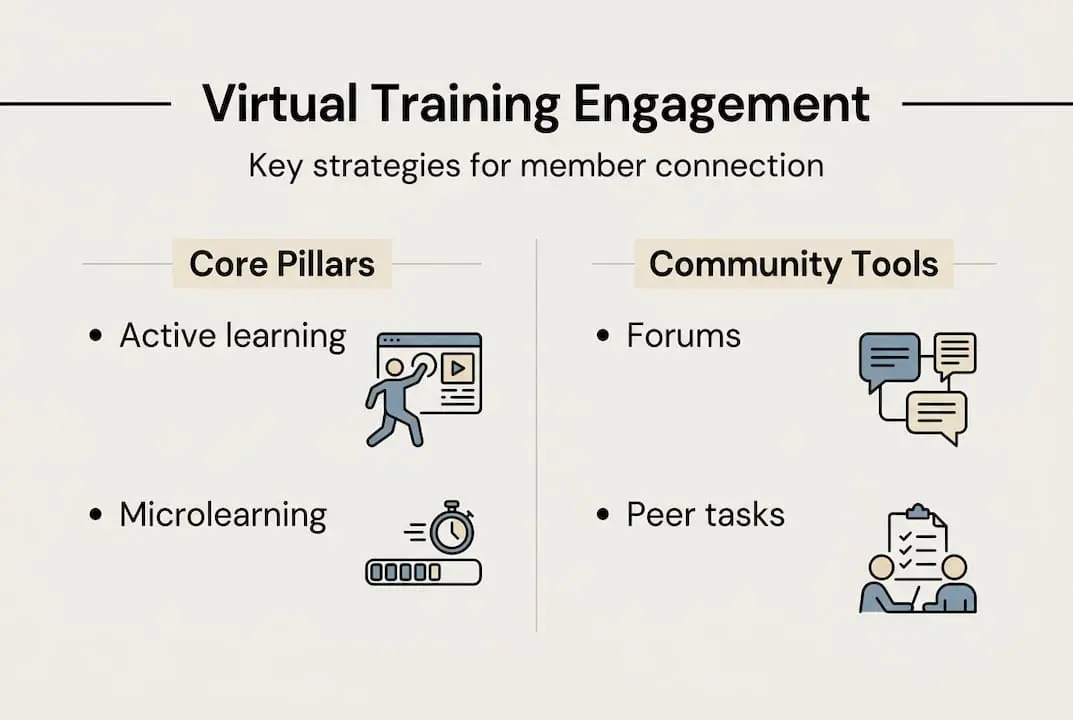
2. Active learning formats. Active learning boosts learning outcomes by 54%. Polls, group tasks, scenario-based challenges, and peer discussions all qualify. Passive listening does not.
3. Microlearning and modular content. Personalised learning pathways and microlearning modules allow members to consume content at their own pace, reducing drop-off and improving retention.

4. Community and social learning. Forums, peer discussion boards, and group challenges create the social fabric that virtual training often lacks. Members who feel connected to a learning community are far more likely to complete programmes.
5. Mobile optimisation and system integration. Members learn across devices and contexts. Ensuring your platform is mobile-friendly and integrates with your existing membership systems removes friction and increases access.
Here is a quick comparison of passive versus active virtual training approaches:
| Approach | Format | Engagement level | Retention impact |
|---|---|---|---|
| Passive lecture | Slides and presenter | Low | Minimal |
| Interactive VILT | Polls, breakouts, Q&A | Medium | Moderate |
| Active learning | Challenges, peer tasks | High | Significant |
| Microlearning modules | Short, focused units | High | Strong |
| Community-led learning | Forums, group projects | Very high | Sustained |
Strengthening virtual learning engagement and investing in forum integration are practical next steps once these pillars are in place.
Pro Tip: Before redesigning your entire programme, survey your members on their preferred learning formats and biggest frustrations. Even a five-question pulse survey will reveal priorities you may not have anticipated.
Designing engaging virtual training: Practical strategies for membership success
Once the pillars are understood, you can apply them using specific strategies tailored to your members’ needs. Here is a step-by-step approach.
- Plan live virtual sessions with interaction built in. Schedule polls every 10 to 15 minutes, use breakout rooms for small group tasks, and assign a dedicated facilitator to monitor the chat and surface questions.
- Deploy microlearning modules between live sessions. Short video lessons, quizzes, or reading tasks sent via drip content keep members engaged between events and reinforce key concepts.
- Set up discussion boards for every programme. Give members a space to share reflections, ask questions, and connect with peers. Assign a moderator to keep conversations active.
- Define and monitor engagement KPIs. Event coordinators should track attendance, completion rates, discussion contributions, and satisfaction scores from the outset.
- Introduce gamification. Badges, leaderboards, and completion certificates reward participation and create healthy competition among members.
- Use hybrid events and micro-conferences. Offering both in-person and virtual attendance options broadens reach and caters to varying member preferences.
Active learning increases retention and performance significantly, so every session design decision should ask: where is the active element here?
Here is a practical reference for matching strategies to common engagement challenges:
| Challenge | Recommended strategy | Expected outcome |
|---|---|---|
| Low attendance | Automated reminders, hybrid access | Higher session turnout |
| High drop-off mid-session | Shorter modules, energy breaks | Improved completion rates |
| Passive participation | Polls, breakout tasks, challenges | Increased interaction |
| Weak community feel | Forums, peer groups, networking | Stronger member bonds |
| Poor knowledge retention | Microlearning, spaced repetition | Better long-term recall |
Exploring virtual event strategies, investing in member engagement software, and applying virtual networking tips will help you put these strategies into practice efficiently.
Pro Tip: Schedule a five-minute energy break every 45 minutes during live sessions. Encourage members to stand, stretch, or complete a quick reflection task. This simple adjustment measurably reduces digital fatigue and improves post-session satisfaction scores.
Overcoming common obstacles and adapting for special cases
Even well-designed virtual training programmes encounter obstacles. Knowing how to address them in advance keeps your programme on track.
Energy fluctuations, distractions, and low digital literacy are among the most common hurdles. Members with limited digital confidence need clear onboarding guides, proactive technical support, and reassurance that asking for help is expected and welcomed.
Gen Z members present a different challenge. They expect flexibility, self-direction, and coaching rather than instruction. Offering on-demand content alongside live sessions, and providing optional one-to-one coaching touchpoints, meets these expectations without alienating other member groups.
Key strategies for overcoming common obstacles:
- Support low digital literacy with step-by-step platform guides and a dedicated helpdesk contact before each session
- Adapt for Gen Z by offering flexible learning models, self-paced modules, and peer coaching options
- Combat energy dips by scheduling sessions in shorter bursts and avoiding back-to-back virtual events
- Ensure equity in access by testing content on low-bandwidth connections and across multiple device types
- Introduce immersive tools gradually so members build confidence before encountering more advanced formats
“VR can increase safety awareness by 30%, but only if users are already comfortable with digital tools.”
This is an important caution. Immersive technologies like virtual reality hold real promise, but they require a digitally confident membership base to deliver results. Invest in foundational digital skills first.
Resources such as event coordinator training and time management classes can help your team build the skills needed to manage these challenges confidently.
Measuring impact and refining your virtual training approach
Delivering great virtual training is only half the work. Measuring its impact and iterating based on evidence is what separates high-performing programmes from those that plateau.
Here is a structured approach to evaluation and improvement:
- Set clear KPIs before each programme launches. Attendance rates, completion percentages, satisfaction scores, and knowledge gain assessments should all be defined in advance.
- Analyse engagement data after every session. Look at login frequency, time spent on modules, discussion board activity, and drop-off points to identify where members disengage.
- Run pulse surveys post-session. Short, three to five question surveys capture immediate feedback while the experience is fresh. Use this data to adjust the next session.
- Iterate on content regularly. Drop or adapt elements that consistently underperform. Double down on formats and topics that generate strong completion and positive feedback.
- Leverage hybrid approaches. 82% of members want flexibility in how they access learning, so building hybrid options into your programme design is no longer optional.
The return on this investment is substantial. Virtual platforms achieve a 467% ROI over three years when implemented strategically. That figure makes a compelling case for treating evaluation as a core part of your programme, not an afterthought.
Reviewing learning engagement strategies will give your team additional frameworks for continuous improvement.
Pro Tip: Survey your members every quarter rather than only at programme end. Quarterly check-ins reveal shifts in preference and emerging needs before they become drop-off statistics.
Streamline your virtual training with integrated solutions
Implementing these strategies becomes significantly more manageable when your tools work together. Colossus Systems brings membership management, event planning, virtual training delivery, and analytics into one unified platform, so your team spends less time switching between systems and more time focusing on member experience.
Our membership management features connect your virtual programmes to automated reminders, member records, and real-time engagement data, giving you a clear picture of what is working and where to improve. With our event management software, you can plan, promote, and deliver hybrid and virtual events with the kind of seamless coordination that keeps members coming back. If you are ready to deliver smarter, more engaging member experiences at scale, we are here to help you make that happen.
Frequently asked questions
What is the most effective virtual training format for engaging members?
Active learning formats such as group discussions, scenario-based challenges, and peer tasks outperform passive lectures by boosting learning outcomes by 54%. Replacing slides-only sessions with interactive elements is the single most impactful change you can make.
How can I reduce drop-off in virtual training sessions?
Breaking content into microlearning modules, using regular check-ins, and adding community features like forums support retention and maintain accountability throughout the programme.
What key KPIs should I track for virtual training success?
Monitor attendance, completion rates, session participation, and satisfaction scores. Event coordinators should track these metrics from the outset to evaluate effectiveness and identify where to improve.
Is hybrid training really in demand among members?
Yes. 82% of association members want hybrid access to learning and training experiences, making flexible delivery a core requirement rather than a nice-to-have option.