Virtual training for educators: engage and develop members

TL;DR:
- Well-designed virtual training with interactive features improves educator engagement and retention.
- Blended approaches combining coaching and community support lead to lasting behavior change.
- Selecting platforms that support both synchronous and asynchronous learning, with focus on accessibility, enhances success.
Many membership organisations assume virtual training is a compromise. The thinking goes that remote delivery means less interaction, lower retention, and educators who simply click through slides without absorbing anything meaningful. The evidence tells a different story. 84% of districts prioritising coaching and mentoring report above-average retention rates, suggesting that when virtual professional development is structured thoughtfully, it produces real results. This guide walks through what effective virtual training actually looks like, which methodologies and standards underpin it, how to choose the right platforms, and how to overcome the practical barriers that trip up even well-resourced organisations.
Table of Contents
- What virtual training for educators really means
- Key methodologies and standards for impactful virtual PD
- Selecting platforms, providers, and models: what works for member organisations
- Common challenges and practical solutions for virtual educator training
- Why sustained coaching and blended models outpace one-off webinars
- Next-level member engagement: solutions from Colossus Systems
- Frequently asked questions
Key Takeaways
| Point | Details |
|---|---|
| Blend learning models | Combining live and self-paced virtual methods boosts engagement and knowledge retention for educators. |
| Prioritise coaching | Ongoing coaching and professional learning communities have a major impact on member retention and instructional quality. |
| Tackle practical barriers | Address time constraints, technology gaps, and digital equity to ensure successful virtual training for all members. |
| Choose the right partners | Select providers and platforms that value interactivity, support, and recognised standards to guarantee PD outcomes. |
What virtual training for educators really means
Virtual training for educators in professional associations refers to any structured learning experience delivered online, designed to build teaching skills, subject knowledge, or leadership capability. It is not simply a recording of a face-to-face workshop. Done well, it is an interactive, community-driven experience that meets educators where they are.
There are two primary formats to understand:
- Synchronous training happens in real time. Think live webinars, virtual coaching sessions, and online workshops where participants interact with a facilitator and each other simultaneously.
- Asynchronous training is self-paced. Educators work through pre-recorded modules, reading materials, or micro-learning units at a time that suits them.
Most effective programmes blend both. Virtual professional development includes synchronous and asynchronous modes, featuring interactive tools such as polls, breakout rooms, and professional learning communities (PLCs). PLCs are structured peer groups where educators collaborate regularly to improve their practice, and they are one of the most powerful retention tools available to membership organisations.
Interactive features are what separate high-impact virtual training from passive content consumption. Breakout rooms encourage small-group discussion. Polls surface real-time understanding. PLCs sustain the learning conversation long after a session ends.
| Feature | Synchronous model | Asynchronous model |
|---|---|---|
| Timing | Fixed schedule | Flexible, self-directed |
| Interaction | Real-time with peers and facilitator | Forum-based or pre-set activities |
| Best for | Coaching, live Q&A, community building | Deep study, reflection, accessibility |
| Technology needed | Stable internet, video platform | LMS access, reliable device |
| Engagement risk | Zoom fatigue if poorly structured | Low motivation without accountability |
Pro Tip: Combine synchronous sessions for community building and accountability with asynchronous content for deeper individual learning. This blended approach, supported by PD models for organisations, consistently outperforms either format used alone.
Understanding these formats gives your organisation the foundation to make informed decisions about design, technology, and facilitation. The format is only the starting point; the methodology behind it is what drives genuine impact.
Key methodologies and standards for impactful virtual PD
Having mapped out the forms of virtual training, we turn to the principles and standards that determine its effectiveness.
The most impactful virtual professional development (PD) shares several core characteristics. It is flexible enough to accommodate the varied schedules of working educators. It is accessible, meaning it works across devices and accounts for different levels of digital confidence. And it offers personalised feedback rather than generic content delivery. Effective models emphasise flexibility, accessibility, and coaching aligned with NSQOL and ISTE+ASCD standards, which are the two leading frameworks for evaluating online teaching quality.
Mentoring and coaching sit at the heart of these standards. When educators receive regular, targeted feedback from an experienced coach, their practice improves faster and they are more likely to remain engaged with the organisation’s learning community.
Here are the steps for aligning your virtual PD with recognised standards:
- Audit your current provision against NSQOL quality indicators for online teaching.
- Identify gaps in personalisation, accessibility, and community support.
- Select a certification pathway such as those offered through the ISTE+ASCD Learning Academy, which provides structured virtual PD paths for professional organisations.
- Embed coaching cycles into your programme design, not as an add-on but as a core component.
- Evaluate outcomes using pre and post assessments, engagement data, and member feedback.
| PD model or accreditation | Key outcomes | Recognition offered |
|---|---|---|
| NSQOL standards | Improved online teaching quality | Framework alignment |
| ISTE+ASCD Learning Academy | Structured skill development | Digital badges, certificates |
| Learning Forward standards | Sustained, job-embedded learning | Professional credibility |
| Coaching-embedded PD | Behaviour change, retention | Internal and external recognition |
For a deeper look at how these principles translate into practice, the best practices for virtual CPD and engagement strategies available through Colossus Systems offer practical guidance tailored to membership organisations.
Selecting platforms, providers, and models: what works for member organisations
Armed with an understanding of proven methods and standards, it is time to choose the right platforms and partnerships for your members.
Professional associations such as ISTE+ASCD, Learning Forward, OLC, and edWeb offer a range of virtual training formats, from webinars and certification programmes to full learning academies and custom PD pathways. Each serves different organisational needs, so selecting the right one requires a clear evaluation process.
When assessing a potential platform or provider, ask these questions:
- Does the platform support both synchronous and asynchronous delivery?
- What interactive features are built in (polls, breakout rooms, discussion boards)?
- Does it provide analytics so you can track engagement and completion rates?
- Is there dedicated user support for both administrators and participants?
- Can the provider integrate ongoing coaching or PLC facilitation into the programme?
- What are the minimum technology requirements, and will your members meet them?
Pro Tip: Prioritise providers who embed coaching and PLCs into their offering rather than treating them as optional extras. Organisations that boost member engagement through sustained, community-driven learning see measurably better outcomes than those relying on one-off content delivery.
“The most effective virtual PD providers do not just deliver content. They build learning environments where educators feel supported, challenged, and connected to a professional community over time.”
It is also worth exploring online engagement strategies used by other membership-focused organisations. Even nonprofit engagement ideas from adjacent sectors can spark creative approaches to keeping your members motivated and invested in their development.
Common challenges and practical solutions for virtual educator training
Understanding provider choice leads naturally to the practical barriers and solutions that impact lasting success.
Virtual training is widely adopted. Yet adoption does not equal effectiveness. While virtual instructor-led training (VILT) is used by 98% of organisations, only 79% report even moderate success. In one study, 15 out of 17 schools experienced dropout from virtual PD programmes. Time constraints, technology gaps, inconsistent routines, and digital equity issues all contribute.
Here are five practical strategies to address the most common pain points:
- Shorten session lengths and use micro-learning modules to reduce Zoom fatigue and accommodate busy schedules.
- Provide technology audits before programmes begin, identifying members who need device support or improved connectivity.
- Assign accountability partners or small PLC groups to maintain motivation between sessions.
- Design for low bandwidth by offering downloadable resources and recorded content for members in rural or under-connected areas.
- Replace AI-only feedback tools with human coaching check-ins, since AI feedback often lacks the nuance needed for meaningful professional growth.
Centralised solutions work well for organisations with consistent tech infrastructure, but decentralised approaches, where local leads facilitate smaller cohorts, better serve organisations with significant digital equity gaps across their membership.
Addressing the digital divide is not optional. Rural members and those with limited digital confidence are often the educators who most need quality PD, yet they are the most likely to drop out. Exploring virtual learning websites designed specifically for membership organisations can help you identify platforms that prioritise accessibility. You can also review strategies to increase member engagement through thoughtful programme design that accounts for these realities.

Human coaching remains irreplaceable. AI tools can deliver content at scale, but they cannot replicate the responsive, relationship-driven feedback that changes educator behaviour over time.
Why sustained coaching and blended models outpace one-off webinars
With the main challenges addressed, it is important to step back and reconsider which strategies truly deliver long-term impact.
Here is an uncomfortable truth most organisations avoid: a single webinar, however well-produced, rarely changes what an educator does on Monday morning. Short, isolated sessions can raise awareness, but they do not shift practice. Research is clear that sustained, coaching-embedded PD of 60 to 100 hours per year yields far greater return on investment than single-shot training events.
Blended models, those that combine live coaching, asynchronous content, and ongoing PLC participation, create the conditions for genuine behaviour change. The coaching relationship provides accountability. The asynchronous content allows for reflection. The PLC sustains the community beyond any single event.
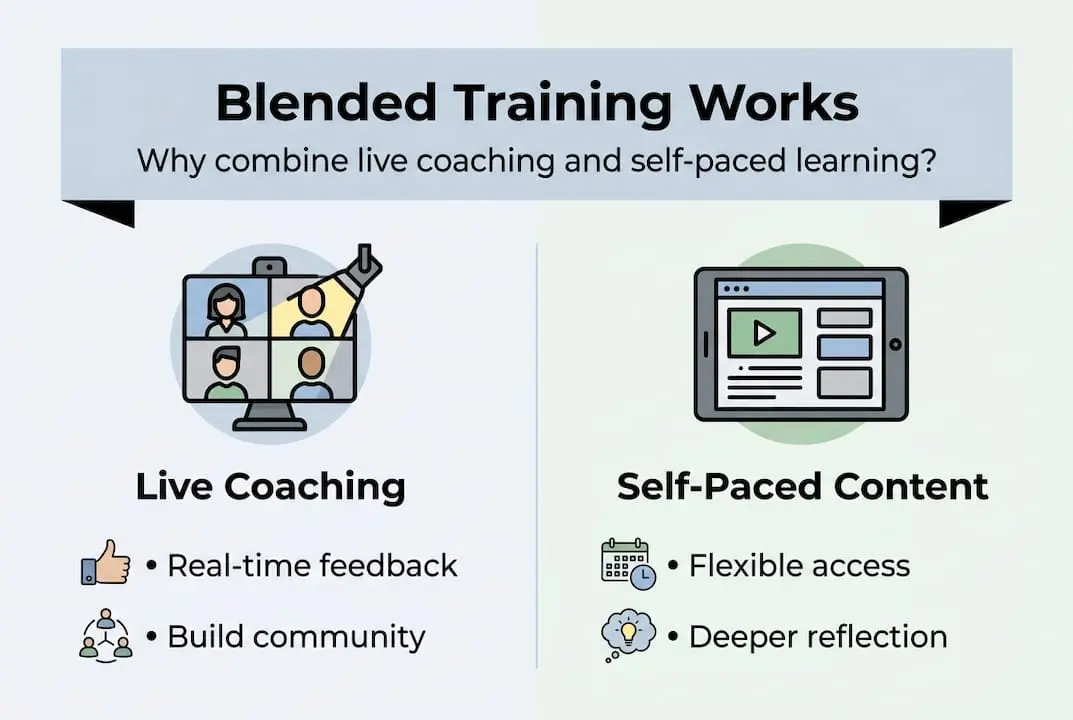
Many membership associations default to webinars because they are easy to organise and simple to market. But easy is not the same as effective. Budgeting for sustained PD is not an extravagance; it is the mechanism by which your organisation demonstrates real value to members. When educators feel genuinely supported in their growth, retention follows. Organisations that invest in blended engagement models consistently report stronger member loyalty and higher programme completion rates. That is the ROI worth measuring.
Next-level member engagement: solutions from Colossus Systems
To close, let us connect these insights to practical tools that can help your organisation achieve its virtual training vision.
Colossus Systems is built for membership organisations that want to do more than manage lists. Our platform brings together membership management features, event management solutions, and CRM for membership engagement into a single, streamlined system.
From scheduling virtual training events and tracking attendance to managing member communications and analysing engagement data, we give your team the tools to deliver on everything this guide recommends. Whether you are building a blended PD programme, launching a certification pathway, or simply trying to reduce the administrative burden of running virtual sessions, Colossus Systems supports every step. Contact us today to arrange a tailored demo and see how our platform can enhance your organisation’s virtual training outcomes.
Frequently asked questions
What is the difference between synchronous and asynchronous virtual training?
Synchronous training happens in real time via webinars or live workshops, while asynchronous training is self-paced using pre-recorded modules or online courses. Both formats serve different learning needs and work best when combined.
How can my membership organisation boost engagement in virtual sessions?
Incorporate interactive elements such as polls, breakout rooms, and professional learning communities to sustain motivation and collaborative learning throughout the programme.
What are the typical challenges of implementing virtual educator training?
Common challenges include time constraints, technology gaps, inconsistent routines, and digital equity issues among rural members, all of which require proactive planning to address.
Are certifications or coaching more effective for long-term impact?
Blending certification programmes with sustained coaching delivers the best results, outpacing single-session webinars for meaningful professional growth and member retention.