Professional Development Options for Membership Organisations

More than 60 percent of membership-based organisations worldwide struggle to achieve sustainable member engagement. Whether you lead a Canadian association or guide a british network, operational efficiency hinges on clear professional development strategies. The right approach can reshape your organisation’s culture, empower teams, and keep your objectives aligned with fast-changing industry standards. Discover how tailored professional development solutions can drive greater engagement and position your organisation for measurable success.
Table of Contents
- Defining Professional Development for Organisations
- Major Types of Professional Development Solutions
- Key Features of Virtual and Online Training
- Costs, Integration, and Customisation Factors
- Common Pitfalls and Best Practice Strategies
Key Takeaways
| Point | Details |
|---|---|
| Strategic Professional Development | Organisations should implement structured programmes that align with specific organisational goals to enhance workforce capabilities. |
| Diverse Learning Modalities | A blend of in-person and online training, alongside collaborative communities, can support various professional development needs effectively. |
| Customisation is Essential | Tailoring learning paths and content to individual roles and skill levels ensures relevance and engagement in professional development initiatives. |
| Avoiding Common Pitfalls | Proactively addressing strategic misalignment and ensuring active participation can significantly increase the effectiveness of training programmes. |
Defining Professional Development for Organisations
Professional development represents a strategic approach organisations use to systematically enhance the capabilities, skills, and professional competencies of their workforce. The Centers for Disease Control and Prevention defines this concept as a comprehensive set of structured activities and learning experiences specifically designed to improve professional knowledge, performance, and organisational outcomes.
At its core, professional development encompasses a wide range of learning modalities tailored to meet the evolving needs of membership organisations. These typically include workshops, conferences, online training modules, mentorship programmes, coaching sessions, and collaborative learning initiatives. Such activities are not merely about acquiring new skills, but about creating a continuous learning environment that supports individual growth while simultaneously driving organisational effectiveness. Membership organisations frequently leverage these strategies to ensure their teams remain adaptable, innovative, and aligned with emerging industry standards.
Successful professional development programmes share several critical characteristics. They are intentionally designed to be goal-oriented, addressing specific skill gaps and strategic objectives. Educational resources highlight that effective programmes integrate formal training, advanced learning opportunities, and ongoing education to create a holistic approach to workforce development. By investing in systematic professional growth, organisations can cultivate a culture of continuous improvement, boost employee engagement, and maintain competitive advantage in rapidly changing professional landscapes.
Professional Growth Tip: Develop a personalised professional development roadmap for each team member, aligning individual aspirations with organisational goals to maximise learning investment and retention.
Major Types of Professional Development Solutions
Membership organisations have access to a diverse range of professional development solutions designed to enhance workforce capabilities and drive organisational growth. Cambridge’s comprehensive research highlights several key professional development formats, ranging from traditional in-person programmes to innovative digital learning experiences that adapt to evolving workplace needs.
These professional development solutions typically encompass multiple modalities, each offering unique advantages. In-person programmes include workshops, conferences, and face-to-face training sessions that provide direct interaction and immediate feedback. Online learning platforms offer flexible, self-paced modules enabling professionals to acquire skills without disrupting their work schedules. Collaborative learning communities represent another powerful approach, facilitating knowledge sharing through peer networks, discussion forums, and group projects. The Southeast Education Resource Centre identifies additional models like peer coaching, action research, and study groups that can be tailored to specific organisational contexts.
Advanced professional development solutions are increasingly leveraging technology to create more interactive and personalised learning experiences. Hybrid approaches combining online and offline elements allow organisations to provide comprehensive skill development programmes that are scalable, cost-effective, and aligned with individual and collective learning objectives. Mentorship programmes, webinars, microlearning modules, and virtual conference platforms have emerged as sophisticated tools that enable continuous professional growth across geographically dispersed teams.
Here’s a comparison of major professional development formats and their unique organisational impact:
| Format | Ideal Usage Scenario | Main Organisational Benefit |
|---|---|---|
| In-person Workshops | Team-building and networking | Immediate feedback, stronger bonds |
| Online Learning Platforms | Flexible, remote upskilling | Scalable access, personalised pace |
| Collaborative Communities | Innovation and best practice | Enhanced peer support, shared ideas |
| Hybrid Programmes | Diverse workforce needs | Blended engagement, wider inclusion |
Professional Learning Strategy: Design a blended learning approach that combines multiple development solutions, ensuring flexibility, engagement, and targeted skill acquisition for your organisation’s unique professional development needs.
Key Features of Virtual and Online Training
Online training platforms offer membership organisations innovative approaches to professional development, transforming traditional learning models through technology-enabled solutions. These digital learning environments provide unprecedented flexibility and accessibility, enabling professionals to acquire new skills without geographical or temporal constraints. Virtual training has evolved from simple video lectures to sophisticated, interactive learning experiences that engage participants through multiple multimedia channels.

The core features of virtual and online training encompass several critical elements. Remote accessibility allows participants to join training from any location, breaking down traditional learning barriers. Flexible scheduling enables professionals to integrate learning seamlessly with their existing work commitments, accommodating diverse personal and professional needs. Coursera highlights the significant advantages of online learning platforms, including personalised learning environments that adapt to individual learning styles, progress tracking, and real-time performance analytics. Interactive features such as discussion forums, live webinars, and collaborative project spaces further enhance engagement and knowledge retention.
Advanced virtual training solutions leverage cutting-edge technologies to create immersive learning experiences. These include adaptive learning algorithms that personalise content difficulty, gamification elements that increase motivation, and integrated assessment tools that provide immediate feedback. Multimedia content like video tutorials, interactive simulations, podcasts, and downloadable resources cater to different learning preferences, ensuring comprehensive skill development. The ability to revisit and replay learning modules allows participants to learn at their own pace, reinforcing complex concepts and supporting long-term knowledge acquisition.
Professional Learning Preparation: Conduct a comprehensive skills audit before selecting an online training platform, ensuring the chosen solution precisely matches your organisation’s specific learning objectives and technological infrastructure.
Costs, Integration, and Customisation Factors
Professional development investments represent complex strategic decisions that require careful analysis of costs, technological integration, and organisational alignment. Membership organisations must evaluate both direct financial expenditures and potential long-term returns when selecting professional development solutions. These strategic considerations extend beyond simple monetary calculations, encompassing broader impacts on workforce capabilities, organisational culture, and operational efficiency.
The financial landscape of professional development involves multiple cost dimensions. Direct costs include platform subscriptions, licensing fees, content development, and trainer expenses. Indirect costs encompass employee time investment, potential productivity adjustments, and technological infrastructure requirements. Cambridge’s comprehensive whitepaper highlights the importance of integrating professional development with organisational performance cycles, suggesting that effective programmes should demonstrate measurable impact through skills enhancement, knowledge retention, and tangible performance improvements.
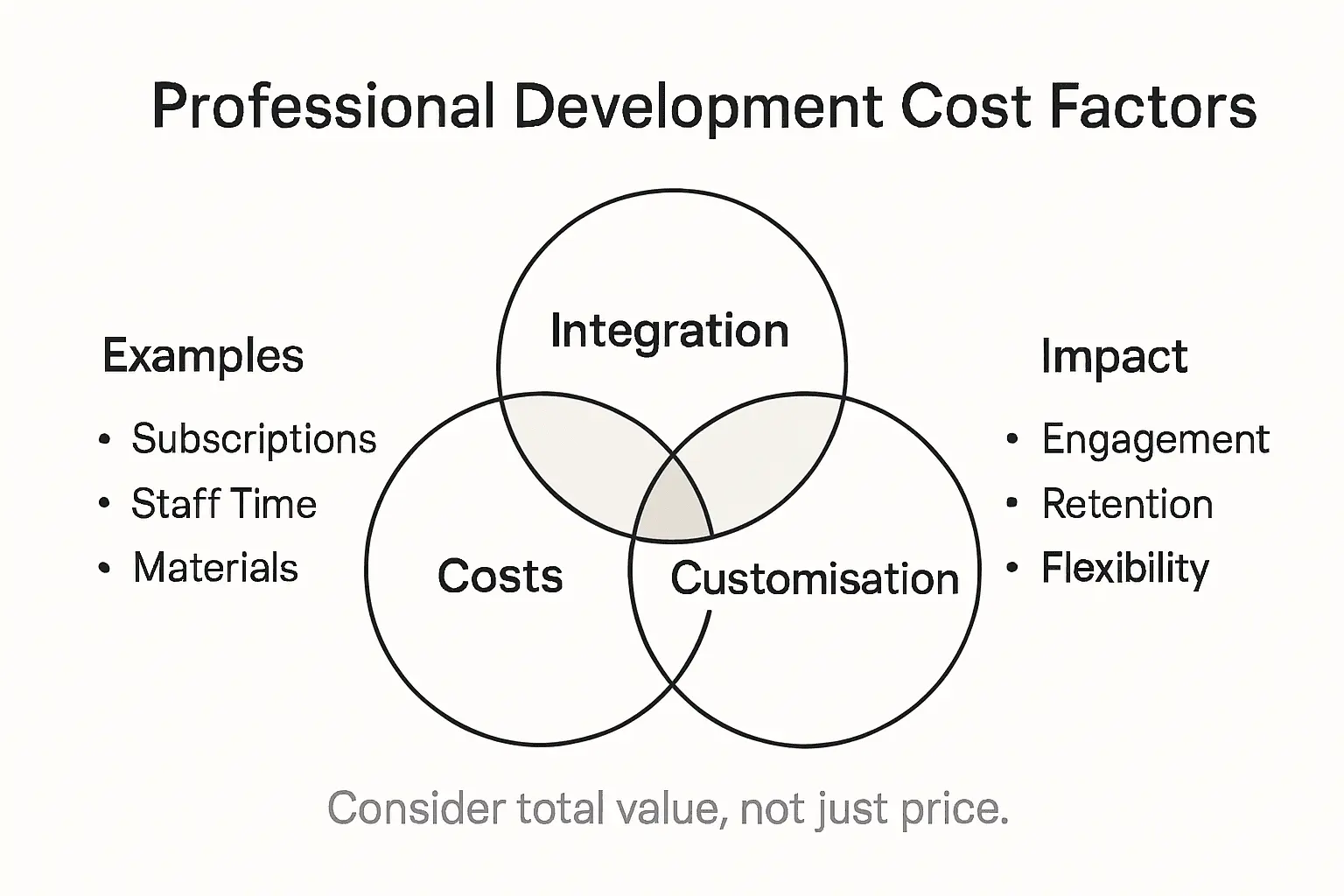
Customisation represents a critical factor in successful professional development strategies. Modern organisations require flexible solutions that can be tailored to specific team roles, skill levels, and strategic objectives. Advanced platforms offer modular design capabilities, allowing granular customisation of learning paths, assessment metrics, and content difficulty. This personalisation ensures that training programmes address precise skill gaps, support individual learning preferences, and maintain high engagement levels across diverse workforce segments. Integration capabilities with existing human resources management systems, learning management platforms, and performance tracking tools further enhance the strategic value of professional development investments.
Below is an overview of customisation options in modern professional development platforms:
| Customisation Feature | Target Outcome | Benefit for Organisations |
|---|---|---|
| Modular Content Pathways | Role-specific learning | Highly relevant skill development |
| Adaptive Difficulty Levels | Mixed learner abilities | Increased engagement rates |
| Assessment Metric Control | Tailored progress tracking | Granular performance insights |
| Integration Capabilities | Connected HR management | Seamless workflow and reporting |
Budget Optimisation Strategy: Conduct a comprehensive cost-benefit analysis that considers not just immediate expenses, but potential long-term organisational productivity gains and skill development returns when selecting professional development solutions.
Common Pitfalls and Best Practice Strategies
Professional development initiatives frequently encounter systemic challenges that can undermine their effectiveness and organisational impact. Membership organisations must proactively identify and mitigate these potential obstacles to ensure meaningful learning experiences that genuinely transform professional capabilities. Understanding these pitfalls requires a nuanced approach that goes beyond surface-level training interventions.
Several critical pitfalls consistently emerge in professional development programmes. Strategic misalignment represents a primary concern, where learning initiatives fail to connect directly with organisational objectives. Other significant challenges include passive learning formats that do not engage participants, insufficient follow-up mechanisms, and training content that lacks contextual relevance. High-quality professional development research highlights the importance of creating adaptive, responsive learning environments that integrate adult learning principles, provide ongoing coaching, and maintain rigorous quality monitoring processes. Successful strategies involve comprehensive design approaches that prioritise active participation, reflective practice, and continuous skill integration.
Best practice strategies demand a holistic, systematic approach to professional development. Organisations should implement robust feedback loops, ensure leadership engagement at multiple levels, and develop clear, measurable learning objectives. Customisation becomes crucial, with training programmes tailored to specific team roles, individual learning preferences, and precise skill development needs. Advanced approaches incorporate real-world scenario simulations, peer learning networks, and personalised coaching to enhance knowledge retention and practical application. Technology-enabled platforms can further support these strategies by providing adaptive learning pathways, performance tracking, and sophisticated analytics to measure training effectiveness.
Implementation Insight: Create a structured evaluation framework that measures professional development impact through multiple metrics, including skill acquisition, behaviour change, and demonstrable performance improvements across different organisational levels.
Elevate Your Membership Organisation’s Professional Development Strategy Today
Achieving seamless professional development means overcoming challenges like strategic misalignment, inconsistent engagement, and lack of customised learning pathways. This article highlights the importance of blended learning approaches, personalised content, and scalable virtual training solutions—all essential elements that can feel overwhelming without the right tools. Colossus Systems addresses these pain points by offering a fully customisable platform that unites member management, event hosting, virtual training, and communication channels, designed specifically for membership organisations seeking growth and measurable impact.

Take control of your professional development initiatives now by integrating a platform built to streamline event registration, facilitate remote learning, and track engagement effortlessly. Join numerous organisations who have transformed workforce capabilities while ensuring secure and flexible member interactions. Discover how to personalise learning journeys, enhance participation, and accelerate organisational outcomes by connecting with us at Contact Colossus Systems. Make the next step to future-proof your development strategies and unlock your organisation’s full potential today.
Frequently Asked Questions
What is professional development for membership organisations?
Professional development for membership organisations refers to structured activities and learning experiences aimed at enhancing the skills, capabilities, and competencies of their workforce, ultimately improving professional knowledge and organisational outcomes.
What are the major types of professional development solutions available?
The main types include in-person programmes such as workshops and conferences, online learning platforms for flexible training, collaborative learning communities for peer support, and hybrid programmes that blend both online and offline elements for comprehensive skill development.
How can virtual and online training benefit members of an organisation?
Virtual and online training offers significant flexibility, allowing participants to learn from any location and at their own pace, which makes it easier to balance learning with existing work commitments. Interactive elements and multiple multimedia channels enhance engagement and knowledge retention.
What are common challenges faced in professional development initiatives?
Common challenges include strategic misalignment with organisational goals, passive learning formats, lack of follow-up, and training content that does not connect with participants’ real-world experiences. Identifying and proactively addressing these pitfalls are essential for effective learning outcomes.