- Home
- Membership challenges
- Subscription dependence
We rely too heavily on subscription income
Subscriptions pay for nearly everything we do, so every lapse and every fee freeze comes straight off the budget. We have tried events, training, sponsorship and job adverts, but each ran off the side of someone’s desk and nobody measured what it made. This guide covers how to build other income that members value, and how to tell whether it pays.
Signs that one income line carries everything
- A handful of lapses, or a year without a fee rise, leaves a gap in the budget that nothing else can fill.
- Events, training and sponsorship happen every year, but nobody can say what each one made after costs.
- New income ideas are run by whoever has time, on top of the day job, and quietly stop when things get busy.
- Bookings, publication orders and job adverts are taken in different tools, so you can’t see which members buy anything.
- When the board asks for growth, the only lever anyone can name is the subscription fee.
A typical case: a trade body freezes its fee for a second year because member firms are under pressure. The finance director asks which other lines could close the gap. The events team knows the conference is busy and the guidance notes sell, but nobody has set costs against either.
Other income never gets a proper system
New income has no routine
Subscriptions have a renewal cycle, an invoice run and a budget line. Other income is set up project by project, with no regular point where anyone prices it, costs it or reviews it.
Each line lives in its own tool
Bookings go through one tool, publications through email and invoice, job adverts through a web form. Each records sales differently, and none of them knows who is a member.
Trading feels risky, so it stays small
Boards understand fees and are wary of anything that looks commercial. Income projects go to whoever has capacity, so they are judged on effort rather than results.
When one line carries all the risk
- Every lapse and fee freeze hits the budget directly. With thin margins there is little room to absorb either.
- Staff time goes on lines that may not pay. Without costs per line, a busy event can look like a success while it loses money.
- Members get one offer at one price. A firm that values a single service pays the full fee for everything, and some decide it isn’t worth it.
- The board sees turnover, not contribution, so decisions about what to grow or stop rest on anecdote.
PARN and Buzzacott’s 2026 benchmarking of 500 UK professional bodies’ accounts found typical margins of just 1–2%. In 2025, 41% were operating in deficit. Source
Naylor’s 2026 benchmark surveyed 665 association professionals across North America. Generating non-dues revenue was their top challenge for the fourth year running, named by 51.9%. Job-posting sales rose from 3.6% to 10% of non-dues revenue, while sponsorship’s share fell from 29.7% to 25.3%. Source
ASAE’s first State of Associations report (March 2026, mostly US) found that more than 60% of associations are diversifying their revenue. Source
Five steps towards a broader income base
Write down your real income mix
List every income line for the last full year: subscriptions, events, training, publications, sponsorship and recruitment. Next to each, put its direct costs and a rough figure for staff time. The point is a margin for each line, not a total.
Start from what members already value
Look at what members ask you for, buy elsewhere, or already pay you for in small amounts. Guidance, training days and help with recruitment are common starting points. A line built on an existing need is easier to test than a new idea.
Price members and non-members differently
A visible member price shows what the subscription is worth, and the non-member price is where new income comes from. Keep core benefits members-only, so a new line never undercuts the fee.
Run new income on your member data
If bookings, orders and job adverts sit in separate tools, nobody can see who buys, and member prices get checked by hand. Run them on the same records as your members, so you can see which members buy and which buyers might join.
Test small and judge on contribution
Run one event or one product for a season before scaling it. Agree beforehand what contribution, after direct costs and staff time, would justify carrying on. Turnover alone hides lines that lose money.
Events, a shop and a job board, alongside membership
Colossus sells event tickets and shop products through one basket and card checkout. Members-only ticket tiers follow the membership types in your CRM. The same platform runs an industry job board that employers pay to use.
| What it does | How it works | Plans |
|---|---|---|
| Paid events and tickets | In-person and online events with draft, open and closed states. Each ticket has its own allocation and sold-out handling, and staff mark attendance and process refunds. | Core (basic)GrowthScaleEnterprise |
| Member and non-member prices | A Members Only ticket tier, restricted to the membership types you choose, beside a standard tier for everyone else. Promo codes take a fixed amount or a percentage off one product or all, between set dates. | GrowthScaleEnterprise |
| Online shop | Products with variants, stock, postage options, bundles and returns. Buyers pay by card at checkout and get a receipt. | Core (optional)GrowthScaleEnterprise |
| Industry job board | Job listings, job alerts, saved searches, CVs and applications. Employers buy job credits to post adverts, and firms can be shown as featured employers. Staff can import adverts with AI from text or a PDF. | GrowthScaleEnterprise |
| Sales you can see | The E-commerce dashboard shows sales for a period against the one before, what the sales are made of, top products and recent orders. The events summary shows tickets sold and remaining for each event. | Core (optional)GrowthScaleEnterprise |
Sales figures show turnover. To see what each line contributes, set its direct costs and staff time against those figures with your finance team.
How a trade body turned three side projects into income it could measure
Illustrative example. The Association of Plant Hire Inspectors is a fictional trade body with 300 member firms and a staff of six. This is a composite scenario, not a customer story.
Subscriptions paid for almost everything. The conference ran on a separate booking tool, logbooks were sold by email and invoice, and vacancies went on a free noticeboard. Nobody could say what any of it made after costs.
The team started with what members already asked for. They put the inspection logbooks in the shop with A4 and A5 variants, tracked stock and gave members a spring discount code. The conference got a Members Only tier for current member firms and a standard tier for non-members, sold through the same checkout.
The noticeboard became a job board, with job credits that hire firms buy at checkout. Each month the finance lead pulls each line’s sales from Colossus and sets its direct costs against them. After the first conference, the board saw turnover and contribution for each line side by side, and agreed which to grow.
Sell a conference, a handbook and job adverts alongside membership
The Association of Plant Hire Inspectors, a fictional trade body, leans on subscriptions. It wants its conference, logbooks and job adverts to earn income it can measure.
- Organisation
- Association of Plant Hire Inspectors (fictional), 300 members
- Goal
- Set member and non-member prices for a paid event, a shop product and job credits, and see what each one sells
- Takes
- About 85 seconds, 7 steps
- Plan
- Growth, Scale and Enterprise plans
A walkthrough of real Colossus screens with a fictional organisation and demonstration data. Your own set-up, fields and wording will differ.
-
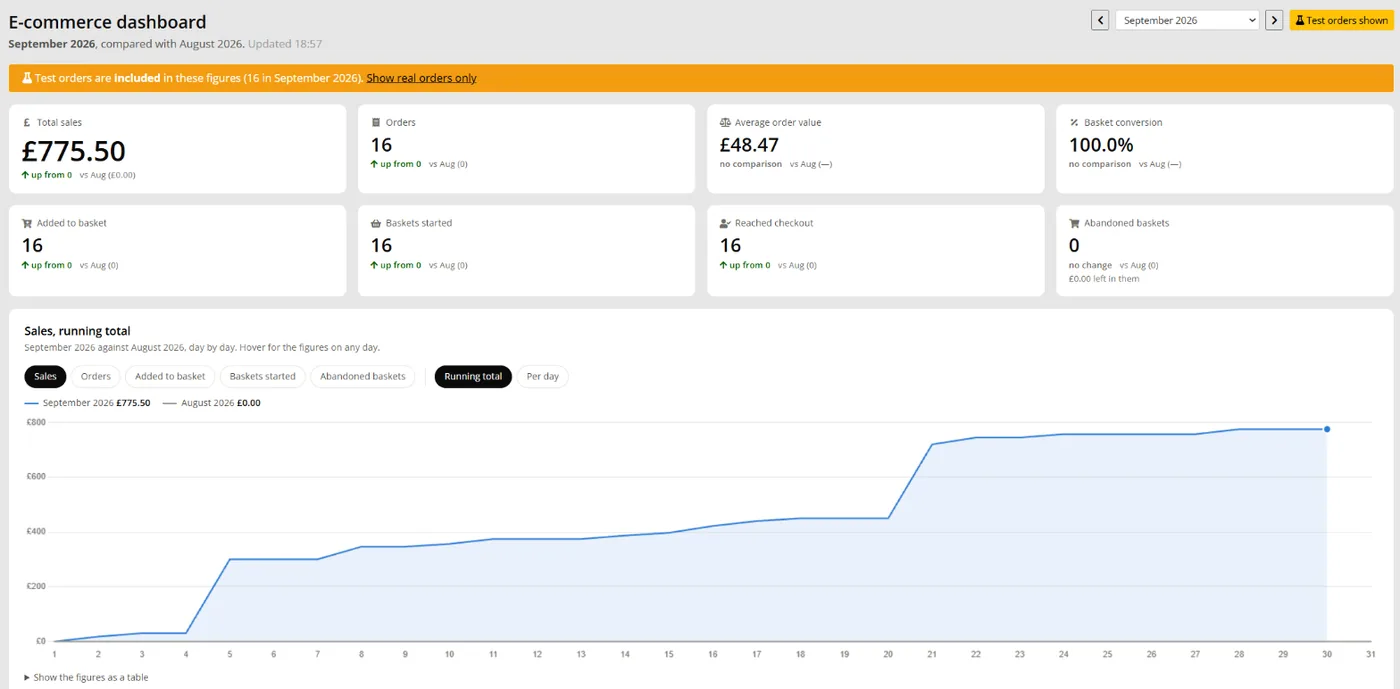
Colossus screen, demonstration data Step 1 of 7See what already sells
What you do: Open the E-commerce dashboard and choose last month.
What to notice: Sales are set against the month before, with what the sales are made of, the top products by sales and recent orders. Test orders are marked and can be left out.
-
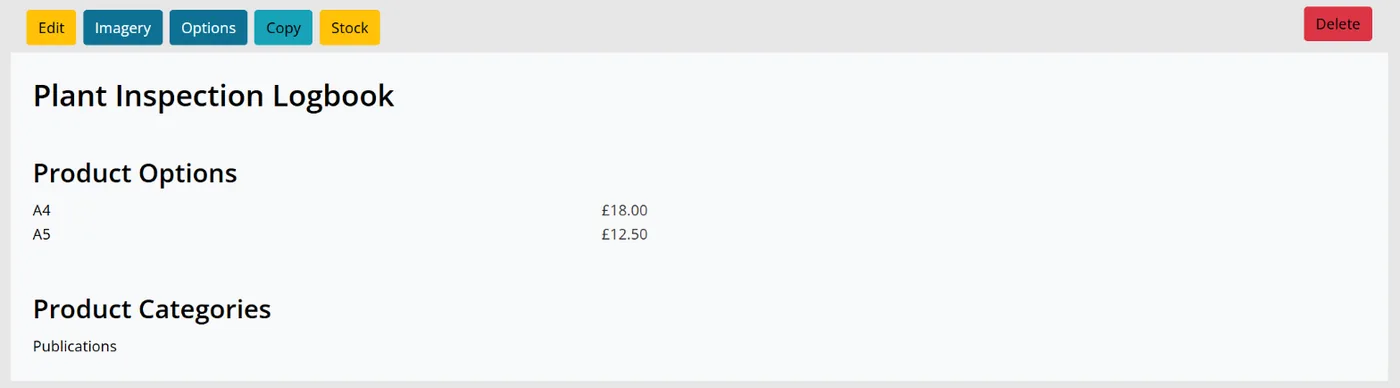
Colossus screen, demonstration data Step 2 of 7Add a product members already ask for
What you do: Add the inspection logbook as a product, give it A4 and A5 options with their own prices, and switch on Track Stock.
What to notice: The product carries its options, stock and shipping weight, so printed copies are sold and posted without an invoice run.
-
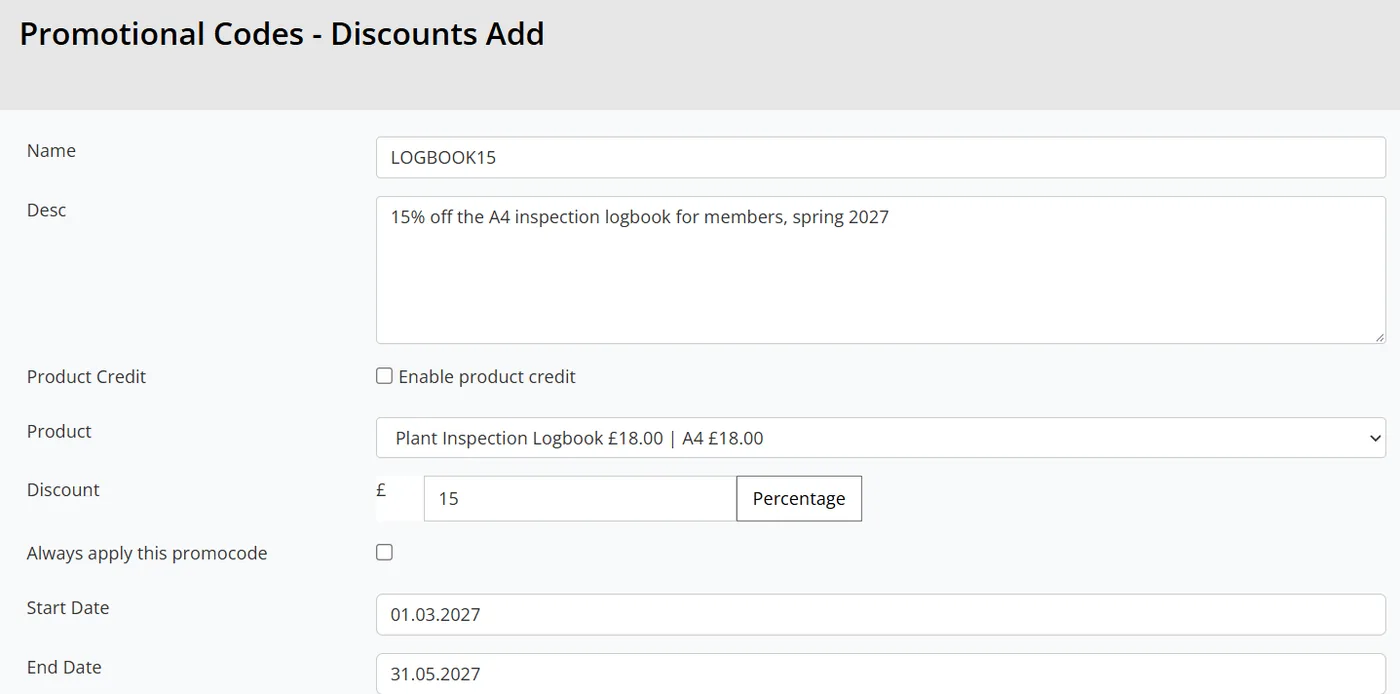
Colossus screen, demonstration data Step 3 of 7Give members their discount
What you do: Create a percentage code for the A4 logbook with a start date of 1 March and an end date of 31 May, then switch it on in the Active column.
What to notice: A code takes a fixed amount or a percentage off one product option or all products, and it is taken off at the basket.
-
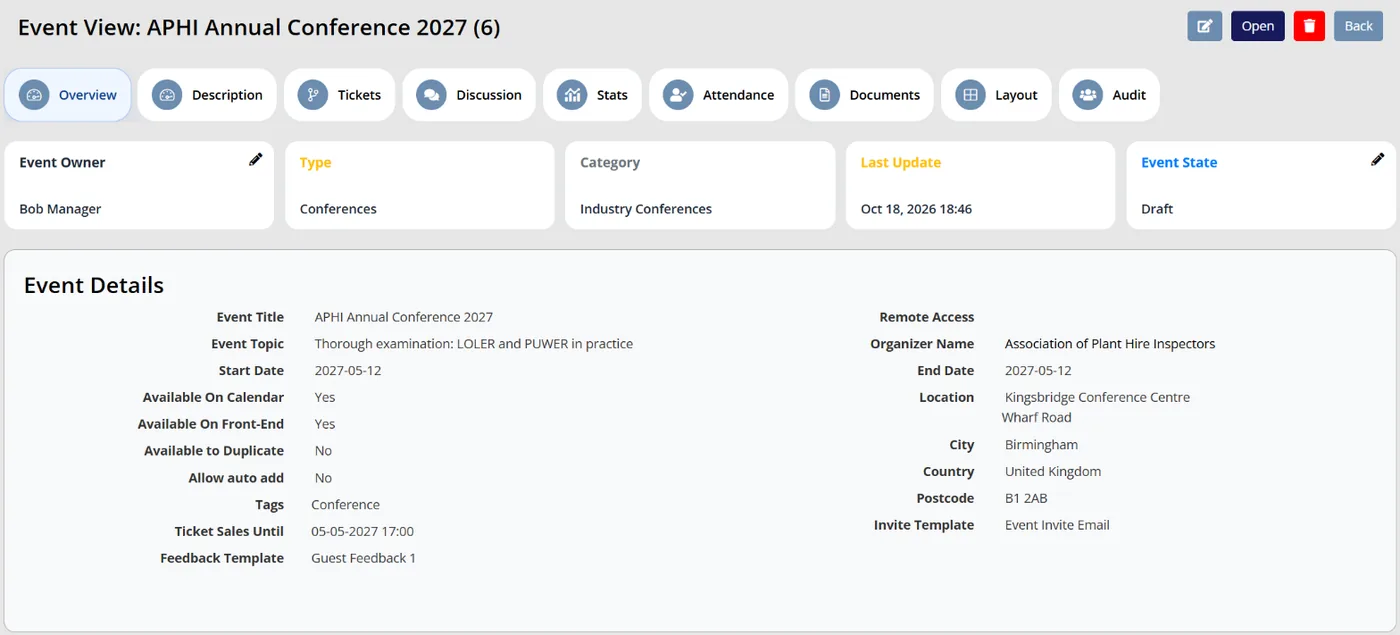
Colossus screen, demonstration data Step 4 of 7Create the paid conference
What you do: Add the annual conference with its date, location and the date ticket sales end. A new event starts as Created: set it to Draft from the Event State card on its page.
What to notice: The summary lists every event with its tickets sold and tickets remaining.
-
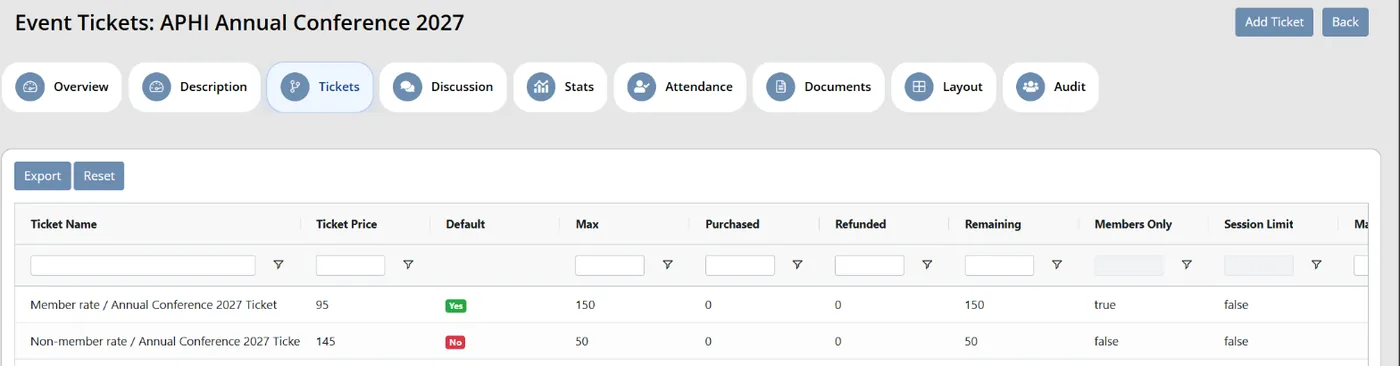
Colossus screen, demonstration data Step 5 of 7Set a member tier and a standard tier
What you do: Add a Members Only ticket for the current membership types using the conference ticket's member-rate option, then a standard ticket using the non-member rate, with an allocation for each.
What to notice: Only the membership types you choose can book the member tier, and both tiers are paid for at the same checkout.
-
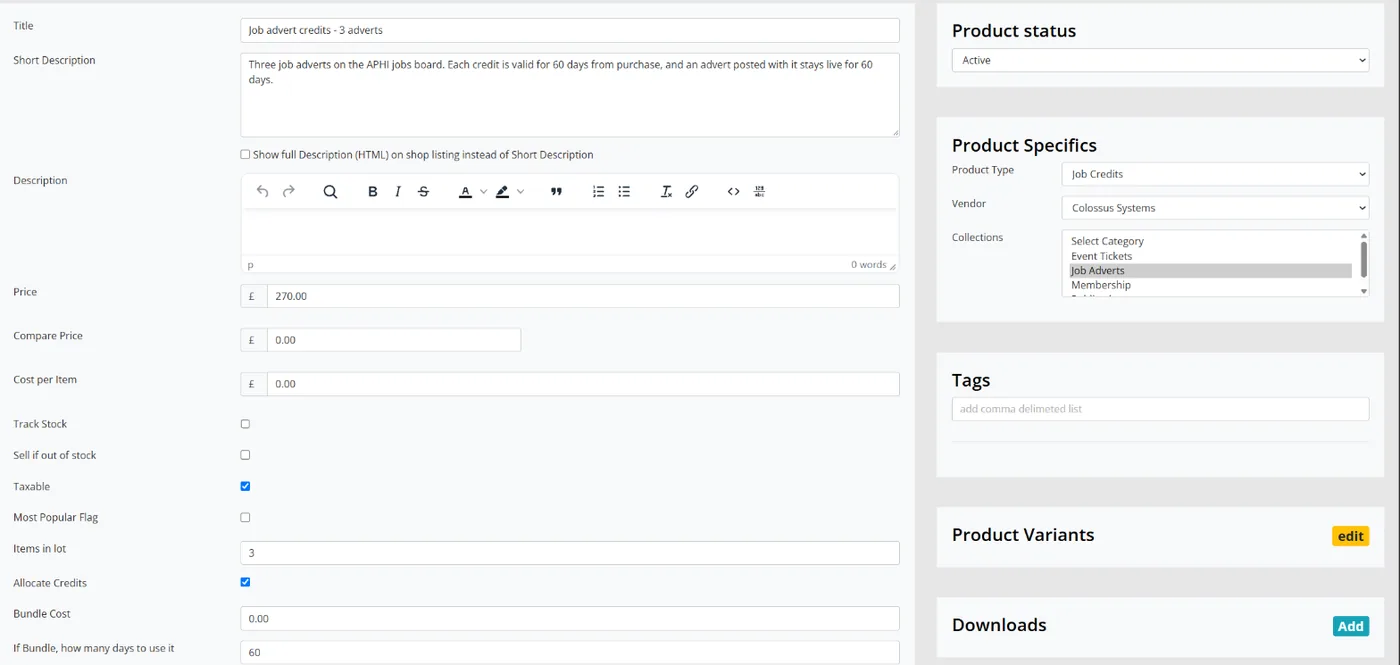
Colossus screen, demonstration data Step 6 of 7Charge employers for job adverts
What you do: Add a job credits product: tick Allocate Credits, set Items in lot to 3 and the number of days in 'If Bundle, how many days to use it'. Live adverts are listed under Recruitment > Live Jobs.
What to notice: A purchase adds three credits to the buyer's account with a use-by date, and an advert posted with a credit stays live for the same number of days. A firm can be marked as a featured employer on its account.
-
ScreenShop basket and checkoutStep 7 of 7
Check what a member sees
What you do: As a demonstration member, add a member ticket and a logbook to the basket. Apply the promo code and go through to card payment.
What to notice: Tickets and products share one basket and one checkout, and the buyer gets a receipt.
The result
Conference tickets and logbooks sell through one basket and checkout, and members get their own price. Employers buy job credits to advertise. Shop sales show on the E-commerce dashboard and ticket sales on the events summary, ready to set against each line's costs.
What to measure
Measure each line over a full year against your own starting point. The aim is income you can explain line by line, not a bigger total for its own sake.
- Subscriptions as a share of total incomeSubscription income divided by total income, from your management accounts, each quarter.Lower means less exposure, as long as total income holds
- Contribution per income lineIncome from each line minus its direct costs and an honest share of staff time.Higher is better
- Members buying a paid serviceMember organisations that bought at least one ticket, product or job advert in the year.Higher is better
- Non-member buyers who later joinNon-members who bought something, and how many of them became members within a year.Higher is better
- Staff hours per lineHours spent running each line, set against what it contributes.Lower is better for the same contribution
Frequently asked questions
Which income line should we try first?
Will selling to non-members devalue membership?
Is a job board worth it for a specialist association?
Can people pay for tickets and products in one place?
Which Colossus plans include events, the shop and the job board?
Sources
- PARN and Buzzacott, Financial benchmarking for professional bodies 2026, 16th edition. Accounts of 500 UK professional bodies, for financial years ending between July 2024 and June 2025.
- Naylor Association Solutions, 2026 Association Benchmarking Report, 15th edition, publisher’s summary of 3 August 2026. 665 senior association professionals across North America.
- ASAE, State of Associations report, first edition, publisher’s release of 23 March 2026. Based on a year of pulse polls of association leaders, mostly in the US; ASAE does not publish the sample size.
See where your own systems stand
The Membership Systems Health Check is ten multiple-choice questions about your data, renewals, automation, reporting and member experience. You get your score out of 100 on screen straight away, with no email needed to see it.
Prefer to talk it through? Book a tailored demonstration and we will start from this problem, not a feature tour.