Why associations need CRM: Grow, engage, and streamline

TL;DR:
- Manual processes hinder growth, increase errors, and reduce member retention in associations.
- CRM centralizes data, personalizes communication, automates tasks, and enhances operational efficiency.
- Selecting a purpose-built CRM and careful implementation foster stronger member relationships and strategic growth.
Associations that still rely on spreadsheets and email chains to manage their members are leaving real growth on the table. Many organisations assume that their existing tools are “good enough,” yet quietly struggle with poor renewal rates, disengaged members, and administrative teams buried in repetitive tasks. A modern CRM (customer relationship management) system changes that picture entirely. This guide explains precisely why manual processes hold associations back, how CRM transforms member engagement and operational efficiency, and what to look for when selecting and implementing the right platform for your organisation.
Table of Contents
- The limitations of manual processes in associations
- How CRM transforms association member engagement
- Operational benefits: Efficiency, reporting, and growth
- Choosing and implementing the right CRM for your association
- Why member-focused CRM strategy is the future for associations
- Take your association forward with the right CRM solution
- Frequently asked questions
Key Takeaways
| Point | Details |
|---|---|
| Manual methods limit growth | Spreadsheets and ad hoc tracking cause missed renewals and lower member retention. |
| CRM boosts engagement | CRM software enables personalised communication and event automation for higher member loyalty. |
| Efficient operations | Automated processes and real-time reporting free staff time and enable better strategic decisions. |
| Choose the right CRM | Select a CRM based on key features and your members’ needs for long-term association success. |
The limitations of manual processes in associations
Managing memberships manually is a task of the past. Yet a surprising number of associations still rely on a patchwork of tools such as spreadsheets, generic email clients, and disconnected databases to track hundreds or even thousands of members. The short-term convenience of these tools quickly becomes a long-term liability.
The most common manual processes associations use include:
- Spreadsheets to track member contact details and renewal dates
- Generic email tools to send mass newsletters without segmentation
- Separate databases for event attendance, billing, and engagement history
- Paper-based or PDF forms for membership applications and renewals
- Manual follow-up calls or emails for lapsed members
Each of these approaches requires significant staff time and introduces the risk of human error. When a team member updates a spreadsheet incorrectly or forgets to log a phone call, that data is effectively lost. Over time, these small errors accumulate into a fragmented view of your membership, making targeted communication nearly impossible.
Poor data accuracy is not just an inconvenience. It directly affects retention. When your team cannot quickly identify which members are at risk of lapsing, renewal campaigns become reactive rather than proactive. Members who feel forgotten or receive irrelevant communications are far more likely to disengage or leave. Many associations experience significant member churn and engagement challenges due to outmoded tools.
“Retention rates can improve by 27% when associations adopt a dedicated CRM system, replacing fragmented manual workflows with centralised, data-driven processes.”
Consider a mid-sized professional association managing 2,000 members. Their administrator spends roughly 15 hours per week manually updating records, sending renewal reminders, and compiling reports. That is 780 hours per year focused on administration rather than member experience. Now multiply that by salary costs and missed engagement opportunities, and the true price of manual management becomes clear.

Reporting is another critical weakness. Without a centralised system, generating a simple report on member demographics, event attendance trends, or revenue forecasts requires pulling data from multiple sources and reconciling inconsistencies. Leadership decisions made on incomplete data lead to strategies that do not reflect the actual state of the organisation. The case for moving beyond manual processes is not just about convenience. It is about survival in an increasingly competitive landscape for member attention.
How CRM transforms association member engagement
With manual limitations clearly identified, the shift to a CRM becomes not just appealing but necessary. A CRM centralises every piece of member data in one place: contact details, communication history, payment records, event attendance, preferences, and engagement scores. Your team no longer wastes time hunting across systems for basic information.
CRM systems improve member engagement in several concrete ways:
- Personalised communication: Segment members by interest, tenure, or engagement level and tailor every message accordingly
- Automated renewal reminders: Schedule timely, friendly reminders that reduce lapsed memberships without staff intervention
- Event management integration: Connect event registrations to member profiles, enabling targeted invitations and post-event follow-ups
- Behavioural analytics: Track which emails members open, which events they attend, and which benefits they use, then act on those insights
- Feedback collection: Automate post-event surveys and annual satisfaction polls, feeding results directly into member records
CRM centralises data to offer tailored communications and better event targeting, which is where associations see the most immediate return on investment.
Pro Tip: Use CRM segmentation to create separate communication tracks for new members, long-standing members, and those who have not engaged in the last 90 days. Each group has different needs, and addressing those differences directly will lift engagement noticeably.
The table below illustrates the contrast between member engagement before and after CRM adoption:
| Engagement area | Before CRM | After CRM |
|---|---|---|
| Member communication | Mass emails, no segmentation | Personalised, targeted messaging |
| Renewal process | Manual reminders, high lapse rate | Automated sequences, improved retention |
| Event targeting | All-member invitations | Interest-based, segmented invitations |
| Feedback collection | Infrequent, manual surveys | Automated, linked to member profiles |
| Engagement tracking | Limited or non-existent | Real-time dashboards and scoring |
The personalisation factor cannot be overstated. Members who receive communications relevant to their interests and career stage feel valued. That sense of value is the foundation of long-term loyalty. A well-configured CRM enables your team to build those relationships at scale, something that is simply not achievable through manual methods regardless of how dedicated your staff may be.
Exploring tools designed specifically for CRM for membership growth reveals just how far purpose-built platforms have advanced beyond generic contact management software. Similarly, reviewing research on CRM for engagement reinforces that member-facing personalisation is consistently the highest-impact feature associations report after implementation.
Operational benefits: Efficiency, reporting, and growth
Beyond member engagement, the operational impact of CRMs is just as transformative. Many association managers are initially drawn to CRM for its engagement capabilities but quickly discover that the efficiency gains across their entire operation are equally compelling.
Here is a step-by-step view of how a CRM frees your team for member-focused initiatives:
- Automate routine tasks: Renewal invoices, event confirmation emails, and membership certificate delivery are triggered automatically based on member actions or dates.
- Centralise billing and payments: Integrate payment gateways directly into the CRM so that financial records update in real time without manual data entry.
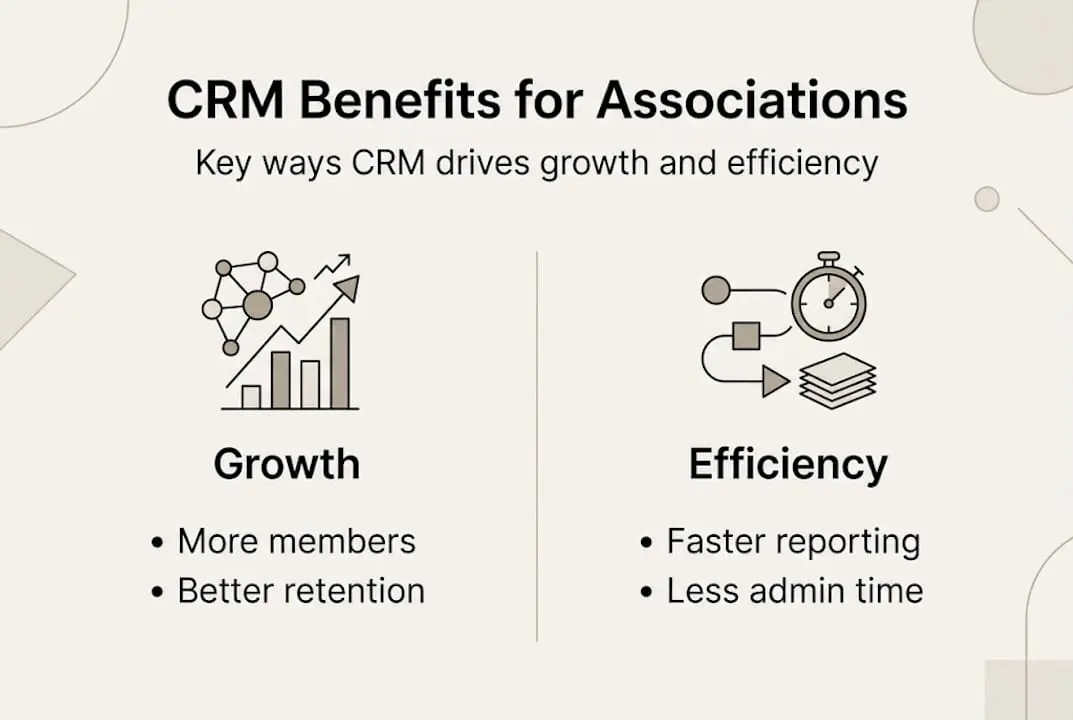
- Generate reports instantly: Replace hours of spreadsheet work with one-click dashboards showing revenue, retention, event performance, and member growth.
- Track pipeline activity: Monitor new membership enquiries and applications through a visual sales pipeline, ensuring no prospective member falls through the cracks.
- Enable remote team access: Cloud-based CRMs allow your entire team to access accurate, up-to-date member information from any location.
Using a CRM significantly reduces admin time and increases actionable insights, meaning your management team spends less time chasing data and more time acting on it.
The table below compares manual versus CRM-driven operations directly:
| Operational area | Manual approach | CRM-driven approach |
|---|---|---|
| Renewals | Staff sends individual emails | Automated sequences triggered by expiry date |
| Reporting | Multi-source spreadsheet compilation | Real-time, customisable dashboards |
| Event sign-ups | Email or paper forms | Online registration linked to member profile |
| New member onboarding | Manual welcome emails | Automated onboarding workflows |
| Data accuracy | Prone to human error | Validated, centralised records |
Scalability is another operational advantage that associations often underestimate before implementation. When your organisation grows from 500 to 2,000 members, manual processes require proportionally more staff. A CRM, by contrast, handles increased volume through automation, meaning your team can support a significantly larger membership without a corresponding increase in administrative headcount.
Pro Tip: Before selecting a platform, review what good CRM features look like for membership organisations specifically. Generic CRMs built for sales teams often lack the event management, tiered membership, and communication tools that associations genuinely need.
Leadership also benefits enormously from the reporting capabilities. Real-time dashboards showing membership growth, event attendance, revenue forecasts, and engagement scores allow boards and senior managers to make informed decisions quickly. That visibility transforms strategy from a guesswork exercise into a data-driven process. When you can see exactly which membership tier is growing fastest or which events generate the most renewals, you can allocate resources with confidence.
Choosing and implementing the right CRM for your association
To fully realise CRM benefits, choosing the right system and planning implementation carefully is critical. The market offers dozens of options, and not every platform suits the specific needs of a membership organisation. Selecting the wrong system leads to low adoption rates, wasted investment, and frustrated staff.
Key features to look for when evaluating association CRM software:
- Native membership management: Tiered membership levels, renewal tracking, and member portals should be built in, not added as workarounds
- Automation capabilities: Look for flexible workflow builders that handle renewals, onboarding, event reminders, and follow-ups without custom coding
- Custom reporting: Your board will have specific reporting requirements; ensure the platform allows you to create and schedule the exact reports you need
- Integration options: The CRM should connect seamlessly with your website, payment gateway, email marketing tools, and event registration system
- User-friendliness: A powerful system that your team finds confusing will not be used consistently, which defeats the purpose
Common pitfalls to avoid during CRM selection:
- Choosing a platform based on price alone without evaluating fit for purpose
- Overlooking data migration complexity from existing systems
- Failing to involve frontline staff in the evaluation process
- Selecting a system without a clear implementation and training plan
- Ignoring the vendor’s experience with membership organisations specifically
Associations must align CRM features with unique member needs for success, which means resisting the temptation to adopt a generic sales CRM simply because it is well-known or inexpensive.
Steps for a successful CRM implementation:
- Define your goals: Identify the top three to five outcomes you expect from CRM adoption, whether that is improved retention, faster reporting, or better event management.
- Audit your existing data: Clean and consolidate your current member records before migration to avoid importing inaccurate data into the new system.
- Map your processes: Document how renewals, event sign-ups, and communications currently work so you can replicate and improve them in the CRM.
- Configure before launch: Set up automations, communication templates, and reporting dashboards before going live rather than discovering gaps afterwards.
- Train your team thoroughly: Schedule structured training sessions for all staff who will use the system, covering both daily tasks and advanced features.
- Pilot with a small group: Run the system with a subset of members or a single department first, gather feedback, and refine before full rollout.
- Review and optimise: Schedule a formal review at 30, 60, and 90 days post-launch to identify what is working and what needs adjustment.
Member buy-in matters too. When members interact with self-service portals, online renewal forms, or personalised event invitations, their experience reflects your CRM’s configuration. Poorly set up member-facing features create a negative first impression that is difficult to recover from. Investing time in the setup phase pays dividends across every subsequent member interaction.
Pro Tip: Involve both your administrative staff and a small group of engaged members in the testing phase. Staff will identify workflow gaps, while members will surface usability issues that your internal team may not notice.
Why member-focused CRM strategy is the future for associations
Most association leaders approach CRM adoption as a technical upgrade: new software replaces old spreadsheets, tasks get automated, and efficiency improves. That framing is not wrong, but it misses the deeper opportunity entirely.
The real advantage of CRM is not the technology itself. It is the cultural shift the technology makes possible. When every team member has access to accurate, real-time member data, decisions naturally become more member-centric. Conversations shift from “what do we need to send out this month?” to “what does this particular segment of our membership actually need right now?” That is a fundamentally different way of running an association.
The organisations that will lead their sectors over the next decade are those using CRM as a tool for genuine two-way communication, not just efficient outreach. Engagement software strategies consistently show that the most successful associations treat their CRM data as a continuous conversation with their membership, rather than a contact list to broadcast at.
Transparency and personalisation, powered by thoughtful CRM use, build the kind of trust that turns ordinary members into active advocates. That is where CRM delivers its most exceptional results: not in the automation of admin, but in the cultivation of lasting, meaningful relationships.
Take your association forward with the right CRM solution
Applying the insights from this guide requires a platform built specifically for the demands of membership organisations. Generic tools will not cover the nuances of tiered memberships, event-driven engagement, or the reporting granularity your board expects.
At Colossus Systems, we offer purpose-built association CRM software designed to centralise your member data, automate routine workflows, and give your leadership team the real-time visibility they need to grow. From advanced event integration and targeted email marketing to secure payment processing and detailed analytics, every feature on our platform is built around your members. Explore our full range of membership management features and see how your organisation can move from reactive administration to proactive, data-driven member engagement.
Frequently asked questions
What is a CRM and why is it crucial for associations?
A CRM (customer relationship management) system helps associations manage member data, engagement, and communications in one place, improving retention and growth. As evidence shows, a CRM system centralises data and directly boosts member retention for organisations of all sizes.
How does CRM software increase member engagement?
CRM tools allow associations to personalise outreach and automate reminders, increasing event participation and renewals. CRM supports effective communication and targeted engagement, replacing one-size-fits-all messaging with genuinely relevant interactions.
Can small associations benefit from CRM or is it only for large ones?
Associations of all sizes gain value from CRM, especially smaller ones needing to maximise limited resources and member engagement. Research discussing CRM impact on membership engagement and tracking confirms that smaller associations often see the fastest return on investment.
What are key features to look for in association CRM software?
Look for automation, easy integration, custom reporting, and member communication tools to suit your organisation’s needs. Key features should align with your association’s unique operational and engagement requirements before you commit to any platform.