Best CRM Software – Boost Membership Engagement

Managing ever-growing member lists can quickly overwhelm even the most organised American nonprofit executive. The struggle to maintain personalised connections while juggling event management and reporting demands underscores why CRM software for membership organisations matters. These specialised platforms unify contact management, automate communications, and integrate with vital tools, empowering Canadian and American leaders to build stronger relationships and simplify operations.
Table of Contents
- CRM Software For Membership Organisations Explained
- Types Of CRM Systems And Key Features
- Essential Tools For Member Engagement
- Comparing Pricing And Integration Options
- Common Mistakes When Choosing A CRM
Key Takeaways
| Point | Details |
|---|---|
| CRM Software is Essential | Membership organisations benefit significantly from implementing CRM systems that cater specifically to their unique operational challenges. |
| Types of CRM Systems | Understanding the different types of CRM—Operational, Analytical, Collaborative, and Strategic—helps organisations choose the right tools for their objectives. |
| Integration and Scalability | Selecting a CRM with strong integration capabilities and scalable pricing models ensures long-term efficiency and adaptability. |
| Avoid Common Pitfalls | Involving key stakeholders and conducting thorough assessments of organisational needs can prevent strategic and implementation mistakes during CRM selection. |
CRM software for membership organisations explained
Navigating the complex world of member management requires sophisticated technological support, and Customer Relationship Management (CRM) software has emerged as a critical tool for membership organisations. Understanding membership CRM involves recognising how these specialised systems transform engagement strategies, streamline administrative processes, and provide deep insights into member behaviours.
A robust CRM for membership organisations is not merely a digital rolodex, but a comprehensive platform designed to address unique operational challenges. These systems offer powerful capabilities that go beyond traditional contact management:
- Centralised member database with comprehensive profile tracking
- Automated communication workflows
- Event registration and management tools
- Membership renewal tracking and reminders
- Detailed reporting and analytics capabilities
- Integration with payment and communication platforms
The primary objective of membership-focused CRM software is to create seamless, personalised experiences that enhance member satisfaction and organisational efficiency. By consolidating disparate data sources and providing actionable insights, these systems enable nonprofits and professional associations to build stronger, more meaningful relationships with their members.
Key technological features distinguish modern membership CRM solutions from generic customer management platforms. They are specifically engineered to handle the nuanced requirements of membership-based organisations, including complex fee structures, multi-tier membership levels, and specialised communication protocols.
Pro tip: Conduct a thorough audit of your current membership management processes before selecting a CRM to ensure you choose a solution that precisely matches your organisational needs.
Types of CRM systems and key features
Membership organisations require sophisticated Customer Relationship Management (CRM) solutions that go beyond standard business tools. Types of CRM systems demonstrate the nuanced approaches organisations can take to manage member interactions and organisational data effectively.
Traditionally, CRM software is categorised into distinct types, each addressing specific organisational needs:
- Operational CRM: Focuses on automating sales, marketing, and service processes
- Analytical CRM: Provides deep insights through comprehensive data analysis
- Collaborative CRM: Enhances communication across different departments and teams
- Strategic CRM: Concentrates on long-term member value and relationship development
Each CRM type offers unique features tailored to different organisational objectives. Operational CRMs, for instance, streamline administrative tasks by automating membership renewals, event registrations, and communication workflows. Analytical CRMs dive deeper, transforming raw member data into actionable insights that can inform strategic decision-making.

Here is a comparison of CRM system types by their main organisational focus and biggest strengths:
| CRM Type | Organisational Focus | Key Strength |
|---|---|---|
| Operational CRM | Automating administrative tasks | Efficiency in daily processes |
| Analytical CRM | Interpreting member data | Data-driven decision support |
| Collaborative CRM | Enhancing team coordination | Better internal communication |
| Strategic CRM | Maximising long-term member value | Relationship longevity |
The most advanced membership CRM systems integrate multiple approaches, offering comprehensive tools that adapt to an organisation’s evolving needs. These systems typically include sophisticated features such as:
- Advanced member segmentation capabilities
- Personalised communication tracking
- Comprehensive reporting and predictive analytics
- Seamless integration with existing organisational platforms
- Customisable dashboards for different user roles
- Automated workflow and task management
Pro tip: When selecting a CRM, prioritise systems that offer flexibility and can grow alongside your organisation’s changing membership requirements.
Essential tools for member engagement
Effective membership management demands sophisticated digital tools that transform how organisations connect with their members. Member engagement strategies require comprehensive technological solutions that go beyond basic communication platforms.
The most critical tools for enhancing member engagement encompass several key technological capabilities:
- Member Management Platforms
- Centralised contact databases
- Automated membership tracking
- Personalised communication systems
- Communication Tools
- Email marketing integration
- Multi-channel messaging capabilities
- Event invitation and registration systems
- Analytics and Reporting
- Engagement tracking dashboards
- Member behaviour insights
- Predictive participation analytics
Digital engagement platforms have revolutionised how organisations interact with their members. These sophisticated systems enable real-time communication, providing intuitive interfaces that make participation seamless and enjoyable. By leveraging advanced technologies, membership organisations can create more personalised, responsive experiences that keep members actively involved and invested in the community.
Advanced membership engagement tools now incorporate artificial intelligence and machine learning capabilities, allowing organisations to predict member needs, automate personalised communications, and develop targeted engagement strategies. These technologies transform traditional membership management from reactive administrative tasks to proactive, data-driven relationship building.
Pro tip: Implement a comprehensive digital engagement strategy that integrates multiple communication channels and provides members with consistent, personalised experiences.
Comparing pricing and integration options
Navigating the complex landscape of CRM pricing requires a strategic approach tailored to membership organisations’ unique needs. CRM software pricing typically ranges from £15 to £200 per user monthly, with significant variation based on functionality and organisational scale.
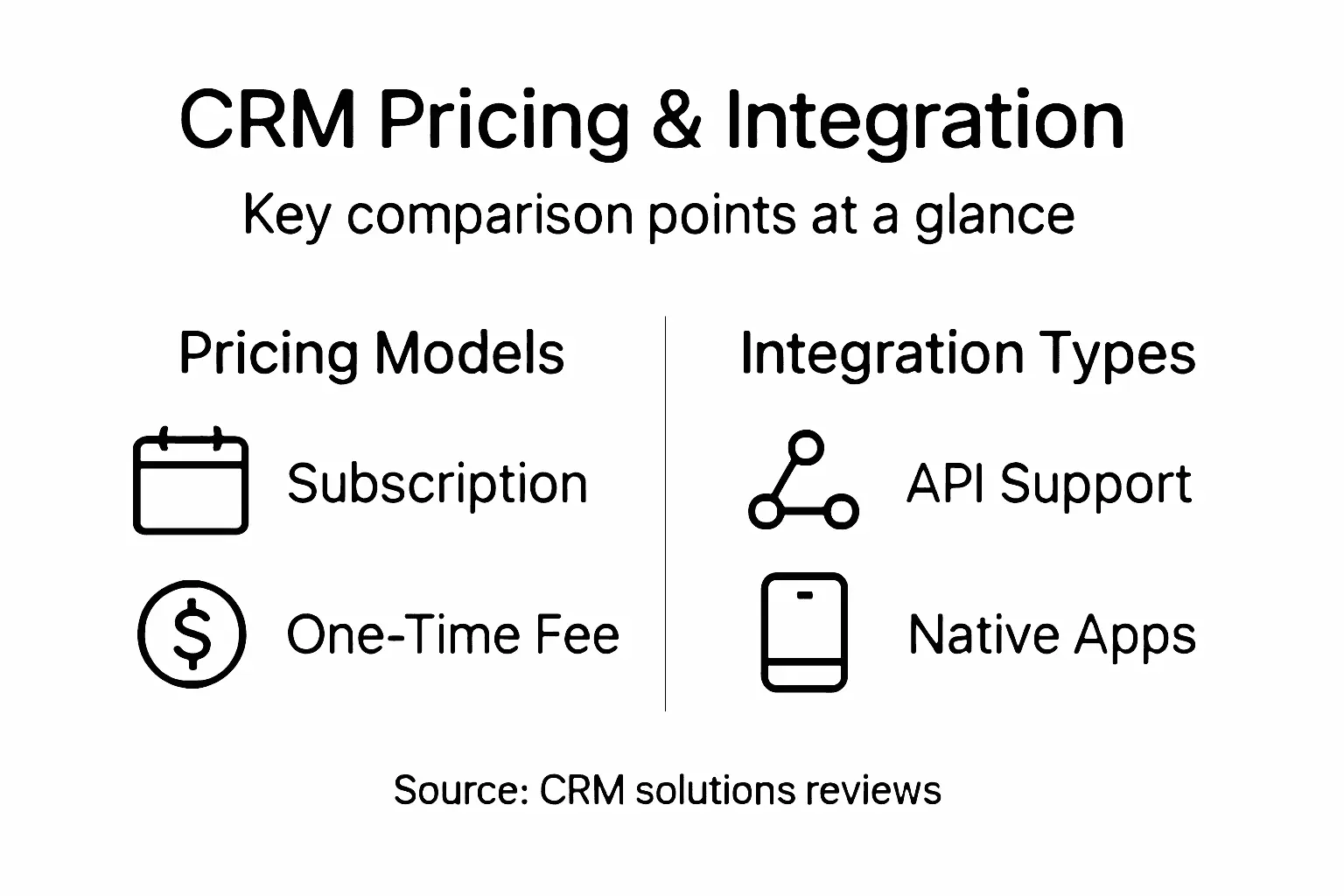
Pricing models for membership CRM solutions generally fall into several key categories:
The table below summarises CRM pricing models with their main advantages and best-fit situations:
| Pricing Model | Main Advantage | Best For |
|---|---|---|
| Per-User Pricing | Easy scalability as you grow | Smaller or expanding organisations |
| Flat-Rate Packages | Predictable budgeting | Large teams with many users |
| Modular Pricing | Customisable and flexible | Niche or evolving requirements |
- Per-User Pricing
- Fixed monthly rate per individual user
- Scalable for growing organisations
- Often includes tiered access levels
- Flat-Rate Packages
- Comprehensive solution with unlimited users
- Predictable monthly or annual costs
- Ideal for larger membership organisations
- Modular Pricing
- Pay only for required features
- Customisable to specific organisational needs
- Allows incremental system expansion
Integration capabilities represent another critical consideration for membership organisations. Modern CRM systems must seamlessly connect with existing technological ecosystems, including:
- Accounting software
- Event management platforms
- Learning management systems
- Payment processing gateways
- Email marketing tools
- Member communication platforms
Advanced CRM solutions now offer sophisticated integration frameworks that enable organisations to create unified, streamlined digital environments. These platforms eliminate manual data transfer, reduce administrative overhead, and provide comprehensive insights across multiple organisational functions.
Pro tip: Request detailed integration documentation and conduct thorough compatibility testing before finalising your CRM investment to ensure seamless technological alignment.
Common mistakes when choosing a CRM
Selecting the right Customer Relationship Management system requires careful consideration and strategic planning. Common CRM selection mistakes can significantly undermine an organisation’s operational effectiveness and long-term member engagement strategies.
Membership organisations frequently encounter several critical pitfalls during CRM selection:
- Strategic Planning Errors
- Failing to understand existing system limitations
- Neglecting long-term organisational scalability
- Overlooking specific membership management requirements
- Decision-Making Mistakes
- Excluding end-users from selection process
- Prioritising cost over functional fit
- Choosing generic, one-size-fits-all solutions
- Implementation Challenges
- Inadequate staff training
- Poor data migration strategies
- Insufficient system customisation
Organisational leaders must recognise that a CRM is more than just software—it’s a strategic tool for member relationship development. Successful implementation demands comprehensive understanding of organisational workflows, member interaction patterns, and technological integration capabilities.
Beyond technical considerations, cultural adoption represents a crucial factor in CRM success. Organisations must invest in comprehensive training programmes, create change management strategies, and demonstrate the tangible benefits of new technological systems to ensure user engagement and system effectiveness.
Pro tip: Conduct a thorough organisational needs assessment and involve key stakeholders from multiple departments before finalising your CRM selection to ensure comprehensive alignment.
Transform Your Membership Engagement with a Tailored CRM Solution
Struggling to find a CRM that truly understands the complexities of membership organisations? Managing multi-tier memberships, automating renewals, and delivering personalised communications are common hurdles. At Colossus Systems we know these pain points well and offer a comprehensive SaaS platform designed to streamline member management, event planning, and digital engagement all in one place. Our system’s flexibility lets you customise workflows and communication channels so you can build stronger, longer-lasting member relationships while saving time.
Take control of your organisation’s growth today by exploring how a specialised membership CRM can enhance engagement and simplify operations. Learn more about the power of understanding membership CRM with Colossus Systems. Ready to make a change that matters Contact us now at Colossus Systems Contact to discover how our platform can be tailored precisely for your needs and take your membership journey to the next level.
Frequently Asked Questions
What is CRM software for membership organisations?
CRM software for membership organisations is a specialised system designed to manage member relationships, streamline administrative processes, and enhance engagement strategies. It includes features like centralised member databases, automated communication workflows, and detailed reporting capabilities.
How does CRM software boost membership engagement?
CRM software boosts membership engagement by providing personalised communication, automated tracking of member activities, and deep insights into member behaviours. This enables organisations to create tailored experiences that enhance satisfaction and retention.
What types of CRM systems are most beneficial for membership organisations?
The most beneficial types of CRM systems for membership organisations include Operational CRM, which automates administrative tasks; Analytical CRM, which provides data insights; Collaborative CRM, which enhances team communication; and Strategic CRM, which focuses on long-term member relationships.
What should I consider when choosing a CRM for my membership organisation?
When choosing a CRM, consider factors such as the system’s features, integration capabilities, pricing models, and flexibility. It’s essential to assess your organisational needs and involve key stakeholders in the selection process to ensure the chosen CRM aligns with your goals.
Recommended
- Integrating Your Website into a Membership CRM to Enhance Engagement |CS
- Membership CRM | Colossus Systems
- Types of CRM Software: Driving Member Growth | Colossus Systems
- What Is a CRM System? Guide for Membership Groups 2025|CS
- CRM for Consultants: Streamlining Client Success
- 7 Effective Email Marketing Automation Examples for Creators