Types of CRM Software: Driving Member Growth

Managing member relationships often feels like juggling hundreds of moving parts, from event registrations to timely renewals. For many nonprofit marketing managers, keeping every detail organised and accessible under one roof is a constant challenge. CRM software acts as a powerful solution, serving as a single source of truth for all member data, communications, and analytics. Discover how a membership CRM system can transform engagement, simplify event coordination, and support growth for your organisation.
Table of Contents
- Defining CRM Software for Membership Groups
- Major Types of CRM Software Explained
- Top Features for Member Engagement
- Comparing CRM, AMS, and MMS Solutions
- Cost Implications and Common Pitfalls
Key Takeaways
| Point | Details |
|---|---|
| Understanding CRM Software | Membership CRM software centralises member interactions, enabling organisations to analyse and enhance engagement through comprehensive member profiles. |
| Types of CRM | Operational, analytical, and collaborative CRMs each serve specific purposes, from automating processes to providing insights and fostering cross-department communication. |
| Key Features for Engagement | Top CRM systems offer automated communications, advanced analytics, and personalisation tools to tailor member interactions and improve loyalty. |
| Cost Considerations | A thorough understanding of both direct and indirect costs, including hidden expenses related to implementation and maintenance, is essential for successful CRM adoption. |
Defining CRM Software for Membership Groups
CRM software represents a sophisticated digital strategy designed specifically to transform how membership organisations manage relationships with their members. At its core, a membership CRM system is a centralised platform that tracks, analyses, and enhances every interaction between an organisation and its members.
The fundamental purpose of CRM software for membership groups goes beyond simple contact management. Relationship management technologies enable organisations to create comprehensive member profiles, track engagement levels, and develop targeted communication strategies. These systems capture critical data points such as:
- Member contact information
- Membership history and renewal dates
- Event participation records
- Communication preferences
- Donation or purchase history
- Engagement metrics
Typically, membership CRM software functions as a digital nervous system for organisations, connecting disparate data sources and providing actionable insights. Unlike generic customer relationship platforms, these specialised systems are tailored to understand the nuanced dynamics of membership-based groups.
Constituent relationship management represents more than just technological infrastructure—it’s a strategic approach to understanding and nurturing member connections. Open source CRM solutions have particularly revolutionised how nonprofits and membership organisations approach relationship tracking, offering customisable tools that adapt to unique organisational needs.
Pro tip: Select a CRM system that offers robust integration capabilities and customisable reporting to maximise your organisation’s member engagement strategies.
Major Types of CRM Software Explained
CRM software for membership organisations typically falls into three primary categories, each serving distinct strategic purposes. Strategic customer relationship management approaches help organisations choose the most appropriate system based on their specific operational requirements and growth objectives.
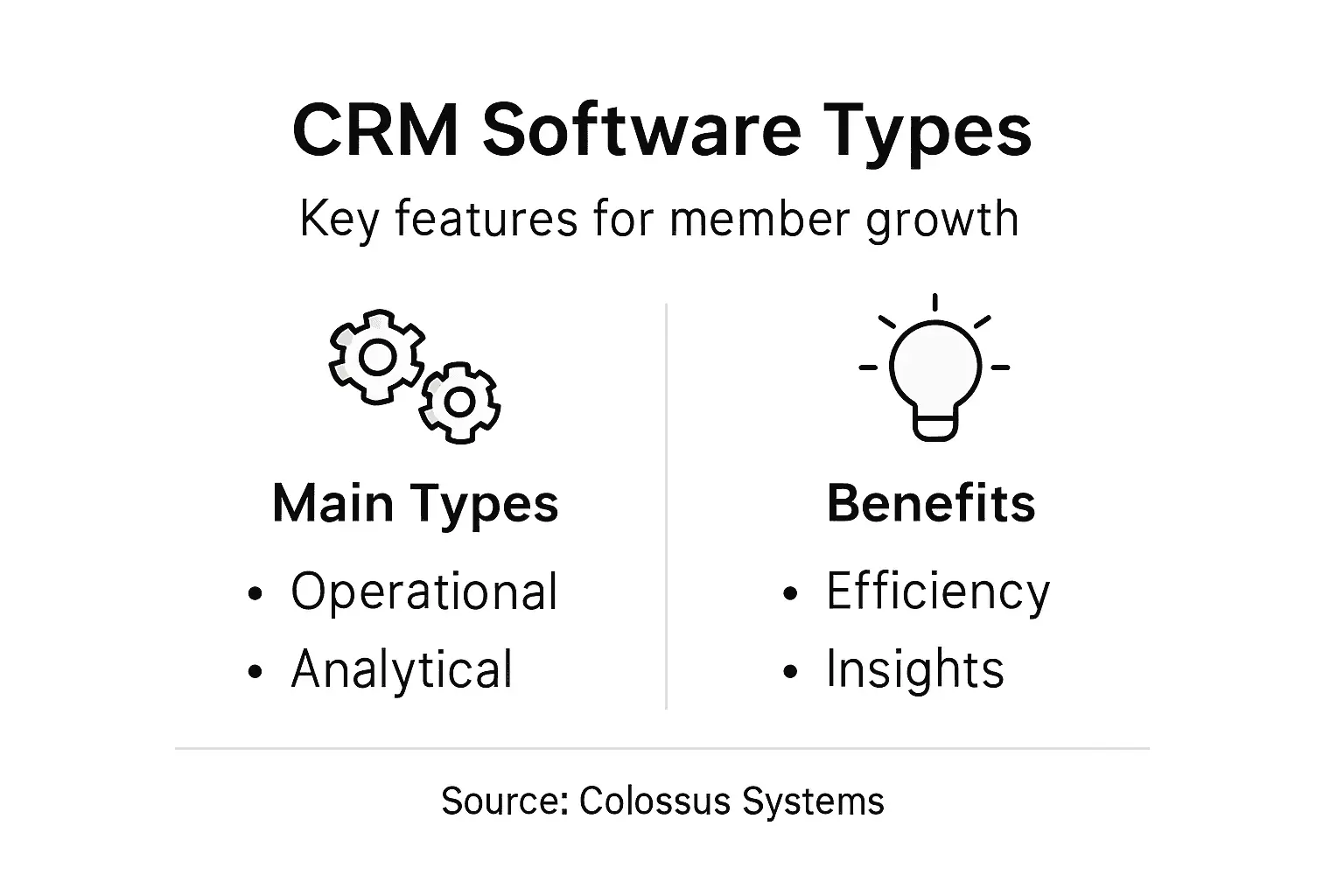
Operational CRM focuses on streamlining and automating critical business processes related to member interactions. Key features include:
- Automated membership renewal reminders
- Contact management systems
- Sales pipeline tracking
- Member communication workflows
- Service request management
- Event registration processes
In contrast, analytical CRM provides deep insights by transforming raw member data into actionable intelligence. This approach enables organisations to:
- Predict member retention patterns
- Identify engagement trends
- Segment members based on behaviour
- Develop targeted marketing strategies
- Forecast membership growth potential
- Understand member lifecycle dynamics
The third category, collaborative CRM, emphasises communication and information sharing across different organisational departments. This approach breaks down internal silos, ensuring that member interactions are consistent and comprehensive across marketing, finance, and membership services.
Different CRM types serve unique organisational needs, making it crucial to select a system that aligns with your specific membership management strategy.
Pro tip: Evaluate your organisation’s specific needs across operational, analytical, and collaborative dimensions before selecting a CRM system to ensure maximum effectiveness and member engagement.
Here’s how the main types of CRM software address key organisational needs:
| CRM Type | Primary Objective | Typical Use Case Example | Key Organisational Benefit |
|---|---|---|---|
| Operational CRM | Process automation | Membership renewal management | Increased efficiency |
| Analytical CRM | Data analysis for insight | Member segmentation and prediction | Improved decision-making |
| Collaborative CRM | Departmental information sharing | Unified cross-team communication | Consistent member experience |

Top Features for Member Engagement
Member engagement represents the cornerstone of successful membership organisations, and modern CRM software offers sophisticated tools to transform how groups interact with their members. Personalised member engagement platforms enable organisations to create meaningful, targeted connections that drive loyalty and participation.
Key features that distinguish top-tier member engagement CRM systems include:
- Automated Communication Workflows
- Personalised email sequences
- Targeted event invitations
- Renewal reminder systems
- Segmented communication channels
- Advanced Analytics Capabilities
- Real-time engagement tracking
- Member behaviour prediction
- Detailed interaction reporting
- Comprehensive member lifecycle insights
- Intelligent Personalisation Tools
- Dynamic content adaptation
- Individual member profiling
- Customised communication strategies
- Contextual interaction recommendations
The most effective CRM platforms go beyond simple data collection, transforming raw information into actionable insights. These systems use sophisticated algorithms to understand member preferences, anticipate needs, and create highly personalised engagement experiences.
Successful member engagement requires more than technology—it demands a strategic approach that treats each member as a unique individual with specific interests and motivations.
Artificial intelligence and machine learning are revolutionising member engagement by enabling unprecedented levels of personalisation and predictive interaction. Modern CRM systems can now anticipate member needs, recommend relevant content, and create seamless, contextually aware communication strategies.
Pro tip: Implement a comprehensive member feedback loop within your CRM system to continuously refine and improve your engagement strategies based on real-world interactions and member responses.
Comparing CRM, AMS, and MMS Solutions
Organisations seeking comprehensive member management face a complex landscape of technological solutions designed to streamline interactions and drive engagement. Management system technologies offer distinct approaches to tracking, supporting, and nurturing member relationships across different organisational contexts.
The primary distinctions between these systems emerge through their core functionalities:
Customer Relationship Management (CRM)
- Focuses on sales and marketing automation
- Emphasises external relationship building
- Integrates with multiple marketing tools
- Tracks comprehensive interaction histories
- Provides predictive analytics capabilities
Association Management System (AMS)
- Specialises in administrative association activities
- Manages comprehensive membership databases
- Handles event registrations and billing
- Supports financial transaction tracking
- Enables detailed reporting for organisational leadership
Membership Management System (MMS)
- Concentrates on membership lifecycle management
- Automates renewal processes
- Tracks member engagement metrics
- Provides targeted communication workflows
- Supports granular member segmentation
Successful member management requires selecting a system that aligns precisely with your organisation’s unique operational requirements and strategic objectives.
While these systems share overlapping functionalities, they differ significantly in depth and specialisation. Modern organisations often implement integrated solutions that combine features from multiple platforms to create a comprehensive member engagement strategy.
Pro tip: Conduct a detailed audit of your organisation’s specific membership management needs before selecting a system, ensuring you choose a solution that provides maximum flexibility and scalability.
The table below compares CRM, AMS, and MMS solutions for member management effectiveness:
| System Type | Core Focus | Best For | Limitation Compared to Others |
|---|---|---|---|
| CRM | Relationship management | Sales-driven organisations | Less detailed membership admin tools |
| AMS | Association administration | Large associations | Weaker marketing automation |
| MMS | Membership lifecycle | Small to medium membership groups | Limited event and transaction support |
Cost Implications and Common Pitfalls
Navigating the financial landscape of membership management software requires strategic planning and keen awareness of potential hidden expenses. CRM project implementation challenges extend far beyond initial licensing fees, demanding comprehensive financial and operational considerations.
The primary cost categories and potential pitfalls include:
Direct Financial Expenses
- Initial software licensing costs
- Implementation and setup fees
- Customisation and configuration expenses
- Training programme investments
- Ongoing technical support subscriptions
Indirect Cost Considerations
- Staff time invested in system learning
- Productivity disruptions during transition
- Potential data migration complexities
- Integration with existing technological infrastructure
- Potential requirement for additional hardware
Potential Implementation Risks
- Insufficient user adoption rates
- Poor data quality management
- Inadequate system integration
- Misalignment with organisational processes
- Underestimating total cost of ownership
Successful CRM investments require meticulous planning, clear goal-setting, and a holistic understanding of both immediate and long-term financial implications.
Organisations frequently underestimate the complexity of CRM system implementation, often encountering unexpected challenges that can significantly inflate initial budget projections. Careful, phased implementation strategies can help mitigate these financial risks and ensure more predictable investment outcomes.
Pro tip: Develop a comprehensive cost-benefit analysis that includes not just immediate expenses, but potential long-term efficiency gains and productivity improvements.
Unlock Seamless Member Growth with Tailored CRM Solutions
Understanding the types of CRM software is essential for any membership organisation striving to enhance engagement and streamline operations. This article highlights the challenges in choosing between operational, analytical, and collaborative CRM systems to meet your unique member management needs. Pain points such as managing complex membership lifecycles, automating communication workflows, and extracting actionable data insights show that a one-size-fits-all approach rarely works.
Colossus Systems offers a comprehensive SaaS platform designed to address these exact challenges. By integrating CRM functionalities with event planning, virtual training, email marketing, and e-commerce tools, our solution empowers you to grow your membership efficiently while delivering personalised experiences. The platform’s customisable sales pipelines and targeted communication channels ensure your organisation remains agile and member-focused.
Start transforming your member engagement strategy today. Discover how our unified system simplifies the complexities of membership management and delivers measurable results.
Harness proven technology to elevate your organisation’s growth. Connect with us now at https://colossus.systems/contact-us to explore a CRM solution that adapts to your operational goals and drives real member value. Find out how to integrate your membership workflows seamlessly and build stronger, lasting relationships. Visit Contact Us and take the first step towards smarter member management.
Frequently Asked Questions
What are the primary types of CRM software for membership organisations?
CRM software for membership organisations typically falls into three categories: Operational CRM, Analytical CRM, and Collaborative CRM. Each type serves distinct purposes, such as process automation, data analysis, and communication across departments.
How can Operational CRM benefit membership organisations?
Operational CRM focuses on streamlining processes related to member interactions, which can improve efficiency through features like automated membership renewal reminders, contact management systems, and communication workflows.
What role does Analytical CRM play in understanding member engagement?
Analytical CRM transforms raw member data into actionable insights, allowing organisations to predict retention patterns, identify engagement trends, and create targeted marketing strategies based on member behaviour.
Why is Collaborative CRM important for membership management?
Collaborative CRM emphasises the sharing of information across different organisational departments, ensuring that member interactions are consistent and comprehensive, which enhances the overall member experience.
Recommended
- What Is CRM In Marketing: Unlocking Member Growth | Colossus Systems
- Integrating Your Website into a Membership CRM to Enhance Engagement |CS
- Customer Service Relationship Management: Enhancing Member Engagement|CS
- What Is CRM Software? Examples for Member Groups | Colossus Systems
- Elevate Your Business: Boost Revenue & Team Productivity - Wurkn