Customer Service Relationship Management: Enhancing Member Engagement

Membership managers across North America often wrestle with building deeper connections while juggling administrative tasks. Strong member relationships are the backbone of any successful organisation. The growing focus on Customer Relationship Management (CRM) means you can use people, processes, and technology together to deliver tailored experiences that drive engagement. This article guides you through practical CRM strategies proven to help retain members and support real organisational growth.
Table of Contents
- Defining Customer Service Relationship Management
- Types Of CRM Solutions For Membership Groups
- Key Features And Functional Processes Explained
- Practical Benefits For Associations And Nonprofits
- Common Pitfalls And How To Avoid Them
Key Takeaways
| Point | Details |
|---|---|
| Holistic CRM Framework | CRM is a strategic approach that emphasises understanding and retaining members through integrated strategies across technology, processes, and people. |
| Diverse CRM Solutions | Membership organisations can choose from various CRM types, including Operational, Analytical, and Strategic CRM, to effectively meet their engagement needs. |
| Importance of Data Management | Effective CRM relies on robust data management processes to ensure accurate member information and enhance engagement strategies. |
| Avoiding Common Pitfalls | Organisations should proactively address CRM challenges, such as data quality and technological limitations, to ensure successful implementation and member satisfaction. |
Defining Customer Service Relationship Management
Customer Service Relationship Management (CRM) represents a sophisticated strategic approach that organisations use to manage interactions with current and potential members. CRM integrates comprehensive strategies across people, processes, and technology to enhance customer engagement and organisational performance.
At its core, CRM is not merely a technological solution but a holistic framework designed to understand, acquire, and retain members through targeted strategies. Key components of effective CRM include:
- Data collection and analysis
- Personalised communication channels
- Member lifecycle management
- Automated interaction tracking
- Performance measurement and insights
The evolution of CRM has transformed from basic contact management to a sophisticated system that leverages advanced analytics and intelligent automation. Member relationship management now goes beyond transactional interactions, focusing on creating meaningful, long-term connections that drive organisational growth and member satisfaction.
Professional membership organisations can utilise CRM to develop nuanced understanding of member behaviours, preferences, and engagement patterns. Strategic CRM approaches enable predictive insights that help organisations anticipate member needs and proactively design targeted engagement strategies.
Pro tip: Implement a centralised CRM system that integrates data across all member touchpoints to create a comprehensive, 360-degree view of member interactions and preferences.
Types Of CRM Solutions For Membership Groups
Membership organisations have diverse CRM solutions available, each designed to address specific operational needs and engagement strategies. CRM systems for membership groups range from basic contact management platforms to sophisticated, integrated engagement ecosystems that transform how organisations interact with their members.
These CRM solutions can be categorised into several key types:
- Operational CRM: Focuses on streamlining day-to-day interactions
- Member registration processes
- Event management
- Basic communication tracking
- Analytical CRM: Emphasises data-driven insights
- Member behaviour analysis
- Predictive engagement modelling
- Detailed performance reporting
- Strategic CRM: Aligns technological capabilities with long-term organisational objectives
- Personalised member journey mapping
- Retention strategy development
- Advanced segmentation techniques
Each CRM type offers unique advantages, enabling membership organisations to select solutions that precisely match their operational complexity and strategic goals. Membership growth strategies increasingly depend on choosing the right technological framework that supports nuanced, intelligent member interactions.
Here’s a summary comparing the main CRM approaches for membership organisations:
| Approach Type | Focus Area | Key Benefit | Typical Implementation |
|---|---|---|---|
| Operational CRM | Process automation | Streamlined daily operations | Automated member tasks |
| Analytical CRM | Data insights | Better engagement strategies | Advanced reporting |
| Strategic CRM | Long-term planning | Sustainable member growth | Customised journey mapping |
Modern CRM solutions have transcended traditional database management, evolving into intelligent platforms that integrate multiple communication channels, automate administrative tasks, and provide real-time insights into member preferences and engagement patterns.
Pro tip: Conduct a comprehensive audit of your organisation’s specific needs before selecting a CRM solution, ensuring the chosen platform offers scalability and seamless integration with existing operational systems.
Key Features And Functional Processes Explained
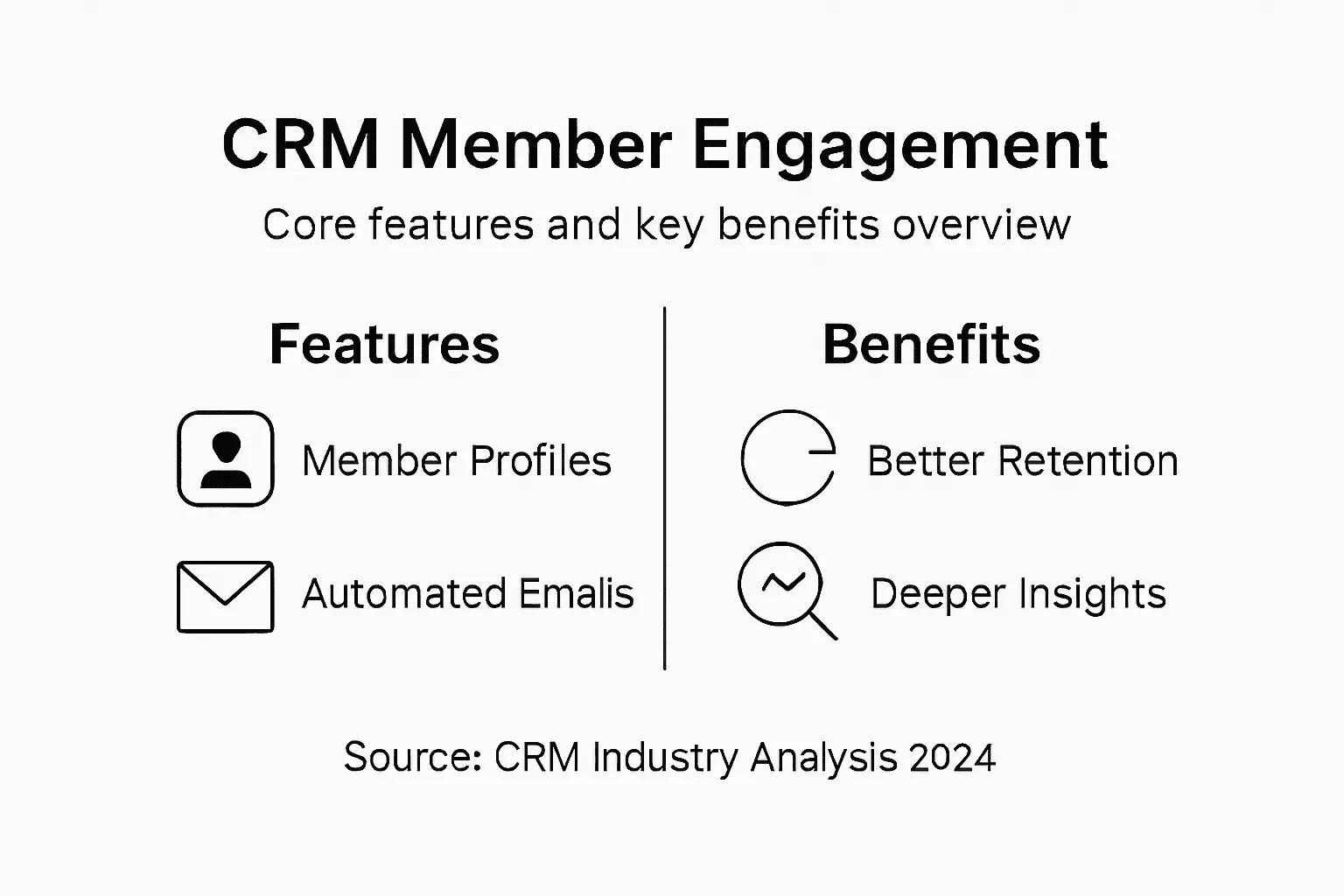
Customer Relationship Management (CRM) encompasses a comprehensive set of functional processes designed to transform member interactions and organisational performance. Strategic cross-functional processes enable membership organisations to develop sophisticated engagement strategies that go beyond traditional communication methods.
The key functional processes of an effective CRM system include:
- Data Management
- Member profile creation
- Contact information tracking
- Historical interaction logging
- Communication Processes
- Personalised communication channels
- Automated email workflows
- Multi-channel engagement strategies
- Analytics and Reporting
- Member behaviour tracking
- Engagement performance metrics
- Predictive interaction modelling
Customer relationship strategies fundamentally rely on integrating technological capabilities with human-centric approaches. Modern CRM systems combine advanced analytics, automation technologies, and nuanced communication techniques to create deeply personalised member experiences.
The most sophisticated CRM solutions transform raw data into actionable insights, enabling organisations to anticipate member needs, personalise interactions, and develop targeted engagement strategies that drive long-term membership value and organisational growth.
Pro tip: Implement continuous training programmes that help staff understand and leverage your CRM system’s full functional capabilities, ensuring maximum technological and human resource alignment.
Practical Benefits For Associations And Nonprofits
Nonprofit organisations and associations face unique challenges in managing complex stakeholder relationships, making Customer Relationship Management (CRM) systems increasingly critical. Nonprofit CRM strategies transform organisational capabilities by providing sophisticated tools for engagement and operational efficiency.
Key practical benefits for associations and nonprofits include:
- Donor Management
- Comprehensive donor profile tracking
- Personalised communication strategies
- Donation history and trend analysis
- Volunteer Coordination
- Streamlined volunteer recruitment
- Skills and availability tracking
- Automated scheduling and communication
- Fundraising Optimization
- Campaign performance monitoring
- Targeted outreach capabilities
- Predictive donation modelling
Centralized data management enables nonprofits to consolidate disparate information systems, reducing administrative overhead and creating more meaningful interactions with stakeholders. These technological solutions allow organisations to shift focus from manual data management to mission-critical activities.

Modern CRM platforms provide nonprofits with unprecedented insights into stakeholder behaviours, enabling more strategic decision-making, enhanced member engagement, and more efficient resource allocation across organisational objectives.
Pro tip: Conduct an annual review of your CRM system’s utilisation, identifying underused features and training opportunities to maximise your technological investment.
Common Pitfalls And How To Avoid Them
Customer Relationship Management (CRM) implementations can encounter significant challenges that undermine their effectiveness and organisational performance. CRM success requires understanding potential drawbacks and proactively developing strategies to mitigate risks.
Common CRM pitfalls organisations must navigate include:
- Data Quality Issues
- Incomplete member information
- Outdated contact details
- Inconsistent data entry practices
- Technological Limitations
- Poor system integration
- Inadequate user training
- Inflexible software configurations
- Strategic Misalignment
- Unclear implementation objectives
- Mismatched technological capabilities
- Lack of cross-departmental collaboration
Maintaining customer trust represents a critical consideration in avoiding CRM pitfalls. Organisations must prioritise transparency, fairness, and ethical data management to prevent perceived exploitation and maintain positive stakeholder relationships.
Successful CRM implementation demands a holistic approach that balances technological capabilities with human-centric strategies, ensuring that data-driven insights support rather than replace genuine relationship-building efforts.
Review common CRM challenges and corresponding solutions:
| Pitfall Category | Example Risk | Prevention Strategy |
|---|---|---|
| Data Quality | Inconsistent member records | Enforce clear data entry standards |
| Technological Limitations | Integration difficulties | Select adaptable software platforms |
| Strategic Misalignment | Unclear objectives | Prioritise cross-team collaboration |
Pro tip: Conduct regular audits of your CRM data and processes, establishing clear governance protocols that maintain data integrity and protect member privacy.
Transform Member Engagement with Colossus Systems
The article highlights the critical challenge of managing complex member relationships through effective Customer Service Relationship Management that combines data, personalised communication, and strategic processes. Membership organisations often struggle with disjointed data, lack of automation, and unclear engagement strategies that hinder growth and member satisfaction. Colossus Systems addresses these challenges by offering a fully customisable SaaS platform that centralises member management, automates event planning and communication, and leverages advanced analytics to create targeted, meaningful interactions that retain and expand your audience.
Experience the power of unified CRM tailored for membership organisations, associations, and nonprofits who want to move beyond basic contact management to strategic, data-driven growth. With features like integrated email marketing, secure payment gateways, and seamless member lifecycle tracking, your organisation can eliminate operational bottlenecks and foster long-term member loyalty.
Ready to elevate your member engagement and streamline your operations? Discover how Colossus Systems can help you put strategic CRM into action today. Visit our Contact Us page to get started or learn more about membership growth strategies and optimise your member relationships with a platform designed specifically for your unique needs.
Frequently Asked Questions
What is Customer Service Relationship Management (CRM)?
Customer Service Relationship Management (CRM) is a strategic approach that organisations use to manage interactions with current and potential members. It integrates strategies across people, processes, and technology to enhance customer engagement and organisational performance.
What are the different types of CRM solutions available for membership organisations?
Membership organisations can utilise several types of CRM solutions, including Operational CRM for day-to-day interactions, Analytical CRM for data insights and member behaviour analysis, and Strategic CRM for long-term planning and member growth strategies.
How can CRM enhance member engagement?
CRM enhances member engagement by enabling organisations to collect and analyse data about member behaviours, communicate through personalised channels, and manage the member lifecycle, resulting in more meaningful relationships and targeted engagement strategies.
What are the common pitfalls in implementing a CRM system, and how can they be avoided?
Common pitfalls in CRM implementation include data quality issues, technological limitations, and strategic misalignment. To avoid these, organizations should enforce clear data entry standards, select adaptable software solutions, and prioritise cross-departmental collaboration.