Competency-Based Education Explained: How It Works

Competency-based education (CBE) is a way of teaching and assessing in which learners progress by proving they can do something, not by sitting through a set number of hours. The unit of progress is a competency: a defined combination of knowledge, skills and behaviours that someone can demonstrate. If you can show it, you move on. If you cannot yet, you keep working at it with support until you can.
That sounds simple. Running it is not, and this guide covers both: what CBE means, how it differs from the course-and-credit model, how assessment works, where it struggles, and what an organisation needs in place before it starts.
TL;DR
- CBE organises learning around what a person knows and can do, not around time spent in a classroom or credit hours.
- Learners move at their own pace and are assessed against clear criteria, using evidence of performance rather than seat time.
- It is already familiar in the UK: English apprenticeships are built on an occupational competence model with an end-point assessment.
- The hard part is operational: redesigning systems, agreeing the competencies, and recording mastery without a traditional grade book.
- Start small, agree the competencies with your stakeholders first, and choose technology second.
Table of Contents
- What competency-based education means in plain terms
- How CBE differs from traditional, time-based learning
- Where you may already have met CBE in the UK
- The building blocks of a CBE programme
- How competencies are assessed
- The benefits, and the honest downsides
- What it takes to implement CBE
- Our perspective on CBE for membership organisations
- Supporting CBE with the right tools
- Choosing technology for a competency-based programme
- FAQ
- Sources
What competency-based education means in plain terms
The U.S. Department of Education describes CBE as an approach that organises academic content according to what a student knows and can do, which it calls a competency, rather than by time-based measures such as courses or credit hours. A report from the American Institutes for Research puts the same idea slightly differently: learning and completion are centred on clearly defined competencies, and learners must demonstrate what they know and can do.
A useful way to hold it in your head is to compare two ways of learning to drive. In a time-based model, you attend twenty hours of lessons and are then considered ready. In a competency-based model, you are ready when you can reverse park, handle a roundabout and read the road, however long that takes. Some people get there faster than expected. Others need extra practice on one specific skill, not a repeat of the whole course.
A competency is broader than a skill. The NCIEA report on assessing 21st-century competencies notes that the word captures more than skills, because competencies also draw on knowledge, beliefs, attitudes and behaviours. “Leads a team meeting effectively” is a competency. “Knows the agenda template” is only a piece of it.
How CBE differs from traditional, time-based learning
| Traditional model | Competency-based model | |
|---|---|---|
| Unit of progress | Course, term or credit hour | Demonstrated competency |
| Pace | Fixed for the whole cohort | Set by the learner |
| Time | Fixed, results vary | Variable, standard of mastery fixed |
| Assessment | Often end of module, graded | Ongoing, against stated criteria |
| Feedback | Mostly after the grade | Built into the process |
| Record of achievement | Grades and transcripts | Evidence of mastery per competency |
The central switch is that time becomes the variable and learning becomes the constant. In a traditional course, everyone gets the same time and ends up with different levels of understanding, which a grade then summarises. In CBE, the standard is fixed and the time varies.
Two models in practice
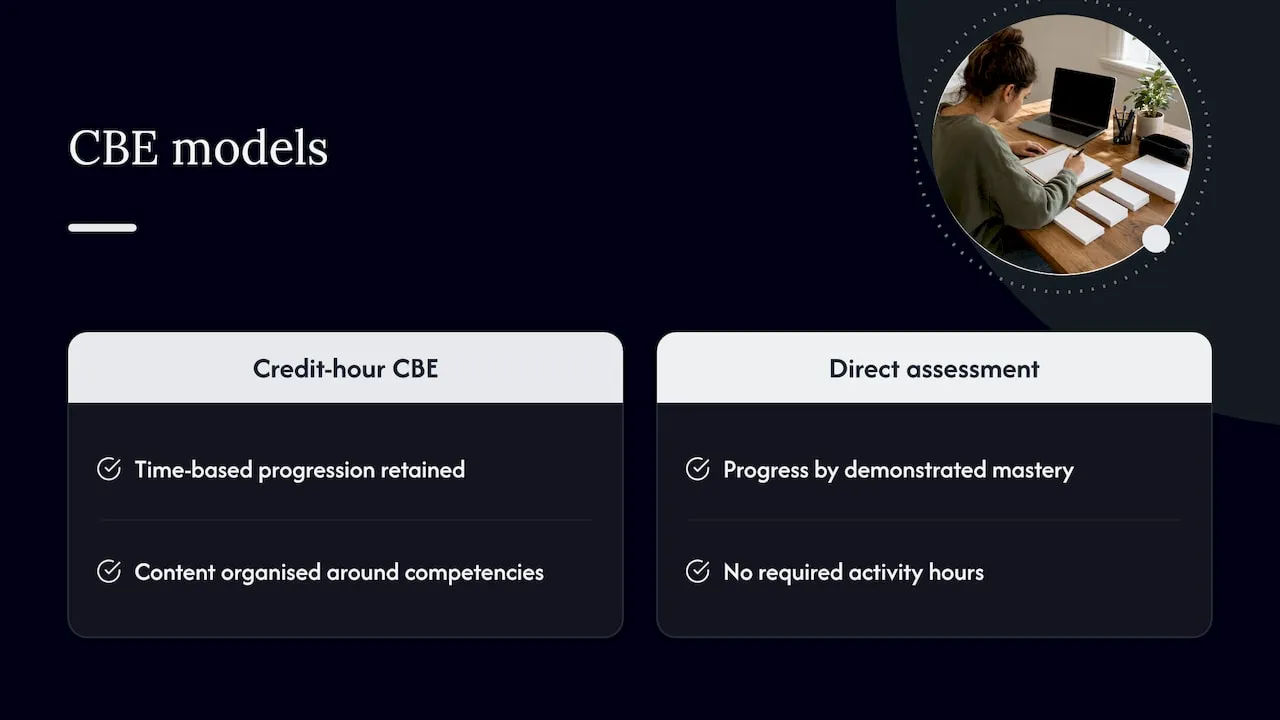
The U.S. Department of Education distinguishes two primary models. Credit-hour CBE keeps the traditional time-based structure for progression but organises content around competencies. Direct assessment measures progress solely through demonstrated mastery, without specifying required hours of educational activity. Those labels come from US federal financial aid rules, but the distinction is useful anywhere: some programmes bolt competencies onto an existing timetable, while others drop the timetable altogether.
The Department notes in its experimental sites guide that there are many types of CBE programme and no federal definition of these methods. Expect the term to mean slightly different things from one institution to the next.
Where you may already have met CBE in the UK
CBE is not a foreign import. Apprenticeships in England are a clear example. According to the SFIA Foundation, the English system moved after the 2012 Richard Review from being qualification-based to an occupational competence model. Every apprenticeship standard requires formal off-the-job training (20%), controlled practice in the workplace to develop skills and behaviours, and an end-point assessment.
Medical education offers another example. A commentary in the medical education literature reports that competency-based medical education is now entrenched in Canada, the United States and parts of Europe and the United Kingdom, and that it has attracted criticism as well as support.
Professional bodies use the same logic when they require members to evidence continuing professional development against a competency framework. If your organisation certifies or accredits people, you are probably closer to CBE than you think.
The building blocks of a CBE programme
Every working CBE programme, whatever its size, has the same core parts.
- Defined competencies. Clear statements of what a learner must be able to do, written so that two assessors would read them the same way.
- Performance criteria. What good looks like at each level, ideally with descriptive levels such as “sufficient” or “good”.
- Flexible learning routes. Content, coaching, practice and projects that learners can use at their own pace.
- Authentic assessment. Evidence from real or realistic tasks: portfolios, observed practice, projects, interviews.
- Feedback and reflection. Regular input, plus the learner’s own assessment of what they did and why.
- Records of mastery. A way to show which competencies a learner has achieved, and when, to the learner, the employer or the regulator.
The sixth is where many programmes stumble, and we return to it below.
How competencies are assessed
Assessment in CBE is judged against criteria, not against other learners. That has practical consequences.
Evidence, not explanations
Take the competency-based interview, one of the most common assessment formats. Radboud University’s guidance describes the STAR method (Situation, Task, Action, Result, sometimes with Reflection or Transfer added). It asks the person being assessed for specific, verifiable evidence of what they did rather than a general account of their abilities.
The University of Washington’s competency interviewing guide makes a related point about preparation: identify and define the essential competencies first, then write questions that correlate with them, and ask all candidates the same. The same discipline applies to any CBE assessment. Define first, assess second.
Calibrate your assessors
Radboud advises calibration sessions among assessors so they agree on performance levels, and descriptive judgements such as sufficient or good rather than numerical grades, which can give a misleading sense of precision. If you run a certification scheme, this is a cheap way to improve fairness before you spend anything on technology.
Avoid the precision paradox
The NCIEA report describes what it calls a precision paradox: organisations try to quantify complex qualities such as creativity or synthesis with an unjustified level of detail, which weakens the assessment’s validity. Reliable assessment needs a clear definition of what you are measuring and a willingness to accept qualitative judgement. Not everything worth learning fits a 0 to 100 scale.
The benefits, and the honest downsides
What CBE does well
- Relevance. Competencies are defined from what the work requires, so learning links directly to practice.
- Flexibility. Experienced learners do not repeat what they already know, and those who need longer are not rushed.
- Transparency. Learners see exactly what is expected and where they stand.
- Portable evidence. A record of demonstrated competencies tells an employer more than a course title does.
What makes it hard
The AIR report highlights significant operational challenges: a large redesign of administrative, academic and support systems, faculty resistance because workloads shift, and the lack of a universally shared theoretical framework, which can impede scaling. A study in the CBE journal makes a similar point: CBE is not simply a delivery mode, and it challenges long-held conventions about how curricula are created and how instruction is designed and delivered.
The medical education commentary cited earlier lists criticisms including the danger of reductionism, where complex professional judgement is chopped into checklists, and a perceived lack of evidence for the approach. It also argues that some concerns reflect unclear language rather than flaws in the idea. A fair reading: CBE works best when competencies are meaningful and assessed with judgement, and poorly when it becomes tick-box compliance.
Data matters too. Researchers examining the Tecnológico de Monterrey Tec21 model, published in Education Sciences, stress continuous analysis of how module designs relate to student performance. Without it, programmes can look sound on paper and still suffer dropout or uneven outcomes.
What it takes to implement CBE
Agree the competencies before you pick a platform
Practitioners quoted in the Wiley study find that the most overlooked step is building consensus among faculty, staff and leadership on which competencies will be measured, before choosing any technical platform or assessment tool. Skip it and you get fragmented implementations that struggle to scale.
Treat it as system change
AIR’s guidance is that leaders should treat CBE as a transformational change, not a delivery update. The organisations that succeed tend to have strong senior sponsorship that holds momentum over several years. If you are a trustee or chief executive reading this, that is the line to take to your board. Leadership capability matters here, and our guides on nonprofit leadership skills and management and leadership training programmes are a sensible place to start. For a longer-term view of leadership development, RELA’s curriculum is an example of a cohort-based leadership programme that pairs frameworks with structured modules.
Pilot with workarounds
AIR also found that programmes often begin as small, manually intensive pilots, with leaders deliberately using workarounds before investing in automated systems. This surfaces the awkward questions early, such as how to record mastery without a traditional grade book, before you commit to enterprise-level tooling.
A sensible sequence for a membership body or training provider:
- Pick one qualification or pathway and write five to ten competencies for it.
- Agree performance criteria with the people who will assess.
- Run a cohort using spreadsheets and shared folders.
- Calibrate assessors on sample evidence.
- Note every manual step that hurts. That list becomes your system requirements.
- Only then move to dedicated software.
Our perspective on CBE for membership organisations
We work with associations, nonprofits and educational bodies, and we see the same pattern. The idea behind CBE is rarely the obstacle. The obstacle is that the evidence of learning sits in five places: a learning platform, an events spreadsheet, an inbox, a payments system and somebody’s memory.

Our view is that a competency is only useful if you can see it. A member who completed a workshop in March, passed a practical assessment in June and renewed in September has a story, and your organisation should be able to read it in one place. That is why we build around a single record per member, with events, virtual training, CRM and payments connected, not bolted on.
We would also say, plainly, that software will not fix unclear competencies. If you cannot describe in a paragraph what “competent” means for your profession, no platform will do it for you. Do that work first, pilot manually, then automate what hurts. Our article on tracking student achievement for nonprofits looks at the tracking side in more detail.
— Rob
Supporting CBE with the right tools
Once your pilot shows what you need, a unified platform removes the manual work. Colossus brings membership management, events and virtual training and CRM into one system, with member and learner portals, analytics and online payments. That means attendance, assessments, renewals and communications all feed the same member record.
Plans on our pricing page start with Core at £349 per month, then Growth at £699 per month and Scale at £1299 per month. Enterprise starts from £2500 per month, and a contributor licence is available from £29 per month. If you want to see how the pieces fit, our features overview is the quickest route.
Choosing technology for a competency-based programme
Whatever you choose, test it against these questions.
- Can it hold a record per member of what they have achieved, not just what they attended?
- Can learners work at their own pace through a portal, with self-service access to their progress?
- Can assessors capture feedback and evidence consistently?
- Can you report on patterns, such as which modules correlate with drop-off?
- Does it connect to payments, events and communications so staff are not re-keying data?
- Can you change workflows as your competency framework matures?
The reporting question links back to the Tec21 research: continuous analysis is how you find out whether your design works. For wider planning, our guides to digital transformation for membership organisations and the nonprofit technology stack cover how the parts connect, and membership management basics is a good primer if you are starting from spreadsheets.
FAQ
What is competency-based education in simple terms?
It is education where you progress by showing you can do something, not by completing a set number of hours. The standard is fixed and the time it takes varies from person to person. Assessment checks your performance against clear criteria.
What are the downsides of competency-based education?
It demands a major redesign of administrative, academic and support systems, and staff workloads can change significantly, according to the AIR implementation report. Critics also warn of reductionism, where complex abilities are broken into checklists. Careful competency design, calibrated assessors and qualitative judgement help to manage both risks.
How do you pass a competency-based interview?
Answer with specific examples, not general claims. The STAR method (Situation, Task, Action, Result) is the standard structure, and the University of Washington guidance recommends questions tied to defined competencies. Adding what you learned, or what you would do differently, shows maturity and is often what interviewers probe for.
Is competency-based education the same as online learning?
No. CBE is about how progress is defined and assessed, and it can run in classrooms, workplaces or online. The Wiley study stresses that it is not simply a delivery mode. Technology can support it, but the competencies and assessment design come first.
Sources
- Direct Assessment (Competency-Based) Programs, U.S. Department of Education
- Competency-Based Education guide, U.S. Department of Education experimental sites
- Implementing Postsecondary Competency-Based Education, American Institutes for Research
- Assessing 21st Century Competencies, NCIEA
- Apprenticeship standards, England, SFIA Foundation
- Outcomes are what matter: Competency-based medical education
- Competency-based interview, Radboud University
- Competency interviewing, University of Washington
- Deconstructing competency-based education, Wiley
- Tec21 model study, Education Sciences (MDPI)