Effective student achievement tracking for nonprofits

TL;DR:
- Traditional grades only capture a snapshot, missing important factors like engagement and well-being.
- Nonprofits should utilize holistic tracking tools combining academic, engagement, and safety indicators.
- Moving beyond grades fosters meaningful conversations and long-term student growth.
Grades on a report card tell you where a student stands at a single moment in time. They rarely explain why a student is struggling, whether they feel safe enough to learn, or how engaged they are with the material. For nonprofit leaders managing education programmes, afterschool initiatives, or youth development services, this gap is significant. You are accountable to funders, boards, and the communities you serve, which means your tracking systems must go further than letter grades. This article covers the frameworks, tools, and strategies your organisation needs to build a tracking approach that genuinely reflects student growth.
Table of Contents
- Why student achievement tracking matters for nonprofits
- Core methodologies: From grading to growth dashboards
- Practical tools and platforms for nonprofit achievement tracking
- Solving common challenges: Fragmented data, bias, disengagement
- Measuring what matters: Outcomes, benchmarks and reporting
- Our perspective: Moving beyond grades to true growth
- Take your achievement tracking to the next level
- Frequently asked questions
Key Takeaways
| Point | Details |
|---|---|
| Track more than grades | Progress on engagement, safety, and belonging gives a truer assessment of student success. |
| Choose tools strategically | Prioritise dashboards and AI-powered systems that integrate with existing data and focus on key outcomes. |
| Address equity and ethics | Mitigate bias and ensure student data is collected securely and used for positive interventions. |
| Clear reporting matters | Transparent, outcome-focused reporting to stakeholders strengthens funding and trust. |
Why student achievement tracking matters for nonprofits
Grades have long been the shorthand for student success, but they capture only one dimension of a very complex picture. A student may score well on a test yet rarely attend sessions, feel disconnected from peers, or lack the confidence to ask for help. Conversely, a student with average marks might be showing remarkable growth in self-advocacy and attendance. Neither profile is fully visible through grades alone.
Nonprofits working in education sit in a unique position. You are not constrained by the same assessment structures as schools, which gives you the freedom to build richer tracking systems. However, that freedom also creates pressure to prove your impact in measurable terms. Funders want data. Boards want evidence. Students and families want to see progress. Meeting all three demands requires a broader set of indicators.
The outcomes nonprofits should prioritise typically fall into three categories:
- Academic progress: reading levels, maths fluency, course completion rates, and standardised assessment scores
- Engagement: session attendance, participation rates, programme retention, and self-reported motivation
- Safety and belonging: sense of connection to the programme, relationships with staff, and comfort seeking support
Nonprofits use practical tools such as pre and post surveys, attendance tracking, progress indicators, performance dashboards, and tapping existing school data for outcomes like sense of belonging, attendance, and academic achievement. These tools, used together, produce a far more accurate and actionable picture of student progress than any single grade could.
“Tracking engagement and belonging alongside academics is not supplementary work. It is foundational to understanding whether your programme is actually working.”
When nonprofits connect these three outcome areas, they are far better positioned to design timely, targeted interventions. A student flagged for declining attendance and lower engagement can be supported before their academic performance drops sharply. That is the power of holistic tracking, and it starts with planning engagement strategies from the very beginning of your programme design.
With this context in mind, let us break down the main approaches to tracking achievement in nonprofit settings.
Core methodologies: From grading to growth dashboards
Having overviewed the core need, we now compare the main tracking systems used in education and nonprofits. Understanding each method’s strengths and limitations helps you choose what fits your team’s capacity and your students’ needs.
Student achievement tracking methodologies include traditional point-based grading, standards-based grading (SBG) focusing on mastery of specific standards using 1 to 4 scales, competency-based systems, and analytics-driven tools like dashboards for growth metrics.
| Methodology | How it works | Strengths | Limitations |
|---|---|---|---|
| Point-based grading | Averages scores across all assignments | Familiar, simple to report | Obscures real skill gaps |
| Standards-based grading | Rates mastery of specific skills on a 1 to 4 scale | Precise, equity-focused | Risk of inconsistent implementation |
| Competency-based | Progress on demonstration of defined skills | Flexible pacing | Requires significant staff training |
| Dashboard analytics | Aggregates multi-source data into visual growth reports | Actionable, real-time insight | Needs data infrastructure |
Each methodology suits different contexts. Point-based systems are easy to explain to families, but they can mask genuine progress or decline. Standards-based grading offers remarkable specificity. You can see exactly which reading standard a student has mastered and which one still needs attention. However, SBG carries risks including potential grade inflation, inconsistent implementation across staff, no guaranteed improvement in standardised test scores, and an overemphasis on content standards without corresponding changes in pedagogy.
Competency-based systems work especially well for time management training and structured skill-building programmes where students progress at their own pace. Dashboard analytics, meanwhile, synthesise data from multiple sources into a single view, giving programme managers the clearest picture of trends.

Pro Tip: If you adopt SBG, invest in professional development for all staff before launch. Inconsistent scoring across team members is the most common reason SBG underperforms. Pair it with clear rubrics and regular calibration sessions to maintain reliability. You might also explore tools for student productivity that reinforce the skills you are tracking.
The most effective nonprofit programmes often combine methodologies: using SBG for academic skills, competency tracking for soft skills, and a dashboard to view everything together.
Practical tools and platforms for nonprofit achievement tracking
With the system options laid out, let us explore real tools and platforms nonprofits use to operationalise these methods. The good news is that many effective options are accessible to small and medium-sized teams without enterprise-level budgets.
Tools for tracking include Outstanda for weekly check-ins in literacy and maths, SAS EVAAS for predictive growth analytics, NWEA MAP Growth dashboards for national benchmarks, Beacon Learning LMS for competency-based reporting, and AI systems like College Possible’s Coach Possible for milestone tracking.
Here is a practical summary of these tools and their best-fit contexts:
| Tool | Primary function | Best for |
|---|---|---|
| Outstanda | Weekly literacy and maths check-ins | Small nonprofits with tutoring programmes |
| SAS EVAAS | Predictive growth analytics | Organisations with access to district data |
| NWEA MAP Growth | National benchmark dashboards | Programmes serving K-8 students |
| Beacon Learning LMS | Competency-based reporting | Workforce or skills development programmes |
| Coach Possible (AI) | Milestone and goal tracking | College access and transition programmes |
Predictive analytics tools, like SAS EVAAS, are particularly powerful for early intervention. Rather than waiting for a student to fall behind, these systems use existing data to flag who is most at risk before a crisis develops. Integrating these tools with your existing workflow does not need to be complicated. Follow this straightforward process:
- Audit your current data sources: Identify what data you already collect, such as attendance records, survey responses, and assessment scores.
- Choose a central platform: Select a dashboard tool that can ingest data from your existing sources, whether that is a learning management system or a CRM.
- Define your priority metrics: Limit your focus to three to five indicators that directly connect to your programme goals.
- Set review cycles: Schedule monthly data reviews with your team, not just end-of-year reporting.
- Train staff on interpretation: Data literacy matters as much as data collection. Ensure your team can read and act on the information presented.
Pro Tip: When evaluating tools, prioritise FERPA-compliant platforms that give families meaningful control over their student’s data. This is not only an ethical requirement but also builds the trust that strengthens your programme’s reputation. Explore free nonprofit software courses to build your team’s capacity, and consider how your tracking tools can connect with your event tracking and coordination systems for a more unified view. For broader infrastructure decisions, reviewing your organisational growth technology strategy is a sound starting point.
Solving common challenges: Fragmented data, bias, disengagement
Now, let us address the biggest pitfalls faced by nonprofits aiming for accurate, equitable tracking. Even the best-designed system can fail when implementation gaps undermine the data’s reliability or ethical integrity.
Early identification of at-risk students via multi-indicator early warning systems (EWS) that use attendance, grades, and behaviour together helps organisations respond proactively, while also surfacing issues like data fragmentation, bias in grading, student disengagement cycles, and the need for interventions that match individual risk profiles.
The most common challenges and how to address them:
- Fragmented data: Student information scattered across spreadsheets, paper forms, and separate software systems makes it nearly impossible to see the whole picture. Consolidate into a single platform or build a clear data-sharing protocol between tools.
- Grading bias: When staff apply standards inconsistently, the data becomes unreliable. Regular calibration sessions, where team members score the same student work and discuss differences, significantly reduce this problem.
- Disengagement cycles: Students who disengage are often the least visible in traditional reporting. Build engagement metrics into your standard tracking so that declining participation triggers a conversation, not just a note in a file.
- Misaligned interventions: A student flagged for low attendance needs a different response than one struggling with reading fluency. Use multi-indicator EWS to ensure your interventions match the actual risk profile rather than applying a one-size-fits-all solution.
“The danger of fragmented data is not just inefficiency. It is that students who need help most are the ones most likely to fall through the cracks.”
Your ethical data checklist should include: written consent from families, clear data retention policies, anonymised reporting wherever possible, and staff training on responsible data use. Review your data security basics to ensure your organisation’s protocols are sound.
Pro Tip: Create a simple one-page data governance document that every staff member signs and reviews annually. It makes expectations explicit and reduces the risk of accidental misuse.
Measuring what matters: Outcomes, benchmarks and reporting
With technical and ethical challenges addressed, we turn to what really drives meaningful progress, which is measuring and clearly reporting the right outcomes. This is where many nonprofits lose credibility with funders or boards, not because their work is poor, but because their reporting is unfocused.
Follow this step-by-step process for clear, credible outcome reporting:
- Select two to three primary outcomes: Fewer, sharper outcomes are far more compelling than a long list of loosely connected metrics. Choose outcomes that directly reflect your theory of change.
- Choose appropriate benchmarks: Use national standards where they exist, such as NWEA MAP Growth norms, and supplement with internal year-on-year comparisons for context.
- Create a reporting template: Build a one-page summary that shows baseline data, current status, and direction of change. Boards and funders respond to clarity.
- Schedule stakeholder updates: Share data with programme staff monthly, with board members quarterly, and with funders in alignment with grant reporting cycles.
- Include narrative context: Numbers alone rarely tell the full story. Pair each metric with a brief qualitative note that explains what the data means for real students.
The post-pandemic context makes this especially urgent. As of Spring 2024, students in the United States are approximately 0.5 grade levels behind pre-pandemic norms in maths and reading, chronic absenteeism rates reached 36 to 39 per cent in some districts, maths recovery is ongoing but reading progress has stalled, and NWEA dashboards are actively tracking K-8 recovery trends. For nonprofits serving students in similar contexts within the UK and beyond, these benchmarks offer important reference points when making the case for sustained investment in your work.
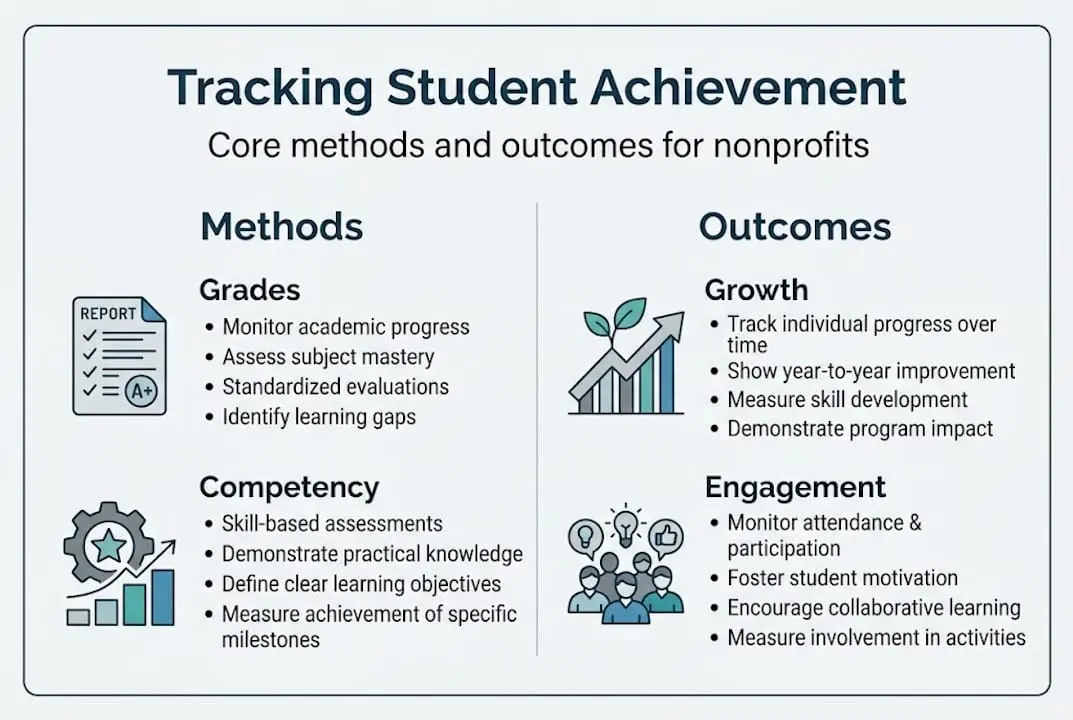
Focusing on two or three clear outcomes also builds your organisation’s credibility over time. Funders learn to trust organisations that consistently measure and honestly report on a defined set of results. Tools that support leveraging membership software for reporting can help you automate and standardise this process, saving significant staff time.
Our perspective: Moving beyond grades to true growth
Stepping back, let us share a perspective most leaders miss when building these systems. The organisations we see making the most meaningful impact are not those with the most sophisticated data tools. They are the ones who have made a deliberate decision to separate achievement from behaviour, to allow reassessment as a genuine learning tool, and to use data as the starting point for conversations rather than the end of them.
Tracking soft skills, such as persistence, collaboration, and self-regulation, matters as much as reading levels for long-term student success. Yet these dimensions are often the first to be dropped when teams feel pressed for time. That is a missed opportunity. When students help track their own progress through goal-setting tools or self-assessment activities, engagement increases because ownership increases.
Data becomes most powerful not in the report that goes to a funder but in the conversation between a tutor and a student on a Tuesday afternoon. We believe that strong deeper engagement strategies are inseparable from good data practices. When staff use tracking information to genuinely understand a student’s experience, rather than simply fulfilling a reporting obligation, outcomes improve for everyone.
Take your achievement tracking to the next level
Ready to simplify reporting and boost impact? Here is how Colossus Systems empowers leaders to apply what you have learned.
Managing achievement tracking, engagement data, and funder reporting across disconnected tools is exactly the kind of operational burden that slows nonprofits down. Our platform brings these functions together in one place, giving your team a clearer view of student progress and a more efficient path to meaningful reporting.
Our membership software features include integrated data management, automated reporting workflows, and secure CRM tools designed specifically for membership and nonprofit organisations. Whether you need to consolidate student data, automate progress reports, or build a system your funders can trust, our CRM tools for nonprofits are built to scale with your organisation’s needs. Contact our team today to explore a tailored solution for your programme.
Frequently asked questions
What is the difference between standards-based grading and traditional grading?
Standards-based grading measures mastery of specific skills using a limited scale, while traditional grading averages points across varied assignments regardless of which skills were demonstrated. SBG provides a clearer, skill-by-skill picture of where a student actually stands.
How can nonprofits track soft skill development in students?
Nonprofits use pre and post surveys and progress indicators alongside self-assessment tools to measure engagement, sense of belonging, and behavioural growth. Combining these with academic data gives a much fuller view of each student’s development.
What are early warning systems and how do they help?
Multi-indicator early warning systems combine attendance, grades, and behaviour data to identify at-risk students before they fall significantly behind, enabling timely, targeted support rather than reactive crisis management.
Which benchmarks are best for tracking academic recovery after the pandemic?
NWEA MAP Growth dashboards and district-level recovery data offer the most robust post-pandemic benchmark comparisons for K-8 students, tracking trends in maths and reading against pre-pandemic norms over time.