Team Member Onboarding: A Practical Guide for UK Teams

Good team member onboarding starts when the offer is accepted, not on day one, and continues for months afterwards. It is a planned sequence: preparation before arrival, a structured first day and week, regular check-ins through the first 90 days, and a review at three and six months. This guide sets out each stage, with a checklist you can copy and the UK legal basics every employer needs to get right.
TL;DR
- Onboarding runs from the accepted offer to the end of the first year, not just the first morning.
- Prepare before arrival: workspace, system access, a first-day plan and a buddy.
- In the UK, complete the right to work check before the person starts and give the principal statement of employment particulars on day one.
- Use a 30-60-90-day plan with at least weekly one-to-ones in the early months.
- Track progress in one place so nothing depends on one manager’s memory.
Table of Contents
- What team member onboarding is and why it matters
- The stages of onboarding at a glance
- Before they start: pre-boarding
- Day one: make it welcoming, not overwhelming
- The first week and first few weeks
- A team member onboarding checklist
- The 30-60-90-day plan
- Keeping onboarding on track with check-ins and reviews
- How long should onboarding last?
- Common onboarding mistakes and how to avoid them
- Our perspective
- Bringing your onboarding process into one platform
- FAQ
- Sources
What team member onboarding is and why it matters
Onboarding is the process of assimilating new people into the workplace and giving them the knowledge and tools to succeed. UC Davis describes it as a bridge between selection and productivity that runs from pre-arrival through the end of the first year. Done well, it builds positive working relationships and supports engagement, performance and retention.
The cost of getting it wrong is practical. The CIPD notes that effective induction helps new starters settle in, gives them the information they need to perform, and reduces the risk of early leavers and the costs that follow. SHRM reports that only 12 percent of employees felt their company did a great job with onboarding, and that those employees were nearly three times as likely to say they have the best possible job.
There is also a question of promises. Recruitment makes claims about the role, the culture and the support on offer. Onboarding is the first moment a new starter sees whether those claims hold up, which is why SHRM links it to the employee value proposition.

The same principles apply whether you run a high street business, a charity or a membership body. In a small organisation with a handful of staff and a rota of volunteers, a missing login or an unanswered question on day two is felt immediately.
The stages of onboarding at a glance
| Stage | When | Main aim | Owner |
|---|---|---|---|
| Pre-boarding | Offer accepted to day one | Remove surprises, build excitement | HR and line manager |
| Day one | First morning to close of play | Welcome, orient, set up | Line manager and buddy |
| First week | Days two to five | Required training, key relationships | Manager, buddy, colleagues |
| First 30 days | Weeks one to four | Learn the role and the organisation | Manager |
| 60 and 90 days | Months two and three | Apply knowledge, work more independently | Manager and employee |
| Reviews | Three and six months | Confirm progress, adjust support | Manager and HR |
Before they start: pre-boarding
Once the person has accepted, the University of Minnesota advises creating a tailored plan to move them into the role and team: keep in contact to build excitement, plan resources, and map out the policies and procedures they will need. The plan should fit their level and position, not a generic template.
The practical preparation list
UC Berkeley’s guidance covers the basics:
- Tell the team who is joining and when.
- Prepare interesting first-day tasks, not just paperwork.
- Get the workspace ready and arrange any passes or ID.
- Identify a buddy for the first week if you can.
Two to three days before arrival, UC Merced suggests contacting the new hire to confirm the date and time, directions, parking and entrance, dress code, lunch plans and any paperwork they need to bring. In the UK, add which documents you need for the right to work check.
Technology and access
A new starter without a laptop, email address or system login cannot do anything useful. UT Arlington’s checklist says to prepare the computer, software and any building or system access before the person arrives. Raise those requests as soon as the offer is accepted, because IT and facilities teams rarely turn things round in a day.
UK legal essentials
Two requirements deserve a fixed place in your process.
- Right to work check. The Home Office’s employer’s guide to right to work checks explains that all UK employers have a legal duty to prevent illegal working by carrying out checks before they employ someone. Follow the prescribed method in the guide so you keep your statutory excuse.
- Written statement of employment particulars. GOV.UK states that the employer must provide the principal statement on the first day of employment and the wider written statement within two months of the start. It is not the employment contract itself.
For anything specific to your contracts, pension enrolment or payroll, speak to your HR adviser or payroll provider.
Day one: make it welcoming, not overwhelming
The UC Davis first-day guidance suggests a morning greeting, such as a team breakfast, coffee break or tour, followed by a one-to-one meeting to review the role, the onboarding plan and key questions.
A workable day-one shape:
- Arrival: greet them in person or on video, and introduce the buddy.
- Mid-morning: walk through the plan for the week and what is expected by Friday.
- Lunch: with the team, so the first social contact is not forced.
- Afternoon: logins, equipment, and one small, genuine task.
- Close of play: a ten-minute check-in on how it went and what is unclear.
Keep the paperwork short. The principal statement and any forms should be handed over and explained, not left in a pile.
The role of the buddy
Columbia defines a buddy as a colleague other than the manager who advises the new employee and is their go-to person for questions about culture and how things work. That separation matters. New starters will ask a buddy things they would hesitate to ask a manager, such as where people actually eat lunch or whether it is acceptable to message the director directly.
Choose someone who is settled in the organisation, patient and has time. Tell them in advance what is expected, and give them a few hours of protected time that week.
The first week and first few weeks
The aim of the first week is orientation. UC Davis recommends focusing on required training, the purpose of the role, alignment with the organisation, core working relationships and informal check-ins. It also warns that the amount of information absorbed can be overwhelming, so keep check-ins light and offer help rather than testing recall.
Columbia suggests writing a first-week plan that lists the systems to learn, policies to review, people to meet and tasks to complete. A simple grid works well:
| Day | Learn | Meet | Do |
|---|---|---|---|
| Monday | Plan for the week, core systems | Team, buddy | Set up accounts |
| Tuesday | Key policies, health and safety | Manager one-to-one | First small task |
| Wednesday | Role processes | A key colleague in an adjacent team | Shadow a live task |
| Thursday | Customer or member context | Senior stakeholder | Complete required training |
| Friday | Review | Manager | Reflect on the week and agree week two |
Over the first few weeks, Cornell’s supervisor guide points to required training, introductions to key partners and stakeholders, and building a sense of belonging by showing how the role connects to the wider organisation.
A team member onboarding checklist
UT Arlington’s list of what a checklist should hold is a sound base: the mission and organisation chart, role expectations and job description, relevant policies, key contacts and a first-week schedule with meetings, training and check-ins. Emerson College adds that plans should balance technical skills, organisational information such as values and culture, and opportunities to build relationships.
Combined, and adapted for a UK employer, that gives you:
Before day one
- Right to work check completed as required before employment starts
- Contract and principal statement prepared
- Equipment, accounts and building access requested
- Team told, buddy confirmed
- Welcome message sent with arrival details
Day one and week one
- Principal statement given on the first day
- Tour, introductions and a team lunch
- Job description and expectations walked through
- Policies, key contacts and the organisation chart shared
- Required training scheduled
- First-week plan agreed, with informal check-ins diarised
First 90 days
- 30-60-90-day goals agreed in writing
- Weekly one-to-ones in the diary
- Wider written statement provided within two months
- Three- and six-month reviews booked
For a deeper look at structured checklists in a membership setting, our guide to onboarding new team members for membership officers goes through the tasks a small team should own.
The 30-60-90-day plan
The 30-60-90-day framework uses regular check-ins to review and adjust the plan as the employee moves from learning the role to applying what they know and working more independently.
A practical version:
- Days 1 to 30, learn: understand the organisation, people, systems and priorities. Goals are about knowledge and relationships, such as completing required training and meeting the key contacts.
- Days 31 to 60, contribute: take on real tasks with support. Goals are about delivering a defined piece of work and giving feedback on processes.
- Days 61 to 90, own: work more independently on their core responsibilities. Goals are about outcomes, and about agreeing development priorities for the next six months.
Write the goals down in the first week and share them with the new starter. Vague goals are the most common reason a 90-day plan fades into a conversation nobody remembers.
Keeping onboarding on track with check-ins and reviews
UC Davis recommends at least weekly one-to-ones during the first few months to clarify questions, address concerns and review progress against the 30-60-90-day plan. In those meetings, use open-ended questions and active listening to learn what the employee expects and to make your own expectations clear.
Plan the formal reviews on day one. UC Merced advises putting three-month and six-month probationary reviews in the diary from the start date. Cornell also suggests a thorough check-in in the first 90 days to assess how the new hire’s experience is going.
Some useful questions for those conversations:
- What has been clearer than you expected, and what less?
- Who have you found most helpful so far?
- What would help you do your best work next week?
- Is there anything about the role that differs from how it was described at interview?
Who is responsible?
Onboarding is not an HR task alone. Emerson College describes it as a community effort shared between HR, the manager, the new employee and their colleagues. Cornell adds that the manager has a critical role in equipping the person with the relationships and cultural understanding they need. Agree who owns each task in advance so that nothing sits in a gap between roles.
How long should onboarding last?
SHRM notes that onboarding can last one or two days at some organisations or extend to a series of activities of up to 12 months. UC Davis argues that the greatest return comes when onboarding is intentional, collaborative and managed across the first year as the employee grows into the job.
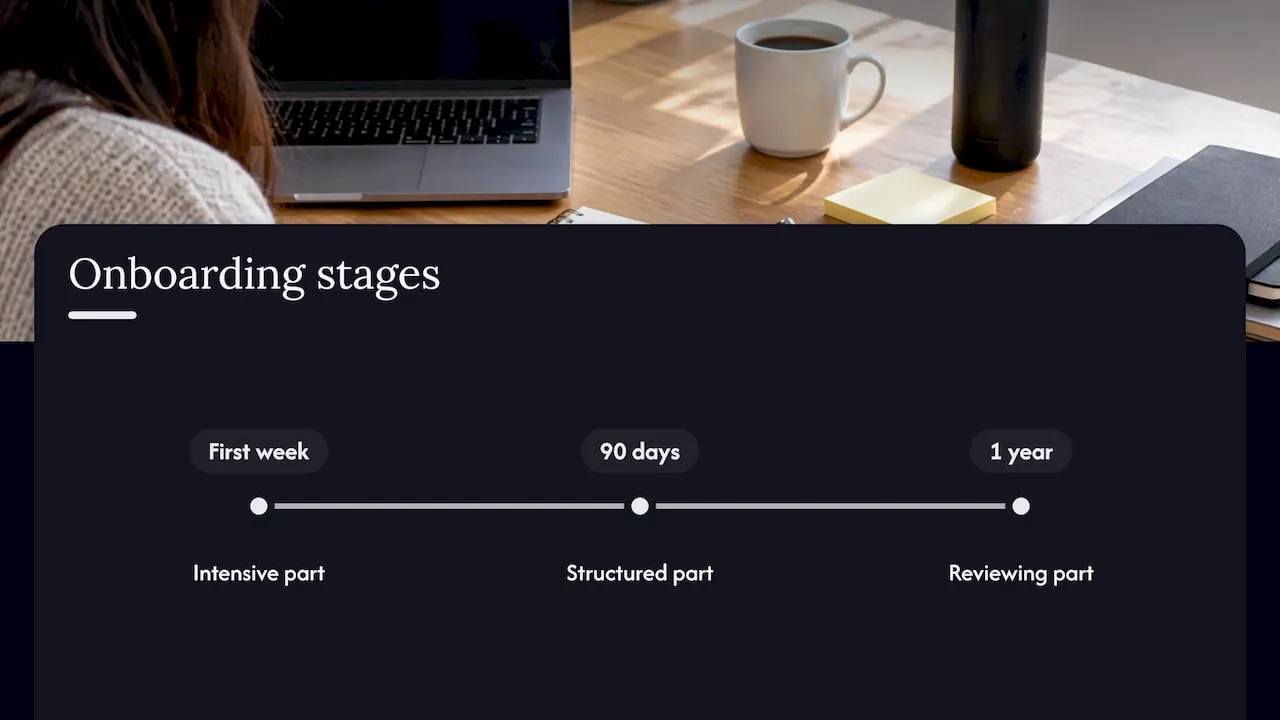
In practice: the intensive part is the first week, the structured part is the first 90 days, and the reviewing part runs until the one-year mark. Each stage needs less hand-holding than the one before, but none of them should be skipped.
The same logic holds if you bring in volunteers, committee members or trustees. A volunteer treasurer who starts without access to the accounts or a clear handover is in the same position as an employee without a login. If you are building a similar journey for people joining as members rather than staff, our guides to effective member onboarding and improving member onboarding show how the same principles carry across.
Common onboarding mistakes and how to avoid them
- Starting too late. If the first contact after the offer is the morning of day one, you have lost weeks of goodwill. Schedule a welcome message and a logistics email.
- Information overload. Spread training across the first weeks and keep the first week’s check-ins informal, as UC Davis advises.
- Everything depends on one manager. Use a buddy and a written plan so holidays and busy weeks do not leave the new starter unsupported.
- No written goals. Without a 30-60-90 plan, feedback becomes subjective.
- Forgetting the legal basics. Right to work checks before employment and the principal statement on day one are not optional steps.
- Treating onboarding as finished after a week. Book the three- and six-month reviews at the start.
If you coordinate cohorts of newcomers, for example student officers or volunteers who join in waves, this student organisation onboarding playbook shows how a staged approach carries a group from sign-up through to being productive.
Our perspective
Most onboarding problems we see in membership organisations are not about intent. They are about scattered information. The contract sits in one folder, the welcome email in someone’s inbox, the training dates in a spreadsheet and the member records in a separate system. A new colleague then has to learn the organisation and also learn where everything lives.
We built Colossus Systems to bring member management, events, CRM, email marketing, virtual training and reporting into one platform. For a team that is onboarding staff, volunteers or committee members, this means one place to give people access to the right records, schedule induction events and training, send timed welcome emails and see who has completed what. Our workflows are designed to be tailored to how each organisation actually works, so your onboarding plan is not forced into a generic template.
Our view is simple: the organisations that onboard well treat it as a repeatable process, not a favour done by whoever has time. A platform that makes the process visible makes it repeatable. You can read more in our own guide to new team member onboarding for membership organisations.
Rob
Bringing your onboarding process into one platform
If your organisation runs on memberships, events and a small team, you can use the same tools that manage your members to onboard the people who run the organisation. With Colossus Systems you can keep records in our membership management software, schedule induction sessions and training through our event management software, and track conversations and follow-ups in our CRM.

Published plans start at £349 per month for Core, £699 per month for Growth and £1299 per month for Scale, with Enterprise from £2500 per month. A Contributor licence is available from £29 per month. See the full breakdown on our pricing page, or explore the platform features to see what fits your team.
FAQ
What is the 30-60-90 rule for a new job?
It is a framework that divides the first three months into learning, contributing and working independently. Regular check-ins review and adjust the plan as the employee progresses, according to UC Davis. Write the goals for each stage down in the first week so both sides can see progress.
What should I do before a new team member’s first day?
Prepare their workspace, systems and access, plan some meaningful first-day tasks, tell the team and, if possible, name a buddy. Contact the new starter a few days before to confirm arrival details. In the UK, make sure the right to work check is completed before employment begins.
How long does onboarding take?
The intensive orientation is usually the first week, and structured support covers at least the first 90 days. SHRM says onboarding can stretch to as long as 12 months, depending on the organisation and the role.
When must I give a new employee their written statement?
In the UK, the principal statement must be provided on the first day of employment, and the wider written statement within two months, according to GOV.UK. Your HR adviser can confirm what each document must contain for your contracts.
Who is responsible for onboarding a new team member?
It is shared between HR, the line manager, the buddy, the new starter and their colleagues. The manager has the biggest influence on the experience, so agree in advance who owns each task on the checklist.
Sources
- Onboarding Introduction, UC Davis Human Resources
- Complete Employee Onboarding Guide, SHRM
- Employee induction, CIPD
- Planning New Employee Onboarding, University of Minnesota
- Before the Employee Arrives, UC Berkeley
- How to Plan for a New Team Member, UC Merced
- Onboarding, Columbia University Human Resources
- The First 90 Days, UC Davis
- Hiring Supervisor Guide to New Employee Orientation, Cornell University
- Onboarding Toolkit for Departments, UT Arlington
- Onboarding a New Team Member, Emerson College
- Employer’s guide to right to work checks, Home Office
- Written statement of employment particulars, GOV.UK