Onboarding new members effectively: a practical guide

TL;DR:
- Effective member onboarding focuses on building trust within the first 48 hours to enhance engagement and retention. It relies on automated tools, personalized messaging, and a simple checklist to guide new members toward their first meaningful action. Continuous measurement and iteration improve onboarding success and long-term community loyalty.
Onboarding new members effectively is the process of welcoming and integrating new members in a way that maximises engagement, retention, and perceived value from the very first day. The industry term for this is member onboarding, and it covers everything from the initial welcome email to the first meaningful action a member takes inside your community. Members decide within the first 48 hours whether joining was worthwhile. That window is your best opportunity to build trust, reduce early cancellations, and turn a new sign-up into an active, loyal participant. A well-designed member onboarding process uses membership management software, automated email sequences, and structured onboarding checklists to guide members from curiosity to commitment.
What tools support onboarding new members effectively?
The right tools determine whether your member onboarding process runs on autopilot or collapses under manual effort. Membership management software sits at the centre of any effective setup. It handles automated welcome sequences, member segmentation, profile management, and engagement tracking without requiring your team to intervene at every step.
Collecting the right data at sign-up is equally important. Segmented onboarding messaging that references a member’s stated goals and interests improves both clarity and connection. Ask members about their primary reason for joining and one goal they want to achieve. That information lets you route them to the most relevant resources immediately.
A dedicated onboarding hub, whether a member portal or a pinned resource page, gives new members a single place to find orientation materials, community guidelines, and their first tasks. Without a central hub, members scatter across your platform and lose momentum quickly.
| Tool | Primary role | Key benefit |
|---|---|---|
| Membership management software | Automates welcome sequences and tracks engagement | Reduces manual workload and speeds up first contact |
| CRM system | Stores member data and communication history | Enables personalised follow-up at scale |
| Onboarding checklist | Guides members through first actions step by step | Builds habit and reduces drop-off in early days |
| Member portal or hub | Centralises resources, events, and community access | Removes confusion about where to start |
| Email marketing tool | Delivers sequenced, targeted communications | Keeps members engaged between logins |
Key prerequisites before launching any onboarding programme:
- A defined member persona with clear goals and motivations
- A welcome email template ready to send within minutes of sign-up
- A short onboarding checklist covering the first 48 hours
- Segmentation rules set up in your CRM or membership platform
- A feedback mechanism to capture early member impressions
How to design a step-by-step member onboarding process
A structured onboarding flow moves new members from joining to their first meaningful action without overwhelming them. The goal is a single small win early. Onboarding that emphasises one early win increases stickiness far more reliably than sending a library of resources on day one.
The six-step onboarding email sequence
- Day 0: Welcome email. Send within minutes of sign-up. Confirm membership, set expectations, and give one clear next step. Link to the onboarding hub.
- Day 1: Orientation. Introduce the community’s purpose, key rules, and where to find help. Keep it to three bullet points maximum.
- Day 2: First action prompt. Ask the member to complete one task: fill in their profile, introduce themselves in a forum thread, or register for an upcoming event.
- Day 5: Value delivery. Share one resource directly relevant to the goal they stated at sign-up. This is where segmentation pays off.
- Day 10: Connection prompt. Introduce the member to a relevant sub-group, committee, or peer. Connection is a primary driver of retention.
- Day 14: Check-in. Ask a single question: “What has been most useful so far?” This signals that you care and surfaces early friction.
Designing the onboarding checklist
An effective onboarding checklist covers four stages: orientation, activation, connection, and return path. Orientation tells members where they are. Activation gets them to do something. Connection links them to people. The return path gives them a reason to come back.
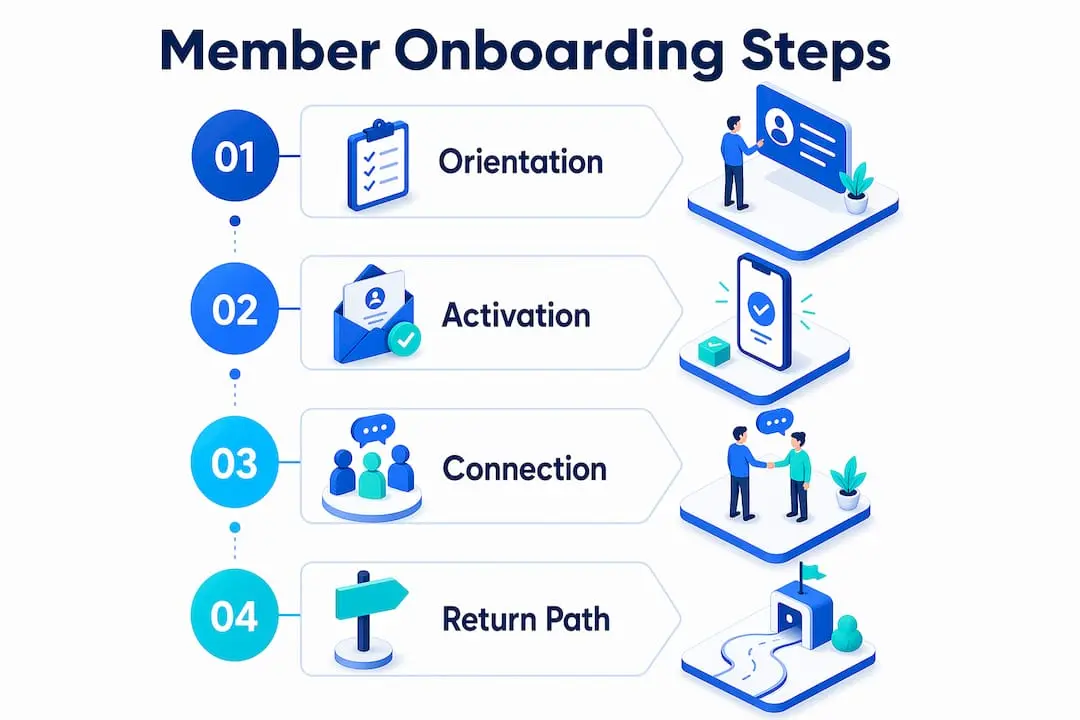
Keep the checklist to five items or fewer. Each item should take no more than five minutes to complete. A checklist with twelve steps is not an onboarding tool. It is a barrier.

Pro Tip: Display the checklist inside your member portal with a progress bar. Visual progress is a proven motivator. Members who see themselves at 60% complete are far more likely to finish than those who see a flat list with no indication of progress.
Personalisation sharpens every step. When a member tells you they joined to access professional development resources, your day-five email should link directly to your training library, not your general newsletter archive. Colossus supports this kind of segmentation natively, routing members to relevant content based on the data collected at sign-up.
What are common onboarding challenges and how do you avoid them?
The three most common reasons new members leave early are lack of connection, lack of engagement, and lack of consumption. These three factors are the leading causes of early churn, not information overload as many organisations assume. That distinction matters because it changes where you focus your effort.
Common onboarding problems and their fixes:
- Information overload. Sending ten resources in the first email signals enthusiasm but causes paralysis. Send one resource per email and save the rest for later in the sequence.
- Low profile completion rates. Long sign-up forms kill momentum. Deferring non-essential fields until after the initial sign-up excitement reduces friction and improves completion rates significantly.
- Passive members who never take a first action. Trigger an automated nudge at 72 hours if a member has not completed step one of the checklist. Keep the nudge short and friendly.
- No early warning system for churn. Track first post, first reply, and return visits rather than sign-up numbers. These predictive actions tell you far more about future retention than vanity metrics.
“If new members don’t know what to do in their first week, they will likely disengage permanently.” — Association onboarding best practices
Automation handles the mechanics, but personal outreach closes the gap that automation cannot. Direct personal contact with your first 100 new members builds foundational trust that automated emails simply cannot replicate. A short voice message or a personalised note from a real team member creates a connection that members remember.
Pro Tip: For your first 50 new members, send a brief personal video message from your community manager. Tools like Loom make this fast. Members who receive a personal video are significantly more likely to complete their onboarding checklist and attend their first event.
How do you measure and refine your onboarding programme?
Onboarding is a living programme, not a one-off setup task. Regular pulse surveys and optional interviews enable continual improvements that adapt to changing member behaviour. The organisations that improve retention year on year treat their onboarding process the same way a product team treats software: release, measure, iterate.
The 30, 60, 90-day review cycle
- 30-day check-in. Send a three-question pulse survey asking about first impressions, biggest challenge, and one thing that could be improved. Keep it under two minutes to complete.
- 60-day review. Analyse engagement data: login frequency, checklist completion rate, event attendance, and forum activity. Identify where members are dropping off.
- 90-day assessment. Compare retention rates against your pre-onboarding baseline. Interview three to five members who disengaged early to understand why.
Key metrics to track
| Metric | What it measures | Why it matters |
|---|---|---|
| Checklist completion rate | Percentage of members finishing onboarding steps | Predicts early engagement and habit formation |
| Time to first action | Hours between sign-up and first meaningful activity | Lower is better; signals a clear, frictionless path |
| 90-day retention rate | Members still active after three months | The primary indicator of onboarding effectiveness |
| Event attendance rate | New members attending first event within 30 days | Connection is the strongest retention driver |
| Survey response rate | Percentage completing feedback surveys | Low rates signal disengagement or poor survey timing |
Segment your survey responses by member type, joining reason, and activity level. A professional association member who joined for networking has different friction points than a volunteer who joined for training access. Treating all feedback as one pool produces generic improvements that help nobody specifically.
Pro Tip: Test one change at a time. If you rewrite your welcome email and redesign your checklist simultaneously, you cannot know which change drove any improvement. Isolate variables and run each change for at least 30 days before drawing conclusions.
What I have learned from leading onboarding programmes
After working with membership organisations of all sizes, the pattern is consistent: the organisations with the highest retention rates are not the ones with the most sophisticated onboarding technology. They are the ones that make new members feel seen within the first 48 hours.
The biggest mistake I see repeatedly is the assumption that more information equals more value. A new member who receives a 12-page welcome pack and links to 20 resources does not feel welcomed. They feel assessed. Strip your onboarding down to the single most important action you want a member to take, and build everything else around that.
Technology is an enabler, not a replacement for human connection. Automated sequences save time and maintain consistency, but they cannot replicate the feeling of a real person reaching out. The organisations I have seen retain members most effectively combine automated sequences with personal touchpoints at key moments, particularly in the first two weeks.
The final lesson is about iteration. Most organisations design an onboarding programme, launch it, and leave it untouched for two years. Member behaviour changes. Your community evolves. Your onboarding process should reflect that. Build a quarterly review into your calendar and treat every piece of member feedback as a signal worth acting on. The member retention strategies that work long term are always the ones built on genuine listening.
— Rob
How Colossus supports your member onboarding process
Effective member onboarding requires the right infrastructure behind it. Colossus brings together the tools that make a structured onboarding programme possible at scale: automated email sequences, member segmentation, CRM, event invitations, and engagement tracking, all within a single platform.
Organisations using Colossus can configure personalised onboarding journeys based on member type, goals, and activity data collected at sign-up. The platform’s membership management features support automated check-ins, checklist delivery, and early churn signals, so your team spends less time chasing members and more time building community. For organisations that use events as a connection tool, Colossus also offers dedicated event management tools to invite and engage new members from day one. Speak to the Colossus team to see how the platform fits your onboarding process.
Key takeaways
Onboarding new members effectively requires a structured, personalised process that delivers one clear early win within the first 48 hours and builds connection before it builds content.
| Point | Details |
|---|---|
| Act within 48 hours | Send a welcome message and checklist immediately; members judge value within the first two days. |
| Prioritise connection over content | Lack of connection is the leading cause of early churn, not lack of information. |
| Keep checklists short | Limit onboarding checklists to five steps; each step should take under five minutes to complete. |
| Measure predictive actions | Track first post, first reply, and return visits rather than sign-up numbers alone. |
| Treat onboarding as ongoing | Run 30, 60, and 90-day reviews and test one change at a time to drive continuous improvement. |
FAQ
What is member onboarding?
Member onboarding is the structured process of welcoming new members and guiding them to their first meaningful actions within a community or organisation. It typically includes a welcome email, an onboarding checklist, and a sequenced follow-up series.
How long should a member onboarding process last?
The most critical period is the first 14 days, but a full onboarding programme typically runs for 90 days. The first 48 hours are the highest-risk window for early cancellation.
What should a membership onboarding checklist include?
An effective membership onboarding checklist covers four stages: orientation, activation, connection, and a return path. Keep it to five items or fewer to avoid overwhelming new members.
Why do new members disengage early?
Early churn is caused primarily by lack of connection, engagement, and consumption during the onboarding period. Members who do not make a connection or take a first action within their first week are at high risk of leaving permanently.
How do you measure onboarding effectiveness?
Track checklist completion rate, time to first action, 90-day retention rate, and event attendance within the first 30 days. Avoid relying on sign-up numbers alone, as these are vanity metrics that do not predict long-term retention.