Master the member onboarding process for higher retention

Over half of associations in 2026 are struggling with flat or declining retention, despite investing in member benefits and engagement programmes. The culprit isn’t always weak offerings, it’s how you introduce new members to your organisation. A poorly executed onboarding process leaves members confused about value, disconnected from your community, and likely to abandon ship before their first renewal. This guide reveals evidence-based strategies to transform your member onboarding into a retention powerhouse, addressing the specific challenges membership managers face when trying to build lasting engagement from day one.
Table of Contents
- Why Member Onboarding Is Critical For Retention
- Common Pitfalls In Onboarding And Their Impact
- Designing An Effective Member Onboarding Process
- Measuring And Refining Onboarding For Ongoing Success
- Discover Tools To Enhance Your Member Onboarding
- FAQ
Key takeaways
| Point | Details |
|---|---|
| Retention crisis affects most associations | Over 55% of associations face flat or declining retention rates in 2026 |
| Onboarding shapes member perception | First impressions during onboarding determine whether members see value and stay engaged |
| Personalisation drives connection | Tailored onboarding by member segment significantly improves engagement and renewal rates |
| Measurement enables improvement | Tracking cohort-specific metrics reveals friction points and guides iterative refinement |
| Technology streamlines delivery | Software platforms automate personalised communications and simplify onboarding management |
Why member onboarding is critical for retention
The membership landscape in 2026 presents a sobering reality. Research shows that 55% of associations face flat or declining retention due to weak value propositions, with only 11% offering truly compelling reasons for members to stay. This isn’t simply about benefits packages or pricing structures. The gap between what organisations offer and what members perceive stems largely from how you introduce new members to your community.
Your onboarding process creates the foundation for every member relationship. During those critical first weeks, new members form lasting impressions about whether your organisation understands their needs, delivers tangible value, and deserves their continued investment. Poor onboarding fails to establish these connections, leaving members adrift without clear pathways to engagement or understanding of exclusive benefits.
Consider what happens when onboarding falls short:
- Members struggle to identify relevant benefits amongst generic communications
- Early engagement opportunities pass unnoticed, preventing relationship building
- Value perception remains low because members don’t understand how to leverage resources
- Personal connections never form, reducing emotional investment in the community
These failures compound quickly. Members who don’t engage within their first 90 days rarely become active participants later. They view membership as a transactional expense rather than a valuable investment, making them prime candidates for attrition at renewal time. Effective membership retention ideas start with getting onboarding right.
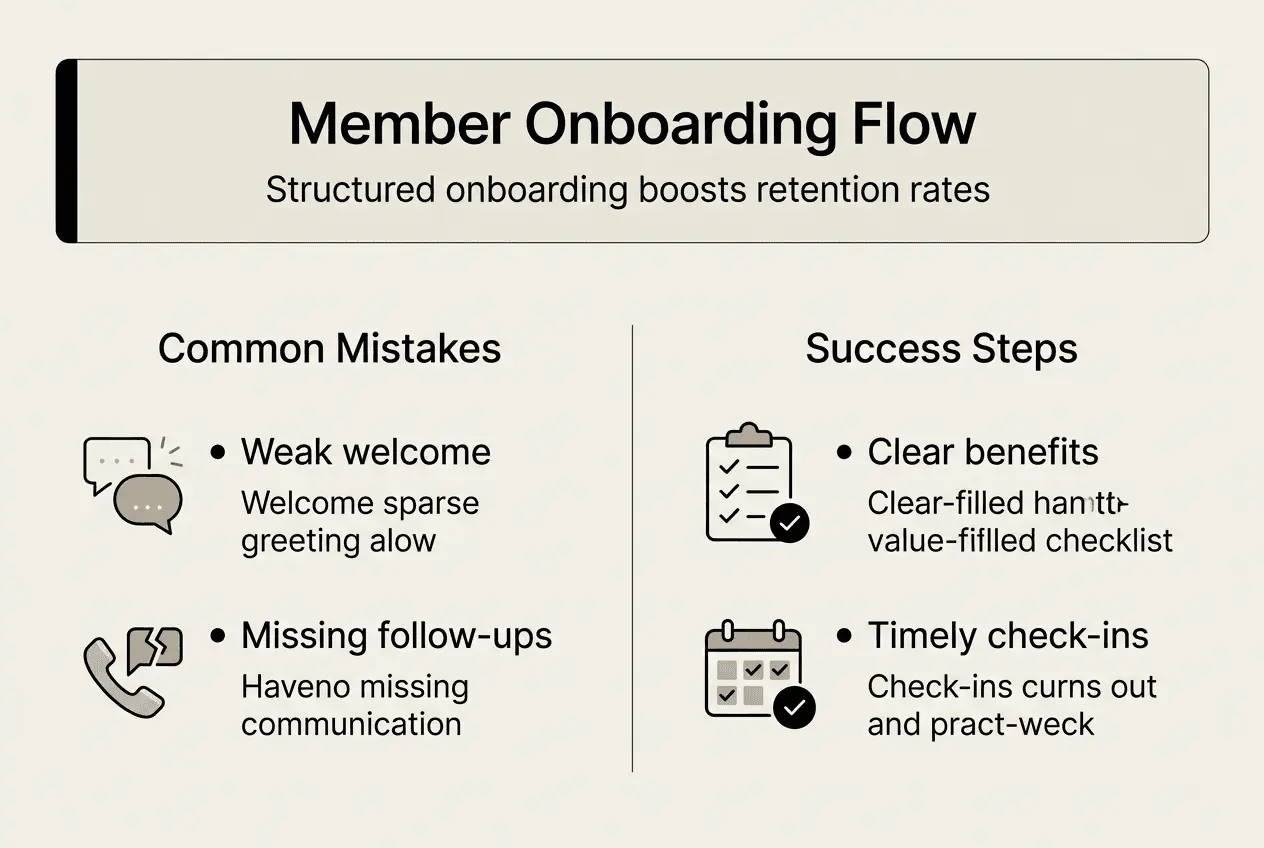
The alternative transforms outcomes. Structured onboarding establishes clear expectations about member benefits, creates multiple touchpoints for early engagement, and demonstrates your organisation’s commitment to individual member success. When members understand what they’ve gained and how to access it, renewal becomes the obvious choice rather than a questioned expense.
Pro Tip: Map your current member journey from signup through day 90. Identify every communication touchpoint and ask whether it clarifies value or creates confusion. Most organisations discover significant gaps where members receive no guidance during critical decision windows.
Common pitfalls in onboarding and their impact
Membership managers often assume that sending a welcome email and granting portal access constitutes adequate onboarding. This assumption costs organisations thousands in lost renewals annually. Research into association membership strategies reveals that members consistently cite weak cost-to-value ratios and lack of personal connection as primary reasons for non-renewal, both directly tied to onboarding failures.
The most damaging mistakes share a common thread: they treat all members identically despite vastly different needs and expectations. A newly qualified professional joining your association has completely different priorities than a senior practitioner or academic researcher. Generic onboarding messages fail to speak to any of these groups effectively, resulting in mass disengagement.
Here are the specific pitfalls undermining your retention efforts:
-
Overwhelming information dumps: Sending comprehensive guides covering every benefit and resource in the first email paralyses new members rather than guiding them. They don’t know where to start, so they start nowhere.
-
Invisible exclusive benefits: Members can’t value what they don’t know exists. Burying premium resources in general newsletters means most members never discover the offerings that would justify their investment.
-
Missing personalisation: Using first names in email templates isn’t personalisation. True personalisation connects members with resources, events, and community members relevant to their specific professional context and goals.
-
Delayed engagement invitations: Waiting until members are “settled in” before inviting them to events or committees wastes the enthusiasm window. New members are most receptive to involvement immediately after joining.
-
One-way communication: Onboarding that broadcasts information without soliciting feedback creates passive relationships. Members need opportunities to share their goals and challenges so you can demonstrate responsiveness.
These mistakes compound member uncertainty about value. When members can’t articulate what they’ve gained from membership, they won’t renew. The onboarding new members guide addresses these challenges with practical frameworks for engagement.
Pro Tip: Survey members who didn’t renew about their onboarding experience. You’ll likely discover they never engaged with your most valuable offerings simply because they didn’t know those offerings existed or how to access them.
Designing an effective member onboarding process
Building onboarding that drives retention requires moving beyond generic welcome sequences to structured, segmented journeys that address specific member needs. Evidence from association membership research demonstrates that attrition causes and unmet needs differ across professional segments, making segmentation essential rather than optional.

Start by identifying your primary member segments. Most organisations can effectively group members by career stage, professional role, or engagement goals. Each segment needs tailored messaging that speaks directly to their priorities and highlights relevant benefits.
Your onboarding framework should include these essential elements:
-
Welcome sequence with clear next steps: Send a focused welcome message within 24 hours highlighting three specific actions members should take immediately, such as completing their profile, joining a relevant community group, and registering for an upcoming event.
-
Benefit education across multiple touchpoints: Don’t explain everything at once. Space benefit introductions across weeks two through eight, focusing each message on one category of value with specific examples and access instructions.
-
Early engagement opportunities: Invite new members to low-commitment activities like webinars or online discussions within their first week. These create initial connections without overwhelming busy professionals.
-
Personalised resource recommendations: Use member profile data to suggest specific resources, training modules, or networking connections that align with stated professional goals and challenges.
-
Check-in communications: Schedule automated messages at days 14, 30, 60, and 90 asking members about their experience and offering assistance. These demonstrate ongoing support and catch problems before they become reasons for non-renewal.
The table below outlines key onboarding elements tailored by member segment:
| Segment | Priority Benefits | Engagement Focus | Communication Frequency |
|---|---|---|---|
| Early Career | Training resources, mentorship, job boards | Skill development events | Weekly first month |
| Mid Career | Networking, leadership opportunities, research | Committee involvement | Bi-weekly first quarter |
| Senior Practitioners | Recognition, speaking opportunities, influence | Advisory roles, thought leadership | Monthly first quarter |
| Academic/Research | Publications, grants, collaboration | Research networks, conferences | Bi-weekly first quarter |
Technology platforms enable this level of personalisation at scale. Modern membership management systems can automate segmented communications, track engagement patterns, and trigger follow-up based on member behaviour. This ensures no member falls through gaps whilst reducing manual workload for your team. Effective membership recruitment and retention strategies leverage these tools to maintain consistent member experiences.
Consider adding value-specific touchpoints that directly address common member needs. For instance, if your research shows members value career advancement, highlight your job board integration early in onboarding with concrete examples of positions members have secured through your platform.
Pro Tip: Create a 90-day onboarding calendar that maps every communication, invitation, and touchpoint. Review this calendar quarterly, removing messages that don’t drive engagement and adding new touchpoints based on member feedback about what they wish they’d known sooner.
Measuring and refining onboarding for ongoing success
Even well-designed onboarding requires continuous measurement and refinement. Member expectations evolve, professional contexts shift, and what worked brilliantly last year may fall flat today. Organisations that treat onboarding as a fixed process rather than an iterative system leave renewal rates on the table.
The most critical metric is cohort-based renewal rate. Track what percentage of members who joined in each quarter renew their membership. Compare these rates across cohorts to identify whether onboarding changes improved or harmed retention. Research demonstrates that renewal rates can drop by 10 to 16 points when onboarding fails to address member segment needs, making this measurement essential.
Beyond renewal rates, monitor these engagement indicators:
-
Time to first engagement: How many days pass between joining and first event attendance, resource download, or community participation? Shorter timeframes correlate with higher retention.
-
Onboarding email performance: Track open rates, click rates, and conversion rates for each message in your sequence. Messages with poor performance need rewriting or repositioning.
-
Benefit awareness: Survey new members at day 60 asking them to identify available benefits. Low awareness scores reveal communication gaps.
-
Member satisfaction progression: Measure satisfaction at days 30, 60, and 90. Satisfaction should increase over time as members discover value. Flat or declining satisfaction predicts attrition.
Use comparison testing to refine your approach systematically. The table below illustrates how to structure these tests:
| Element Tested | Approach A | Approach B | Key Metric | Winning Approach |
|---|---|---|---|---|
| Welcome timing | Immediate automated | 24-hour delayed personal | First engagement rate | Test and measure |
| Benefit introduction | Comprehensive week 1 | Staged across 8 weeks | Benefit utilisation | Test and measure |
| Engagement invitations | Generic broadcast | Segment-specific | Event attendance | Test and measure |
| Check-in frequency | Monthly | Bi-weekly first quarter | Response rate | Test and measure |
Gather qualitative feedback through brief surveys at days 30 and 90. Ask open-ended questions about what surprised members positively, what confused them, and what they wish they’d known sooner. These responses reveal friction points that quantitative metrics miss.
Technology platforms supporting membership management optimisation provide dashboards tracking these metrics automatically. This eliminates manual data compilation and enables faster iteration cycles. When you can see in real-time which cohorts are engaging and which are drifting, you can intervene before members disengage completely.
Pro Tip: Create a quarterly onboarding review ritual. Gather your membership team, review cohort performance data, discuss member feedback themes, and identify one specific element to test in the coming quarter. This systematic approach prevents onboarding from becoming stale whilst avoiding chaotic constant changes.
Discover tools to enhance your member onboarding
Implementing these onboarding strategies requires robust systems that automate personalised communications whilst tracking member engagement across multiple touchpoints. Colossus Systems provides membership management software designed specifically for associations and nonprofits seeking to transform member experiences from signup through renewal.
The platform integrates CRM capabilities that segment members automatically based on profile data and behaviour, enabling the targeted messaging essential for effective onboarding. Combined with event management tools, you can seamlessly invite new members to relevant activities whilst tracking their engagement journey. These integrated systems eliminate the manual coordination that typically prevents organisations from executing sophisticated onboarding sequences, freeing your team to focus on strategy and member relationships rather than administrative logistics.
FAQ
What is the ideal length for a member onboarding process?
Effective onboarding typically spans the first 90 days of membership, with the highest intensity during the first 30 days. This timeframe allows you to introduce benefits progressively without overwhelming new members whilst maintaining frequent touchpoints during the critical engagement window. Segmenting communications into distinct phases, such as immediate welcome, benefit education, early engagement, and establishment, helps members absorb information and take action at appropriate intervals.
How can technology improve the member onboarding experience?
Technology platforms enable personalised messaging at scale by automating communications based on member segments, behaviour triggers, and engagement patterns. These systems track the complete member journey from signup through renewal, identifying members who aren’t engaging so you can intervene with targeted outreach. Advanced platforms integrate CRM, email marketing, event management, and analytics, providing a unified view of each member’s experience whilst eliminating manual coordination between disconnected tools.
What are the biggest challenges associations face in onboarding members?
Most organisations struggle with three interconnected challenges: lack of personalisation due to limited segmentation, unclear value communication that fails to highlight member-specific benefits, and resource constraints preventing consistent follow-up. These challenges create onboarding that feels generic and transactional rather than welcoming and valuable. Addressing them requires investing in systems that automate personalisation, developing segment-specific messaging frameworks, and leveraging technology to maintain touchpoint consistency without increasing staff workload.
How quickly should new members receive their first communication?
Send your welcome message within 24 hours of membership purchase, ideally within minutes if your systems support real-time automation. This immediate acknowledgement capitalises on the enthusiasm and attention members have at signup. Your welcome message should be brief, focus on three specific next steps, and set expectations for upcoming communications. Delayed welcome messages signal that member experience isn’t a priority, creating negative first impressions that undermine subsequent retention efforts.