Improve member onboarding: best practices to boost retention

Organisations that treat onboarding as a one-time welcome email are quietly haemorrhaging members. Structured 90-day onboarding programmes see 25 to 40% higher first-year retention than those without a formal process. That gap represents real revenue, real relationships, and real organisational growth. This guide walks you through a proven, phased framework to overhaul your onboarding, from the prerequisites you need in place to the metrics that tell you it’s working.
Table of Contents
- Why effective onboarding matters for member retention
- Preparing for successful onboarding: prerequisites and essentials
- Step-by-step framework: effective member onboarding in action
- Avoiding common onboarding pitfalls
- Technology and automation: scaling onboarding and engagement
- Measuring onboarding success: key metrics and ongoing improvement
- Transform onboarding with the right technology partner
- Frequently asked questions
Key Takeaways
| Point | Details |
|---|---|
| Structure drives retention | Memberships with a 90-day onboarding framework see significantly higher first-year retention. |
| Personalisation matters | Individualised journeys and timely CTAs prevent information overload and support engagement. |
| Technology enables scale | Automation and analytics allow for scalable, personalised onboarding across large or multi-chapter organisations. |
| Continuous improvement | Reviewing onboarding KPIs and gathering feedback help refine processes and boost long-term member value. |
Why effective onboarding matters for member retention
Retention data tells a clear story. First-year members renew at 75% compared to an overall renewal rate of 84%. That 9-point gap is almost entirely an onboarding problem. New members who do not quickly find value, make connections, or understand what their membership offers will simply not renew.
The long-term cost of poor onboarding compounds quickly. A member who stays for five years contributes far more in dues, event attendance, and referrals than one who leaves after twelve months. Investing in onboarding is not a nice-to-have; it directly affects your organisation’s financial health.
Ad-hoc onboarding, where new members receive a welcome pack and little else, consistently underperforms structured programmes. When you follow a deliberate onboarding new members guide, you give every new member a clear path to engagement rather than leaving them to figure it out alone.
The bottom line: Members who feel connected and supported in their first 90 days are significantly more likely to renew, volunteer, and refer others. Onboarding is where that connection begins.
Key consequences of neglecting onboarding include:
- Lower first-year renewal rates, directly impacting dues revenue
- Reduced event participation, as members never discover relevant activities
- Missed referral opportunities, since disengaged members rarely advocate for your organisation
- Higher acquisition costs, because you spend more replacing lapsed members than retaining engaged ones
For practical membership retention ideas that complement strong onboarding, it helps to see retention as a continuous process rather than a single intervention.
Preparing for successful onboarding: prerequisites and essentials
Before you redesign your onboarding workflow, you need the right foundations in place. Rushing into a new process without clear goals or staff alignment will produce inconsistent results.
Start by defining your onboarding KPIs. What does success look like at 30, 60, and 90 days? Common targets include profile completion rates, first event attendance, and community forum participation. Without baseline metrics, you cannot measure improvement.
Next, audit your current technology. Many organisations use disconnected tools: a spreadsheet for member data, a separate email platform, and a manual event registration process. These gaps create inconsistent experiences and make personalisation nearly impossible. Reviewing your membership management basics is a useful starting point for identifying where integration is needed.

Pro Tip: Before launching any onboarding improvements, run a brief survey with members who joined in the past 12 months. Their candid feedback will reveal gaps that internal reviews often miss.
A phased onboarding structure provides a clear blueprint: Welcome (Days 1 to 7), Activate (Days 8 to 30), and Integrate (Days 31 to 90). Each phase has distinct goals and actions.
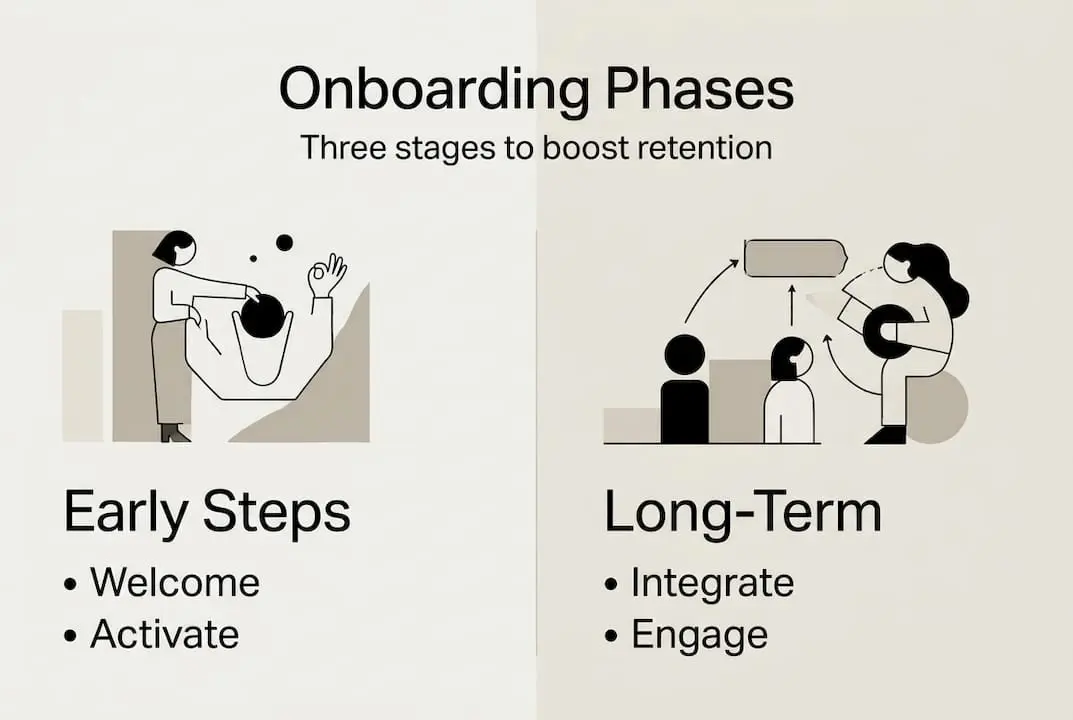
| Phase | Timeframe | Primary goal |
|---|---|---|
| Welcome | Days 1 to 7 | Confirm decision, provide key resources |
| Activate | Days 8 to 30 | Profile completion, first event or activity |
| Integrate | Days 31 to 90 | Peer connections, committee involvement |
Finally, secure organisation-wide buy-in. Onboarding is not solely the membership team’s responsibility. Staff across events, communications, and leadership all play a role in making new members feel valued.
Step-by-step framework: effective member onboarding in action
With your foundations set, here is how to execute each phase of the onboarding journey.
Phase 1: Welcome (Days 1 to 7)
- Send a personalised welcome message within 24 hours of joining, signed by a real person rather than a generic address.
- Confirm the member’s decision with a brief summary of the key benefits they now have access to.
- Provide a curated resource list, not everything at once, just the three or four most relevant starting points.
- Set expectations for what they will hear from you over the next 90 days.
Phase 2: Activate (Days 8 to 30)
- Prompt profile completion with a direct link and a clear explanation of why it matters for their experience.
- Invite them to a relevant upcoming event, ideally one that matches their stated interests or role.
- Encourage their first community post with a low-barrier prompt such as an introduction thread. 69% of first-time community posters go on to engage regularly, making that first post a critical milestone.
Phase 3: Integrate (Days 31 to 90)
- Introduce peer connections through mentoring matches, working groups, or committee invitations.
- Share volunteer or leadership opportunities relevant to their background.
- Measure engagement and identify members who have not yet taken a key action, then trigger a targeted follow-up.
Automation is what makes this scalable. Automated emails, member portals, and build online communities tools allow you to deliver personalised touchpoints without manual effort for every single member. Review community engagement benchmarks to understand what strong engagement looks like at each stage.
Pro Tip: Map each automated email to a single CTA. Members who receive one clear next step are far more likely to act than those presented with five options at once.
| Onboarding action | Recommended timing | Delivery method |
|---|---|---|
| Welcome message | Day 1 | Personalised email |
| Resource guide | Day 2 | Email or member portal |
| Profile completion prompt | Day 8 | Automated email |
| First event invitation | Day 10 | Email + portal notification |
| Community post prompt | Day 14 | Automated email |
| Peer connection introduction | Day 35 | Personal outreach or portal |
| 90-day check-in | Day 90 | Survey or personal email |
For a deeper look at structuring each stage, the onboarding process steps guide covers the practical detail behind each phase.
Avoiding common onboarding pitfalls
Even well-intentioned onboarding programmes fall into predictable traps. Knowing them in advance saves you significant rework.
Common onboarding mistakes include flooding inboxes with generic information, overwhelming new members with too much content at once, inconsistent experiences across chapters or branches, and dropping communication after the initial welcome. Each of these erodes the trust you are trying to build.
Worth remembering: A new member who receives five emails in their first week and then hears nothing for a month will assume their membership is not worth the investment.
Here is how to avoid the most damaging pitfalls:
- Drip your content. Spread resources across the 90-day window rather than front-loading everything into the first week.
- Personalise outreach. Use member data to tailor communications by role, interest, or location. Generic messages feel impersonal and reduce engagement.
- Maintain communication cadence. Plan touchpoints at regular intervals throughout the full 90 days, not just at the start.
- Standardise across chapters. If your organisation has multiple branches, ensure every new member receives the same quality of experience regardless of location.
To boost member engagement beyond onboarding, the same principles apply: consistency, personalisation, and regular communication. For broader inspiration, community building ideas can help you extend the onboarding momentum into long-term engagement.
Pro Tip: Create a simple onboarding checklist that staff can use to verify each new member has received every touchpoint. Manual oversight catches automation gaps before they become retention problems.
Technology and automation: scaling onboarding and engagement
Manual onboarding works when you have ten new members a month. It breaks down at a hundred. Technology is what bridges that gap.
A well-configured CRM allows you to map each member’s journey, trigger automated emails based on behaviour, and flag members who have gone quiet. Targeted recommendations based on role and experience, delivered through a consistent tech stack across all chapters, are what separate scalable onboarding from ad-hoc processes.
Members who are not engaged in their first 90 days face 60 to 70% higher churn risk. Automation ensures no member slips through the cracks during that critical window.
| Approach | Manual process | Automated process |
|---|---|---|
| Welcome email | Sent individually by staff | Triggered instantly on joining |
| Profile completion | Chased manually | Automated reminder at Day 8 |
| Event invitation | Sent to all members | Targeted by interest or role |
| Engagement monitoring | Periodic manual review | Real-time analytics dashboard |
| Re-engagement follow-up | Ad-hoc | Triggered by inactivity threshold |
Key technology capabilities to look for in your onboarding stack:
- Automated email sequences tied to member actions and milestones
- Member portal with self-service profile management and resource access
- CRM integration for a single view of each member’s engagement history
- Mobile-friendly design across all touchpoints, as many members engage via smartphone
- Analytics and reporting to identify drop-off points in the onboarding journey
The right platform removes the administrative burden from your team and ensures every member receives a consistent, personalised experience at scale.
Measuring onboarding success: key metrics and ongoing improvement
Onboarding is not a set-and-forget process. Regular measurement tells you what is working and where members are disengaging.
Key onboarding KPIs include profile completion rates, time to first engagement, event attendance, forum participation, and first-year retention. Notably, 93% of members who find involvement very easy stay for five or more years, which makes ease of engagement a metric worth tracking in its own right.
| Metric | What it measures | Review frequency |
|---|---|---|
| Profile completion rate | Activation quality | Monthly |
| Time to first engagement | Onboarding speed | Monthly |
| First event attendance | Early activation | Per cohort |
| Community post rate | Connection quality | Monthly |
| First-year renewal rate | Overall onboarding effectiveness | Annually |
To build a culture of continuous improvement, follow these steps:
- Set a baseline by measuring current KPIs before making any changes.
- Review onboarding data quarterly to spot trends and identify drop-off points.
- Collect member feedback at the 30 and 90-day marks with a short survey.
- Test one change at a time so you can attribute improvements to specific actions.
- Share results with leadership to maintain buy-in and secure resources for ongoing improvement.
Tracking member engagement metrics beyond the onboarding window helps you understand whether early engagement translates into long-term loyalty.
Transform onboarding with the right technology partner
The best onboarding frameworks are only as effective as the tools behind them. Colossus Systems brings together membership software features including CRM, automated email marketing, member portals, and event management software in a single platform built specifically for membership organisations.
With CRM software that maps every member’s journey and analytics that surface engagement gaps in real time, Colossus Systems helps you deliver personalised onboarding at scale without adding to your team’s workload. Whether you manage a single chapter or a national association, the platform adapts to your structure and your members’ needs. Book a demo to see how Colossus Systems can support your onboarding goals.
Frequently asked questions
How long should an effective onboarding process last?
Aim for a structured 90-day programme with phased milestones across Welcome, Activate, and Integrate stages. This timeframe significantly reduces first-year churn risk.
What metrics should I use to measure onboarding success?
Track profile completion, event attendance, community engagement, and first-year renewal rates. These four indicators give a clear picture of onboarding effectiveness.
How can automation improve member onboarding?
Automation enables scalable, personalised onboarding by triggering timely communications based on member behaviour, ensuring no one is missed without increasing staff workload.
What is the biggest mistake in member onboarding?
Information overload and lack of personalisation are the most damaging errors. Dripping content across 90 days and tailoring messages to member interests consistently outperforms a one-size-fits-all approach.