Master member engagement metrics to improve retention

Measuring member engagement feels straightforward until you realise most organisations track the wrong things. Activity counts and event attendance tell you what happened, not why members stay or leave. The member engagement scorecard framework reveals that true engagement spans five dimensions, each requiring distinct measurement approaches. This guide clarifies which metrics matter, how to interpret them accurately, and practical ways to apply insights for measurably better retention outcomes. You’ll learn benchmarks, frameworks, and implementation strategies that transform data into action.
Table of Contents
- Key takeaways
- Understanding core member engagement metrics and frameworks
- Benchmarking retention and additional key metrics to track
- Advanced insights: data integration, behavioural nuances and metric quality
- Applying member engagement metrics to drive practical improvements
- Discover Colossus Systems membership solutions
- Frequently asked questions
Key Takeaways
| Point | Details |
|---|---|
| Five core indicators | The scorecard measures five distinct engagement dimensions across multiple channels to produce an overall health score. |
| Engagement ladder stages | Members progress from passive consumers to leaders through clearly defined stages and motivating triggers. |
| Data integration boosts accuracy | Integrating data from diverse platforms improves predictive accuracy and supports targeted retention actions. |
| Quality over quantity | Quality interactions and meaningful exchanges predict retention better than sheer volume of activity. |
| Retention as north star | Retention remains the guiding metric, with improvements in the first ninety days signalling long term sustainability. |
Understanding core member engagement metrics and frameworks
The member engagement scorecard framework provides structure for measuring what truly drives retention. This approach evaluates five core indicators across multiple channels, then aggregates scores into an overall health percentage. Each indicator captures a distinct dimension of how members connect with your organisation.
The five core indicators measure different engagement aspects:
| Indicator | What it measures |
|---|---|
| Participation breadth | Range of activities members engage with across programmes and offerings |
| Contribution and leadership | Active involvement through volunteering, committee work, or content creation |
| Mission-aligned activity | Engagement with core purpose initiatives and advocacy efforts |
| Touchpoint frequency | Consistency of interactions across communication channels and platforms |
| Member sentiment | Satisfaction, loyalty, and emotional connection expressed through feedback |
You score each indicator across relevant channels, then calculate weighted averages. Common engagement channels for scoring include:
- Events (in-person conferences, webinars, workshops)
- Online forums and community platforms
- Surveys and feedback mechanisms
- Content consumption (newsletters, resources, publications)
- Volunteering and committee participation
The engagement metrics explained guide demonstrates how to weight these channels based on your organisation’s priorities. A professional association might weight committee participation heavily, whilst a fitness club prioritises facility usage patterns.
The engagement ladder framework complements scorecards by mapping member progression through distinct stages:
- Passive members who consume content but rarely interact
- Active participants who attend events and engage regularly
- Contributors who volunteer time or share expertise
- Leaders who guide committees, mentor others, or advocate publicly
Moving members up this ladder requires understanding where they currently sit and what motivates progression. Someone stuck at passive might need personalised invitations to relevant events. An active participant ready to contribute needs clear volunteer opportunities aligned with their interests.
Pro Tip: Focus on consistent relevance and two-way value exchange rather than activity volume alone. A member attending one highly relevant quarterly event demonstrates stronger engagement than someone passively opening every email. Quality interactions predict retention better than quantity metrics.
Benchmarking retention and additional key metrics to track
Retention benchmarks average 80% across membership organisations, with high performers achieving 90-94% renewal rates. Trade associations typically see 82-85% retention, whilst professional bodies with mandatory credentials often exceed 90%. These variations reflect different value propositions and switching costs.

Retention serves as your north star metric because it directly impacts sustainability and growth. A 5% improvement in retention compounds dramatically over time, reducing acquisition costs and stabilising revenue. You can predict retention by tracking engagement patterns during the critical first 90 days after joining.
Complementary metrics provide context for retention performance:
| Metric | Average organisation | High performer | What it reveals |
|---|---|---|---|
| Renewal rate | 80% | 90-94% | Overall membership stability and satisfaction |
| Net Promoter Score | 30-40 | 60+ | Member loyalty and likelihood to recommend |
| Customer lifetime value | £2,400 | £4,800+ | Long-term revenue potential per member |
| Annual churn rate | 20% | 6-10% | Rate of membership loss requiring replacement |
Net Promoter Score (NPS) measures loyalty through a simple question: “How likely are you to recommend us?” Responses from 0-10 split into detractors (0-6), passives (7-8), and promoters (9-10). Subtract detractor percentage from promoter percentage for your NPS. Scores above 50 indicate strong loyalty, whilst anything below 20 signals problems.
Customer lifetime value (CLV) calculates total revenue expected from a member throughout their relationship with your organisation. Multiply average annual membership fee by average retention years, then add revenue from events, training, and other services. High CLV justifies greater investment in engagement and retention initiatives.
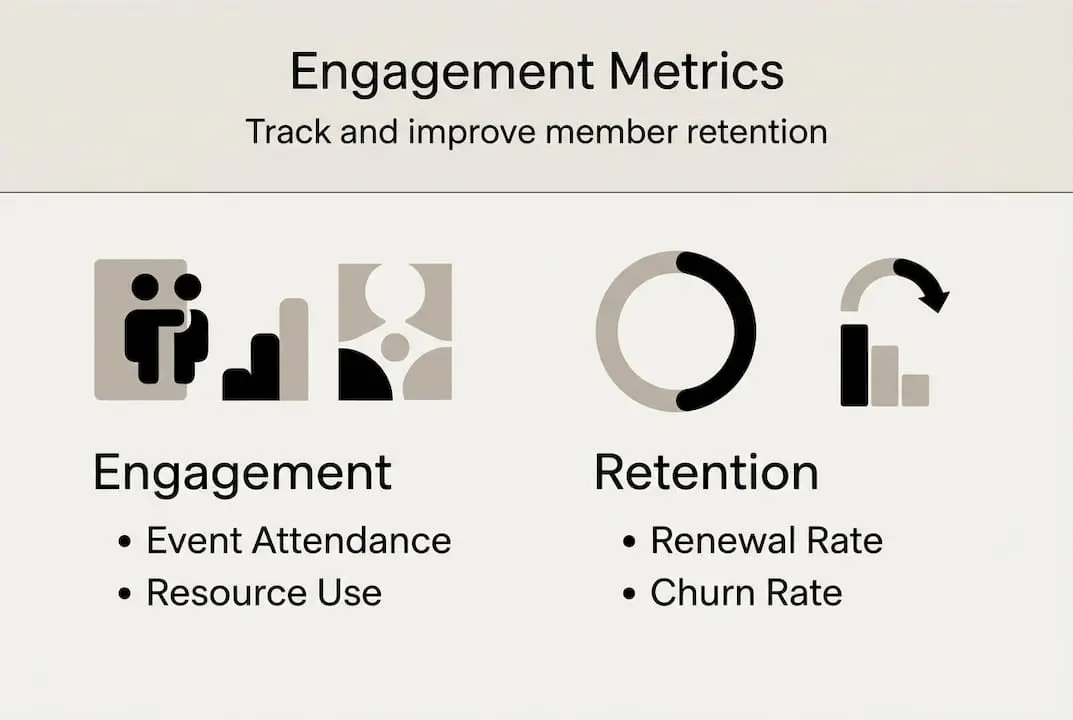
Churn rate tracks the percentage of members who don’t renew annually. Calculate it by dividing non-renewals by total members at the start of the period. A 20% churn rate means you must recruit 20 new members just to maintain 100 total members, before achieving any growth.
The membership retention ideas resource explains how these metrics interconnect. Strong engagement during onboarding improves NPS, which correlates with higher retention and increased CLV. Each metric informs different strategic decisions.
Pro Tip: Use retention data to prioritise engagement interventions during the first 90 days after joining. Members who engage with three or more touchpoints in this window show 40% higher renewal rates. Track early engagement signals and trigger personalised outreach when members show declining activity patterns.
Advanced insights: data integration, behavioural nuances and metric quality
Cross-platform data integration reveals that community users generate 5x revenue, register for 6x more events, and demonstrate 50% higher retention compared to non-engaged members. These dramatic differences emerge only when you connect data across membership databases, event platforms, learning management systems, and community forums.
Integrating data across platforms delivers measurable benefits:
- Revenue increases of 5x from highly engaged community participants
- Event registration rates 6x higher among active forum contributors
- Retention improvements of 50% for members with multi-platform engagement
- Predictive accuracy gains enabling proactive intervention before members disengage
- Personalisation capabilities based on comprehensive behaviour profiles
“Organisations that integrate analytics across membership, events, and community platforms identify at-risk members 90 days earlier, enabling targeted retention interventions that improve renewal rates by 15-20%.”
Behavioural segmentation provides deeper insights than demographic categories. Rather than grouping members by age or location, segment by engagement patterns: frequent event attendees, content consumers, forum contributors, or dormant members. These behavioural segments predict future actions more accurately than traditional demographics.
Avoid over-segmenting through excessive surveys. Each survey request creates friction and survey fatigue. Instead, integrating your website into membership CRM captures behavioural data passively as members interact naturally with your platforms. This approach reveals preferences through actions rather than stated intentions.
Seasonal patterns affect metric interpretation significantly. Professional associations often see engagement spikes around annual conferences, followed by summer lulls. Educational organisations experience cycles aligned with academic calendars. Recognise these patterns when evaluating month-to-month changes to avoid misinterpreting normal fluctuations as trends.
Larger communities show more total activity but a smaller percentage of contributors, demonstrating that quality matters more than quantity. A community with 10,000 members and 500 active contributors (5%) often generates more value than one with 20,000 members and 400 contributors (2%). Focus on depth of engagement rather than raw participation numbers.
Simplistic yes/no scoring systems miss nuance. A member who attends one highly relevant event demonstrates different engagement than someone attending three tangentially related sessions. Weighted multidimensional approaches combine qualitative sentiment signals with quantitative behavioural data for richer insights. Score engagement intensity alongside frequency, and factor in relevance to member interests and organisational mission.
Applying member engagement metrics to drive practical improvements
The engagement ladder framework guides practical strategies for moving members from passive observers to active leaders. Each stage requires different interventions tailored to member readiness and interests. You can’t skip stages, members must progress sequentially through increasing involvement levels.
Monitor early engagement signals and intervene proactively within the first 90 days:
- Track welcome email opens and clicks within 48 hours of joining
- Monitor first login to member portal and initial content consumption
- Identify members who haven’t engaged after 14 days and trigger personalised outreach
- Invite to relevant upcoming events based on stated interests from application
- Assign peer mentors or ambassadors for new member onboarding conversations
- Survey satisfaction and gather feedback at 30, 60, and 90-day milestones
The first 90 days prove critical for long-term renewal success. Members who remain passive during this window show 60% lower retention rates than those who engage with multiple touchpoints. Early intervention prevents disengagement before it becomes entrenched.
Practical tactics for increasing engagement across the ladder stages include:
- Personalised email communications addressing members by name and referencing their interests
- Relevant content delivery through segmented newsletters matching member preferences
- Strategic event invitations to programmes aligned with career stage and goals
- Clear volunteer opportunities with defined time commitments and impact descriptions
- Recognition programmes celebrating contributions and progression up the engagement ladder
- Mentorship matching connecting new members with established leaders
The how to boost member engagement guide demonstrates how software automates these interventions at scale. Manual tracking becomes impossible beyond 500 members, whilst automated systems monitor thousands simultaneously.
Pro Tip: Track sentiment and touchpoint frequency regularly to identify at-risk members before they lapse. Members showing declining email opens, reduced event attendance, or negative survey responses need immediate personalised outreach. Intervene 120 days before renewal rather than waiting until 30 days out when re-engagement proves much harder.
Member management platforms automate metric tracking and trigger actions based on engagement thresholds. Set rules like “Send personalised email when member hasn’t logged in for 30 days” or “Assign retention specialist when engagement score drops below 40%.” These automated workflows ensure consistent intervention without overwhelming staff.
The improving member engagement strategies resource outlines how to build engagement playbooks mapping specific interventions to member segments and lifecycle stages. Document what works, measure results, and refine approaches based on data rather than assumptions.
Discover Colossus Systems membership solutions
Tracking engagement metrics manually across spreadsheets creates gaps where at-risk members slip through unnoticed. Colossus Systems integrates membership management, event registration, and CRM capabilities into a unified platform that automatically captures engagement data across every touchpoint.
Our membership management software features include engagement scoring dashboards that visualise member health in real-time. You’ll see which members are thriving, who needs attention, and where to focus retention efforts for maximum impact. Automated workflows trigger personalised communications based on engagement patterns, ensuring timely intervention.
The event management software tracks attendance patterns and connects event participation to broader engagement profiles. Identify which events drive the strongest retention, then replicate those formats. The CRM software centralises member interactions from emails, calls, and meetings, providing complete visibility into relationship health.
Data integration across these modules reveals the cross-platform insights that predict retention most accurately. Request a demo to see how Colossus Systems transforms engagement metrics from theoretical concepts into practical tools that measurably improve member retention.
Frequently asked questions
What are member engagement metrics?
Member engagement metrics measure how members interact with and contribute to your organisation across multiple dimensions. They quantify participation breadth, contribution levels, mission-aligned activity, touchpoint frequency, and sentiment. These metrics help identify engagement levels, predict retention likelihood, and guide improvement strategies. Common metrics include participation rates, contribution intensity, renewal rate, Net Promoter Score, and sentiment analysis from surveys and feedback.
How can organisations use engagement metrics to improve member retention?
Use metrics to identify disengaged or at-risk members early, ideally within the first 90 days when intervention proves most effective. Tailor communications and offers based on member activity patterns and stated preferences revealed through behavioural data. Measure the effectiveness of retention interventions through A/B testing and cohort analysis to refine strategies continuously. Automated alerts triggered by declining engagement scores enable proactive outreach before members decide not to renew.
What is the engagement ladder and why is it important?
The engagement ladder framework describes member progression through distinct stages from passive observers to active leaders. It helps organisations tailor engagement efforts to member readiness and current involvement levels rather than applying one-size-fits-all approaches. The critical early stages, particularly the first 90 days, dramatically affect long-term retention success. Members who advance beyond passive participation show 40-60% higher renewal rates than those who remain disengaged.
What retention rate should membership organisations target?
Target retention rates depend on your organisation type and maturity, but aim for at least 85% as a baseline goal. High-performing organisations achieve 90-94% retention through systematic engagement measurement and intervention. Professional associations with mandatory credentials naturally see higher retention than voluntary membership groups. Focus on year-over-year improvement rather than comparing directly to organisations with different value propositions and member demographics.
How does data integration improve engagement measurement accuracy?
Integrating data across membership databases, event platforms, learning systems, and community forums reveals cross-platform behaviour patterns invisible in siloed systems. Members who engage across multiple platforms demonstrate fundamentally different retention profiles than single-channel users. Integrated analytics enable predictive modelling that identifies at-risk members 90 days earlier than single-source data, allowing proactive intervention that improves retention by 15-20%. Complete behaviour profiles also enable more relevant personalisation that drives deeper engagement.