Build vibrant online communities for membership growth

Membership organisations using integrated platforms boost engagement by 30% within a year, yet many leaders struggle to transform passive rosters into thriving digital communities. The difference lies in strategic platform choices, personalised experiences, and systematic engagement frameworks. This guide equips you with proven tactics to overcome common obstacles and cultivate vibrant online spaces that drive retention and growth.
Table of Contents
- Understanding The Foundations Of Online Communities
- Strategic Integration Of Engagement Platforms
- Personalised Member Experiences As Growth Drivers
- Frameworks For Measuring And Optimising Engagement
- Enhance Your Community Building With Colossus Systems
- Frequently Asked Questions
Key takeaways
| Point | Details |
|---|---|
| Community foundations matter | Membership communities thrive when they combine belonging, targeted engagement, and active management through robust digital platforms. |
| Platform integration transforms results | Unified SaaS solutions streamline event management, CRM, and communication, significantly increasing engagement and operational efficiency. |
| Personalisation drives participation | Tailored content and segmented experiences double participation rates by addressing individual member needs and motivations. |
| Measurement guides optimisation | Tracking engagement rates, retention, satisfaction scores, and contribution metrics enables systematic improvement and sustained growth. |
| Balance automation with authenticity | Automated routine tasks free time for genuine personal interactions, maintaining human connection whilst scaling community management. |
Understanding the foundations of online communities
Membership organisations operate within a unique ecosystem where communities combine belonging and targeted engagement differently from casual social networks. These spaces exist to serve specific professional or interest-based goals, creating focused environments where members connect around shared purposes. Unlike open platforms, membership communities filter participants through qualification criteria, fostering deeper trust and more substantive interactions.
Four core mechanisms drive engagement in these spaces. Content provision delivers valuable resources, training materials, and industry insights that members cannot easily access elsewhere. Connection facilitation helps members network, find mentors, and build professional relationships. Contribution opportunities allow members to share expertise, answer questions, and create value for peers. Recognition systems acknowledge member achievements, building status and motivation to participate actively.
Digital platforms transform these mechanisms from theory into practice. Integrated engagement platforms enhance communication efficiency by centralising discussions, resource libraries, event calendars, and member directories in accessible interfaces. Real-time interaction capabilities enable spontaneous conversations, live events, and immediate feedback loops that strengthen relationships. Members can contribute content, comment on discussions, and collaborate on projects without technical barriers.
Active management distinguishes thriving communities from stagnant member lists. Passive membership databases store contact details but fail to facilitate meaningful interaction. Vibrant communities require dedicated facilitation, content curation, conflict resolution, and strategic programming that responds to evolving member needs. Leaders must commit resources to community stewardship, treating it as core organisational infrastructure rather than an optional add-on.
Successful community building for member organisations requires several prerequisites:
- Digital literacy amongst both leadership and membership base
- Clear community guidelines and moderation policies
- Dedicated staff time for facilitation and content creation
- Commitment to consistent effective communication practices
- Infrastructure supporting mobile access and varied interaction formats
These foundations create conditions where strategic interventions can generate significant engagement gains.
Strategic integration of engagement platforms
Fragmented technology stacks plague many membership organisations, forcing staff to juggle separate systems for email, events, payments, and member data. This fragmentation creates data silos, duplicated effort, and disjointed member experiences. Integrated platforms consolidate these functions, streamlining workflows whilst providing unified member views that enable personalised engagement strategies.

Membership CRM integration enhances engagement by connecting member profiles with their entire interaction history. When event registrations, content downloads, email responses, and community participation feed into one system, leaders gain actionable insights into individual preferences and engagement patterns. This visibility enables targeted outreach, identifies at-risk members before they lapse, and reveals opportunities to deepen involvement.
Unified platforms deliver measurable operational benefits:
- Single sign-on eliminates password frustration and access barriers
- Automated workflows reduce administrative burden by 40%
- Consolidated reporting provides clear engagement metrics across channels
- Seamless payment integration simplifies event registration and renewals
- Mobile-optimised interfaces support participation from any device
Member journeys improve dramatically when platforms connect touchpoints logically. A member registers for a webinar through the event system, receives automated confirmation emails, joins pre-event community discussions, accesses recorded content through their member portal, and engages with follow-up resources without navigating multiple logins or interfaces. This friction-free experience encourages repeated participation.
Pro Tip: Evaluate platform integration capabilities before feature checklists when optimising membership management SaaS selection. A platform with moderate features that connect seamlessly outperforms feature-rich systems requiring manual data transfers between modules.
| Approach | Administrative Burden | Member Experience | Data Visibility | Personalisation Capability |
|---|---|---|---|---|
| Standalone tools | High (manual data sync) | Fragmented (multiple logins) | Limited (siloed data) | Minimal (incomplete profiles) |
| All-in-one platform | Low (automated workflows) | Seamless (single interface) | Comprehensive (unified view) | Advanced (complete interaction history) |
The investment in platform consolidation pays dividends through reduced staff time, increased member satisfaction, and the data foundation required for sophisticated engagement strategies.
Personalised member experiences as growth drivers
Generic communications feel impersonal in an era where members expect relevance. Behavioural psychology reveals that people engage more with content aligned to their specific interests, career stage, and participation history. Personalisation can double participation rates by demonstrating that the organisation understands and values individual members rather than treating them as interchangeable contacts.
Segmentation forms the foundation of effective personalisation. Basic demographic divisions by geography, industry, or membership tier enable targeted communications. Behavioural segmentation based on engagement patterns proves even more powerful. Identify highly active contributors, occasional participants, lurkers who consume content without contributing, and inactive members at risk of lapsing. Each segment requires different engagement strategies.
Tailored content delivery matches resources to member needs. Early-career professionals benefit from foundational training and mentorship programmes. Senior leaders value executive networking and strategic insights. Technical specialists engage with deep-dive resources and peer collaboration opportunities. Automated systems can route relevant content based on profile attributes and past behaviour, ensuring members see opportunities aligned with their interests.
Event targeting becomes surgical with robust member data. Rather than broadcasting every event to the entire membership, promote specific programmes to segments most likely to attend. Regional chapters see local events prominently. Members who attended previous webinars on specific topics receive notifications about related sessions. This precision reduces notification fatigue whilst increasing conversion rates.
Data requirements for personalisation need not be overwhelming:
- Basic profile information: industry, role, location, membership tier
- Engagement history: event attendance, content downloads, community activity
- Communication preferences: frequency, channels, topic interests
- Lifecycle stage: new member, established, leadership, at-risk
Privacy considerations demand transparency and control. Clearly communicate how member data enables better experiences. Provide preference centres where members control communication frequency and topics. Ensure compliance with data protection regulations whilst leveraging information to serve members more effectively.
Pro Tip: Start with simple segmentation based on engagement level and expand personalisation gradually as you build confidence and capability. Attempting complex individualisation immediately overwhelms resources without proportional returns.
The contrast between generic and personalised approaches manifests in member satisfaction scores, participation rates, and retention metrics. Members who feel understood and valued become active contributors and enthusiastic advocates.
Frameworks for measuring and optimising engagement
Systematic measurement transforms community management from guesswork into strategic practice. The Four Pillars framework provides a structured approach to evaluating community health across content quality, connection strength, contribution levels, and recognition effectiveness. Each pillar requires specific metrics that reveal performance and guide improvement efforts.
Quantitative metrics establish baselines and track progress:
- Engagement rate: percentage of members actively participating monthly
- Retention rate: proportion of members renewing versus lapsing
- Contribution ratio: percentage of members creating content versus consuming only
- Event attendance: participation rates for virtual and in-person programmes
- Satisfaction scores: net promoter scores and qualitative feedback ratings
- Growth velocity: new member acquisition rate and referral percentages
Tracking engagement rates and retention enables leaders to identify patterns and test interventions systematically. Monthly reporting reveals seasonal fluctuations, programme impact, and early warning signs of declining interest. Comparative analysis across member segments highlights which groups thrive and which need additional support.
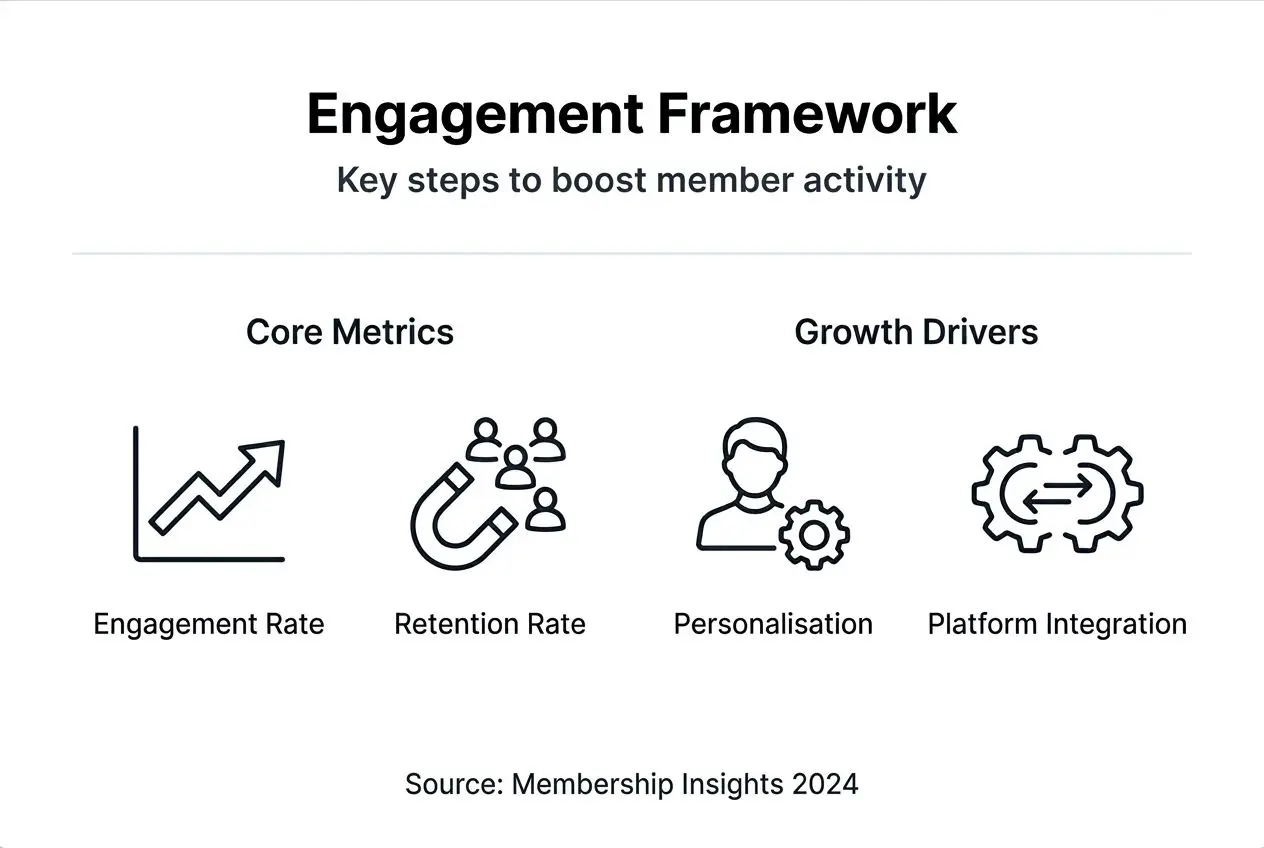
Feedback loops close the gap between measurement and action. Quarterly surveys capture member sentiment and feature requests. Community analytics reveal which content generates discussion and which falls flat. A/B testing of communication approaches identifies optimal messaging strategies. This continuous learning cycle ensures strategies evolve with member needs rather than remaining static.
Implementing an engagement measurement routine requires structured steps:
- Define key metrics aligned with organisational goals and community maturity stage
- Establish baseline measurements across all metrics before implementing new strategies
- Set realistic improvement targets based on industry benchmarks and resources
- Schedule regular reporting cycles (monthly metrics, quarterly deep dives)
- Create accountability structures assigning metric ownership to specific staff
- Review results with leadership quarterly to adjust strategies and allocate resources
- Communicate progress transparently with members to demonstrate responsiveness
Data-driven optimisation relies on connecting metrics to actionable insights:
| Metric | Target Range | Primary Tools | Typical Interventions |
|---|---|---|---|
| Monthly engagement rate | 35-50% | Analytics dashboard, activity logs | Targeted outreach to inactive segments, content variety expansion |
| Annual retention rate | 85-92% | CRM renewal tracking | At-risk member campaigns, onboarding improvements |
| Contribution ratio | 15-25% | Community analytics | Recognition programmes, contribution incentives |
| Event attendance | 25-40% | Registration systems | Event format experimentation, promotion timing optimisation |
| Net promoter score | 40-60 | Survey platforms | Service recovery for detractors, referral programmes for promoters |
Advanced organisations layer qualitative insights onto quantitative foundations. Exit interviews with lapsed members reveal friction points. Focus groups with highly engaged members identify what works well. This mixed-method approach provides depth that numbers alone cannot capture.
Pro Tip: Review member engagement strategies for 2026 quarterly to ensure your measurement framework captures emerging participation patterns and technology shifts.
Enhance your community building with Colossus Systems
Implementing these strategies becomes dramatically simpler with purpose-built technology designed for membership organisations. Colossus Systems integrates membership management features, event planning tools, and CRM capabilities into one unified platform that eliminates fragmentation and streamlines workflows.
Our platform empowers you to personalise member experiences through sophisticated segmentation whilst automated workflows handle routine communications, freeing your team to focus on high-value interactions. Robust analytics provide the engagement metrics and insights needed to optimise continuously, ensuring your community thrives and grows. Discover how Colossus Systems supports membership leaders in building vibrant online communities that drive retention and organisational success.
Frequently asked questions
How do I start building an online community for my membership organisation?
Begin by assessing current engagement levels and technology capabilities through member surveys and infrastructure audits. Define specific community goals aligned with organisational priorities, whether networking, knowledge sharing, or professional development. Building online communities for membership growth requires selecting platforms that match member technical comfort and organisational resources. Start with a pilot programme involving your most engaged members to test approaches before scaling widely.
What metrics should I track to know if my community is thriving?
Prioritise engagement rate (percentage participating monthly), retention rate (renewal versus lapse), contribution ratio (creators versus consumers), and member satisfaction scores. Track event attendance rates and growth velocity through new member acquisition. These metrics provide a balanced view of community health across participation breadth, depth, and member sentiment.
How can I balance automation without losing the human touch?
Use automation for routine communications like event confirmations, renewal reminders, and content notifications to eliminate repetitive manual tasks. Reserve personal responses for member enquiries, milestone celebrations, and support requests requiring judgement. Monitor feedback to adjust the balance, ensuring efficiency gains do not compromise relationship quality. Members appreciate prompt automated information alongside genuine personal engagement when they need assistance.
What if members resist adopting new community platforms?
Address resistance through phased rollouts with extensive training resources including video tutorials, live walkthrough sessions, and written guides. Identify champion users who adopt early and can peer-mentor hesitant members. Maintain legacy communication channels temporarily whilst demonstrating new platform benefits through exclusive content or features. Gather feedback continuously to address usability concerns quickly.
How much staff time does active community management require?
Expect to dedicate 15 to 25 hours weekly for organisations with 500 to 2,000 active members, scaling proportionally with community size. Initial setup and transition periods require higher investment. Efficient platforms reduce administrative burden significantly through automation, allowing staff to focus on facilitation, content creation, and strategic programming rather than manual data entry.