Onboarding new team members: a guide for membership officers

A well-run induction for volunteers, committee members and trustees follows a clear three-stage flow: prepare paperwork and checks before arrival, deliver day-one essentials in person, then phase remaining learning across the first month with a formal review at 2–3 months. NCVO recommends covering organisational aims, role expectations, practical facilities and key policies from the outset, with longer or higher-risk roles phased across several weeks. Before any new team member starts, confirm whether their role meets the threshold for a Disclosure and Barring Service (DBS) check and identify your designated safeguarding lead, in line with Charity Commission and NCVO guidance.
At a glance:
- Day one: welcome, site tour, named point of contact, safety brief, key policies signposted
- Weeks 1–4: role shadowing, handbook reading, basic training, system access
- 2–3 month review: role clarity, development needs, DBS and safeguarding updates as required
Key takeaways
Effective new team member onboarding in UK membership organisations requires a structured induction plan, clear compliance checks, a named buddy, and a formal review at 2–3 months to confirm fit and development needs.
| Point | Details |
|---|---|
| Prepare before arrival | Gather role profile, volunteer agreement, handbook and DBS decision before day one. |
| Cover compliance on day one | Signpost safeguarding, GDPR and health and safety policies; meet the designated safeguarding lead for regulated roles. |
| Assign a named buddy | Every new volunteer or trustee needs a specific point of contact from day one, not a general team email. |
| Schedule the 2–3 month review | DIY Committee Guide recommends a formal review at this point to confirm role clarity and agree development needs. |
| Use Colossus for admin | Colossus hosts handbooks, automates forms and tracks compliance dates, freeing coordinator time for relationship building. |
Table of Contents
- What does onboarding new team members actually require?
- What to prepare before your new volunteer or trustee arrives
- How to deliver the induction on day one and across the first weeks
- What does a trustee or committee member induction need?
- Risk, safeguarding and legal compliance in every induction
- How to support and develop new team members after induction
- Which templates belong in your induction pack?
- How do you know if your induction is working?
- Why human connection is the part most inductions get wrong
- How Colossus can take the admin off your plate
- Sources
What does onboarding new team members actually require?
A printable induction checklist keeps every coordinator on the same page. Use the groupings below as your master reference.
Day one
- Formal welcome from a named lead or chair
- Site tour and introduction to key colleagues
- Named point of contact confirmed in writing
- Health and safety brief completed and signed
- Safeguarding, GDPR and code of conduct policies signposted
- Volunteer or trustee agreement signed
Weeks 1–4
- Volunteer handbook read and acknowledged
- Role shadowing arranged with an experienced team member
- System access and login credentials provided
- Expenses form and process explained
- Mandatory training scheduled (including safeguarding and data protection)
2–3 month review
- One-to-one meeting with line manager or buddy
- Role clarity and confidence self-rating discussed
- Development needs identified and logged
- DBS renewal noted if applicable
- DIY Committee Guide recommends this review as the point to confirm fit and agree any further training
What to prepare before your new volunteer or trustee arrives
Good preparation prevents a chaotic first day. Gather these documents before arrival:
- Role profile: specific duties, time commitment, reporting line
- Volunteer or trustee agreement: sets expectations on conduct, expenses and how the arrangement ends; the Sprintlaw UK guidance recommends avoiding contractual language to reduce employment-status risk
- Volunteer handbook: policies, procedures and organisational overview
- IT and system access: logins, email address, any software training required
- Expenses form: reimbursement process and receipts policy
- Practical items: ID badge, PPE where relevant, travel instructions, accessibility adjustments
Run your DBS decision before the start date. Log the check type, date and outcome in your records. For roles without a DBS requirement, document your risk assessment so you can demonstrate due diligence.
Pro Tip: Draft your volunteer agreement in plain, non-contractual language. Phrases such as “we hope you will” rather than “you must” help protect both parties from an unintended employment relationship.
How to deliver the induction on day one and across the first weeks
Cover the non-negotiables on day one; schedule everything else. Trying to deliver a full induction in a single session overwhelms new team members and reduces retention of key information.
Sample day-one agenda (2–3 hours)
- Welcome conversation with the membership officer or chair (15 minutes)
- Site tour and introductions to immediate colleagues (20 minutes)
- Review and sign volunteer or trustee agreement (15 minutes)
- Safeguarding, GDPR and health and safety policy briefings (30 minutes)
- System access walkthrough and IT setup (20 minutes)
- Shadowing or observation session with a buddy (45 minutes)
- Close: confirm next steps, check-in date and who to contact with questions
Policies to cover immediately: safeguarding, GDPR/data protection, health and safety, and code of conduct. Policies that can wait until week two include financial procedures, complaints handling and communications guidelines. For roles involving children or adults at risk, NCVO’s safeguarding guidance requires new starters to meet the designated safeguarding lead and complete role-appropriate training before working unsupervised.
Group inductions work well for volunteer cohorts starting together. One-to-one onboarding suits committee and trustee roles, where governance responsibilities are individual and nuanced.
Pro Tip: Automate administrative forms such as expenses requests and IT access using a membership platform. That frees your staff time for the human welcome that actually builds loyalty.
What does a trustee or committee member induction need?
Trustee induction carries additional governance requirements that a standard volunteer pack does not cover. Historic England’s guidance recommends explaining governing documents, management accounts and legal duties, inviting new trustees to observe a meeting before they formally start, and assigning a trustee buddy from the existing board.
Your trustee induction pack should include:
- Governing document (constitution or articles of association)
- Most recent annual accounts and trustees’ report
- Minutes from the last two or three board meetings
- Code of conduct and conflicts of interest policy
- Charity Commission guidance on trustee duties
- Contact list for fellow trustees and key staff
Arrange a pre-meeting briefing so the new trustee understands the agenda before attending. At the meeting itself, a brief formal introduction from the chair sets the right tone and signals that the board takes inclusion seriously. For deeper guidance on improving board engagement, a structured onboarding process is one of the strongest predictors of long-term trustee commitment.
Risk, safeguarding and legal compliance in every induction
Compliance is not optional, and the steps below apply regardless of organisation size.
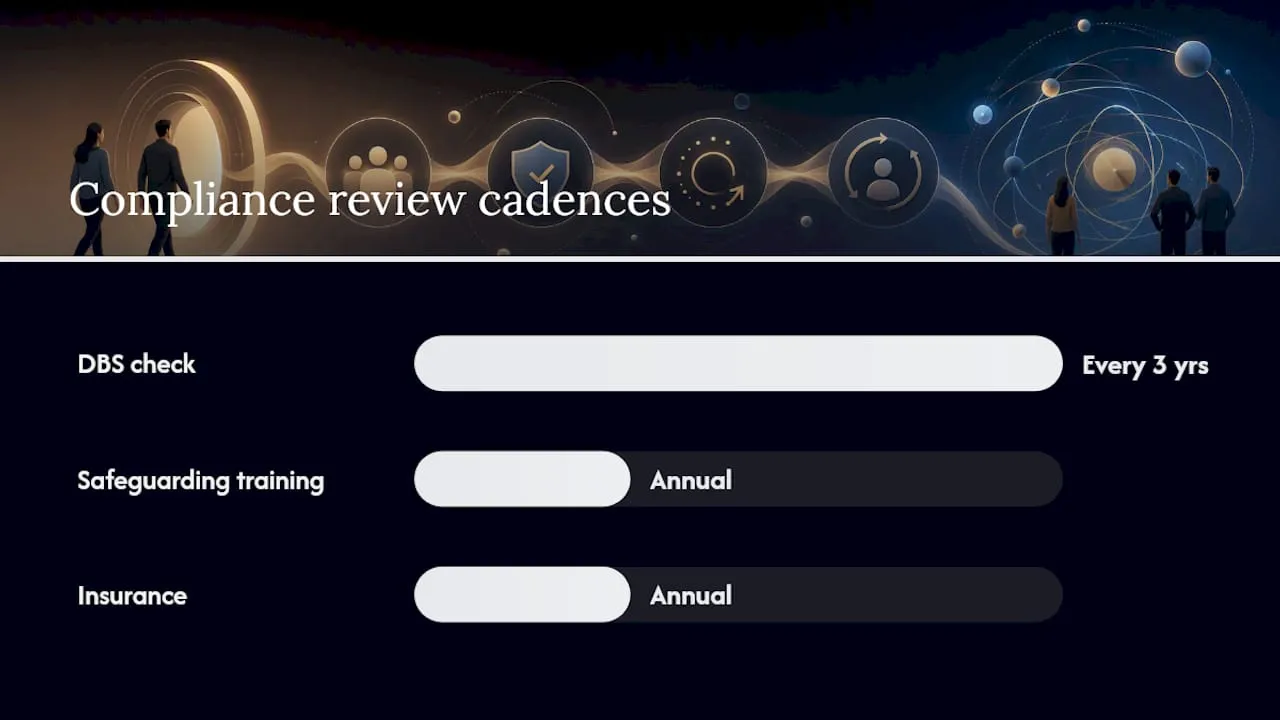
| Compliance area | Action required | Review cadence |
|---|---|---|
| DBS check | Run enhanced or standard check where role involves regulated activity with children or adults at risk | Every 3 years or on role change |
| Safeguarding training | Complete role-appropriate training; meet the designated safeguarding lead | Annual refresh |
| UK GDPR | Explain how volunteer personal data is held, used and deleted; obtain consent where required | On policy update |
| Insurance | Confirm volunteers are covered under your public liability and employers’ liability policies | Annual renewal |
| Health and safety | Complete role-specific risk assessment; brief new starter on emergency procedures | On role change |
The Fundraising Regulator states that DBS checks are necessary where a role involves regulated contact with children or adults at risk. Keep a central log of check dates, training completions and policy sign-offs so you can demonstrate compliance at any point.
Key compliance note: UK GDPR applies to volunteer records just as it does to paid staff. Store only what you need, document your lawful basis for processing, and delete records when the volunteer relationship ends.
How to support and develop new team members after induction
Induction ends; development does not. Assign every new joiner a named buddy and a clear point of contact before day one; for structured mentoring processes and matching techniques, see the Mentorship Program Guide for Entrepreneur Growth. Rushmoor Voluntary Services Toolkit 3 recommends appointing a mentor alongside the practical logistics of badges, equipment and expense forms.
- Buddy scheme: pair new volunteers or trustees with an experienced peer for the first three months
- Regular check-ins: a five-minute call or message each week surfaces misalignments before they become problems
- Phased training: schedule mandatory training in week one, role-specific development in weeks two to four, and optional sector events or away days from month two onwards
- Engagement KPIs to monitor: attendance at induction sessions, mandatory training completion, confidence self-rating at the 2–3 month review, and buddy check completion
For a fuller picture of managing volunteer members, structured check-ins and clear role expectations are the two factors most consistently linked to early retention.
Pro Tip: Send a short pulse survey at two weeks and again at the 2–3 month review. Keep it under five questions. Response rates drop sharply beyond that, and you lose the honest signal you need.
Which templates belong in your induction pack?
A well-organised induction pack removes ambiguity and gives new team members something to refer back to. VODA’s induction guidance recommends including an organisation overview, facilities information, policies, sign-off sheets and the volunteer handbook as core items.
Your pack should contain:
- Role profile
- Volunteer or trustee agreement
- Volunteer handbook (policies, procedures, contacts)
- Induction checklist with sign-off boxes
- Safeguarding declaration
- Expenses form
- IT access request form
- Emergency contacts and site map
Store the pack in a ring binder with tabbed sections, or in a digital portal where policies can be updated without reissuing the whole document. A digital portal also lets you track which documents a new member has read and acknowledged. Colossus can host handbooks and automate administrative forms within a single membership platform, reducing the manual effort of keeping packs current.
For onboarding new members effectively, the pack is the scaffold; the human welcome is what makes it stick.
How do you know if your induction is working?
Measure a small set of practical indicators rather than trying to capture everything.
Recommended KPIs:
- Attendance rate at induction sessions
- Mandatory training completion within four weeks
- First-month retention (did the new member return after week one?)
- Confidence self-rating at the 2–3 month review
- Buddy check completion rate
Simple measurement methods:
- Checklist sign-offs at each induction stage
- Two-week pulse survey (under five questions)
- 2–3 month one-to-one review with structured notes
- Supervisor or buddy notes logged centrally
Pro Tip: Ask one open question in your pulse survey: “What would have made your first two weeks better?” The answers consistently surface practical gaps that structured KPIs miss.
For volunteer retention strategies that go beyond induction, the 2–3 month review is the single highest-leverage moment to identify and act on early dissatisfaction.
Why human connection is the part most inductions get wrong
Most induction failures are not compliance failures. They are relationship failures. A new trustee who receives a folder of documents but never hears from the chair in their first fortnight will disengage, regardless of how thorough the paperwork was.
The evidence points consistently in one direction: a personalised welcome from the chair or team lead, a named buddy who actually makes contact, and a check-in call in week two do more for early retention than any policy document. Automation handles the administrative scaffolding well. It cannot replicate the effect of a genuine, timely message that says “we noticed you, and we’re glad you’re here.”
The organisations that get this right treat induction as a relationship-building process with administrative requirements attached, not an administrative process with a brief welcome bolted on. That reframe changes everything about how coordinators spend their time in those first critical weeks.
How Colossus can take the admin off your plate
Preparing a thorough induction pack, tracking DBS dates, chasing training completions and managing buddy assignments all consume coordinator time that would be better spent on the human welcome described above.
Colossus gives membership organisations a single platform to host volunteer handbooks, automate administrative forms, manage communications and track engagement across your entire team. Rather than maintaining separate spreadsheets for DBS renewal dates and training completions, your team works from one dashboard. Manual templates and good processes absolutely work on their own; a platform simply removes the friction of keeping them current and consistent at scale.
Explore the membership management features or book a demo to see how Colossus handles induction admin for organisations like yours.
Sources
Use these authoritative UK sources when building or reviewing your induction process:
- Running a volunteer induction | NCVO
- Onboarding and welcome packs for trustees | Historic England
- Working with volunteers | Fundraising Regulator
- How to induct new members — Help Sheet (DIY Committee Guide)
- What is a volunteer agreement? | Sprintlaw UK
For a ready-to-use induction checklist template and trustee handbook structure, the DIY Committee Guide download is the most practical starting point for most UK membership organisations.
This article provides general information for UK membership organisations and is not a substitute for legal or regulatory advice. Confirm current DBS eligibility rules and Charity Commission requirements with the relevant primary sources or a qualified adviser.