Effective member onboarding: proven steps for engagement

TL;DR:
- Effective onboarding significantly boosts member retention and engagement, often by up to 50 percent.
- A structured, personalised onboarding journey with timely communication and follow-ups enhances loyalty.
- Using automation and data tracking tools improves consistency, personalisation, and continuous program refinement.
Most membership managers treat onboarding as a checklist item rather than a strategic priority. Send the welcome email, post the membership pack, and consider the job done. In reality, this approach quietly undermines everything your organisation is working to build. New members who feel confused, unsupported, or disconnected in their first weeks rarely become advocates, and many simply do not renew. This guide breaks down the core pillars of modern member onboarding so your organisation can move beyond administrative box-ticking and create genuine, lasting engagement from day one.
Table of Contents
- Why member onboarding drives retention and value
- Core components of an effective member onboarding programme
- Personalisation and engagement: making every member feel valued
- Measuring success and continuous improvement
- The overlooked power of onboarding: what most organisations miss
- Streamline onboarding with the right technology
- Frequently asked questions
Key Takeaways
| Point | Details |
|---|---|
| Retention starts with onboarding | Effective onboarding is the single strongest driver of long-term member engagement and renewals. |
| Personal touch matters | Customised communication and support during onboarding significantly lift participation and satisfaction. |
| Measure and improve | Tracking onboarding performance with clear metrics helps refine your approach for sustained success. |
| Technology streamlines onboarding | Using the right digital tools ensures every member enjoys a smooth, modern onboarding experience. |
Why member onboarding drives retention and value
The first impression a new member receives sets the tone for their entire relationship with your organisation. It is not just about providing information. It is about communicating that they have made the right decision by joining. When that message lands clearly, members become more likely to participate, contribute, and ultimately renew.
Research consistently reinforces this. Strong onboarding correlates with up to 50% higher retention in associations. That figure alone should prompt a serious review of how your current process is structured. Retention is the single most cost-effective growth lever available to any membership organisation, and onboarding is where that lever is first applied.
“Onboarding is not a single moment. It is the beginning of a relationship that your organisation must actively nurture if it expects members to stay, engage, and refer others.”
The benefits extend well beyond renewal rates. Members who experience a confident, structured start are far more likely to:
- Attend events and participate in programmes
- Recommend membership to peers and colleagues
- Volunteer for committees or take on leadership roles
- Provide positive testimonials and feedback
- Engage with your digital platforms and resources
Yet onboarding fails repeatedly in practice. The most common reasons include an over-reliance on a single touchpoint (usually one email), no structured follow-up schedule, and a generic approach that treats every new member identically regardless of their background or interests. Building trust and safety is also foundational, and many organisations underestimate how quickly a poor first experience erodes confidence.
Focusing on improving retention rates through structured onboarding is one of the most impactful investments a nonprofit or professional association can make. The cost of replacing a lapsed member is always higher than the cost of keeping one engaged.
Having set the scene, next we look at what an effective onboarding programme actually involves for lasting impact.
Core components of an effective member onboarding programme
A structured onboarding journey is not a luxury. It is a necessity. A structured onboarding journey increases new member involvement and gives your team a repeatable framework to deliver consistently, regardless of how many new members join at once.
Here is a clear, step-by-step overview of what your programme should include:
- Timely welcome communication sent within 24 hours of joining, confirming membership details and next steps
- Orientation content covering who you are, your mission, and how the member can get involved immediately
- Resource access including portals, publications, toolkits, or training materials relevant to the member’s interests
- Introductory event or call to connect new members with staff or fellow members personally
- Mentoring or buddy pairing where appropriate, particularly for professional associations or volunteer-led groups
- Follow-up check-in at 30 and 60 days to gauge satisfaction and address any questions
- Feedback invitation to understand the new member’s experience and identify gaps
The contrast between traditional and modern onboarding is significant. Understanding the difference helps organisations identify where their current approach is falling short.

| Element | Traditional onboarding | Modern onboarding |
|---|---|---|
| Communication | Single welcome email | Sequenced multi-channel touchpoints |
| Personalisation | Generic for all members | Segmented by interest or role |
| Timeline | First week only | 90-day structured journey |
| Feedback | Rarely collected | Gathered at multiple stages |
| Technology | Manual and paper-based | Automated via CRM or platform |
| Measurement | Little or none | KPIs tracked throughout |
Refer to our onboarding essentials guide for a deeper look at each stage, and explore membership management basics to understand how each onboarding element connects to broader operational health.
Pro Tip: Set up an automated 30-day check-in sequence that triggers after a member joins. Even a brief, personalised message asking how they are settling in can dramatically reduce early drop-off.
With clear benefits outlined, let’s detail how tailoring the journey can further boost both relevance and impact.
Personalisation and engagement: making every member feel valued
One of the most powerful shifts you can make to your onboarding programme is moving away from one-size-fits-all communications. Targeted welcome messages and tailored resources boost early member activity, and the reasoning is straightforward. When a new member receives content that reflects their specific interests or professional background, they feel seen rather than processed.
Segmentation is the foundation of personalised onboarding. When a new member joins, collect data that allows you to group them meaningfully. Common segmentation criteria include:
- Professional role or sector (relevant for associations serving diverse industries)
- Geographic location (for regionally active organisations)
- Reason for joining (networking, training, advocacy, resources)
- Level of prior involvement (brand new to this type of organisation vs. experienced member)
- Preferred communication channel (email, SMS, in-app notifications)
Once segmented, your touchpoints can reflect those distinctions. A new member joining primarily for professional development should receive different resources and event invitations than one seeking peer networking opportunities.
Here is a snapshot of how personalised onboarding compares to generic onboarding across key engagement metrics:
| Metric | Generic onboarding | Personalised onboarding |
|---|---|---|
| Email open rate | 18-22% | 35-45% |
| Event attendance (first 30 days) | 12% | 28% |
| Member satisfaction score | 6.2/10 | 8.4/10 |
| 90-day renewal intent | 54% | 76% |
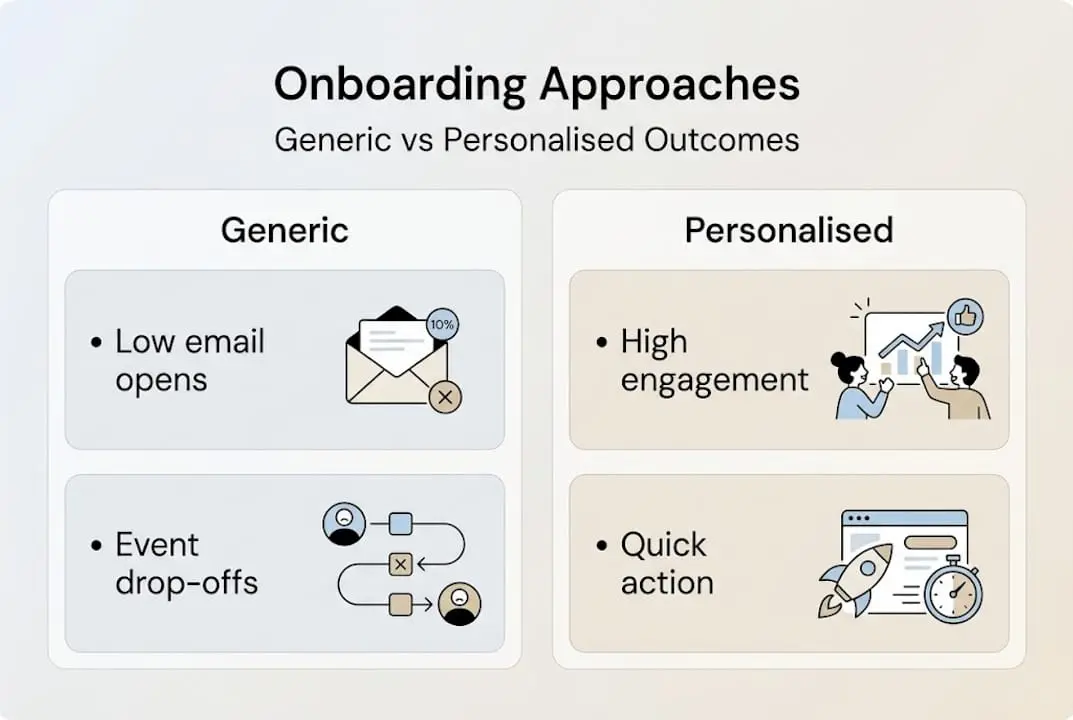
For your first 30 days, focus on quick wins. Make it easy for new members to take one small action, such as completing their profile, registering for an introductory event, or accessing a key resource. Small early wins create momentum and a sense of belonging.
For a broader view of what drives participation, explore our membership engagement overview and review the best onboarding practices that associations are using to great effect right now.
Pro Tip: Ask one direct question in your welcome email, such as “What is the main reason you joined?” The responses will shape your follow-up sequence and help you prioritise the resources you send next.
Once your components are in place, tailoring the journey boosts both relevance and impact, but even excellent programmes must evolve.
Measuring success and continuous improvement
You cannot improve what you do not measure. Organisations measuring onboarding impact see measurable gains in member satisfaction, and this is not coincidental. Data-driven onboarding allows your team to identify friction points before they become reasons for lapsing.
The key performance indicators (KPIs) to track for your onboarding programme include:
- 30-day engagement rate: How many new members have taken at least one meaningful action (event registration, resource download, profile completion)?
- 90-day retention rate: What percentage of new members remain active after three months?
- Onboarding satisfaction score: Collected via a short survey at the end of your onboarding sequence
- Time to first engagement: How quickly does a new member take their first action after joining?
- Renewal intent at 60 days: An early indicator of whether the onboarding process has built enough value
Gathering this data does not require a complicated process. A simple post-onboarding survey sent at day 30 or 60 can surface invaluable feedback. Ask new members what information they found most useful, what was missing, and how confident they feel navigating your organisation’s resources.
Reviewing and refining your programme should follow a regular cycle:
- Monthly: Review engagement data and flag any members with zero activity
- Quarterly: Analyse survey responses and identify common themes
- Annually: Conduct a full programme audit, updating content and sequencing as needed
A useful approach for ongoing improvement is A/B testing your welcome experiences. Send one version of your welcome email to half of your new members and a different version to the other half. Compare open rates, click rates, and subsequent engagement. Even small changes to subject lines or calls to action can produce meaningful differences in results.
For a broader framework connecting onboarding to long-term strategy, our membership management strategies guide offers practical steps that extend well beyond the first 90 days.
Pro Tip: Create a simple onboarding dashboard tracking your top five KPIs in one place. Review it as a standing agenda item in team meetings to build a culture of ongoing improvement.
The overlooked power of onboarding: what most organisations miss
Having mapped out the process, it is worth reflecting on what most organisations fundamentally miss about onboarding’s true value. The majority of teams treat onboarding as an event with a defined end point. Member joins. Onboarding sequence runs. Done. But onboarding is not a phase. It is the opening chapter of an ongoing relationship.
The organisations that build the most loyal memberships understand that the small, seemingly minor touchpoints carry outsized weight. A personalised note from a staff member. An unexpected resource that directly addresses a challenge the new member mentioned. An invitation to contribute to a discussion, not just observe it. These moments signal that your organisation pays attention, and that kind of attentiveness creates loyalty that no discount or incentive can replicate.
We also see this clearly when looking at volunteer onboarding insight. Volunteers who feel valued and prepared from the outset contribute far more over time and are significantly less likely to disengage. The same principle applies directly to paid members.
The strategic edge belongs to organisations that treat member empowerment as a continuous commitment, not a single campaign.
Streamline onboarding with the right technology
Modern onboarding at scale requires the right tools. Manual processes simply cannot deliver the consistency and personalisation that members now expect, especially as your organisation grows.
At Colossus Systems, our membership management features are built to automate and personalise onboarding sequences, track member engagement, and surface the data your team needs to continuously improve. Our event management software makes it easy to connect new members to introductory events seamlessly, while our CRM software tools give you a clear view of every member’s journey from day one. If you are ready to deliver onboarding that genuinely retains members, we have the solutions to help you get there efficiently.
Frequently asked questions
What are the biggest mistakes to avoid in member onboarding?
Generic processes reduce member engagement significantly. The most common pitfalls are relying on a single welcome email, failing to follow up at key intervals, and not adapting communications to different member segments.
How does onboarding affect long-term member retention?
Good onboarding drives retention up to 50%, making it one of the highest-impact activities a membership organisation can invest in. Members who feel supported early are far more likely to remain active and renew.
What should be included in a member onboarding checklist?
A structured approach delivers results consistently. Your checklist should include a timely welcome, resource access, an introductory event, structured follow-ups at 30 and 60 days, and a feedback opportunity.
How can technology improve the onboarding experience?
Technology makes onboarding more effective by automating communication sequences, tracking member progress, and enabling your team to personalise at scale without increasing manual workload.
Recommended
- Improve member onboarding: best practices to boost retention|CS
- Essential Guide to Onboarding New Members Successfully|CS
- Essential engagement tools to transform your membership organisation|CS
- Improving Member Engagement: Proven Strategies for 2025|CS
- Gamification in education: boost engagement and learning - The World Game