Essential engagement tools to transform your membership organisation

Most membership directors believe they’re doing everything right, yet 75% of associations lack a written engagement plan, and many ignore lapsed member reengagement entirely. The gap between intention and execution is costing organisations valuable relationships and revenue. This isn’t about adding more tools to your stack. It’s about understanding which solutions genuinely build belonging, how to implement them strategically, and why technology alone never solves engagement challenges. We’ll explore the psychology behind successful strategies, practical frameworks for building your plan, and how to measure what actually matters.
Table of Contents
- Understanding member engagement: Beyond the buzzwords
- Core engagement tools every organisation needs
- The psychology behind successful engagement strategies
- Building an effective engagement plan: Steps and considerations
- Measuring success: Tracking, feedback, and continuous improvement
- Take your engagement strategy further with Colossus Systems
- Frequently asked questions
Key Takeaways
| Point | Details |
|---|---|
| Strategy beats tools | Prioritise well-planned engagement strategies over just adopting new platforms. |
| Psychology matters | Focusing on belonging and recognition delivers much better engagement than just perks. |
| Measure what matters | Track participation, feedback, and tool adoption to drive ongoing improvement. |
| Integration is key | Combine multiple engagement tools for a seamless member experience and better insights. |
| Continuous improvement | Regularly update your engagement plan and involve members in shaping new initiatives. |
Understanding member engagement: Beyond the buzzwords
Engagement for membership organisations means active participation, a genuine sense of belonging, and ongoing value exchange. It’s not about sending more emails or offering deeper discounts. When members feel recognised and connected to your mission, they participate, renew, and advocate for your organisation.
Yet most organisations stumble over predictable barriers. They lack strategic planning, misuse technology, or rely too heavily on transactional perks. The data reveals a troubling reality: 58% of associations have no community platform, and where platforms exist, fewer than 40% of members actively use them. Technology doesn’t create engagement. Strategy does.
“The most successful organisations prioritise belonging and recognition over perks, avoiding communication fatigue through thoughtful, purposeful outreach.”
Common engagement pitfalls include:
- Launching platforms without clear member value propositions
- Over-communicating without strategic messaging frameworks
- Treating engagement as a marketing problem rather than a relationship challenge
- Ignoring the psychological drivers that motivate participation
- Failing to track meaningful metrics beyond open rates
Understanding membership management basics provides the foundation, but true engagement requires deeper insight into what drives human connection. Your member engagement strategies must address both the practical tools and the emotional needs of your community.
Core engagement tools every organisation needs
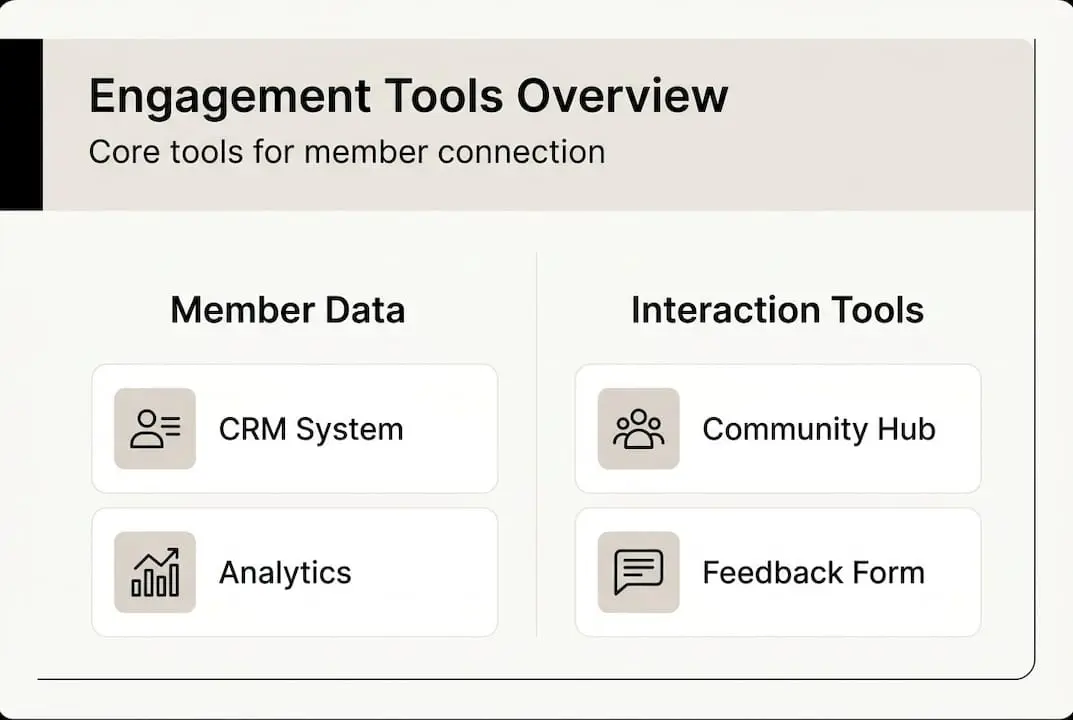
The right technology stack supports your engagement strategy without overwhelming your team or members. Each tool category serves specific functions, and integration between systems creates the visibility you need to personalise experiences effectively.
| Tool category | Primary function | Key benefit |
|---|---|---|
| CRM systems | Centralised member data and interaction tracking | Enables personalised communication at scale |
| Community platforms | Discussion forums, member directories, content sharing | Builds peer connections and knowledge exchange |
| Event management | Registration, ticketing, attendance tracking | Streamlines in-person and virtual gatherings |
| Email automation | Segmented campaigns, triggered messaging | Delivers timely, relevant content efficiently |
| Analytics dashboards | Engagement metrics, participation trends | Identifies opportunities and problem areas |
| Feedback tools | Surveys, polls, sentiment analysis | Captures member voice for continuous improvement |
Your CRM serves as the central nervous system, tracking every interaction and preference. When integrated with your other platforms, it creates a complete picture of each member’s journey. Event management tools handle logistics whilst feeding attendance data back to your CRM. Email automation ensures timely communication without manual effort.
Community platforms offer the greatest potential and the steepest challenges. They create spaces for members to connect directly, share expertise, and build relationships independent of your staff. However, launching a platform without a clear activation strategy leads to the ghost town effect that plagues so many organisations.

Analytics and feedback tools close the loop. You can’t improve what you don’t measure, and member input reveals blind spots your data might miss. The key is selecting tools that integrate seamlessly, reducing administrative burden whilst increasing insight.
Exploring nonprofit digital transformation helps you understand how these tools fit into broader organisational change. Effective engagement tactics leverage technology purposefully, and understanding engagement software benefits clarifies why integrated platforms outperform disconnected point solutions.
The psychology behind successful engagement strategies
Tools enable engagement, but psychology drives it. Members participate when they feel valued, connected to something larger than themselves, and confident their involvement creates meaningful impact. Transactional relationships built solely on discounts or access crumble when competitors offer better deals.
The most effective engagement strategies tap into fundamental human needs. Recognition validates contribution and effort. Community satisfies our innate desire for belonging. Impact demonstrates that participation matters beyond individual benefit. When your engagement approach addresses these psychological drivers, members become active participants rather than passive consumers.
Four pillars support psychologically sound engagement:
- Recognition systems that celebrate contributions publicly and privately, from volunteer efforts to knowledge sharing
- Inclusive practices ensuring diverse voices shape your organisation’s direction and programming
- Two-way communication that genuinely listens and responds to member input, not just broadcasts messages
- Purpose alignment connecting individual member goals with your organisation’s mission and impact
Pro Tip: Quality beats quantity in member communication. Avoid over-communication by establishing clear messaging priorities and respecting member attention. Three meaningful touchpoints outperform ten generic ones.
Your technology should support these psychological principles, not replace them. A CRM that tracks member preferences enables personalised recognition. Community platforms facilitate peer connections. Event management tools create opportunities for meaningful interaction. The software amplifies your strategy but never substitutes for genuine human connection.
Successful community building ideas centre on creating spaces where members feel safe contributing, valued for their expertise, and connected to peers facing similar challenges. These lasting engagement tactics require consistent effort and authentic commitment from leadership.
Building an effective engagement plan: Steps and considerations
Without a written plan, engagement efforts remain reactive and inconsistent. A strategic framework aligns your team, clarifies priorities, and establishes accountability for results. The process needn’t be complicated, but it must be documented and shared.
| Common gap | Practical solution |
|---|---|
| No written engagement strategy | Document goals, tactics, responsibilities, and metrics in a shared plan |
| Disconnected tools and data | Implement integrated platforms with centralised member records |
| Unclear ownership | Assign specific team members to engagement initiatives with defined success criteria |
| Ignoring lapsed members | Create reengagement workflows triggered by inactivity thresholds |
| No feedback mechanism | Establish regular pulse surveys and member advisory groups |
Building your engagement plan follows five essential steps:
- Review current state by auditing existing tools, participation rates, and member feedback to identify gaps and opportunities
- Identify priority tools based on your specific member needs and organisational capacity, not industry trends
- Define roles and responsibilities ensuring every engagement initiative has a clear owner and success metrics
- Test and pilot new approaches with small member segments before full rollout, gathering feedback iteratively
- Refine continuously using data and member input to adjust tactics, messaging, and tool usage quarterly
Lapsed member reengagement deserves special attention. These individuals already demonstrated interest by joining initially. Understanding why they disengaged and creating pathways back builds your community more efficiently than constant new member acquisition.
Pro Tip: Involve members in plan creation through focus groups or advisory committees. Their input increases buy-in and reveals blind spots your team might miss. Members who help shape strategy become its strongest advocates.
Your plan should address both quick wins and long-term initiatives. Quick wins build momentum and demonstrate value to sceptical stakeholders. Long-term initiatives create sustainable engagement infrastructure. Balance both to maintain energy whilst building lasting systems.
Consider refreshing engagement plans annually as member needs evolve and new tools emerge. Strong engagement also supports fundraising ideas by creating a community invested in your mission’s success.
Measuring success: Tracking, feedback, and continuous improvement
Data transforms engagement from guesswork into science. The right metrics reveal what’s working, what’s failing, and where to focus improvement efforts. However, measuring everything creates noise. Focus on metrics that directly connect to your strategic goals.
Essential engagement metrics include:
- Platform adoption rates showing what percentage of members actively use each tool
- Retention and renewal rates indicating overall satisfaction and perceived value
- Event participation tracking both registration and actual attendance across formats
- Feedback response rates measuring member willingness to share input
- Content engagement revealing which resources members find most valuable
- Community activity monitoring discussion participation, peer connections, and knowledge sharing
Tracking member behaviour provides insight into preferences and pain points. Anonymised data protects privacy whilst revealing patterns. Which email subject lines drive opens? What event formats attract different member segments? When do members typically disengage?
Regular feedback collection complements quantitative data with qualitative insight. Quarterly pulse surveys, post-event feedback forms, and annual comprehensive surveys create multiple touchpoints for member voice. The key is closing the loop by sharing what you learned and how you’re responding.
Reality check: Even the best community platforms achieve less than 40% member participation when not paired with strategic activation and ongoing nurturing. Technology enables engagement but doesn’t create it automatically.
Practical monitoring approaches include:
- Monthly dashboard reviews tracking core metrics against targets
- Quarterly deep dives into specific engagement initiatives or member segments
- Annual comprehensive assessments informing strategic planning
- Real-time alerts for concerning trends like sudden participation drops
- Member journey mapping identifying friction points in the experience
Your monitoring system should inform action, not just generate reports. When metrics decline, investigate root causes and test solutions. When initiatives succeed, document what worked and scale the approach. Continuous improvement requires both measurement and willingness to change based on what you learn.
Understanding fundraising metrics provides additional context, as engaged members typically contribute more financially and advocate more actively for your mission.
Take your engagement strategy further with Colossus Systems
You’ve now explored the tools, psychology, and frameworks that drive successful member engagement. Implementing these strategies requires technology that integrates seamlessly, scales with your growth, and supports rather than complicates your team’s work.
Our platform brings together the essential engagement tools you need in one unified system. From CRM and event management to community platforms and analytics, we’ve built solutions specifically for membership organisations facing the challenges you’re navigating. Our membership software features support the strategic approaches outlined in this guide, whilst our event management tools streamline both virtual and in-person gatherings. The CRM for membership organisations centralises your member data, enabling the personalised communication that drives genuine engagement.
We understand that technology alone never solves engagement challenges. That’s why our team works alongside you to implement tools strategically, aligned with your specific goals and member needs. Whether you’re building your first engagement plan or refreshing an existing strategy, we can help you select and deploy the right solutions for sustainable growth.
Frequently asked questions
What is the most important tool for boosting member engagement?
A well-integrated CRM system is often the most impactful, as it enables personalised communication and tracks member participation effectively.
How can you avoid over-communicating with members and causing fatigue?
Set a clear communication schedule and prioritise messages based on value, focusing on recognition and community-building rather than volume.
Why do many membership platforms have low member usage?
Often, platforms lack clear value to members or fail to foster a sense of belonging, resulting in less than 40% adoption among organisations with platforms.
What should an effective engagement plan include?
It should outline major tools, responsible roles, engagement goals, metrics for tracking, and a process for regular feedback and iteration.