New team member onboarding for membership organisations

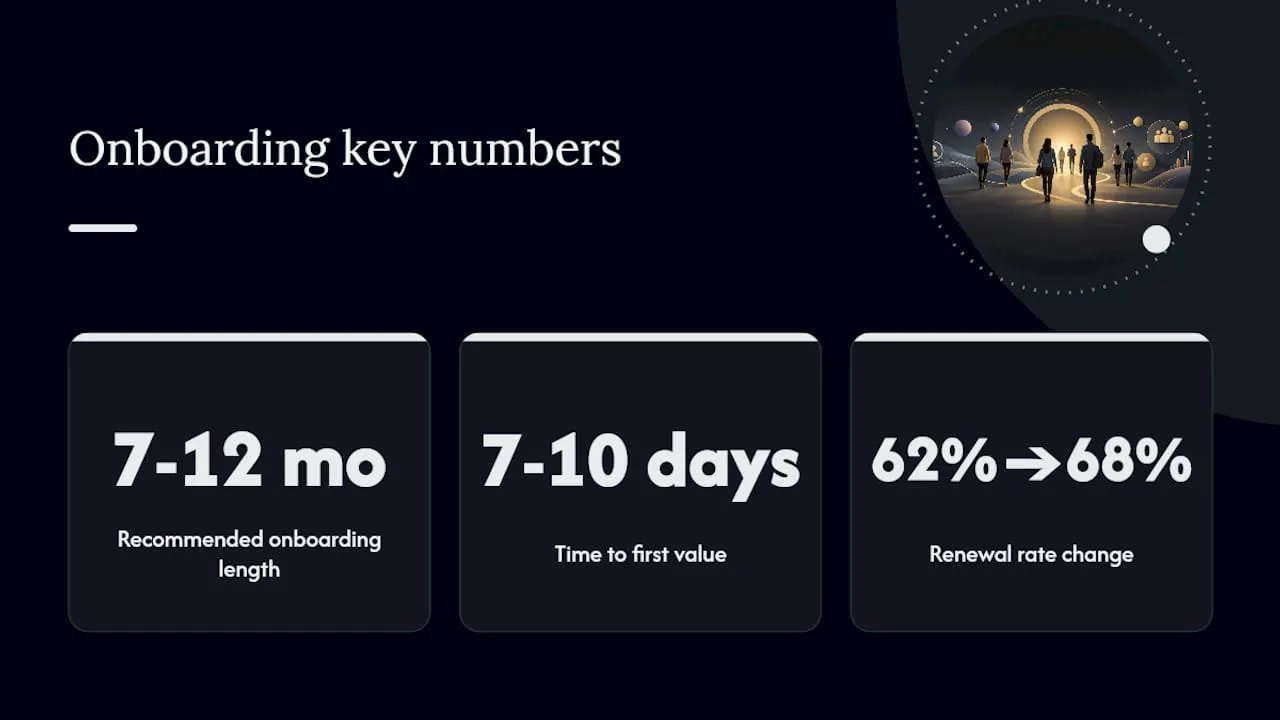
Run a staged onboarding programme lasting seven to 12 months, built to deliver a first-value win within the first seven to 10 days. That single design choice separates associations with strong renewal from those losing quiet members before their first anniversary.
Start this week with:
- A welcome sequence that begins the day someone joins, not the day someone remembers to send it
- One clear first-value action defined for the first 10 days
- A role-specific path for members, volunteers and chapter leaders (they are not the same onboarding)
- A mentor or buddy pairing triggered automatically
- Milestone check-ins scheduled at 30, 90 and 180 days
- Your membership-management system automating the repetitive steps
- A simple KPI dashboard tracking activation, not just sign-ups
Associations that implemented formal onboarding plans saw renewal climb from 62% to 68%. For membership organisations, that is the entire business case in one line.
Key Takeaways
Onboarding programmes that run seven to 12 months with a first-value action inside the first 10 days consistently outperform shorter, one-off welcome campaigns on renewal.
| Point | Details |
|---|---|
| Run a staged 7 to 12 month plan | Longer, structured programmes outperform the five-month plans most associations default to. |
| Deliver first value fast | Aim for a meaningful first action within seven to 10 days of joining, not weeks later. |
| Track activation, not sign-ups | Monitor 30-day activation, benefit engagement and event attendance as leading indicators of renewal. |
| Automate the repetitive steps | Join-date triggers, mentor matching and check-ins should fire automatically, not depend on memory. |
| Use Colossus Systems to run it | Colossus Systems combines membership management, CRM and event tools so onboarding workflows and reporting live in one system. |
Table of Contents
- Why new team member onboarding needs a 7 to 12 month plan
- What should a new team member onboarding programme include?
- What does a 7 to 12 month onboarding timeline look like?
- Which KPIs prove your onboarding programme is working?
- How does membership technology automate onboarding?
- How do you get budget and buy-in for onboarding?
- What actually moves the needle in onboarding
- How Colossus Systems supports your onboarding programme
- Frequently asked questions
- Sources
Why new team member onboarding needs a 7 to 12 month plan
Industry research on association engagement finds that plans spanning seven to 12 months outperform the shorter five-month programmes many organisations still run. A single welcome email and a membership card do not build loyalty. They build what looks suspiciously like buyer’s remorse, and it shows up quietly around renewal time.
The pattern repeats across sectors:
- Short onboarding windows correlate with weaker first-year renewal
- Long, staged plans give members time to actually use their benefits before being asked to pay again
- Most associations already run onboarding for five to 12 months; the best performers simply stretch and structure that window properly
For chapter leaders and volunteer coordinators, this means resisting the urge to declare onboarding “done” after week one.
What should a new team member onboarding programme include?
A working onboarding programme has nine moving parts, and skipping any one of them tends to show up later as a renewal problem, not an onboarding problem.
- Welcome communications that arrive within hours of joining, not days
- A clear first-value action — something the new person actually does, not just reads
- Role-specific orientation because a new committee member, a volunteer marshal and a chapter chair need entirely different first weeks
- Mentor or buddy pairing, ideally matched by shared interest or region rather than assigned at random
- Events and cohort introductions that put new people in a room (physical or virtual) with peers who joined around the same time
- Benefits activation, meaning someone actively walks the member through using at least one paid benefit
- Technology automations that fire based on behaviour, not a static calendar
- Documentation and policy acknowledgements, especially for volunteers and chapter leaders handling data, funds or safeguarding responsibilities
- Feedback loops that ask new members how the first month felt, and actually act on the answer
For members, the first-value action might be booking into the annual conference or accessing the resource library. For volunteers, it is usually completing an orientation shift alongside an experienced hand. For chapter leaders, it is often a governance briefing plus access to the chapter’s own management tools, ideally before they inherit an inbox nobody explained to them.
Pro Tip: Delay donation asks, upgrade pitches and merchandise offers until the member has completed their first-value action. Asking too early creates price sensitivity and signals that your organisation sees them as a revenue line before a person.
A progressive onboarding journey that simplifies the first experience and personalises by segment consistently outperforms a one-size-fits-all welcome pack. Your volunteers do not need the same document as your board candidates.
What does a 7 to 12 month onboarding timeline look like?
A sample calendar makes the seven to 12 month recommendation concrete. Here is a structure you can adapt directly.
- Day 0 — Automated welcome email plus login credentials or member portal access
- Day 3 — Personal follow-up (email or phone) referencing why they joined, if that data was captured at signup
- Week 2 — First-value nudge: a specific benefit, event, or resource to use, aiming to land within seven to 10 days of joining
- Day 30 — Mentor introduction and first milestone check-in, plus a short satisfaction pulse
- Day 60 — Invitation to a cohort event or new-member webinar
- Day 90 — Activation review: has the member engaged with at least two or three benefits?
- Month 6 — Deeper engagement push: committee involvement, volunteering opportunity, or advanced content
- Month 9 — Renewal-intent check, framed as a conversation rather than a sales call
- Month 12 — Renewal outreach, backed by a full record of what the member actually used
Nearly all associations already send at least one special new-member email, and 61% include a phone call somewhere in the plan. The organisations getting better renewal results are the ones layering both channels rather than choosing one.
Build a 30/90/180/365 checklist alongside this:
- 30 days: has the member logged in and completed one action?
- 90 days: have they attended or registered for one event?
- 180 days: have they engaged with three or more benefits?
- 365 days: renewal conversation, informed by the entire activity trail
Flag anyone missing a milestone for a manual outreach. That single escalation step catches most at-risk members before they go quiet.
Which KPIs prove your onboarding programme is working?
Track a mix of leading indicators (which predict trouble early) and lagging ones (which confirm the outcome).
- Time-to-first-value: the days between joining and completing that first meaningful action
- 30-day activation rate: the percentage who have logged in or engaged at all
- Benefit engagement: whether members have touched three or more benefits by the end of quarter one
- Event attendance: whether new members show up to at least one gathering in their first six months
- Mentor matches completed: a simple operational metric, but a strong predictor of engagement
- Satisfaction scores at day 30 and day 90: a quick pulse survey, not a full NPS exercise
- Renewal intent and actual renewal rate: the ultimate lagging measure
Review usage data daily if your platform supports it, cadence metrics weekly, and full reporting monthly, with a proper quarterly retrospective. Associations that formalised this measurement saw renewal move from 62% to 68% on average. Set an alert for anyone who has taken no action by day 30; that stalled window is the clearest early warning sign of a first-year lapse.
How does membership technology automate onboarding?
Manual onboarding does not scale past a few dozen new members a month, and even at small volumes it is where things quietly slip. The fix is a system that triggers actions off real events rather than relying on someone remembering to send an email.
Look for these capabilities in your membership-management platform:
- Join-date triggers that fire welcome sequences automatically, with no manual step
- Segmented workflows so a volunteer, a member and a chapter leader each receive a different path
- Behavioural triggers that catch no-login accounts and prompt a nudge or a human follow-up
- Automated mentor assignment based on rules you set (region, interest area, chapter)
- Event registration flows built directly into the onboarding sequence
- Policy acknowledgement tracking, so compliance sign-offs are logged, not chased over email
A typical flow looks like this: someone joins, triggering a welcome email; if they have not logged in by day five, a first-value reminder fires; a mentor match happens automatically based on their profile; and a 30-day check-in email goes out referencing whatever they have (or have not) done so far.
Colossus Systems bundles these capabilities into a single platform, so the membership management features, event tools and CRM all read from the same member record instead of three disconnected systems that never quite agree with each other.
Pro Tip: Personalise messages around the reason someone joined, captured at signup. Even basic segmented rules lift open rates and activation meaningfully compared with a single generic welcome blast sent to everyone.
How do you get budget and buy-in for onboarding?
Most onboarding programmes die at the budget conversation, not the design stage. Run a small pilot first.
- Define scope: one member segment or one chapter, tracked for three months
- Set two or three KPIs: 30-day activation, one event attendance, one satisfaction pulse
- Assign an owner, even part-time, for mentor coordination and check-ins
- Budget modestly: a welcome kit, one small event, and a few hours a week of coordinator time
Frame the business case around renewal, not activity. A projected renewal lift, fewer support tickets from confused new members, and faster time-to-first-value are numbers governance boards actually respond to. Share progress with a one-page results summary at the three-month mark rather than a lengthy report nobody reads.
What actually moves the needle in onboarding
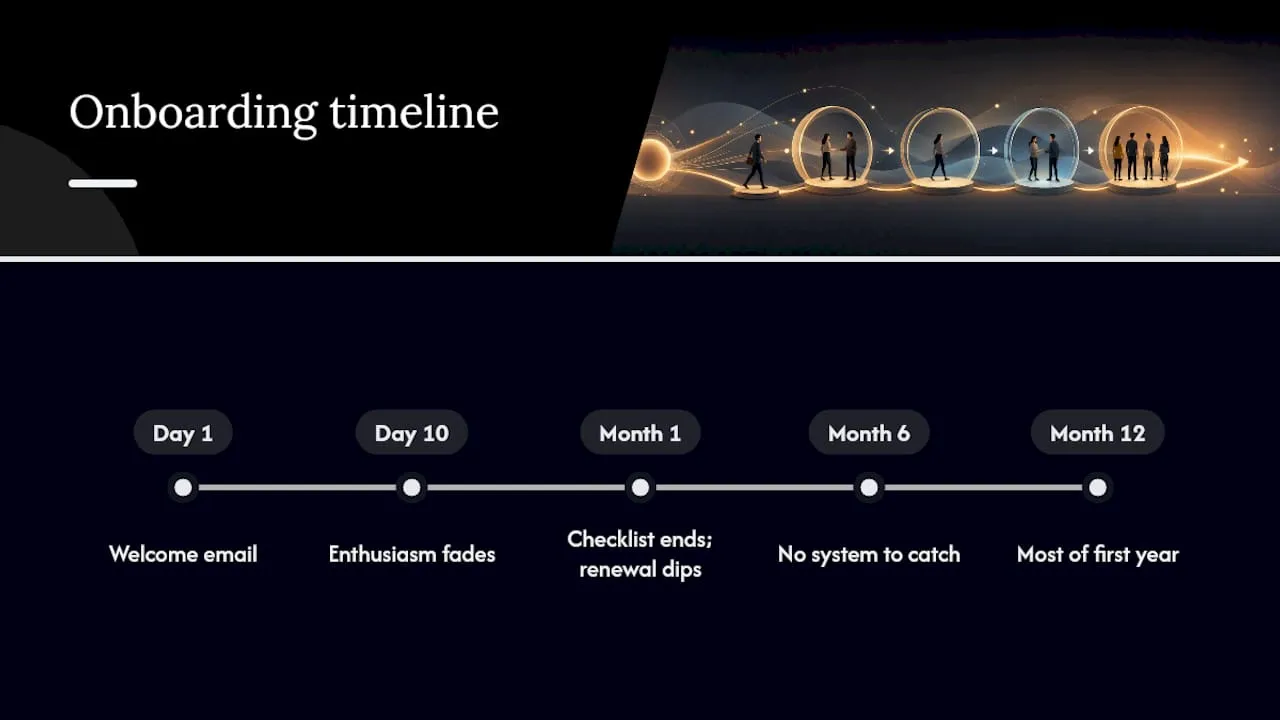
Most onboarding advice focuses on the welcome email. That is the easy part. The harder, less discussed problem is what happens between day 10 and month six, when enthusiasm fades and nobody has a system for catching it.
Organisations that treat onboarding as a checklist finish it in a month and wonder why renewal still dips. The ones getting real results treat it as a relationship with a calendar attached, running for most of the first year.
How Colossus Systems supports your onboarding programme
Building the workflow described above by hand, across spreadsheets and separate email tools, is exactly the kind of manual work that causes onboarding programmes to quietly fall apart after month two.
Colossus Systems brings join-date triggers, segmented welcome sequences, mentor matching and event registration into one platform, so a new member’s first 90 days runs on automation rather than someone’s memory. Reporting dashboards track activation and renewal intent in real time, which means you can see a stalled cohort before it becomes a lapsed one. The same system that handles your event management also handles the onboarding sequence feeding attendance into it, so the two never fall out of sync.
If you are ready to see how this maps onto your own membership structure, request a demo of Colossus Systems or get in touch through the contact page to talk through your first-year retention numbers.
Frequently asked questions
How long should new team member onboarding last for a membership organisation? Seven to 12 months works best, according to association engagement research, well beyond the single welcome email many organisations still treat as the whole process.
What is the single most important first step in onboarding new members? Delivering one clear, achievable first-value action within seven to 10 days of joining, whether that is logging into a portal, booking an event, or completing a profile.
Do volunteers and chapter leaders need different onboarding than regular members? Yes. A volunteer management guide shows volunteers typically need orientation shifts and mentor pairing, while chapter leaders need governance briefings and access to chapter-level tools before members even notice the difference.
How do we measure whether onboarding is working? Track time-to-first-value, 30-day activation, event attendance and eventual renewal rate. Organisations doing this formally have seen renewal move from 62% to 68%.
What technology do we need to automate onboarding? A membership-management platform with join-date triggers, segmentation and behavioural automation removes most of the manual chasing, letting your team focus on the mentor calls and check-ins that genuinely need a human.
Sources
- Association Onboarding engagement research (ASAE)
- First year member retention and onboarding system (Knecht Strategies)