Digital wellness tips to boost member engagement

TL;DR:
- Digital fatigue harms member engagement and staff wellbeing across organizations.
- Leadership behavior and clear policies are essential to promote digital wellness culture.
- Measuring engagement and stress levels helps refine strategies and sustain long-term health.
Member fatigue is quietly draining the energy from membership organisations across every sector. When digital channels multiply without structure, staff and members alike begin to disengage, contributing to declining participation and rising stress. Global wellness spending is projected to reach $94.6 billion by 2026, yet many leaders still treat digital wellness as an afterthought rather than a strategic priority. This guide offers practical, evidence-based strategies that organisational leaders can implement right now to build healthier digital cultures, improve member engagement, and drive long-term organisational health.
Table of Contents
- Identifying digital wellness needs in your organisation
- Preparing for digital wellness: Tools, policies and leadership modelling
- Executing digital wellness strategies: Concrete tactics for engagement
- Verifying impact: Measurement and continuous improvement
- Why digital wellness starts and ends with leadership
- Take your digital wellness further with our software solutions
- Frequently asked questions
Key Takeaways
| Point | Details |
|---|---|
| Digital boundaries matter | Setting clear rules for after-hours communication reduces stress and builds a healthier culture. |
| Leadership drives wellness | Leaders must actively model digital wellbeing to inspire lasting behaviour change in their teams. |
| Balance engagement and detox | Organisational success comes from mixing proactive digital engagement with evidence-based wellness measures. |
| Measurement is key | ROI, engagement scores, and reduced stress days are better impact indicators than app usage alone. |
| Continuous improvement | Review and adapt digital wellness strategies regularly to maintain high member engagement and health. |
Identifying digital wellness needs in your organisation
With the importance of digital wellness established, it is vital to determine where your organisation stands and what specific challenges it faces. You cannot design effective solutions without first understanding the problem in detail.
Recognising the signs of digital fatigue
Digital fatigue shows up in predictable ways, once you know what to look for. Members may begin to ignore email newsletters they once opened consistently. Staff may report feeling overwhelmed by constant notifications, back-to-back virtual meetings, and an expectation to be always available. Attendance at virtual events drops. Replies to community polls slow. Survey scores for satisfaction dip without any obvious cause. These are not coincidences; they are warning signals that your digital environment has become more taxing than rewarding.
Engagement surveys are one of the most reliable assessment tools available to leaders. A short, targeted survey sent quarterly can reveal precisely where members feel overstimulated and where they feel under-served. Pair this with screen time tracking tools embedded in your existing platforms, which show how long members spend interacting with your content and whether that time correlates with positive outcomes such as renewals and event sign-ups. Understanding healthy screen time habits gives leaders a benchmark to work towards when setting internal digital policies.
Digital wellness risks vs. engagement benefits
| Factor | Digital wellness risk | Engagement benefit |
|---|---|---|
| High notification volume | Overwhelm, disengagement | Timely updates, prompt action |
| Always-on communication | Burnout, boundary erosion | Faster response, community feeling |
| Multiple platforms | Fragmentation, confusion | Broader reach, varied touchpoints |
| Rich media content | Screen fatigue, distraction | Higher retention, emotional connection |
| Data analytics use | Privacy concerns, overwhelm | Personalised experience, better ROI |
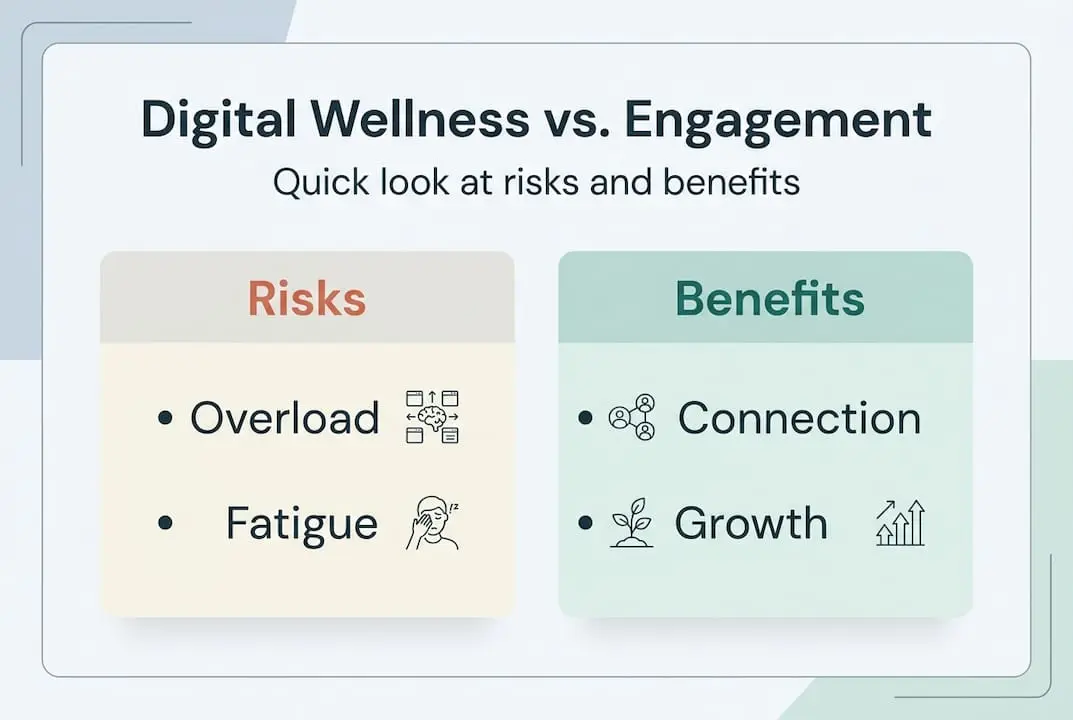
This comparison shows that every engagement lever carries a corresponding wellness risk. Your goal as a leader is not to eliminate digital engagement, but to calibrate it thoughtfully. Investing in digital transformation for nonprofits and developing clear digital communication strategies are excellent starting points for achieving that balance within a structured framework.
Common signs of digital fatigue among members and staff:
- Declining email open rates and click-through rates over consecutive campaigns
- Increased unsubscribe rates following periods of intensive communication
- Reduced attendance at virtual events, particularly those held outside core hours
- Staff reporting difficulty concentrating due to constant platform notifications
- Members expressing frustration with duplicate messages across multiple channels
- Elevated staff sickness or stress leave during high-volume digital periods
“Leaders model healthy digital behaviours, such as avoiding after-hours communication and taking regular breaks, setting the standard that ripples through the entire organisation.” Establishing clear boundaries at the leadership level is not a soft benefit; it is a strategic decision that directly influences organisational culture and member experience.
Preparing for digital wellness: Tools, policies and leadership modelling
Once digital wellness gaps and engagement areas are identified, leaders can prepare for change through structured policies, the right tools, and visible example-setting. Preparation is the stage that most organisations skip, and it is precisely why their wellness initiatives fail to take hold.
Policy, tools and leadership at a glance
| Area | Example action | Expected outcome |
|---|---|---|
| Policy | No after-hours email policy | Reduced stress, clearer boundaries |
| Digital tools | Notification scheduling software | Fewer interruptions, focused work |
| Leadership modelling | Leaders publicly switch off at end of day | Cultural normalisation of boundaries |
| Training | Digital literacy workshops for staff | Confident, less overwhelmed teams |
| Measurement | Regular wellness pulse surveys | Data to guide ongoing improvements |
Step-by-step guide for preparing digital wellness initiatives
-
Conduct a digital audit. Map every communication channel your organisation uses, including email, social media, internal messaging platforms, and member portals. Identify which are essential and which create unnecessary overlap or noise.
-
Draft a digital wellness policy. Include specific commitments such as defined communication windows, limits on after-hours messages, and recommended screen break intervals. A strong workplace wellness strategy provides a reliable template to adapt for membership organisations.
-
Select appropriate tools. Invest in notification management software, meeting scheduling tools that respect focus time, and platform analytics that reveal engagement without adding to cognitive load.
-
Brief leadership teams. Leaders who consistently check emails at midnight send a clear cultural signal, regardless of what any written policy says. Brief your leadership team on the behaviours expected of them.
-
Communicate the initiative to members and staff. Transparency builds trust. Explain why you are introducing digital wellness measures and what benefits they can expect to see.
-
Build review cycles into your plan. Set quarterly review dates from the outset. Wellness policies that are not reviewed become irrelevant within months.
It is worth noting that written policies alone rarely achieve change. Organisational resilience for nonprofits depends on building systems that support those policies in practice. Technical enforcement, such as scheduling tools that prevent emails from being sent outside defined hours, dramatically improves compliance without relying solely on individual willpower. Research supports no after-hours email policies as a tangible way to protect personal time and reduce workplace stress.
Pro Tip: Rather than simply asking staff not to send after-hours emails, configure your email platform to delay delivery until the next working day. This removes the burden of self-regulation and makes compliance almost effortless. Supporting digital fundraising strategies with good wellness boundaries also ensures that intensive campaign periods do not cause lasting burnout.
Executing digital wellness strategies: Concrete tactics for engagement
Now equipped with the right tools and policies, organisations can apply practical digital wellness tactics with a clear focus on balancing engagement with member wellbeing.
Steps for executing wellness tactics
-
Throttle notifications systematically. Rather than switching notifications off entirely, configure your platforms to batch non-urgent alerts into scheduled summaries. This keeps members informed without the relentless interruption of real-time pings. Notification throttling and app limits reduce context-switching by up to 62%, a significant productivity and wellbeing gain for any organisation.
-
Set app usage limits for internal teams. Many staff productivity platforms allow administrators to configure usage recommendations. Use these settings to encourage staff to engage deeply with fewer tools rather than superficially with many.
-
Schedule focused digital engagement windows. Rather than expecting members to engage across the day at random intervals, concentrate your most important communications and content releases within clearly defined windows, such as Tuesday and Thursday mornings.
-
Introduce structured digital detox periods. Periodic detox initiatives, ranging from a tech-free Friday afternoon to a full weekend break from organisational digital channels, can reset attention and motivation. Digital detox initiatives such as blocking mobile internet have been shown to improve mood, attention, and reduce excessive screen time, with many participants reporting benefits within two weeks.
-
Reduce platform fragmentation. Every additional platform your organisation uses is another context-switch for your members and staff. Consolidate where possible.
-
Personalise digital communications. Blanket communications contribute to fatigue because members receive content irrelevant to their interests. Targeted content, delivered less frequently but with higher relevance, consistently outperforms volume-based strategies.
Techniques for balancing engagement and wellness:
- Use segmented email lists so members only receive communications directly relevant to their membership type or interests
- Offer members a communication preference centre where they can choose frequency and channel
- Schedule virtual events at varied times to accommodate different lifestyle patterns
- Create asynchronous engagement opportunities, such as recorded webinars and discussion forums, alongside live events
- Build in deliberate quiet periods after intensive engagement campaigns
- Encourage community engagement in face-to-face formats as a complement to digital interaction
Building digital literacy across your membership and staff base also reduces fatigue significantly. When people understand which tools to use for which purpose, they stop duplicating effort and drowning in unnecessary notifications. Linking your digital advocacy initiatives to clear wellness boundaries reinforces the message that your organisation values its members as whole people, not just data points. The fundamentals of sound membership management basics always include understanding member capacity and respecting it.

Real-world scenario: Consider a professional association that sends daily digest emails to all 3,000 members. Open rates fall to 12% within six months. When they switch to twice-weekly tailored emails based on member interest tags, open rates rise to 38% and unsubscribe rates fall by half. Members report feeling less overwhelmed, and event registrations increase. The organisation achieves more engagement by doing less, but doing it more intelligently.
Verifying impact: Measurement and continuous improvement
After implementing digital wellness tactics, it is vital to ensure they are delivering real engagement and measurable health improvements. Without proper measurement, even excellent strategies become invisible.
Key engagement and wellness metrics to track:
- Email open rates and click-through rates, tracked month-on-month
- Event attendance rates, broken down by format, time, and audience segment
- Member renewal and retention rates correlated against communication frequency changes
- Staff stress and wellbeing scores from regular pulse surveys
- Digital channel participation rates across platforms
- Number of unsubscribes or opt-outs following specific campaigns
- Average screen time per session on your member portal
- Net Promoter Score (NPS), a measure of how likely members are to recommend your organisation
Digital platforms have been shown to improve member engagement in health plans with 50% growth in digital channels when organisations commit to ROI-focused digital strategies. This is a significant benchmark for any membership organisation. Understanding what digital engagement truly means in measurable terms is a critical foundation for this measurement phase.
Pro Tip: Do not let app usage statistics dominate your reporting dashboards. A member who logs in briefly but renews their membership and attends three events is more valuable than one who spends hours browsing but never takes meaningful action. Focus your measurement on ROI, stress day reduction, and quality engagement outcomes.
Summary of key measurement points
| Strategy area | What to measure | How often |
|---|---|---|
| Communication wellness | Open rates, unsubscribes, opt-out trends | Monthly |
| Event engagement | Attendance rates, post-event survey scores | Per event |
| Staff wellbeing | Stress pulse survey scores, sick day patterns | Quarterly |
| Platform health | Session duration, feature adoption rates | Monthly |
| Financial impact | Renewal rates, revenue per member | Annually |
Continuous improvement means revisiting your wellness policies every quarter, not every year. Staff and member needs evolve, platform landscapes shift, and what worked six months ago may now be creating new pressures. Build a culture of honest feedback by making it easy for members and staff to flag when digital demands feel excessive. Linking your measurement approach to broader membership growth digital transformation goals ensures wellness remains embedded in strategic planning rather than treated as a separate initiative. Sustainable growth and a genuine commitment to boosting member engagement go hand in hand with protecting the wellbeing of the people at the heart of your organisation.
Why digital wellness starts and ends with leadership
Having explored digital wellness strategies and their measurement, it is worth addressing an uncomfortable truth that many articles in this space gloss over. Tools do not change culture. Policies do not change culture. Leaders do.
We have seen organisations invest in the best notification management software available, draft beautifully worded wellness policies, and still watch their teams check emails at 11pm because their director does. The policy sits in a shared drive. The leader’s behaviour sets the actual standard. This is not a criticism; it is an observation about how human organisations actually function.
Balancing digital tools for engagement with genuine detox practices requires leaders to model the boundaries they want to see, visibly and consistently. That means not sending Sunday evening messages. It means taking screen breaks in meetings. It means acknowledging when digital demands have become unreasonable. Shared accountability matters too. When wellness is positioned as a leadership-only responsibility, it fails. The strongest organisations make wellness a team commitment, with leaders setting the initial example and members and staff collectively reinforcing the norm. Resistance is normal. Compliance takes months, not weeks. But the organisations that persist see lasting cultural shifts that improve both wellbeing and engagement.
Take your digital wellness further with our software solutions
For leaders seeking scalable, practical ways to embed digital wellness and boost member engagement, Colossus Systems offers solutions that complement these strategies directly.
Our platform brings together the tools you need to manage communications, events, and member relationships without creating digital overload. With our membership management software features, you can segment your audience, schedule targeted communications, and track engagement metrics from one unified dashboard. Our event management software makes it straightforward to plan and deliver events that respect member time and attention. Combined with our CRM software, your organisation gains a clear, actionable view of member behaviour. Request a demo today and see how we can help you build a healthier digital culture.
Frequently asked questions
How can after-hours email policies improve organisational wellness?
By limiting after-hours emails, organisations protect staff personal time, reduce stress, and establish clear boundaries that form the foundation of a healthy digital culture.
What digital wellness metrics should leaders track for maximum impact?
Leaders should track engagement scores, stress days reduction, ROI, and digital channel participation rather than relying on app usage statistics alone, which rarely reflect genuine member health or satisfaction.
What is the evidence for digital detox effectiveness in organisations?
Digital detox initiatives such as blocking mobile internet improved mood and attention in the majority of participants, with measurable benefits appearing within two weeks of consistent practice.
How do leaders model healthy digital behaviour for their teams?
Leaders can set the standard by avoiding after-hours communication, taking visible screen breaks, and applying wellness policies to their own routines before expecting teams to follow.
Does increased digital engagement risk member exhaustion?
Proactive digital engagement can boost retention, but it must be balanced with structured wellness practices to prevent the exhaustion that undermines long-term member loyalty and organisational health.