Building Organisational Resilience for Nonprofits

Most british nonprofit organisations now confront more unexpected challenges than ever before. For executive directors juggling limited resources, the need to sustain member engagement while building organisational resilience is urgent. Recent studies show that nonprofits with strong adaptive capabilities are up to 60 percent more likely to maintain impact during crises. This article examines practical, proven strategies to help leaders like you strengthen resilience, enhance engagement, and safeguard your mission through turbulent times.
Table of Contents
- Defining Organisational Resilience For Nonprofits
- Types And Models Of Resilience In Membership Bodies
- Key Features: Adaptability, Mission Focus And Culture
- Governance, Leadership And Financial Diversification
- Risks, Challenges And Common Mistakes To Avoid
- Embedding Resilience: Technology And Data-Driven Engagement
Key Takeaways
| Point | Details |
|---|---|
| Organisational Resilience | Nonprofits must develop adaptive capacities, transformative potential, and systemic preparedness to effectively navigate complex challenges while maintaining their mission focus. |
| Strategic Leadership | Effective leadership involves governance frameworks that ensure adaptability and ethical accountability, while also preparing for succession and developing diverse financial strategies. |
| Cultural Integration | A culture of continuous learning, psychological safety, and collaborative problem-solving is essential for fostering resilience and organisational integrity. |
| Technology Utilisation | Nonprofits should leverage technology strategically to enhance communication, streamline operations, and build a responsive digital ecosystem that supports their mission. |
Defining organisational resilience for nonprofits
Organisational resilience represents a nonprofit’s capacity to anticipate, respond to, and adapt through complex challenges while maintaining core mission effectiveness. It extends far beyond mere financial stability, encompassing a holistic approach to navigating organisational disruptions with strategic agility and systemic strength. Emerging research in nonprofit management reveals resilience as a dynamic interaction between an organisation’s structures, processes, and external environment.
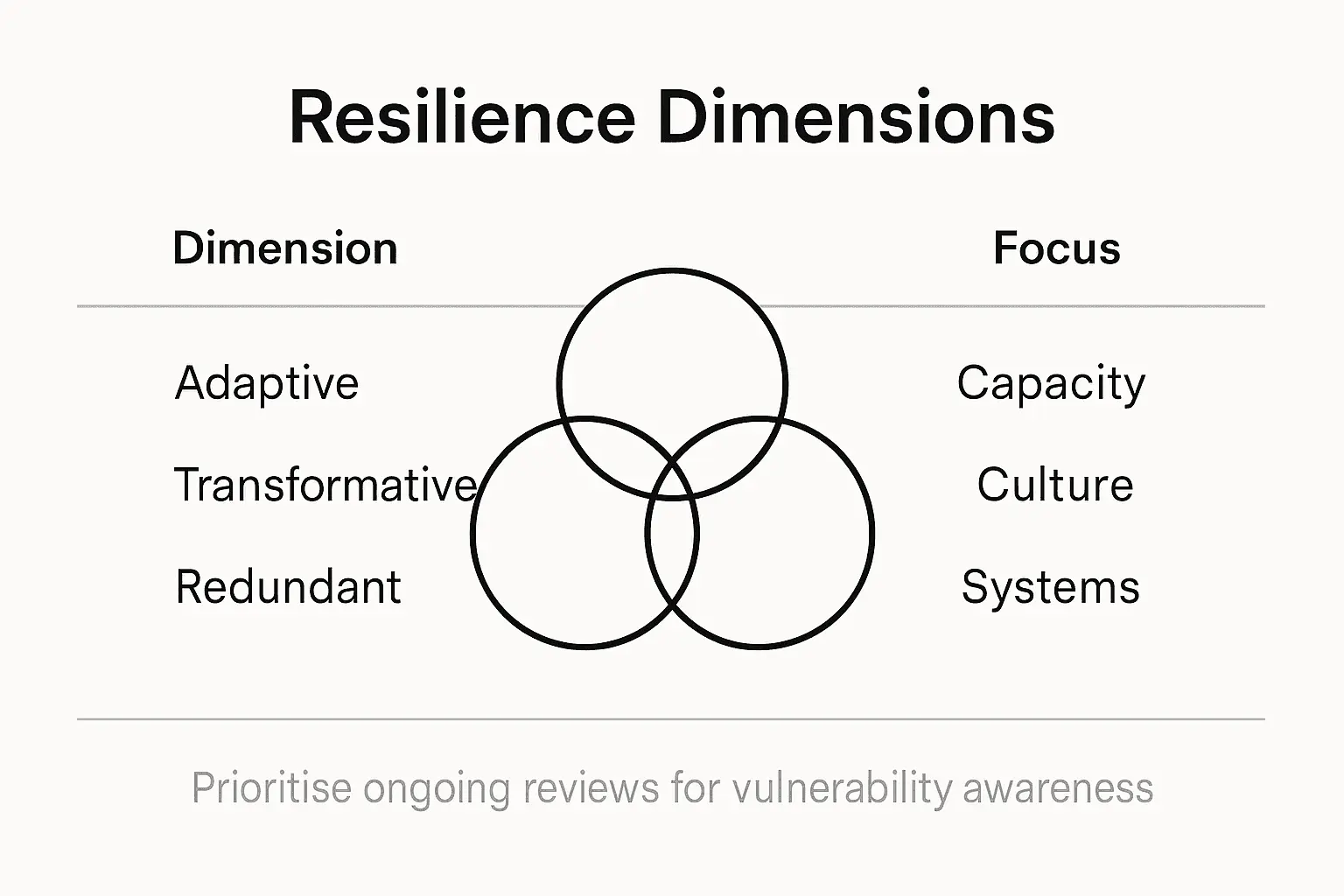
At its core, organisational resilience involves three critical dimensions: adaptive capacity, transformative potential, and systemic preparedness. Nonprofits demonstrating high resilience can absorb unexpected shocks, rapidly recalibrate operational strategies, and continue delivering meaningful impact even under challenging circumstances. This requires a multifaceted approach integrating leadership flexibility, robust communication channels, strategic resource allocation, and a culture of continuous learning and innovation.
Systematic review findings highlight that resilient nonprofits prioritise developing surplus capacities that extend beyond immediate financial considerations. These organisations invest in building comprehensive recovery frameworks, nurturing strong interpersonal relationships, and developing adaptive leadership skills that enable them to pivot effectively during systemic disturbances. Key resilience capabilities include scenario planning, risk management, collaborative networking, and maintaining psychological safety within teams.
Here’s how the dimensions of organisational resilience differ in focus and impact:
| Dimension | Core Focus | Typical Activities | Strategic Impact |
|---|---|---|---|
| Adaptive Capacity | Rapid adjustment | Scenario planning, staff training | Enables quick response to shock |
| Transformative Potential | Fundamental change | Innovation projects, leadership | Drives growth through challenge |
| Systemic Preparedness | Structural readiness | Risk modelling, resource mapping | Maintains mission during crisis |
Pro tip: Conduct a quarterly organisational resilience audit to proactively identify potential vulnerabilities and develop strategic mitigation strategies before challenges emerge.
Types and models of resilience in membership bodies
Membership organisations require nuanced approaches to understanding resilience that go beyond simplistic recovery models. Contemporary research reveals a sophisticated framework categorising organisational resilience into four distinct yet interconnected components: fragility, robustness, adaptation, and transformation. These dimensions represent a comprehensive approach to understanding how membership bodies can strategically navigate complex operational challenges.
The ART framework provides another critical perspective on resilience, integrating multiple dimensions of organisational capacity. This model emphasises acknowledging existing resources, reframing potential threats as opportunities for growth, and developing tailored adaptive responses. By recognising resilience as a multi-level phenomenon, membership organisations can develop strategies that operate across individual, team, and systemic levels, ensuring a holistic approach to managing uncertainty and change.
Each resilience model offers unique insights into how membership bodies can build sustainable operational capabilities. The fragility component identifies potential vulnerabilities, robustness ensures core functions remain stable during disruptions, adaptation enables dynamic response mechanisms, and transformation allows for fundamental reimagining of organisational structures and processes. Comprehensive resilience models underscore that resilience is not merely about surviving challenges, but strategically evolving through them.
Below is a summary contrast between resilience models for membership bodies:
| Model/Framework | Primary Approach | Key Strength | Typical Weakness |
|---|---|---|---|
| Four-Component | Fragility, robustness, etc. | Holistic challenge navigation | May require extensive data |
| ART Framework | Resource/Threat/Reframing | Multi-level adaptability | Complexity for small organisations |
Pro tip: Develop a dynamic resilience scorecard that regularly assesses your organisation’s performance across fragility, robustness, adaptation, and transformation dimensions to proactively identify and address potential systemic weaknesses.
Key features: adaptability, mission focus and culture
Successful nonprofit resilience hinges on three fundamental interconnected features: adaptability, mission focus, and organisational culture. These elements work synergistically to enable nonprofits to navigate complex challenges while maintaining their core purpose and operational integrity. Adaptability emerges as a critical capability, allowing organisations to pivot strategies, reimagine service delivery, and respond creatively to emerging operational landscapes.
The mission-centric approach serves as the organisational compass, ensuring that despite external disruptions, nonprofits remain anchored to their fundamental objectives. This requires developing governance structures and leadership practices that consistently align operational decisions with core organisational values. Adaptable organisations cultivate learning environments that encourage experimentation, tolerate calculated risks, and view challenges as opportunities for innovative problem-solving and strategic transformation.
Organisational practices for enhancing resilience demonstrate that culture plays a pivotal role in building systemic resilience. By fostering a culture of continuous learning, psychological safety, and collaborative problem-solving, nonprofits can create adaptive mechanisms that transcend traditional hierarchical limitations. This involves developing decentralised decision-making processes, promoting transparency, and creating supportive frameworks that enable staff to contribute meaningfully during uncertain periods.
Pro tip: Conduct monthly mission alignment workshops that encourage team members to critically reflect on how current strategies connect with the organisation’s core purpose, and identify potential adaptive responses to emerging challenges.
Governance, leadership and financial diversification
Strong nonprofit governance requires a sophisticated approach that balances strategic oversight, ethical accountability, and adaptive leadership. Boards must develop comprehensive frameworks that enable informed decision-making while maintaining mission-critical focus amid complex operational challenges. This involves cultivating leadership capabilities that can navigate political scrutiny, funding uncertainties, and rapidly evolving organisational landscapes.

Effective leadership succession planning represents a critical component of organisational resilience. Nonprofits must develop robust mechanisms for identifying, nurturing, and transitioning leadership talent, ensuring continuity and strategic alignment. This approach demands creating transparent career development pathways, investing in leadership training programmes, and establishing mentorship frameworks that build institutional knowledge and adaptability across different organisational levels.
Organisational financial strategies are fundamental to building sustainable resilience. Financial diversification goes beyond traditional fundraising, requiring nonprofits to develop multiple revenue streams, establish strategic reserves, and create flexible financial models that can withstand economic fluctuations. This might involve exploring innovative funding mechanisms, developing earned income strategies, cultivating diverse donor relationships, and implementing rigorous financial risk management protocols.
Pro tip: Conduct quarterly financial scenario planning sessions that simulate potential economic disruptions and develop adaptive financial strategies to maintain organisational stability and mission delivery.
Risks, challenges and common mistakes to avoid
Measuring resilience in nonprofits requires a nuanced understanding that goes beyond simplistic quantitative metrics. Organisations frequently encounter critical pitfalls that can undermine their strategic effectiveness, including overreliance on numeric indicators without contextual comprehension, insufficient attention to staff psychological well-being, and inadequate investment in organisational capacity-building initiatives. Recognising these challenges represents the first step towards developing more robust, adaptive organisational frameworks.
The risk management landscape for nonprofits involves navigating complex operational uncertainties. Common mistakes include neglecting comprehensive contingency planning, underestimating potential crisis impacts, and demonstrating insufficient leadership commitment to strategic preparedness. These vulnerabilities can create systemic weaknesses that compromise an organisation’s ability to respond effectively when unexpected challenges emerge. Successful nonprofits develop proactive risk awareness cultures that integrate strategic thinking, scenario planning, and adaptive response mechanisms.
Nonprofit risk management demands deliberate investment in redundancy, communication frameworks, and strategic flexibility. Key challenges include maintaining organisational momentum during disruptions, balancing mission integrity with operational adaptability, and creating sustainable risk mitigation strategies. Organisations must develop holistic approaches that view risk not as a threat, but as an opportunity for innovation, learning, and strategic transformation.
Pro tip: Implement a quarterly cross-departmental risk assessment workshop that systematically identifies potential organisational vulnerabilities and develops collaborative mitigation strategies.
Embedding resilience: technology and data-driven engagement
Digital transformation strategies have become critical for nonprofit organisations seeking to enhance operational resilience and community impact. Technology provides sophisticated mechanisms for improving communication, resource mobilisation, and adaptive service delivery, enabling organisations to respond dynamically to emerging challenges. By leveraging digital platforms, nonprofits can expand their reach, streamline operations, and create more responsive engagement models that transcend traditional organisational boundaries.
The technology resilience framework emphasises strategic consolidation and intentional digital ecosystem development. Successful implementation is not about accumulating multiple technological tools, but about carefully integrating platforms that align with organisational strategy and mission. This approach requires continuous evaluation of technological infrastructure, ensuring that digital systems reduce operational friction, enhance donor engagement, and support mission-critical activities through intelligent, data-driven insights.
Nonprofit technology roadmaps highlight the importance of strategic simplification and purposeful digital adoption. Organisations must develop nuanced approaches that prioritise efficiency, scalability, and seamless integration. Key considerations include selecting platforms that offer robust analytics, supporting real-time decision-making, enabling flexible communication channels, and creating adaptive infrastructure that can rapidly respond to changing operational requirements.
Pro tip: Conduct a comprehensive digital ecosystem audit every six months, mapping technological tools against strategic objectives and identifying opportunities for streamlining and integration.
Empower Your Nonprofit with Resilient Member Engagement Solutions
Building organisational resilience is essential for nonprofits seeking to adapt quickly, maintain mission focus, and thrive through uncertainty. The article highlights key challenges such as adaptive capacity, strategic resource allocation, and effective communication — areas where many membership organisations struggle to integrate technology and maintain robust governance simultaneously. Addressing these pain points ensures your organisation can navigate disruption confidently while fostering member loyalty and continuous innovation.
Colossus Systems offers a comprehensive platform tailored to these exact needs. Our solution streamlines member management, event planning, virtual training, and CRM within a single, customisable system designed to boost operational resilience and mission impact. By centralising communication channels and automating complex processes, you’ll strengthen your organisation’s ability to adapt and innovate without overwhelming staff or compromising your core values.
Get started on transforming your nonprofit’s resilience strategy with tools built for growth and sustainable engagement.

Discover how Colossus empowers you to enhance organisational adaptability and mission alignment today. Contact our team to explore tailored solutions that match your resilience goals: Get in Touch. For more insights on optimising nonprofit operations, see how organisational practices for enhancing resilience and financial diversification strategies can complement your tech-driven approach.
Frequently Asked Questions
What is organisational resilience for nonprofits?
Organisational resilience for nonprofits refers to their ability to anticipate, respond to, and adapt to complex challenges while effectively maintaining their core mission. It encompasses a holistic approach that goes beyond financial stability, focusing on adapting to disruptions and ensuring strategic agility.
What are the key dimensions of organisational resilience?
The key dimensions of organisational resilience include adaptive capacity, transformative potential, and systemic preparedness. These dimensions help organisations quickly absorb shocks, recalibrate strategies, and continue delivering impactful services during challenging times.
How can nonprofits enhance their adaptability?
Nonprofits can enhance adaptability by fostering a culture of continuous learning, encouraging experimentation, and maintaining open communication channels. This enables organisations to pivot strategies and creatively respond to emerging operational challenges.
What role does technology play in building organisational resilience?
Technology plays a crucial role in enhancing operational resilience by improving communication, resource mobilisation, and service delivery. A strategic approach to digital transformation allows nonprofits to streamline operations and create more responsive engagement models with their communities.