Nonprofit Sustainability Plans: A 2–3 Year Roadmap for Leaders

A nonprofit sustainability plan is a structured, multi-year roadmap for keeping an organisation financially stable and mission-focused, typically covering a 2-3 year horizon. A plan that works produces key elements such as diversified revenue to avoid overreliance on any single funder, operating reserves that help absorb shocks, and measurable KPIs that link financial decisions to mission impact.
TL;DR:
- Calculate cash runway by dividing unrestricted cash by average monthly operating expenses, then assess program surpluses, deficits, and revenue concentration before setting priorities.
- Organizations with less than three months of operating cash face greater vulnerability; set reserve release triggers in advance and define who can authorize withdrawals.
- Test one or two earned income pilots alongside existing revenue, and measure each against a specific target before deciding whether to scale it.
- Boards should set risk tolerance and approve major shifts, while staff manage execution and report reserves, revenue mix, and KPI status in quarterly board packets.
- Review cash and spending monthly, revenue mix and reserve trends quarterly, and the full plan annually; use leading indicators to act before funding shortfalls deepen.
Table of Contents
- What the plan covers and how it differs from other documents
- Core components every sustainability plan should include
- Step-by-step process to build or refresh a plan
- Concrete finance measures: reserves, runway, and earned income
- What trustees and senior leaders must do to make the plan real
- KPIs, dashboards and the cadence of review
- How to prepare for shocks: scenarios, levers and communications
- ESG considerations, templates and practical tools
- A note from the author
- How Colossus Systems fits into your sustainability plan
- FAQ
- Sources
What the plan covers and how it differs from other documents
Boards and executive directors often confuse a sustainability plan with the annual budget or the strategic plan, and that confusion is part of why so many organisations lack one. A budget tells you what you expect to spend and earn this year. A strategic plan sets direction for programmes and growth over several years. A sustainability plan sits between the two and answers a different question: can we keep doing this, at this level, if conditions change?
According to Instrumentl’s framework, a sustainability plan is a strategic framework that outlines an organisation’s long-term operational and financial capacity to maintain its mission, bridging the gap between annual budgets and long-term strategic goals by identifying the resources, partnerships and revenue streams required for continuity over several years. It typically addresses leadership transitions, funding volatility and changing community needs, which are not usually anticipated in a one-year budget.
The plan answers specific, practical questions across four domains:
- Finance: how much revenue comes from each source, and what happens if the largest one disappears
- Programmes: which activities generate surplus, which require subsidy, and whether that balance is sustainable
- Operations: whether staffing, technology and partnerships can support the organisation at current or planned scale
- Governance: who decides when conditions change, and how quickly
A multi-year horizon is a pragmatic choice: it is long enough to show the effect of a diversification strategy or a new earned-income pilot, yet short enough that assumptions about funding, staffing and demand are reasonably reliable. Organisations that plan sustainability over very long periods often produce documents that sound good but are less useful for real decisions because later assumptions may become inaccurate.
If your organisation already has a strategic plan built around engagement and impact, the sustainability plan should sit alongside it, translating strategic ambition into financial and operational terms.
Core components every sustainability plan should include
A complete plan covers seven areas. Missing any one of them tends to produce a document that looks thorough but leaves a real gap in practice.
- Mission alignment and strategic priorities: every financial or operational choice traces back to why the organisation exists
- Revenue map and diversification strategy: a clear picture of current revenue sources and a plan to reduce dependence on any single one
- Operating reserves and cash-runway approach: a target reserve level, how it is built, and the conditions under which it can be used
- Programme financial models: which programmes are revenue-generating, which are mission-critical but subsidised, and how that portfolio balance is managed
- Governance, roles and accountability: who owns which part of the plan, and how the board exercises oversight
- Monitoring and reporting framework: the KPIs tracked and how often they are reviewed
- Operational resilience items: technology systems, staffing continuity and partnerships that keep the organisation functioning under stress
Mission alignment comes first because sustainability work without it drifts toward chasing whatever funding is available, which erodes the identity that makes an organisation fundable in the first place. The revenue map should show not just totals but concentration: what percentage comes from the top three funders, and what the plan does to lower that number over time.
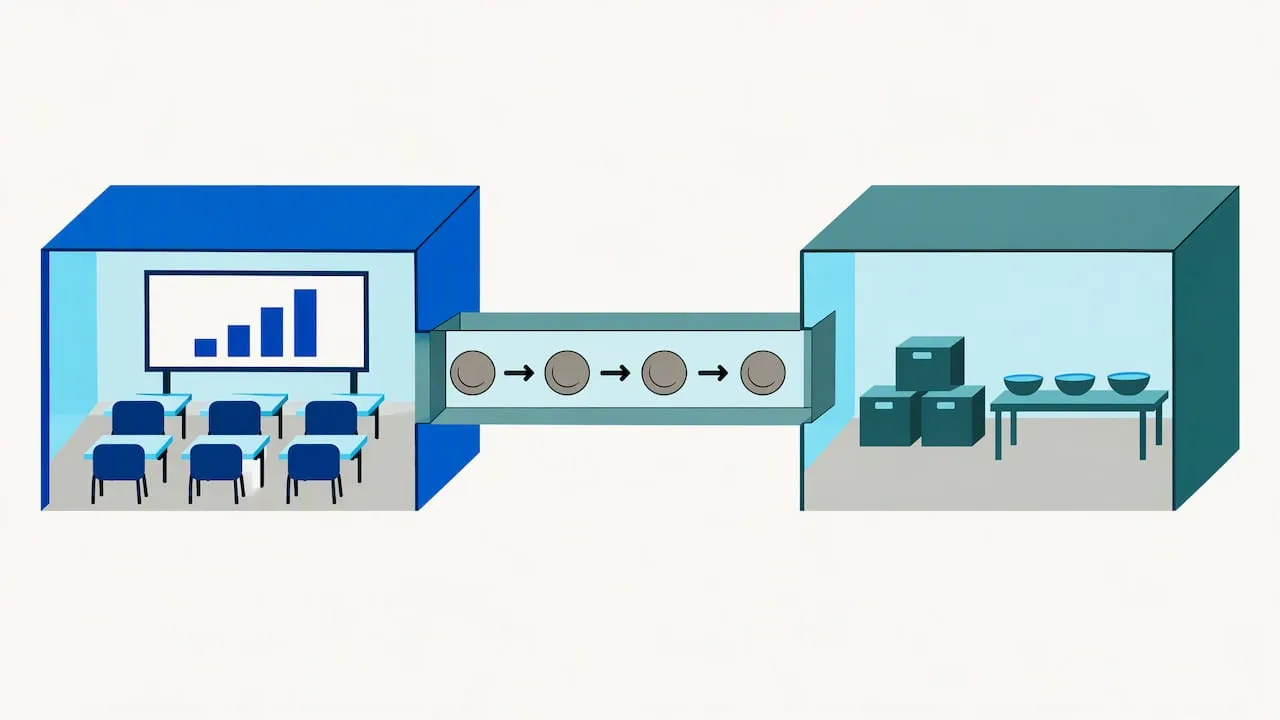
Instrumentl’s analysis frames sustainability as a portfolio approach: some activities directly deliver mission, while others intentionally generate resources to support that core work. A fee-for-service training programme, for instance, might exist primarily to fund a free community programme rather than to stand alone as a mission activity, and treating it that way changes how you measure its success.
Governance deserves its own line item because boards frequently sign off on sustainability plans without understanding the revenue mix or risk exposure behind them, which defeats the purpose of having a plan at all. Operational resilience, covering technology, staffing depth and partnership agreements, is the piece most often left out, yet it determines whether the financial and programmatic strategies in the rest of the document are actually executable. Our piece on association financial sustainability covers the finance and reserves components in more depth.
Step-by-step process to build or refresh a plan
Building a sustainability plan is a repeatable process, not a one-off writing exercise. A practical sequence runs through six stages.
- Assess your current state. Calculate cash runway, review which programmes run at a surplus or deficit, and identify your top three revenue concentrations.
- Set three to five SMART priorities. Tie each one to a revenue or mission outcome, not a vague aspiration like “improve fundraising.”
- Design revenue diversification tactics. Pick one or two realistic pilots rather than a long wish list, and test them before scaling.
- Set a reserves target and document release conditions. Decide now, while calm, what counts as an emergency worth dipping into reserves.
- Assign owners and timelines. Every priority needs a named person and a date, with KPIs built into existing reporting rather than a separate annual exercise.
- Establish a review cycle. Build in a feedback loop so the plan gets revisited on a schedule, not only when a crisis forces the issue.
This structure echoes the guidance behind most effective sustainability action plans: assess, set goals, assign ownership and review on a regular schedule. New Zealand Trade and Enterprise’s framework makes a similar point for businesses generally: a sustainability action plan turns intent into action by identifying risks and opportunities, defining current state and future goals, breaking those goals into tasks with clear ownership, and setting realistic due dates.
The step most organisations skip is the fourth one. Reserve release conditions written during a calm quarter are specific and disciplined. Reserve decisions made mid-crisis tend to be reactive and inconsistent, which is exactly the risk a sustainability plan exists to reduce.
Pro Tip: Write your reserve release conditions as a simple if-then rule (for example, “if unrestricted cash drops below two months of operating costs, the finance committee convenes within five business days”) so the decision is already made before the crisis arrives.
Concrete finance measures: reserves, runway, and earned income
Financial resilience is the part of the plan that gets tested first when conditions turn, and it rests on three figures: reserves, runway and revenue mix.
Holding less than three months of operating cash leaves many nonprofits vulnerable, according to Georgetown’s Center for Public & Nonprofit Leadership, which treats operating reserves as a critical pillar of financial sustainability rather than a nice-to-have. A reserve fund of this kind functions as the organisational equivalent of a rainy-day account: it absorbs a late grant payment, a sudden expense or a temporary drop in donations without forcing programme cuts.
Calculating cash runway is straightforward: divide your current unrestricted cash by your average monthly operating expenses. Candid’s guidance on cash runway frames this as the number of months an organisation could continue operating if revenue stopped entirely, giving board and staff a shared, concrete urgency metric rather than an abstract sense of risk.
Earned-income models give organisations a lever beyond grants and donations:
- Fee-for-service programmes, where a training, consulting or certification offering generates direct revenue
- Membership or subscription tiers, where ongoing access replaces one-off donation asks
- Event-based income, where ticketed conferences or workshops contribute margin alongside mission delivery
- Licensing or earned royalties, where intellectual property such as curricula or research generates recurring income
The practical first step is rarely a full pivot to earned income. It is a small pilot, measured against a specific target, run alongside existing revenue rather than replacing it. Our guide to navigating economic uncertainty covers how organisations sequence these pilots without destabilising core operations.
What trustees and senior leaders must do to make the plan real
A sustainability plan that lives only with staff tends to stall the moment a hard trade-off appears, because staff rarely have the authority to approve a reserve drawdown or a strategic pivot alone. Boards hold fiduciary duty for financial oversight, and that duty extends to understanding the organisation’s revenue mix and risk exposure, not just approving the annual budget total.
Three questions belong on every board’s sustainability agenda:
- What percentage of our revenue comes from our three largest funders, and is that concentration decreasing?
- How many months of operating reserve do we hold, and what would trigger using them?
- Which KPIs are we tracking, and when did we last review them against target?
Clear decision rights prevent confusion later: the board sets risk tolerance and approves major strategic shifts, while staff execute the plan day to day and report against it. Our piece on the board’s role in fundraising sets out a similar division of labour specific to fundraising oversight.
The plan should appear as a standing item in board reporting, not an annual presentation. A short sustainability update, covering reserves, revenue mix and KPI status, fits naturally into existing quarterly board packets. For organisations facing active volatility, a smaller finance or rapid-response committee, empowered to act between full board meetings, closes the gap between a monthly meeting cycle and a fast-moving funding shock.
Pro Tip: Add a single sustainability metric, such as months of reserve or percentage of revenue from the top funder, to the first page of every board pack so it never gets buried in appendices.
KPIs, dashboards and the cadence of review
A sustainability plan only works if someone checks it against reality on a schedule, and the right KPIs link finance directly to mission outcomes rather than tracking activity for its own sake.
Four measures cover most of what a board or executive team needs:
- Revenue diversification ratio: the share of total revenue from the largest single source
- Donor or member retention rate: whether existing supporters are staying, which is cheaper than acquiring new ones
- Operating margin: surplus or deficit as a percentage of total revenue
- Months of operating reserve: current unrestructured cash divided by average monthly costs
| Review level | Frequency | Primary focus |
|---|---|---|
| Operational check | Monthly | Cash position, programme spend against budget |
| Strategic review | Quarterly | KPI trends, revenue mix, reserve movement |
| Full plan update | Annually | Priorities, targets, and assumptions behind the plan |
NPGPS’s guidance on planning and budgeting recommends treating the plan as a living dashboard folded into monthly board packets rather than a document revisited once a year, which keeps KPIs active in decision-making instead of becoming a retrospective exercise.
Good dashboards favour leading indicators over lagging ones: a drop in new donor sign-ups this quarter matters more to a sustainability conversation than last year’s final fundraising total, because it still gives you time to act. These metrics earn their place when they drive an actual decision, such as scaling a programme that consistently runs a surplus, sunsetting one that has required subsidy for three consecutive years, or pivoting a service model before a funding cliff arrives rather than after.
How to prepare for shocks: scenarios, levers and communications
Reserves and KPIs tell you when something is wrong. Scenario planning tells you what to do about it before the moment arrives.
- Map the context. Identify which funding sources, partnerships or demand patterns are most exposed to disruption.
- Understand demand and supply shifts. Work out how a funding cut or a surge in need would change what your organisation is asked to deliver.
- Identify your levers. List the specific actions available: reserve drawdown, a hiring freeze, a programme pause, an emergency appeal, in the order you would use them.
- Prepare the process. Decide in advance who convenes, who decides and how the decision gets communicated.
This four-step approach to scenario positioning, as described by the National Council of Nonprofits, helps organisations act quickly when conditions change rather than improvising under pressure. The Council recommends forming a rapid-response team and preparing a simple communication plan in advance, so that when a trigger is hit, the organisation already knows who speaks, to whom, and with what message.
Documenting the trigger itself matters as much as the lever. Our guide to building organisational resilience walks through how to set up a rapid-response structure that can be activated without a full board vote.
ESG considerations, templates and practical tools
Funders increasingly ask about environmental, social and governance practices alongside financial statements, and a sustainability plan is the natural place to address that without building a separate corporate-style reporting function.
For most nonprofits, ESG integration should be proportionate rather than exhaustive. Council Fire’s guidance for NGOs suggests adopting measures scaled to organisational size, covering energy use, procurement choices and governance practices, and reporting through simplified indicators or recognised frameworks such as GRI where that fits the funder’s expectations. The goal is credibility with funders, not a parallel compliance workload.
A simple action-plan template keeps this manageable:
- Objective: the specific ESG or sustainability goal
- Owner: the named person responsible
- Cost: budget required, even if minimal
- KPI: how success is measured
- Due date: when it will be reviewed
| Template row | Purpose |
|---|---|
| Objective | States the specific goal in plain language |
| Owner | Names who is accountable |
| KPI | Defines how progress is measured |
| Due date | Sets the review point |
Organisations managing multiple revenue streams, events and member or donor data often find that scattered spreadsheets make this kind of reporting harder than it needs to be. Centralising membership, event and CRM data in one system is one way to make the monitoring and reporting side of a sustainability plan easier to maintain, which our note on digital strategies for resilient organisations explores further.
A note from the author
The single highest-leverage first step is calculating your cash runway today, before you write anything else. Everything in a sustainability plan gets easier to prioritise once you know how many months you actually have.
— Rob
How Colossus Systems fits into your sustainability plan
Executing the plan above, tracking reserves, revenue diversification, programme performance and KPI reviews, gets harder when that data lives across five disconnected spreadsheets and three separate tools. We built Colossus Systems to bring membership management, event hosting, CRM, email marketing and reporting into one platform, so the revenue map and KPI dashboard your sustainability plan calls for can run from real, current data rather than a quarterly export.
For diversification pilots specifically, our event management tools support earned-income experiments like ticketed workshops, while our CRM tracks donor and member retention alongside revenue concentration. If you are weighing options for centralising this side of your sustainability plan, you can see plans and pricing on our membership software pricing page or get in touch to talk through your organisation’s specific setup.
FAQ
What does a sustainability plan look like?
A nonprofit sustainability plan is typically a written, multi-year document covering revenue diversification, operating reserves, programme financial models, governance roles and a KPI reporting framework. It usually spans 2 to 3 years and sits alongside, rather than inside, the annual budget and the broader strategic plan.
How do you create a strategic plan for sustainability in a nonprofit?
Start by assessing current cash runway and programme profitability, then set three to five SMART priorities tied to revenue and mission outcomes. From there, assign named owners and timelines, build KPIs into existing reporting and board packets, and set a recurring review cycle so the plan stays active rather than becoming an annual exercise.
What are the pillars of sustainable nonprofit finance?
Most frameworks point to the same core elements: diversified revenue sources, adequate operating reserves, disciplined cash-runway monitoring, and programme financial models that distinguish revenue-generating activities from subsidised mission work. Governance oversight ties these together by ensuring the board understands revenue mix and risk exposure, not just the budget total.
What are examples of sustainability actions a nonprofit can take?
Common actions include building an operating reserve target, piloting an earned-income stream such as fee-for-service training or ticketed events, diversifying away from a single dominant funder, and adopting proportionate ESG measures like efficient procurement or simplified governance reporting. Each works best when assigned an owner, a cost estimate and a review date.
Does Colossus Systems offer tools specific to sustainability planning?
Colossus Systems is a membership and engagement platform, not a sustainability consultancy, so we do not produce the plan itself. What we offer is a way to centralise the membership revenue, event income and CRM data that feed directly into a sustainability plan’s revenue map and KPI dashboard, with plans starting from £349 per month.
Sources
- Nonprofit sustainability plan (Instrumentl)
- Using operating reserves during a crisis (Georgetown CPNL)
- Build a sustainability action plan that works (NZTE)
- The power of nonprofit repositioning (National Council of Nonprofits)