Succession Planning: Safeguarding Leadership Continuity

Succession planning can make or break a nonprofit’s future. With more than 50 percent of British charities reporting leadership gaps, executive directors face real pressure to protect stability during transitions. Strengthening these processes matters for organizations everywhere that depend on clear leadership continuity to serve members and fulfill their missions. This article outlines key frameworks and practical steps to help nonprofits worldwide create resilient succession strategies and safeguard long-term progress.
Table of Contents
- Succession Planning Defined For Organisations
- Types And Models Of Succession Plans
- Core Processes And Stages Explained
- Leadership Roles, Responsibilities And Risks
- Common Pitfalls And How To Avoid Them
- Best Practices For Nonprofit Succession Planning
Key Takeaways
| Point | Details |
|---|---|
| Succession Planning Importance | It is a proactive organisational process essential for ensuring leadership continuity and preserving institutional knowledge. |
| Model Options | Organisations can adopt position-based, pool-based, or competency-based models, each with unique strengths and challenges. |
| Core Stages | The process involves strategic alignment, talent identification, gap analysis, development planning, and continuous assessment for effective succession management. |
| Avoiding Pitfalls | Common pitfalls such as leadership disengagement and superficial assessments can be mitigated with transparent processes and multi-dimensional evaluations. |
Succession planning defined for organisations
Succession planning is a strategic organisational process designed to identify, develop, and nurture potential leadership talent internally. It represents a proactive approach to maintaining leadership continuity across different sectors and organisational structures.
At its core, succession planning involves creating a systematic framework for talent management that goes beyond simply replacing departing executives. The process requires comprehensive mapping of current talent capabilities, identifying critical roles, and developing strategic pathways for potential leaders. This approach helps organisations mitigate risks associated with unexpected leadership transitions and ensures institutional knowledge remains preserved during personnel changes.
Succession planning typically encompasses multiple strategic elements, including talent assessment, leadership development programmes, mentorship initiatives, and structured career progression paths. By implementing robust succession strategies, organisations can create resilient leadership ecosystems that adapt to changing business environments. Key components often include identifying high-potential employees, providing targeted training and development opportunities, and creating clear advancement trajectories that align with organisational goals.
Expert Tip: Create a dynamic succession mapping tool that tracks employee skills, potential, and career aspirations at least 18 months in advance of potential leadership transitions.
Types and models of succession plans
Succession planning encompasses diverse approaches, each tailored to specific organisational needs and structures. Comparative frameworks reveal multiple strategic models that organisations can adopt to ensure effective leadership transition and talent development.
Three primary succession planning models emerge as particularly significant: position-based, pool-based, and competency-based approaches. The position-based model focuses on identifying direct replacements for specific roles, creating a linear progression pathway. In contrast, the pool-based model develops a broader talent reservoir, cultivating multiple potential candidates who could step into leadership roles across different departments. The competency-based model takes a more nuanced approach, emphasising skill sets, leadership capabilities, and potential rather than strictly defined positional requirements.
Each model presents unique advantages and challenges. Position-based models offer clear, predictable succession paths but may limit organisational flexibility. Pool-based approaches provide greater adaptability but require more comprehensive talent development strategies. Competency-based models represent the most holistic approach, aligning individual capabilities with organisational strategic objectives and creating more dynamic leadership ecosystems.
The following table offers a concise comparison of core succession planning models and their business impact:
| Model Type | Focus Area | Strengths | Potential Challenges |
|---|---|---|---|
| Position-based | Specific job roles | Predictable transitions | Low flexibility |
| Pool-based | Talent reservoirs | Greater adaptability | Requires broad development |
| Competency-based | Skills and capabilities | Holistic leadership alignment | Complexity in assessment |
Expert Tip: Develop a hybrid succession planning approach that combines elements from multiple models, ensuring both structural clarity and talent development flexibility.
Core processes and stages explained
Succession planning involves a structured, systematic approach to leadership continuity that encompasses multiple critical stages. Government guidelines outline a comprehensive six-stage process designed to ensure organisations develop robust leadership pipelines and mitigate potential talent gaps.
The core stages of succession planning typically include strategic alignment, talent identification, gap analysis, development planning, and continuous assessment. Strategic alignment involves connecting succession initiatives directly with organisational objectives, ensuring that leadership development supports broader business goals. Talent identification focuses on recognising high-potential employees through rigorous performance evaluations, skills assessments, and potential mapping. This stage requires careful evaluation of both current capabilities and future leadership potential across different organisational levels.

The subsequent stages involve detailed gap analysis, where organisations critically examine the differences between existing leadership capabilities and future requirements. Development planning emerges as a crucial phase, creating targeted learning pathways, mentorship programmes, and leadership training initiatives designed to prepare identified successors. These interventions are not one-size-fits-all but instead tailored to individual potential, organisational needs, and strategic priorities. Final stages involve ongoing assessment and refinement, ensuring that succession plans remain dynamic, responsive, and aligned with evolving organisational landscapes.
Expert Tip: Implement a digital talent tracking system that allows real-time monitoring of employee development, potential, and readiness for leadership transitions.
Leadership roles, responsibilities and risks
Leadership plays a pivotal role in succession planning, with critical responsibilities extending far beyond traditional management functions. Top executives must actively engage in strategic talent identification, development, and organisational resilience to ensure seamless leadership transitions.
The primary leadership responsibilities in succession planning encompass several interconnected domains. Strategic oversight involves aligning succession initiatives with long-term organisational objectives, creating comprehensive talent development frameworks, and establishing robust knowledge transfer mechanisms. Leaders must cultivate a proactive talent ecosystem that identifies, nurtures, and prepares potential successors across multiple organisational levels. This requires a holistic approach that integrates performance management, targeted development programmes, and continuous talent assessment.
Succession planning inherently involves managing significant organisational risks. Potential challenges include leadership vacancies, institutional knowledge loss, operational disruption, and stakeholder uncertainty. Effective leaders mitigate these risks by developing diversified talent pools, implementing comprehensive training programmes, and creating transparent succession pathways. This approach requires ongoing commitment to talent development, regular skill assessments, and adaptive strategies that can respond to changing organisational dynamics. Leadership must balance immediate operational needs with long-term talent cultivation, ensuring organisational stability and strategic continuity.
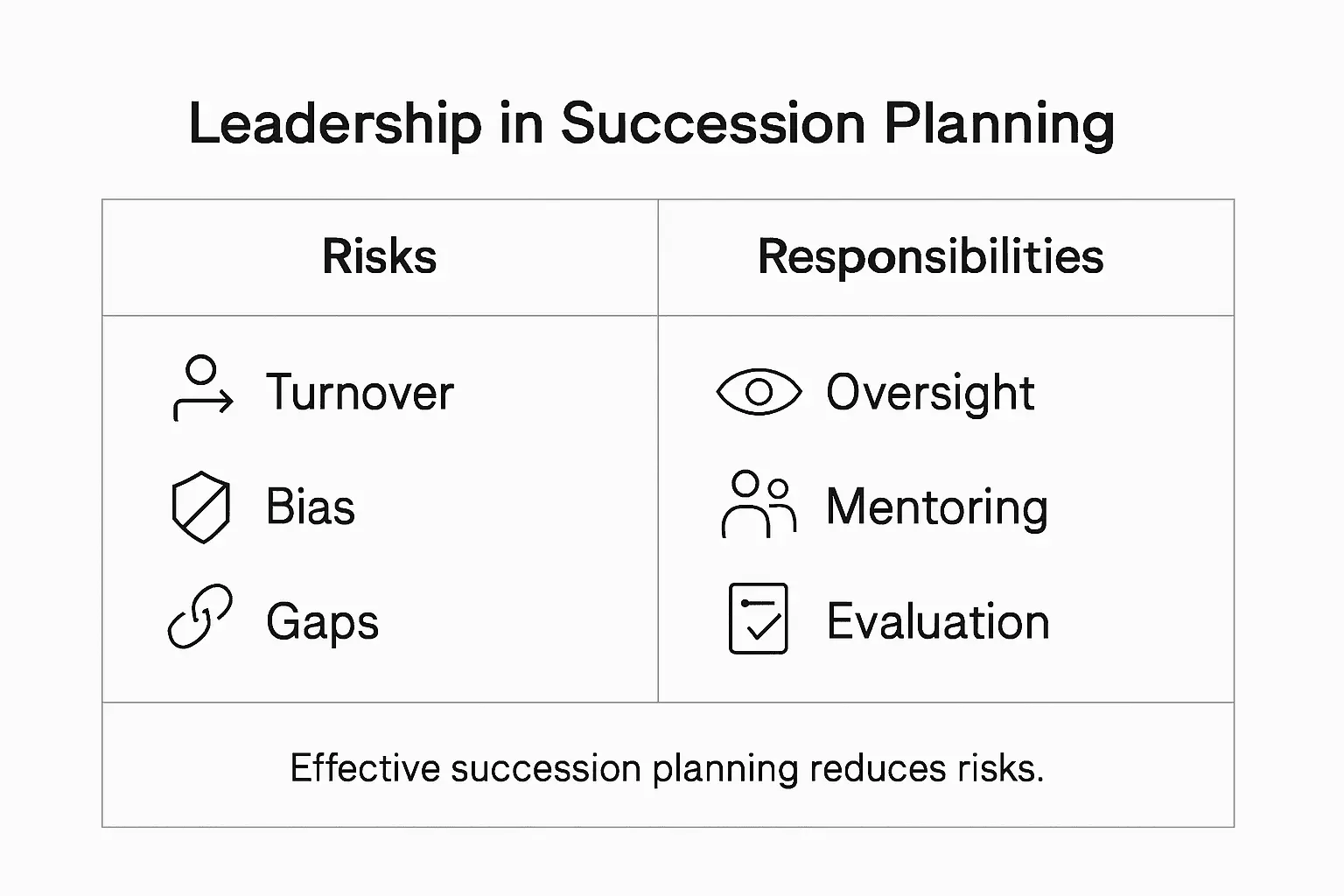
Expert Tip: Conduct annual comprehensive talent reviews that map potential successors against critical organisational roles, creating multi-layered backup plans for key leadership positions.
Common pitfalls and how to avoid them
Succession planning is fraught with potential challenges that can derail even the most well-intentioned organisational strategies. Research reveals multiple systemic pitfalls that organisations must proactively address to ensure effective leadership continuity and talent development.
The most prevalent organisational pitfalls in succession planning emerge from several critical areas of strategic oversight. Leadership disengagement represents a significant risk, where senior executives fail to prioritise talent development and view succession as a peripheral HR function rather than a core strategic imperative. Superficial talent assessment compounds this challenge, with organisations often relying on simplistic performance metrics rather than comprehensive potential evaluation. Bias frequently infiltrates these processes, with decision-makers unconsciously favouring candidates who mirror their own leadership styles or backgrounds, thereby limiting diversity and innovation potential.
Addressing these challenges requires a multi-dimensional approach that emphasises transparency, objectivity, and strategic alignment. Organisations must develop robust, data-driven succession frameworks that incorporate multiple assessment dimensions, including performance history, leadership potential, strategic thinking capabilities, and adaptability. Critical strategies include implementing structured talent review processes, creating cross-functional development opportunities, establishing clear and measurable leadership competency frameworks, and maintaining ongoing dialogue about career progression. By cultivating a culture of continuous learning and transparent talent management, organisations can transform succession planning from a reactive administrative task into a dynamic strategic capability that drives long-term organisational resilience.
Below is a summary of common succession planning pitfalls and effective counter-strategies:
| Pitfall | Root Cause | Consequence | Solution |
|---|---|---|---|
| Leadership disengagement | Lack of executive priority | Talent pipeline stagnation | Elevate succession to strategic aim |
| Superficial assessment | Over-reliance on metrics | Overlooked potential leaders | Use multi-dimensional evaluation |
| Unconscious bias | Preference for similarity | Limits diversity and innovation | Promote objective, transparent processes |
Expert Tip: Implement a quarterly talent calibration process that involves multiple stakeholders, uses 360-degree feedback, and objectively assesses leadership potential across different organisational dimensions.
Best practices for nonprofit succession planning
Nonprofit organisations require distinctive succession planning approaches that recognise their unique operational environments and mission-driven cultures. Successful succession strategies demand comprehensive and forward-thinking methodologies that extend beyond traditional corporate talent management frameworks.
The core principles of effective nonprofit succession planning revolve around holistic talent development and strategic organisational resilience. This involves creating robust leadership pipelines that nurture internal talent, emphasise both technical competencies and mission-aligned soft skills, and maintain flexibility to adapt to evolving organisational needs. Nonprofits must prioritise identifying high-potential individuals who not only possess requisite professional capabilities but also demonstrate deep commitment to the organisation’s core values and strategic objectives. Critical elements include implementing structured mentorship programmes, providing continuous professional development opportunities, and establishing clear career progression pathways that incentivise talented professionals to remain engaged and committed.
Implementation of successful succession strategies requires multifaceted approaches encompassing comprehensive stakeholder engagement. Board members, executive leadership, and human resources professionals must collaborate closely to design dynamic succession frameworks. This collaborative approach ensures transparent talent identification processes, regular performance evaluations, and proactive leadership development initiatives. Organisations should develop comprehensive talent mapping tools, conduct periodic leadership potential assessments, and create individualised development plans that align individual growth trajectories with organisational strategic priorities. By fostering a culture of continuous learning and internal talent cultivation, nonprofits can build sustainable leadership ecosystems that ensure mission continuity and organisational resilience.
Expert Tip: Develop a comprehensive leadership competency framework that explicitly links individual development goals with organisational mission and strategic objectives.
Secure Your Organisation’s Future with Strategic Succession Planning
Succession planning is essential for safeguarding leadership continuity and building resilient organisations as highlighted in the article. Many membership-based organisations face challenges such as leadership disengagement, talent pipeline stagnation, and the complexity of assessing leadership potential. Colossus Systems understands these critical pain points and offers a comprehensive platform designed to streamline talent development and engagement, ensuring your succession planning is proactive, transparent, and aligned with your strategic goals.
Experience the benefit of a unified solution that empowers your nonprofit or association to manage member engagement, facilitate leadership development initiatives, and track organisational talent all in one place. Our platform’s customisable tools help you create clear talent pathways and maintain robust communication channels to nurture future leaders effectively. Take the next step towards securing leadership continuity. Contact us today at Colossus Systems Contact and transform your succession planning into a powerful driver of organisational growth and sustainability.
Frequently Asked Questions
What is succession planning?
Succession planning is a strategic organisational process aimed at identifying, developing, and nurturing potential leadership talent within an organisation to ensure leadership continuity.
What are the key components of a successful succession planning strategy?
A successful succession planning strategy typically includes talent assessment, leadership development programmes, mentorship initiatives, and structured career progression paths for high-potential employees.
What are the common pitfalls in succession planning?
Common pitfalls in succession planning include leadership disengagement, superficial talent assessments, and unconscious bias in selecting potential leaders, which can limit organisation flexibility and diversity.
How do nonprofit organisations approach succession planning differently?
Nonprofit organisations focus on holistic talent development that aligns with their mission-driven cultures, prioritising individuals who demonstrate a commitment to their core values alongside requisite professional competencies.