What is the board's role in fundraising, and how do you activate it?

Trustees exist to govern, model generosity, open networks and steward donors, not to write the appeal letters themselves. The first action for any board is to agree explicit fundraising expectations, backed by an accountability mechanism such as a short board agreement and quarterly reporting. Everything else, from role assignment to metrics, builds on that single decision.
TL;DR:
- Effective board fundraising depends on clear expectations, role-specific training, and a structured onboarding process to build confidence and skills.
- Trustees should be assigned roles that match their strengths, such as ambassador, connector, solicitor, or steward, to maximize their impact.
- Regular tracking of participation, introductions, pipeline value, and funds raised is essential, with ownership shared between staff and a development committee.
- Leaders set the tone for fundraising culture by modeling personal giving, maintaining a standing agenda, and involving the whole board in oversight.
- Using technology to centralize donor information and automate reports turns willingness into a consistent, trackable fundraising habit.
Table of Contents
- Role of board fundraising explained: core responsibilities trustees carry
- How to get board members fundraising: a practical activation plan
- Setting fundraising expectations and measuring real progress
- Where boards go wrong, and how to fix it fast
- How technology makes board fundraising repeatable
- Setting fundraising strategy: the board and executive partnership
- How the board builds and maintains donor relationships
- Why board leadership decides whether fundraising actually works
- Folding fundraising into governance instead of bolting it on
- The gap between what boards say and what boards actually do
- Turning board fundraising commitments into repeatable practice
- Sources
Role of board fundraising explained: core responsibilities trustees carry
The board’s job in fundraising splits into four practical roles, and most trustees only ever perform one or two of them well. Understanding all four lets a fundraising committee assign tasks that match a person’s comfort and network rather than forcing everyone through the same “make ten calls” script.
- Ambassador: represents the organisation publicly, at events, in the community, on social media, lending credibility simply by being visibly associated with the cause.
- Connector: opens doors to prospective donors, corporate contacts or foundation trustees through personal or professional relationships.
- Solicitor: makes the direct ask, whether that’s a peer-to-peer conversation or co-signing a major gift proposal alongside staff.
- Steward: follows up after a gift lands, through thank-you calls, event hosting or simply checking in, which keeps donors renewing.
None of these roles is optional window-dressing. BoardSource’s guidance on board fundraising frames the board’s core duty as ensuring adequate resources exist for the mission, in genuine partnership with staff rather than instead of them. That partnership matters because fundraising professionals already handle research, appeals, events and stewardship operations day to day. Their job is not replaced by board involvement; it’s amplified by it.
Board giving itself deserves a specific expectation reset. Research from the Urban Institute shows board gifts typically make up a modest share of total funds raised, yet full board participation still correlates strongly with organisations hitting their fundraising goals. The money is rarely the point. A 100% giving board signals to major donors and foundations that the people closest to the organisation believe in it enough to fund it themselves, and that signal opens doors elsewhere.
How to get board members fundraising: a practical activation plan
Most trustees agree, in principle, that they should help raise money. The gap is confidence and know-how, not willingness. The Chronicle of Philanthropy’s guidance on building a fundraising culture makes this point directly: trustees need training, toolkits and clear expectations before they’ll engage effectively. Here’s a sequence that works.
- Onboard properly. Give every new trustee a fundraising toolbox on day one: case for support, a 90-second pitch they can memorise, and a shadowing session on a real donor visit before they’re asked to lead one themselves.
- Map roles to people. Build a menu of involvement built on the four Ts, time, talent, ties and testimony, and let trustees choose their lane rather than assigning a generic quota to everyone.
- Support with staff resources. Development staff should produce donor briefs before every meeting, short scripts for common conversations, and run at least one training session a year on the actual mechanics of asking.
- Set a cadence. Pair annual training with monthly progress updates and scheduled donor-visit pairings, so fundraising becomes a rhythm rather than an annual scramble.
This is where onboarding structure matters as much as intent. Many boards borrow techniques from staff onboarding, adapting a structured onboarding approach to build a repeatable trustee toolbox instead of reinventing induction materials every time a new member joins.
Pro Tip: Pair every new trustee with an experienced board member for their first donor visit. Watching someone else handle an awkward pause in a solicitation conversation teaches more than any training deck.
Setting fundraising expectations and measuring real progress
A give-or-get policy only works if it’s designed with room to grow rather than a fixed number that embarrasses newer or less wealthy trustees. Frame it as a personal giving expectation scaled to individual capacity, paired with non-financial contributions like introductions or event hosting, so nobody feels priced out of participation.
Once expectations exist, someone has to track them. The Institute of Directors New Zealand recommends boards actively monitor a diversified funding strategy rather than leaving fundraising as a once-a-year agenda item. Four metrics belong on every quarterly board report:
- Board participation rate: the percentage of trustees who have made a personal gift this cycle.
- Introductions made: how many warm contacts trustees have passed to the development team.
- Pipeline value: the dollar value of prospects currently in cultivation thanks to board connections.
- Funds closed: gifts that have actually landed as a result of board-led activity.
Ownership of this monitoring should sit jointly with staff and a development committee, not with the executive director alone. Staff track and report the numbers; the committee interprets them and follows up constructively with trustees who are falling behind, rather than letting silence do the talking.
Where boards go wrong, and how to fix it fast
Most fundraising friction traces back to a handful of predictable mistakes, each with a straightforward correction.
- Assuming trustees already know how to ask. Most don’t. Fix it with role-specific training and a donor briefing before every meeting, not a generic pep talk once a year.
- Applying one-size-fits-all expectations. A flat “everyone calls five donors” policy alienates introverted or newly-appointed trustees. Replace it with a menu of roles and personalised targets that reflect actual capacity.
- Board overreach into daily operations. Trustees who start directing campaign tactics or contacting donors without staff coordination create chaos. Clear role boundaries, with staff facilitating every trustee-donor interaction, solve this.
- Ignoring non-monetary wins. A trustee who opens three new corporate contacts deserves recognition just as much as one who writes a large cheque. Celebrate both publicly at board meetings.
How technology makes board fundraising repeatable
Good intentions fade without infrastructure behind them. A donor brief that lives in someone’s inbox gets lost; one stored in a shared CRM gets used every time a trustee walks into a meeting. Colossus supports this by keeping membership records, donor history and event attendance in one place, so staff can generate a briefing note in minutes rather than reconstructing a relationship history from memory.
Analytics matter just as much for the board report itself. Pulling participation rates, introduction counts and pipeline value from scattered spreadsheets each quarter is exactly the kind of task that erodes momentum, and a platform built around membership and event data can surface those figures automatically instead.
The single biggest failure point in board fundraising isn’t a lack of willing trustees. It’s the absence of a system that turns willingness into a repeatable, trackable habit.
Setting fundraising strategy: the board and executive partnership
Fundraising strategy is not something the board hands down or the executive director invents alone. It’s built jointly, in the same room, at the same meetings where budget and programme priorities get set. The Valtas Group’s analysis of the board’s fundraising role describes this as a genuine partnership: the executive brings operational knowledge of donor pipelines and campaign mechanics, while the board brings governance oversight and network access that staff simply can’t replicate.
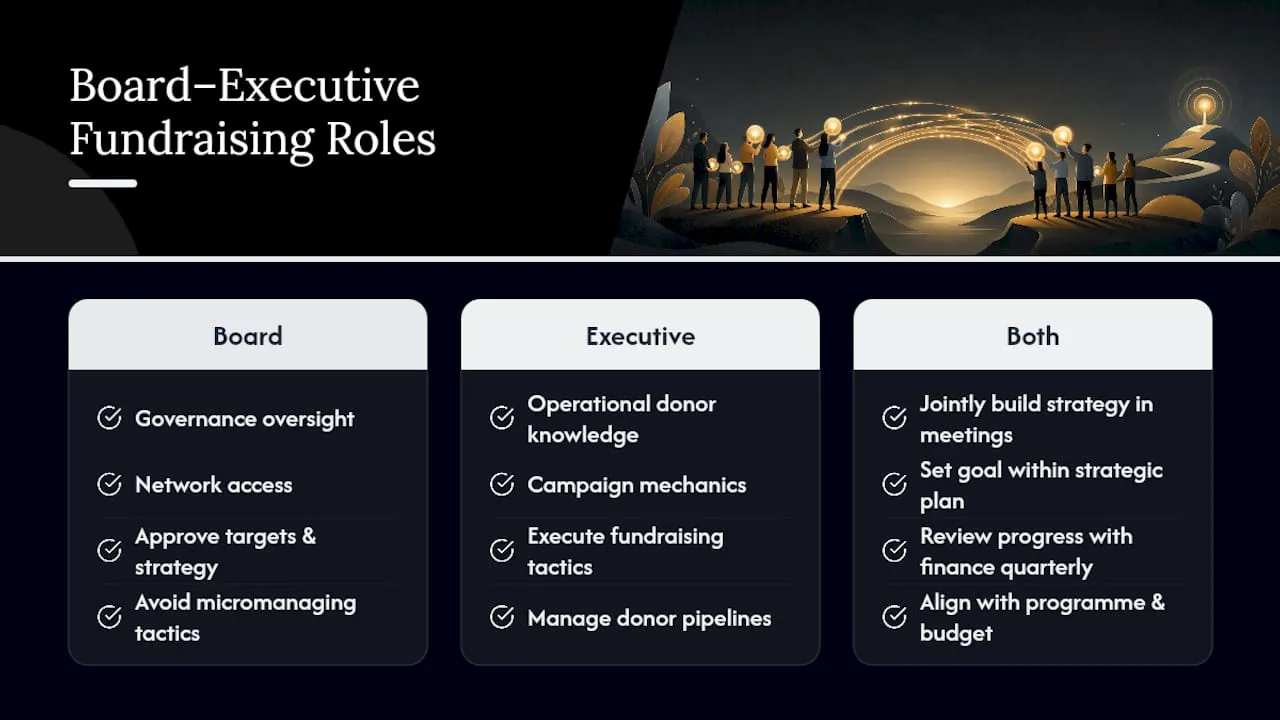
In practice, this means the board should approve annual fundraising targets and the broad strategy behind them, revenue mix, major campaigns, capital projects, then step back and let staff execute the tactics. Trustees who try to micromanage appeal copy or donor segmentation are working outside their lane. Trustees who never ask what the strategy actually is are failing their oversight duty just as badly.
A useful discipline here borrows from broader strategic planning practice for nonprofits: treat the annual fundraising goal as one line item within the organisation’s wider strategic plan, reviewed at the same cadence as programme and financial targets, rather than as a separate conversation that only happens when cash gets tight. Boards that review fundraising progress alongside financial statements, quarterly at minimum, catch shortfalls early enough to adjust rather than panic in the final quarter.
How the board builds and maintains donor relationships
Stewardship is the quietest of the four board roles, and often the most underused. A trustee who calls a donor purely to say thank you, with no ask attached, does more for retention than a dozen solicitation emails from staff. BoardSource’s research on the board’s stewardship function confirms this pattern: trustees who participate in thank-you calls and event hosting measurably strengthen the relationships that keep donors giving year after year.

The practical version of this looks unglamorous. A trustee attends a donor’s table at the annual gala and actually sits with them rather than working the room. A board chair sends a handwritten note after a major gift closes. A finance committee member takes fifteen minutes to explain how a donor’s contribution was actually spent, in plain terms, without a glossy annual report standing in the way.
Cultivation works the same way in reverse, before the gift rather than after it. Trustees with genuine relationships to a prospect should be looped into cultivation visits well before an ask is made, not parachuted in for the final signature. Staff prepare the brief; the trustee brings the relationship; the ask lands because trust was built over months, not minutes.
The organisations that get this right treat stewardship as a standing board duty, assigned to specific trustees for specific donors, rather than a vague aspiration everyone assumes someone else is handling.
Why board leadership decides whether fundraising actually works
A fundraising culture starts at the top of the board table, not with the development team. When the board chair models giving and openly discusses their own fundraising activity at meetings, other trustees follow. When the chair treats fundraising as an awkward afterthought squeezed in at the end of the agenda, so does everyone else.
Board leadership sets the tone in three concrete ways. First, the chair and committee leads decide whether fundraising gets a standing agenda slot or gets mentioned only when a campaign is behind target. Second, leadership decides whether underperforming trustees are quietly excused or genuinely held to the expectations everyone agreed to. Third, and most visibly, leadership decides whether the board chair personally makes asks, because a chair who solicits sends a signal no memo can replicate.
Weak fundraising boards almost always trace back to leadership treating the topic as someone else’s job, usually the development committee’s, rather than a shared governance duty the whole board owns. Strong boards do the opposite: the chair reports on their own fundraising activity first, before asking anyone else to report on theirs.
Folding fundraising into governance instead of bolting it on
Fundraising works best when it’s not a separate initiative competing for attention against “real” board business. It should sit inside the same governance rhythm as financial oversight, risk and strategic planning, reviewed at every board meeting rather than surfacing only during an annual campaign push.
A practical version of this: add a five-minute fundraising update to the standing board meeting agenda, sitting alongside the financial report, covering participation rate, introductions made and pipeline movement. Fold the give-or-get policy into the same board agreement that covers attendance, committee service and conflict-of-interest disclosure, so fundraising reads as one governance duty among several rather than a bolt-on obligation. Understanding how fundraising connects to broader financial sustainability helps trustees see the connection between fundraising performance and the organisation’s ability to fund its mission long-term, which is ultimately a fiduciary question as much as a revenue one.
The gap between what boards say and what boards actually do
Most fundraising advice tells boards to “get more involved,” which is true but useless without structure attached. The research is fairly consistent on what actually predicts success: it’s not enthusiasm, it’s access and participation rate. A board where every trustee gives something, however modest, and where a handful of well-connected members open doors to new donors, will outperform a board full of passionate but disorganised volunteers every time.
The conventional advice oversells solicitation and undersells stewardship. Boards get told to focus on “the ask,” yet the evidence points to donor retention and relationship-building as where trustees add the most distinctive value, precisely because staff can’t personally know every major donor the way a well-matched trustee can. Prioritise stewardship pairing before you prioritise cold solicitation training.
If there’s one place to start, it’s the accountability mechanism, not the training programme. A board that agrees to a written fundraising expectation, reviewed quarterly, will improve participation faster than one that runs an excellent workshop and then never mentions fundraising again until next year’s retreat.
— Rob
Turning board fundraising commitments into repeatable practice
Agreeing expectations is the easy part. Keeping donor briefs current, tracking introductions, and reporting participation rates every quarter without it becoming another spreadsheet nobody updates, that’s where most boards quietly lose momentum. Colossus was built for exactly this gap: a single platform that holds membership records, donor and event history, and CRM pipelines together, so staff can generate a trustee’s donor brief in minutes rather than rebuilding it from memory each time.
The CRM tools track every introduction a trustee makes and where it sits in the pipeline, while the event management features handle registration and stewardship touchpoints for donor-facing events without extra manual work. If your board is ready to make fundraising a tracked, quarterly habit rather than an annual scramble, take a look at the full membership management features and see how the reporting side maps to the metrics your board should already be reviewing.
Sources
- How to create a culture of fundraising on your board — Chronicle of Philanthropy
- Nonprofit fundraising and the board’s role — BoardSource
- Getting on board with fundraising — Institute of Directors New Zealand
- Engaging board members in fundraising — Urban Institute