Building resilient organisations: Digital strategies for nonprofits

TL;DR:
- Resilience involves anticipating, absorbing, and adapting to disruptions beyond just financial reserves.
- Digital infrastructure and a culture of continuous learning are critical for modern organizational resilience.
- Strategic scenario planning and diverse revenue streams strengthen nonprofit stability in uncertain environments.
Most leadership teams equate resilience with a healthy bank balance. Fiscal reserves matter, but they are rarely the whole story. Nonprofits often overlook digital resilience when planning for uncertainty, focusing primarily on financial buffers rather than the operational agility that determines how quickly an organisation actually recovers. This guide challenges that assumption. It brings together research-backed frameworks, practical technology strategies, and leadership insights to help membership organisations and nonprofits build genuine, lasting resilience across every dimension of their operations.
Table of Contents
- Understanding resilience in modern organisations
- Strategic planning and scenario thinking for resilience
- The role of technology: Building for digital resilience
- Funding, revenue diversification, and partnership for sustainability
- Embedding adaptability: Culture, leadership, and continuous improvement
- Rethinking resilience: Why digital-first does not mean people-last
- How Colossus Systems supports resilient organisations
- Frequently asked questions
Key Takeaways
| Point | Details |
|---|---|
| Strategic planning leads | A robust strategic plan predicts nonprofit sustainability better than funding management alone. |
| Digital agility is crucial | Adopting new technologies and maintaining digital security is central to modern resilience. |
| Diversify resources | Resilient organisations spread risk across revenue streams, partners, and programmatic focus. |
| Culture is key | Staff flexibility, leadership transparency, and regular reviews underpin adaptable organisations. |
| Continuous learning | Monitoring trends and experimenting with new models keeps responses sharp and effective. |
Understanding resilience in modern organisations
Having established the importance of digital resilience, let us start by clarifying what true organisational resilience means in 2026. Many leaders still define resilience narrowly as “weathering the storm,” which implies passive endurance. Modern thinking is far more active than that.
Organisational resilience is the demonstrated capacity to anticipate, absorb, adapt to, and grow from disruptions, whether those disruptions are economic downturns, technological shifts, regulatory changes, or sudden leadership transitions. It is not a fixed state. It is a set of capabilities that must be continuously built and tested.
Research on organisational resilience for nonprofits highlights that sustainable organisations combine multiple resilience pillars. The ISVD Resilient Organisation Design Guide captures this well:
“Resilient organisations combine redundancy, diversity, and adaptability across all domains”, including financial resources, personnel, technology, and governance structures.
These three ISVD principles are worth unpacking individually:
- Redundancy means having backup capacity. If your primary donor withdraws funding, do you have alternative revenue? If a key system fails, is there a manual process or a secondary platform?
- Diversity means variety in your board, your funding streams, your service delivery models, and your technology tools. Homogeneous systems and teams break in the same way under the same conditions.
- Adaptability means your organisation can reconfigure itself quickly. This is where digital capability becomes critical.
Traditional resilience planning focused almost entirely on financial reserves and board governance. That was reasonable for a slower-moving world. Today, your ability to shift to virtual events, pivot member communications overnight, or extract data quickly for a grant application depends on your digital infrastructure, not just your cash reserves.
People and culture in resilience are equally decisive. Systems do not make decisions under pressure. People do. A well-trained, psychologically safe team that feels empowered to flag problems early will outperform a technically sophisticated organisation whose culture discourages honest reporting.
There is also a data point worth noting: larger, older nonprofits tend to recover faster after recessions, based on research spanning three recessions between 1989 and 2018. Accumulated experience and institutional memory act as informal resilience assets. Younger or smaller organisations need to compensate by being more deliberate about building the formal structures and digital capabilities that experience has not yet provided.
Strategic planning and scenario thinking for resilience
Understanding resilience requires a closer look at the strategic processes that underpin long-term durability. Scenario thinking is one of the most underused tools available to nonprofit leaders. Many organisations plan for the most likely future and hope the unlikely never arrives. That is a fragile approach.
Scenario planning requires you to identify multiple plausible futures, including adverse ones, and then build strategies that remain sound across most of them. This is not pessimism. It is prudent leadership. Strategic planning is the strongest predictor of sustainability in nonprofit organisations, outperforming financial management as a resilience factor in a study of 75 NGOs.
A practical approach to strategic resilience planning follows four clear phases, drawn from the Info-Tech Research Group blueprint for nonprofits:
- Assess risk. Map your operational vulnerabilities: technology dependencies, funding concentration, staff single points of failure, and regulatory exposure.
- Review resources. Audit what you currently have, including digital platforms, financial reserves, partner relationships, and staff capabilities.
- Build a technology-first action plan. Prioritise digital investments that directly reduce identified risks, such as automating manual processes or migrating to cloud-based systems.
- Prepare for execution. Assign ownership, set review milestones, and ensure that the plan is a living document rather than a shelf document.
The contrast between proactive and reactive planning is stark:
| Dimension | Proactive planning | Reactive planning |
|---|---|---|
| Decision timing | Before disruption occurs | During or after disruption |
| Cost of response | Lower, with planned resources | Higher, driven by urgency |
| Staff impact | Managed, with clear roles | High stress, improvised roles |
| Recovery speed | Faster, with tested processes | Slower, without clear protocols |
| Stakeholder confidence | Maintained through transparency | Eroded by visible confusion |
Look at ten resilience strategies recommended for nonprofits and you will see scenario planning and strategic planning and engagement consistently near the top. The evidence is clear. Planning is not overhead. It is protection.
Pro Tip: Do not try to prepare for every conceivable risk. Focus your scenario planning on the top three to five risks that would cause the most damage if they materialised simultaneously. Depth of preparation beats breadth of coverage when resources are limited. Explore navigating economic uncertainty for a practical starting point.
The role of technology: Building for digital resilience
An essential part of strategic resilience is knowing exactly how technology can make or break your organisation’s ability to adapt and serve. Digital resilience rests on five interconnected pillars: technology infrastructure, the external environment, risk management practices, leadership capability, and workforce agility. Weakness in any one pillar undermines the others.

For membership organisations specifically, digital transformation for nonprofits is no longer optional. Consider that 74% of nonprofits are increasing technology spending and 97% report using artificial intelligence in some capacity, according to BDO’s 2025 Nonprofit Standards Benchmarking survey. Organisations that are not investing in digital capability are increasingly the exception.
The case for a unified, modular technology stack is particularly strong. A modular stack means your CRM, member management system, event platform, and analytics tools are integrated rather than siloed. When these systems share data in real time, your team can make faster and better-informed decisions. They can identify at-risk members before renewal lapses, spot declining event attendance before it becomes a trend, and redirect resources without needing a consultant to extract the data for them.
Key capabilities that strengthen digital resilience include:
- Automated workflows that reduce dependency on individual staff members for routine processes
- Cloud-based infrastructure that ensures continuity during physical disruptions
- Data integration across CRM, finance, and communications platforms
- Real-time analytics that surface problems early, when they are still manageable
- Role-based access controls to protect member data security basics whilst maintaining operational flexibility
Despite this momentum, gaps remain. Only 39% of executives support risk assessments before deploying new technology, and continuous monitoring of supplier and third-party risks remains inconsistent across the sector.
| Digital adoption indicator | Current rate (2025) |
|---|---|
| Nonprofits increasing technology spend | 74% |
| Nonprofits using AI in some capacity | 97% |
| Executives running pre-deployment risk assessments | 39% |
| Organisations with continuous supplier risk monitoring | Minority |
Explore technology roadmaps for nonprofits to understand how structured adoption planning reduces exposure to technical debt and system fragility.
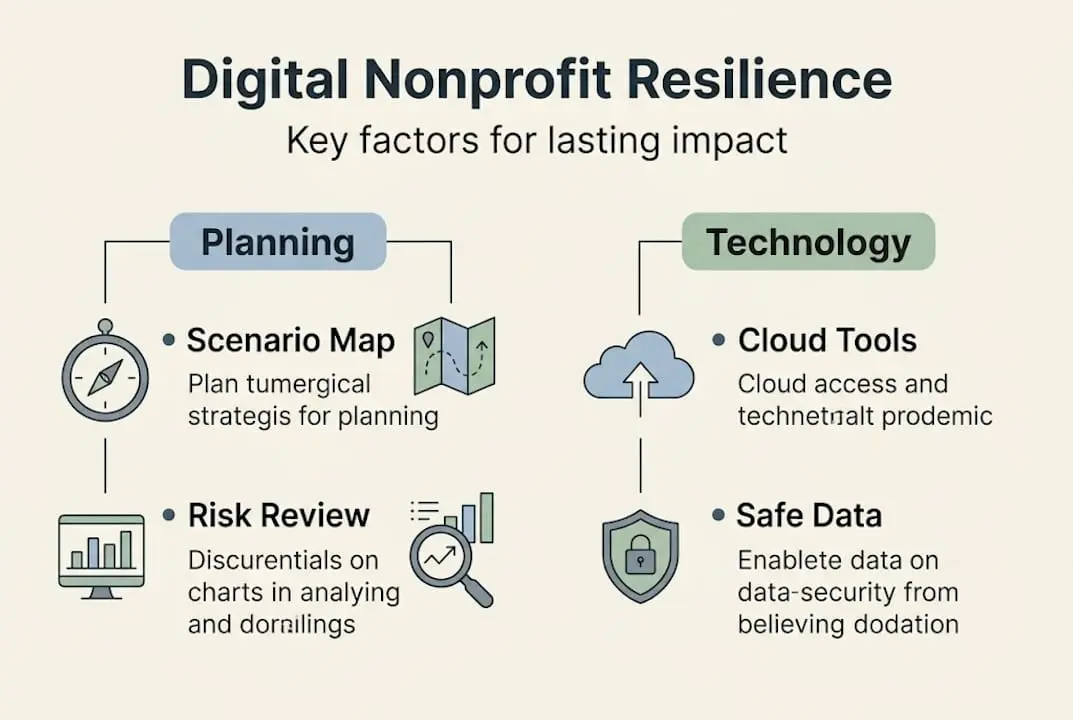
Pro Tip: Embed risk assessments at every stage of digital adoption, not just at the point of procurement. Review new integrations, supplier changes, and platform updates with the same scrutiny you apply to financial decisions.
Funding, revenue diversification, and partnership for sustainability
While technology handles the “how” of resilience, funding and partnerships answer the “with what.” The essential resources question cannot be answered by digital tools alone.
Revenue concentration is one of the most common and most dangerous vulnerabilities for nonprofits. When a single government grant, major donor, or membership tier represents more than 30 to 40 percent of your income, a single decision by that funder can destabilise the entire organisation. This is not theoretical risk. 80% of nonprofit leaders have reported direct impacts from federal funding changes, and 97% are actively diversifying revenue in response, according to BDO’s 2025 research.
A diversified revenue model for a resilient membership organisation typically draws from multiple streams:
- Membership fees, structured with tiered pricing to serve different segments
- Event revenue, from in-person conferences, virtual summits, and training programmes
- Grant funding, spread across multiple funders and funding cycles
- Earned income, through publications, courses, consultancy, or accreditation services
- Corporate partnerships, offering value to sponsors whilst generating unrestricted income
- Donations and individual giving, cultivated through strong member relationships
Partnerships are equally valuable as a resilience mechanism. Working with approaches to funding diversification and peer organisations allows you to share delivery costs, access different donor networks, and build collective political influence when advocating for sector resources.
Essential leadership skills for finance include scenario-based budgeting, where you model best-case, mid-case, and worst-case financial projections for the year ahead. This process forces leadership teams to confront assumptions and identify triggers for early corrective action.
The BDO data also shows that 64% of nonprofits are partnering with other organisations as a resilience strategy. This signals a broader shift away from competitive isolation and towards collaborative models that benefit the entire sector.
Pro Tip: Treat your partnership network as an ongoing investment, not a collection of one-off alliances. Assign a member of your leadership team to actively maintain those relationships, share intelligence, and identify joint opportunities before they become urgent.
Embedding adaptability: Culture, leadership, and continuous improvement
Finally, true resilience is lived day-to-day by your team and your culture, not just by your systems or your budgets. This is the dimension that leadership teams most often underinvest in, and it is frequently the one that determines whether an organisation survives a genuine crisis.
Workforce adaptability is shaped by leadership behaviour more than any policy document. When leaders demonstrate that uncertainty is manageable, that experimentation is welcomed, and that honest reporting of problems is valued over covering them up, staff follow suit. The reverse is also true. A culture of fear or blame produces precisely the sort of information bottlenecks that make crises worse.
The ISVD framework is explicit on this point:
“Adaptability requires ongoing scanning, reviews, and the willingness to experiment.” Organisations that build these habits into their normal operations are better positioned to recognise disruptions early and respond effectively.
Moving from a “hero culture” to systematic capacity-building is one of the most important transitions a maturing nonprofit can make. Hero culture is when the organisation depends on a handful of exceptional individuals to manage everything in a crisis. It is unsustainable and it creates single points of failure in your human capital, not just your technology.
Practical methods to reinforce adaptability across your organisation include:
- Regular vulnerability reviews, conducted quarterly rather than only in response to crises
- Safe channels for staff feedback, such as anonymous reporting tools or structured retrospectives after significant events
- Transparent leadership communication, particularly during periods of uncertainty or change
- Cross-training programmes that ensure critical operational knowledge is held by more than one person
- Structured post-incident learning, where every significant failure or near-miss is reviewed without blame
Strengthen your capabilities with the crisis communications guide and explore the nonprofit leadership books that experienced leaders recommend for building adaptive teams.
The distinction between organisations that recover quickly and those that do not often comes down to whether their leadership had invested in culture before the disruption arrived.
Rethinking resilience: Why digital-first does not mean people-last
Having explored the practical dimensions of resilience, it is worth spotlighting a perspective that very few leadership guides discuss openly.
The sector’s enthusiasm for digital transformation is well-founded, but it carries a quiet risk. Organisations sometimes use technology investment as a proxy for resilience without attending to the human foundations that make any technology investment worthwhile. A sophisticated CRM is only as useful as the people who understand its data. An automated membership workflow only holds up if staff can intervene intelligently when it breaks.
We believe that membership organisation digital growth is only sustainable when digital investment and human development advance in parallel. That means budgeting for upskilling alongside new software licences. It means including frontline staff in technology decisions rather than deploying systems from the top down. It means measuring adoption and confidence, not just feature usage.
The organisations that recover most impressively from disruption are rarely the ones with the most advanced technology. They are the ones where people at every level feel equipped, informed, and trusted to act. Digital tools amplify that capability enormously. They cannot create it.
Pro Tip: Before approving any significant technology investment, assess your team’s readiness to use it effectively. Successful adoption of technology almost always tracks back to a committed, learning-focused culture that was prepared before the system went live.
How Colossus Systems supports resilient organisations
Ready to put these resilience lessons into action? Here is how we can help you adapt and thrive in a changing environment.
At Colossus Systems, our platform is built to support the operational pillars of resilience that this article has outlined. Our membership software features bring CRM, event management, email marketing, analytics, and member management into a single, integrated environment. That means fewer system failures, better data visibility, and faster decision-making when it matters most. From automating renewal workflows to hosting virtual events and tracking engagement in real time, our event management software is designed for organisations that need to remain agile and member-focused, whatever conditions they face. Get in touch with our team today to see how we can strengthen your digital resilience.
Frequently asked questions
What is organisational resilience in a nonprofit context?
Organisational resilience is the ability to anticipate, respond to, and grow from disruption, balancing financial, digital, and cultural strengths. Resilient organisations combine redundancy, diversity, and adaptability across all operational domains.
Why is technology adoption key to resilience?
Technology enables nonprofits to monitor risk, automate tasks, and rapidly adapt to changes, driving efficiency and agility. 74% of nonprofits are increasing tech spend and 97% already use AI in some capacity, signalling that digital investment is now a baseline expectation.
How can nonprofits prepare for financial shocks?
Diversify revenue through memberships, grants, earned income, and partnerships whilst maintaining reserves equivalent to at least six months of operating costs. 97% of nonprofits are already diversifying revenue in response to recent funding shocks.
Does strategic planning really matter more than financial management?
Yes, research shows strategic planning is a stronger predictor of nonprofit sustainability than financial management alone. A PMC study of 75 NGOs found that strategic planning scored a path coefficient of 0.29 compared to 0.17 for financial management.
What practical steps foster a culture of adaptability?
Regular vulnerability mapping, staff training for ambiguity, and transparent communication all encourage organisational flexibility. Adaptability includes scanning, ongoing reviews, and experimentation, which must be normalised as everyday practices rather than crisis responses.