Navigating Economic Uncertainty for Nonprofits

Every American and Canadian nonprofit executive grapples with an environment where financial instability meets rising operational pressures. These uncertainties touch every aspect of organisational life, making it difficult to distinguish between brief disruptions and long-term shifts. This article offers practical insight into the complex dynamics of economic uncertainty for nonprofits and outlines proven approaches to strengthen membership engagement when faced with unpredictable conditions.
Table of Contents
- Defining Economic Uncertainty For Nonprofits
- Types Of Economic Shocks And Impacts
- Adaptive Engagement Strategies For Members
- Financial Planning And Cost Management Tactics
- Common Mistakes In Crisis Decision-Making
Key Takeaways
| Point | Details |
|---|---|
| Economic Uncertainty Challenges | Nonprofits face unstable revenue, rising costs, and increased service demand, complicating strategic planning. |
| Types of Economic Shocks | Government policy changes, macroeconomic shifts, and funding transformations create significant operational disruptions. |
| Adaptive Engagement Strategies | Nonprofits should embrace flexible communication and proactive member engagement to maintain support during economic volatility. |
| Financial Planning Importance | Strategic financial management and dynamic budgeting are essential for nonprofits to respond effectively to funding fluctuations. |
Defining Economic Uncertainty for Nonprofits
Economic uncertainty represents a complex landscape of unpredictability and financial volatility that profoundly impacts nonprofit organisations. For many nonprofit leaders, this concept extends beyond simple budgetary challenges, representing a multifaceted disruption to organisational stability and strategic planning. Financial instability affecting nonprofit operations emerges through several interconnected dimensions that create significant operational pressure.
At its core, economic uncertainty manifests through three primary characteristics: unstable revenue streams, escalating operational expenses, and increasing programmatic demand. Nonprofit leaders consistently report experiencing simultaneous financial pressures that challenge traditional planning models. Nonprofit financial challenges create significant organisational anxiety where leaders struggle to distinguish between temporary economic fluctuations and potential structural shifts in funding environments.
The complexity of economic uncertainty stems from its systemic nature. It is not merely a financial challenge but a holistic disruption that affects workforce dynamics, strategic planning, and mission-critical programming. Nonprofits must navigate unpredictable policy landscapes, shifting donor priorities, and rising operational costs while maintaining programme effectiveness and organisational resilience.
Pro tip: Develop scenario planning frameworks that allow your organisation to anticipate and rapidly respond to multiple potential financial environments, ensuring strategic flexibility and operational adaptability.
Types of Economic Shocks and Impacts
Nonprofit organisations encounter diverse economic shocks that fundamentally disrupt operational stability and strategic planning. These shocks represent complex, interconnected challenges that extend far beyond simple financial fluctuations. Government funding disruptions create systemic nonprofit challenges which can dramatically alter organisational capabilities and service delivery models.
Three primary categories of economic shocks emerge for nonprofits: governmental policy shifts, macroeconomic environmental changes, and sector-specific funding transformations. Governmental policy changes can trigger immediate and profound impacts, such as frozen funding agreements leading to staff reductions and programme suspensions. Exogenous economic shocks disproportionately affect social service providers by reducing critical support mechanisms for vulnerable communities.
Moreover, these economic shocks manifest through complex interconnected dimensions. Revenue instability combines with increased operational expenses and heightened service demands, creating a multifaceted challenge that requires sophisticated adaptive strategies. Nonprofits must develop resilient frameworks that allow rapid recalibration of organisational resources, programme priorities, and funding approaches in response to unpredictable economic environments.
To better understand the challenges nonprofits face, here is a summary of economic shocks and their unique organisational impacts:
| Economic Shock Type | Example Disruption | Organisational Impact |
|---|---|---|
| Government Policy Change | Funding agreements frozen | Staff reductions, halted programmes |
| Macroeconomic Shifts | Inflation, recession | Rising costs, donor unpredictability |
| Sector Funding Transformations | Loss of corporate sponsorship | Need for new fundraising approaches |
Pro tip: Create a dynamic financial contingency matrix that maps potential economic scenarios against organisational response strategies, enabling rapid and strategic adaptation to unexpected funding disruptions.
Adaptive Engagement Strategies for Members
Adaptive engagement represents a critical strategic approach for nonprofits seeking to maintain robust member connections during economic uncertainty. Adaptive governance helps nonprofits navigate complexity by emphasising flexibility and continuous stakeholder involvement. This approach transforms traditional static membership models into dynamic, responsive systems that can quickly adjust to changing organisational needs and member expectations.

The core principles of adaptive engagement centre on three fundamental strategies: iterative communication, flexible programme design, and proactive member listening. Iterative decision-making processes enable organisational responsiveness by allowing nonprofits to continuously realign priorities based on emerging insights. This means creating feedback mechanisms that enable rapid interpretation of member needs, economic shifts, and organisational constraints, transforming potential challenges into opportunities for innovation and deeper member connection.
Successful adaptive engagement requires a multifaceted approach that integrates technological tools, strategic communication, and organisational agility. Nonprofits must develop comprehensive frameworks that allow for real-time data analysis, personalised member interactions, and dynamic resource allocation. By creating flexible engagement models that can quickly pivot in response to external pressures, organisations can maintain member trust and organisational resilience even during periods of significant economic uncertainty.
Pro tip: Develop a quarterly member insight review process that systematically evaluates engagement metrics, solicits direct feedback, and creates actionable adaptation strategies to maintain organisational relevance and member satisfaction.
Financial Planning and Cost Management Tactics
Effective financial planning represents a critical strategic imperative for nonprofits navigating economic uncertainty. Strategic financial management integrates mission-driven priorities with rigorous budgetary approaches, enabling organisations to maintain operational resilience while pursuing their core objectives. This approach requires a sophisticated blend of analytical thinking, creative resource allocation, and proactive financial forecasting.
Nonprofit financial management encompasses several key strategic domains: comprehensive budgeting, cash flow monitoring, and scenario-based financial planning. Nonprofit financial best practices emphasise stakeholder engagement in budgetary processes, ensuring transparency and collaborative decision-making. This involves developing robust financial policies that create clear guidelines for expenditure, investment, and resource optimisation while maintaining organisational flexibility.
The most successful nonprofits approach cost management as a dynamic, iterative process rather than a static exercise. This means continuously evaluating programme effectiveness, identifying potential redundancies, and strategically reallocating resources to maximise impact. By implementing sophisticated financial monitoring systems, organisations can create agile frameworks that respond quickly to changing economic conditions while maintaining fiscal discipline and mission alignment.
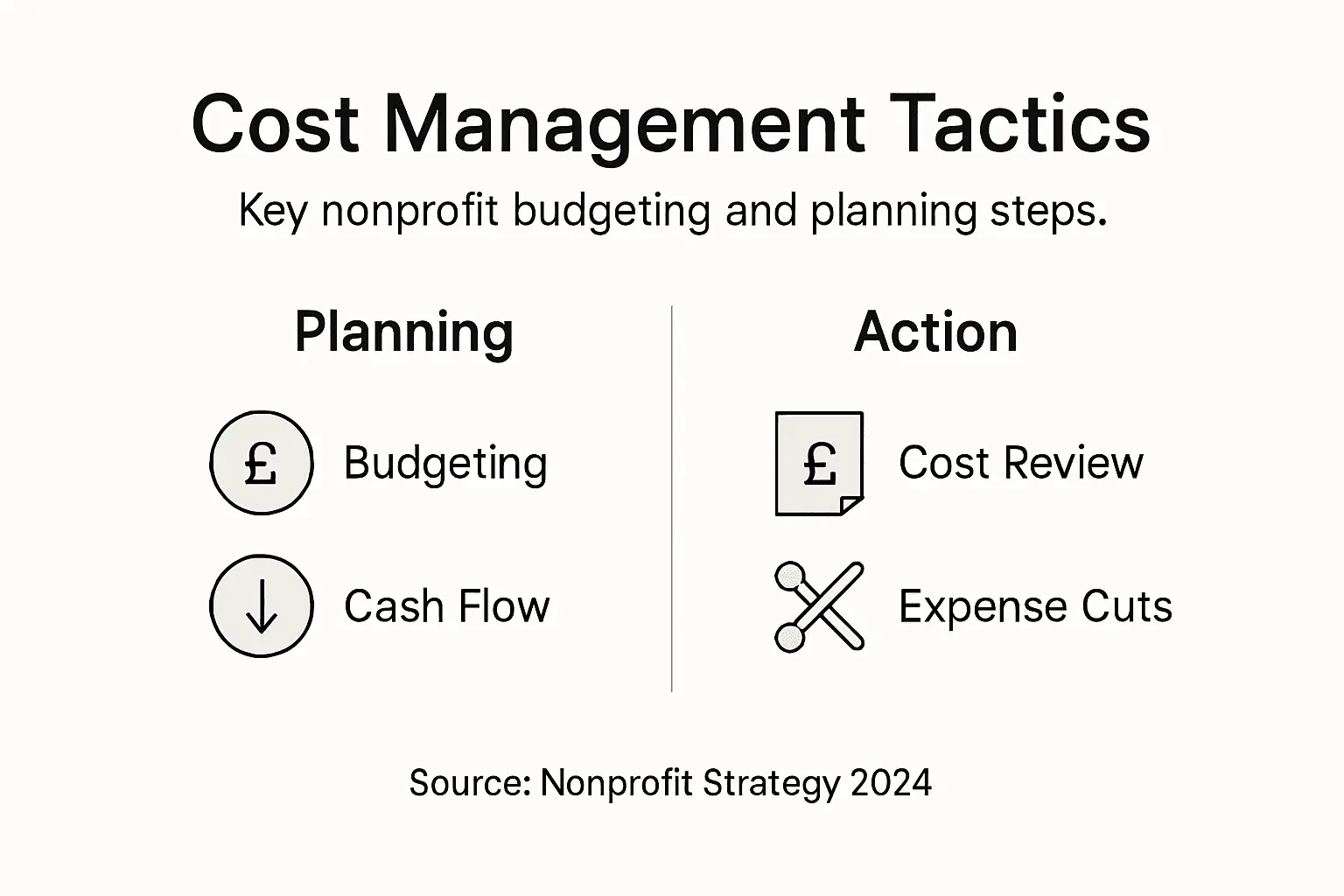
Below is a comparison of key adaptive strategies for financial planning and member engagement in uncertain times:
| Strategy Area | Main Focus | Key Organisational Benefit |
|---|---|---|
| Financial Planning | Scenario-based budgeting | Increases resilience to revenue shocks |
| Member Engagement | Iterative communication | Retains support during disruptions |
| Cost Management | Zero-based budget reviews | Optimises resource allocation |
Pro tip: Implement a quarterly zero-based budgeting review that requires each programme and department to justify its entire budget from scratch, promoting financial accountability and strategic resource allocation.
Common Mistakes in Crisis Decision-Making
Crisis decision-making represents a critical challenge for nonprofit organisations, with potential consequences that extend far beyond immediate financial implications. Common crisis management errors create significant organisational risks by compromising an organisation’s ability to respond effectively and maintain stakeholder confidence during challenging periods. Understanding these potential pitfalls is essential for developing robust strategic responses.
Nonprofit leaders face unique decision-making challenges that demand exceptional adaptability and strategic insight. The most prevalent mistakes include rushing decisions without comprehensive evaluation, succumbing to cognitive biases like confirmation bias, and failing to balance diverse stakeholder priorities. These errors can lead to fragmented responses, misallocated resources, and diminished organisational credibility during critical moments of institutional stress.
Successful crisis navigation requires a multifaceted approach that emphasises proactive recognition, clear communication, and systematic decision-making protocols. Nonprofits must develop adaptive frameworks that encourage collaborative input, maintain mission alignment, and provide structured mechanisms for rapid yet thoughtful response. This involves creating transparent decision-making processes, establishing clear lines of responsibility, and cultivating an organisational culture that values strategic flexibility and continuous learning.
Pro tip: Develop a structured crisis decision-making matrix that pre-defines response protocols, assigns clear responsibilities, and establishes transparent communication channels before a crisis emerges.
Strengthen Your Nonprofit’s Resilience Against Economic Uncertainty
Navigating the complex challenges of economic uncertainty requires more than just careful planning. Nonprofit organisations must enhance member engagement, streamline operations, and adapt rapidly to changing financial environments. The article highlights key pain points such as unstable revenue, rising costs, and the need for adaptive engagement strategies – all critical factors that can strain your organisation’s mission and growth.
Colossus Systems offers a comprehensive SaaS platform designed specifically for membership-based organisations facing these very challenges. With powerful tools for member management, event planning, and targeted communication, our platform enables you to build flexibility into your engagement strategies while maintaining operational control. From customisable sales pipelines to integrated payment solutions, Colossus Systems helps turn economic shocks into sustainable growth opportunities.
Discover how you can protect your organisation’s future with agile, data-driven solutions that enhance member experience and optimise resource allocation. Take the first step today by reaching out to start a conversation about your unique needs.
Explore how Colossus Systems can support your nonprofit
Contact us directly to discuss your organisation’s strategic needs
Begin strengthening your nonprofit’s engagement and financial planning

Don’t wait until economic uncertainty disrupts your mission. Connect with us now to build a resilient, adaptable organisation that thrives no matter the financial climate.
Frequently Asked Questions
What is economic uncertainty for nonprofits?
Economic uncertainty for nonprofits refers to unpredictable financial conditions that affect their operations, including unstable revenue streams, rising costs, and increased demand for services, all of which challenge strategic planning and organisational stability.
What types of economic shocks can nonprofits face?
Nonprofits can encounter various economic shocks, including governmental policy changes, macroeconomic shifts like inflation or recession, and sector-specific funding transformations, each of which can disrupt operations and service delivery.
How can nonprofits adapt their engagement strategies during economic uncertainty?
Nonprofits can adapt by implementing iterative communication, flexible programme designs, and proactive member listening, transforming traditional membership models into dynamic systems that respond to changing organisational needs and member expectations.
What are effective financial planning tactics for nonprofits facing economic uncertainty?
Effective financial planning tactics include comprehensive budgeting, continuous cash flow monitoring, and scenario-based financial planning, enabling nonprofits to maintain operational resilience while pursuing their mission amid financial challenges.
Recommended
- Building Organisational Resilience for Nonprofits | Colossus Systems
- The Essential Guide to Nonprofit Crisis Communications|CS
- Strategic Planning for Nonprofits: Driving Engagement and Impact|CS
- 10 Best Books for Nonprofit Leaders to Thrive | Colossus Systems
- Master Financial Planning for Freelancers in 2025 - Finblog