The Role of Lobbying in Industry Groups: What It Does and Where It Goes Wrong

Lobbying is how an industry group turns the scattered views of its members into one position that policymakers can hear, test and act on. Done well, it brings evidence into rule-making and protects members from badly drafted regulation. Done badly, it chases exemptions for a few members and erodes the trust that holds the group together. This guide explains the role, the mechanics, the transparency rules and the practical habits that separate the two.
TL;DR
- Industry groups lobby to give members a collective voice on regulation, standards and public policy, which no single member can easily achieve alone.
- Lobbying is only one part of the job. Researchers describe trade associations as agents of information that also set voluntary standards and shape public opinion.
- Not every group lobbies. A 2019 study of US trade and professional associations found 39% engaged in none of four political tactics, and only 8% in all four.
- Transparency rules lag behind practice, and gaps between a group’s public position and its members’ private views are common.
- The strongest groups keep clear records of member input, publish their positions and measure what their policy work delivers.
Table of Contents
- What lobbying means for an industry group
- What lobbying actually does for members
- Do all industry groups lobby?
- Good lobbying and bad lobbying
- Transparency: what the rules require and what they miss
- How to run lobbying that members trust
- Our perspective: policy work is a member-data problem
- Turning member input into a working process
- How Colossus supports an industry group’s policy work
- Common questions about lobbying in industry groups
- Sources
What lobbying means for an industry group
In the UK, Parliament describes lobbying as an individual or group trying to persuade someone in Parliament to support a particular policy or campaign, as set out on its lobbying guidance page. The OECD goes further and treats lobbying and influence activities as legitimate acts of political participation, provided they sit inside a legal framework built around integrity and transparency.
An industry group is a membership organisation whose members share a sector, a trade or a set of regulatory concerns. If you want the wider picture of how these bodies are structured, our guide to what membership organisations are covers it. What matters here is the economics. A single manufacturer, software firm or training provider has limited standing with a government department. A group that represents hundreds of them, with data to back its claims, has far more.
That is the core logic of lobbying through a group: pooling cost and credibility. Members fund a policy team once instead of each hiring their own, and officials get one coherent briefing instead of dozens of competing ones.
What lobbying actually does for members
The popular image is a lunch and a quiet word. The daily reality in most groups is far less dramatic. Policy work tends to fall into five activities.
- Monitoring. Tracking bills, consultations, regulatory proposals and procurement rules that touch the sector, so members hear about them early.
- Translating. Turning technical member experience into evidence a civil servant can use: costs, timelines, practical consequences.
- Representing. Responding to consultations, giving evidence to committees and meeting officials and elected representatives.
- Coordinating. Helping members agree a common position, which is often the hardest step.
- Informing. Explaining new rules back to members so they can comply and plan.
The last point is easy to overlook. Management researchers note that trade associations work to influence regulation, government policy and public opinion for their members’ collective objectives, and also act as channels for exchanging information within industries. A group that explains a new rule clearly to members is doing policy work as much as one that lobbies against it.
Setting standards before regulators do
The same research describes how associations set voluntary industry standards. A code of practice, a certification scheme or a published benchmark can steer behaviour without legislation. It can also give a regulator a ready-made model, which is one reason groups invest in them. For members, a credible standard is a market signal. For the group, it is proof that it offers more than a campaign budget.
Do all industry groups lobby?
No, and the data is a useful corrective. The 2019 study in Nonprofit Policy Forum looked at US trade and professional associations and found that fewer than half of occupational associations engaged in formal lobbying or operated a political action committee. Business associations were more likely than other tax-exempt nonprofits to treat lobbying as a core activity. The study is American, so the legal context differs from the UK, but the pattern is instructive: policy engagement is a choice shaped by mission and capacity.
Size does not predict it neatly either. The same study reports that larger membership and budget can sometimes reduce the likelihood of direct lobbying, possibly because large groups spread their effort across many member services. Larger staffs and boards, by contrast, were associated with more political engagement. In practice, internal administrative capacity matters more than raw revenue. A well-organised group of modest size can outwork a wealthy one that has no process for gathering member positions.
Good lobbying and bad lobbying
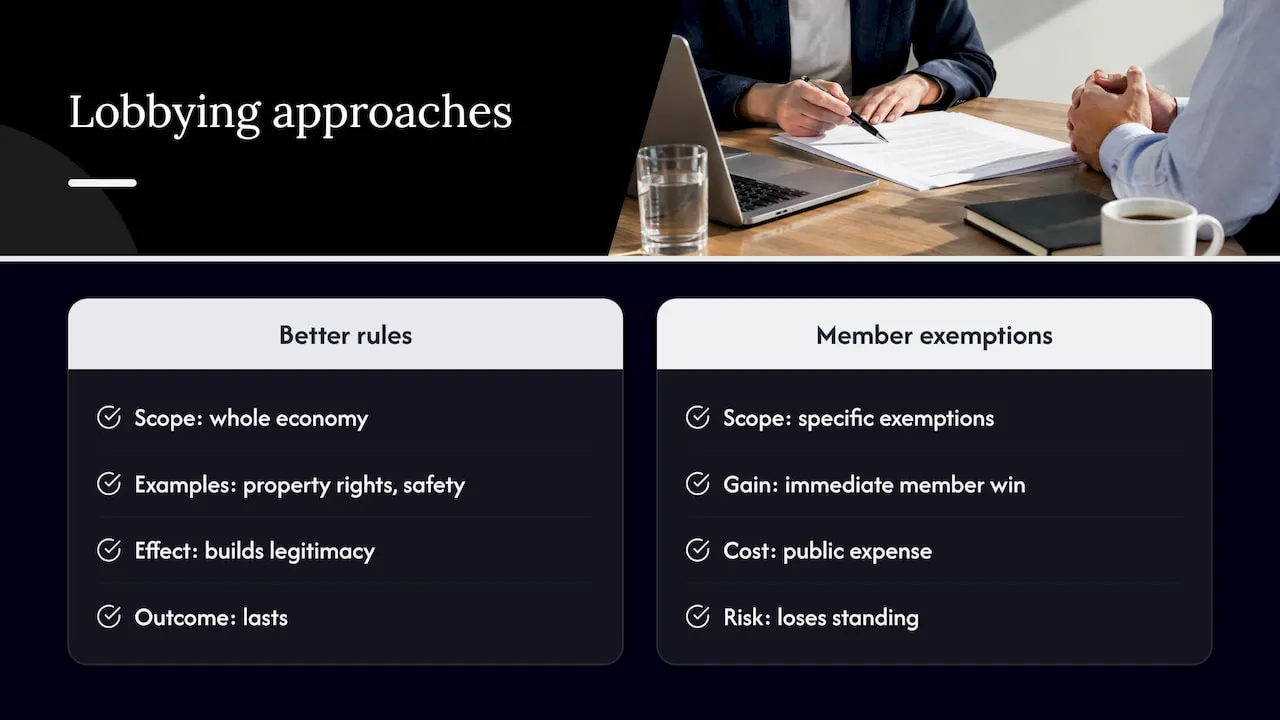
Economists studying trade associations draw a sharp line between two kinds of lobbying. Their model, published in the Journal of Legal Analysis, separates efforts that improve conditions for the whole economy, such as clearer property rights or safer infrastructure, from efforts that win specific exemptions for members at the public’s expense.
The authors suggest the balance shifts with the institutional setting. Where basic rules are weak, associations tend to push for the rules themselves. Where institutions work well, the temptation moves towards rent-seeking, meaning gaining advantage without creating new value.
For a group’s leaders, this has a practical meaning. Seeking an exemption can deliver an immediate, visible win for members. It can also cost the group its standing with officials and the public. Lobbying for better rules for the whole sector builds legitimacy more slowly, but it lasts. A useful test before committing resources is to ask whether the position would still look reasonable if it were printed on the front page with the group’s name on it.
Transparency: what the rules require and what they miss
Transparency is where the role of lobbying is most contested. The OECD’s 2025 Government at a Glance found that only 17 of 32 OECD countries with available data had a publicly available lobbying register. On average, countries met 42% of the criteria for strong lobbying laws and 36% for putting them into practice, as of mid-2025.
Spending disclosure is rarer still. The OECD’s recommendation on transparency and integrity in lobbying records that, as of 2022, only France, the United States and the European Union explicitly required lobbyists to disclose detailed information on lobbying expenditure.
The UK position
The UK has a statutory register, but it is narrow. Under the Transparency of Lobbying, Non-Party Campaigning and Trade Union Administration Act 2014, only consultant lobbyists who contact ministers or specified senior officials on behalf of third parties, for payment, must register. According to a House of Lords Library briefing, in-house lobbyists are exempt, because they lobby for their employer rather than for a paying third party. That briefing covers a 2026 private member’s bill that would widen the register to include them.
Whether a particular industry group falls inside or outside the register depends on how it works, so check the Act and the registrar’s guidance, or take legal advice, rather than assuming. Whatever the legal minimum, members and the public increasingly expect more than the minimum.
The transparency gap inside the group
The OECD’s work on regulating corporate political engagement points to two weaknesses that matter for any membership body:
- Indirect influence has outpaced the rules. Funding research, working with think tanks and running targeted campaigns can shape policy without appearing in a register.
- Associations rarely reveal internal splits. Disclosure focuses on the association, and seldom requires it to show positions held by only part of its membership. A public position can hide real disagreement among members.
The second point is the one leaders can act on directly, because it needs no new law. A group that records how a position was reached, who was consulted and where views differed is far more defensible than one that simply announces a consensus.
How to run lobbying that members trust
There is no formula, but groups that handle this well tend to share a handful of habits.
- Write down the policy mandate. State which issues the group will lobby on, which it will not, and who approves a new position. Put it in the governing documents or a published policy.
- Consult before you speak. Gather member views through surveys, working groups and member forums, and keep a record of the input. Where members split, say so internally.
- Lead with evidence. Officials respond to data on cost, employment, safety or supply. Members are your best source, so make it easy for them to contribute.
- Publish positions and responses. Consultation responses, meeting summaries and the group’s stance on live issues should be easy to find on your own site.
- Disclose beyond the minimum. Where funding, sponsorship or commissioned research supports a campaign, say so. The OECD points to full disclosure of funding sources and relationships as the direction ethical lobbying is heading.
- Report back. Tell members what you did, what changed and what did not. Silence after a campaign reads as failure, even when you made progress.
- Keep compliance current. Registers, charity rules and political-activity limits differ by country and by legal form. Our overview of nonprofit compliance requirements is a starting point, but your own legal adviser should confirm what applies to you.
If you want a practical way to demonstrate openness, our piece on a one-KPI transparency pilot shows how to start small and build trust with members. For the tactics side of influence, see our guide to association advocacy.
Our perspective: policy work is a member-data problem
We build software for membership organisations, and we see the same pattern in the groups we talk to. The weak point in lobbying is rarely the argument. It is the member data behind it.
A group that cannot say how many members work in a given region, which ones attended the last policy briefing, or who responded to the last survey is guessing when it says it speaks for the sector. Officials notice. So do members, who start to wonder whether the group represents them at all.
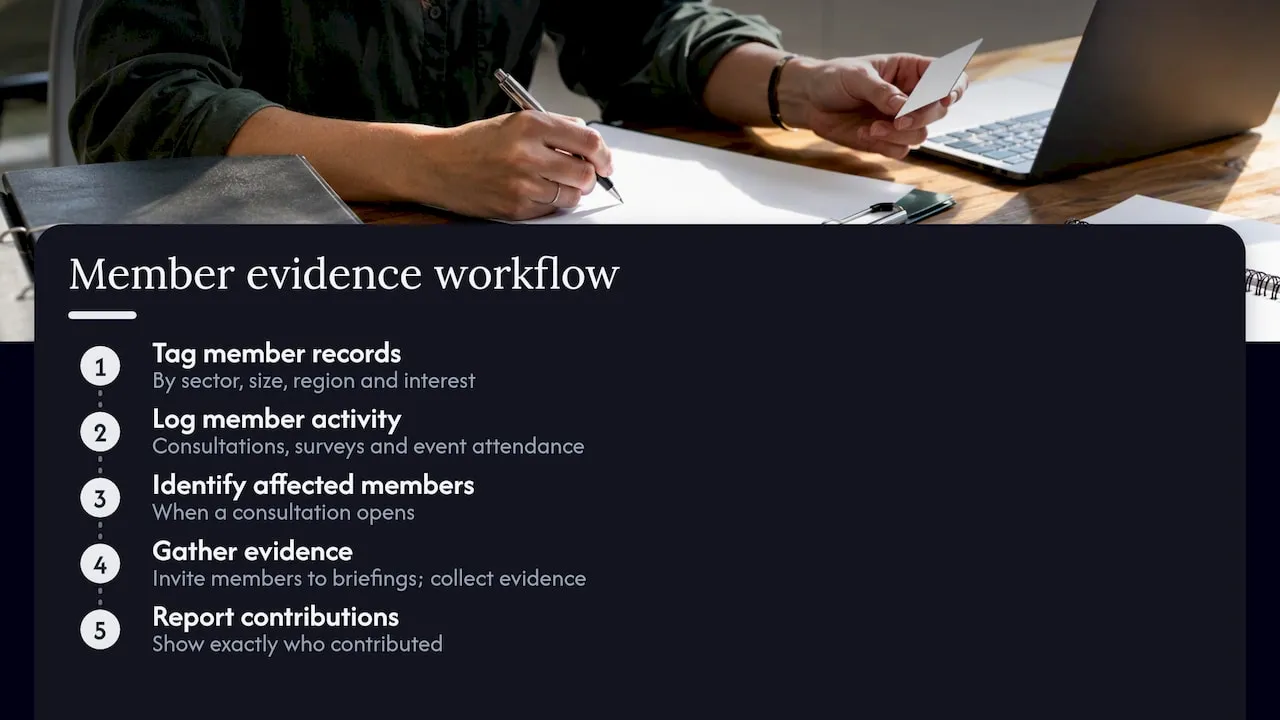
The fix is unglamorous. Keep one record of every member, tagged by sector, size, region and interest. Log every consultation, survey response and event attendance against it. When a consultation opens, you can identify the affected members in minutes, invite them to a briefing, collect their evidence and show afterwards exactly who contributed. That record is also your answer to the transparency gap: if members disagree, you can see it, and you can decide how to represent it honestly.
We also think groups under-use their own channels. Policy briefings, virtual training on new regulation and member-only portals for draft positions do more to build trust than any press release. Members who feel informed rarely feel unrepresented.
None of this replaces judgement. A platform cannot decide whether a position is good lobbying or rent-seeking. But it can make sure that decision is taken with the full picture in front of you, and that the evidence is there if anyone asks.
— Rob
Turning member input into a working process
Here is how the pieces fit when a consultation lands on your desk.
| Stage | What you need | What to record |
|---|---|---|
| Alert | Sector and interest tags on member records | Who was notified and when |
| Gather | Survey, working group or briefing event | Who responded, what they said |
| Decide | Agreed approval route for positions | Where members disagreed |
| Submit | Evidence-based response | The published response |
| Report back | Email update and portal summary | Outcome and next steps |
A CRM that links member records to emails and events makes this repeatable. A group that already uses membership management software for renewals and communications can reuse the same records for policy work, rather than keeping a separate spreadsheet that goes stale. For a broader view on keeping members involved, our article on boosting member engagement explains why engagement tools matter.
How Colossus supports an industry group’s policy work
Colossus Systems brings member management, CRM, event management, email marketing, member portals and analytics into one platform. For a group with a policy agenda, that means you can segment members by sector, invite them to a briefing, collect their input and report back from a single record.
Our plans are published on the pricing page: Core is £349 per month, Growth £699 per month, Scale £1,299 per month, and Enterprise starts from £2,500 per month. You can also browse the full feature list to see what each area covers.
Common questions about lobbying in industry groups
Is lobbying through an industry group legal?
In most democracies, yes. The OECD treats lobbying as a legitimate form of political participation when it takes place within a framework built on integrity and transparency. The rules differ by country, so check the registration and disclosure duties that apply where you operate.
What is the difference between lobbying and advocacy?
Advocacy is the broader term: raising awareness, building public support and shaping the debate. Lobbying usually means direct attempts to influence legislators or officials. Some legal systems define the line for tax or charity purposes, so ask a legal adviser before assuming the two are treated alike. Our guide to association advocacy tactics looks at the wider toolkit.
Does an industry group speak for all its members?
Not automatically. The OECD notes that internal misalignment between an association’s official line and individual members’ private stances is common, and that disclosure rules rarely expose it. Groups close the gap by consulting members, recording dissent and publishing how positions were agreed.
How can members hold their group to account?
Ask to see the policy mandate, the consultation responses the group has filed and the way positions are approved. Check whether the group discloses funding behind campaigns and commissioned research. A group that welcomes these questions is usually one that has good answers.
Sources
- Lobbying Parliament, UK Parliament
- Lobbying, OECD
- The Voice of Industry: why management researchers should pay more attention to trade associations
- Organizational Determinants of Political Involvement in Trade and Professional Membership Associations
- Trade Associations, Lobbying, and Endogenous Institutions, Journal of Legal Analysis
- Institutions and growth: Government at a Glance 2025, OECD
- Transparency and Integrity in Lobbying and Influence, OECD
- Lobbying Transparency (In-house Lobbyists) Bill [HL], House of Lords Library
- Regulating corporate political engagement, OECD