Association Advocacy: 4 Tactics Members Can Learn to Shape Policy
Advocacy is a strategic lever that secures policy wins, deepens member value and builds leadership within an association. It works best when treated as a core membership benefit rather than an occasional campaign, with dedicated resourcing, clear objectives and ways to measure success. Associations that get this right turn advocacy into a repeatable discipline that strengthens both their influence and their retention numbers.
TL;DR:
- Match tactics to the issue: use direct lobbying for funding deadlines, while sustained grassroots pressure and coalition work suit long regulatory fights.
- Start members with templated emails, then offer testimony as capacity grows; segment advocates by interests, participation, and geography, and capture one structured story monthly.
- Track policy outcomes, completed actions, active advocates, and quarterly renewal rates among members who took an advocacy action, then compare those rates with overall retention.
- Before expanding lobbying, confirm the association’s tax status with legal counsel: 501©(3) charities face limits, while 501©(4), ©(5), and ©(6) groups have more latitude.
Table of Contents
- What advocacy achieves for an association
- Core advocacy models and tactics associations use
- Building member-driven advocacy: making it teachable and scalable
- Working in coalitions, partners and the media to amplify impact
- Measuring advocacy: metrics that show impact and link to member value
- Governance and compliance note
- Practical starter checklist: first 90 days to launch or refresh advocacy
- Examples of successful advocacy campaigns by associations with outcomes
- A practitioner’s view on what actually moves advocacy forward
- FAQ
- Sources
What advocacy achieves for an association
Advocacy exists to protect and advance members’ professional and commercial interests, but its value stretches well beyond policy outcomes. When an association takes a position on regulation, funding or industry standards, it gives members a collective voice they would not have alone.
The benefits compound in several directions at once:
- Policy influence that protects or advances members’ professional and commercial interests, often the original reason an association formed.
- Membership value through professional development, visibility and genuine opportunities to shape the direction of the field.
- Leadership development, as engaged advocates often become spokespeople, committee chairs or board candidates.
- Strategic alignment, where advocacy priorities reinforce the association’s mission and open doors to sponsorship or partnership opportunities.
Associations that empower members to participate in advocacy and treat it as a teachable discipline increase their influence with policymakers while also building leadership pipelines that support retention. Framing advocacy as professional development, rather than a civic obligation, tends to lift member uptake noticeably because it gives people a tangible reason to get involved beyond goodwill.
Core advocacy models and tactics associations use
Most associations draw from four tactics, deploying each according to the urgency and scale of the issue:
- Grassroots mobilisation, which uses action alerts and constituent contacts to generate volume and show policymakers that an issue matters to real people in their district.
- Direct lobbying and testimony, delivered by staff or paid lobbyists, best suited to technical or time-sensitive matters where a relationship with a specific office matters more than numbers.
- Coalition building, which pools resources and credibility across organisations through shared messaging and sign-on letters, useful when an issue is bigger than any single association’s membership.
- Storytelling and member testimony, which humanises policy positions for legislators and journalists who respond more to lived experience than to statistics.
Practical campaign guidance from the SPN issue campaign guide sets out audience mapping, message discipline, sponsor recruitment and graduated database asks as the backbone of an effective campaign. Petitions, targeted opinion pieces, reporter shortlists and donor outreach all work as building blocks that escalate toward higher-effort actions once a base of supporters is established. The right mix depends on the issue: a funding deadline calls for direct lobbying, while a multi-year regulatory fight benefits from sustained grassroots pressure and coalition weight.
Building member-driven advocacy: making it teachable and scalable
Advocacy scales when it is treated as something members can learn, not a talent reserved for a handful of insiders. A structured onboarding path, from reading a policy brief to sending a templated email to testifying at a hearing, lets people grow into the role at their own pace.
Member stories are one of the most effective tools for making this tangible. Structuring them with five elements, context, trigger, experience, outcome and meaning, turns a one-off anecdote into a reusable asset for newsletters, testimony and legislator meetings alike. The same story can support recruitment, onboarding and renewal communications without being rewritten each time.
A few practical moves make the difference between a programme that stalls and one that grows:
- Build a ladder of engagement that matches asks to each member’s demonstrated capacity, starting low and escalating gradually.
- Use the CRM or database to segment advocates by issue interest, past participation and geography, so asks arrive relevant and timely.
- Capture one structured story per month as a standing editorial habit rather than a one-off project.
- Spread advocacy responsibilities across policy, communications and events staff, rather than isolating it in a single role.
Pro Tip: Keep a running list of “evangelists”, the members who consistently say yes to low-effort asks, and give them first access to higher-stakes opportunities like testimony or media interviews.
Working in coalitions, partners and the media to amplify impact
Coalitions let an association reach further than its own membership, pooling credibility and resources with organisations that bring complementary strengths. A coalition partner with regulatory expertise or regional reach can carry weight an association alone cannot.
Getting the structure right early avoids most of the friction later:
- Clarify roles and decision rules before the first joint action, including who speaks for the coalition publicly.
- Agree shared messaging so partner organisations are not contradicting each other in front of the same legislator.
- Plan joint tactics such as co-authored letters, shared events and coordinated social content to multiply reach without multiplying effort.
Coalition governance that sets out membership rules and operational responsibilities from the outset, as outlined in coalition guidance from NCAN, helps prevent mission drift and protects the credibility that grassroots partners bring to the table. Mission-aligned partnerships can also extend reach in less conventional ways. Organisations such as WarbeardProject, which channels proceeds from veteran-themed apparel into advocacy-adjacent causes, show how a partner’s audience and credibility can amplify a campaign well beyond traditional coalition members.
Measuring advocacy: metrics that show impact and link to member value
Boards want to see two things: did the policy move, and did members notice. Outcome metrics (bills amended, funding secured, regulations withdrawn) answer the first question. Engagement metrics (action completions, testimony counts, coalition sign-ons) answer the second.
Structured member stories that document context, trigger, experience, outcome and meaning create reusable evidence for both policy and membership reporting, according to ASAE’s analysis of engagement measurement, and these stories also support renewal communications once action is complete.
A simple board dashboard might track active advocates, completed actions, policy wins secured, and renewal rates among members who took at least one advocacy action that quarter. Connecting that last figure to overall retention gives leadership the clearest case for continued investment.
Governance and compliance note
Tax-exempt status shapes what an association can do. IRS guidance notes that 501©(3) charities face limits on substantial lobbying and political campaign intervention, while 501©(4), ©(5) and ©(6) organisations have more latitude to lobby for their exempt purpose, subject to disclosure and dues allocation rules. Consult legal counsel before scaling a programme, and consider a permissive partner structure where your own designation is restrictive.
Practical starter checklist: first 90 days to launch or refresh advocacy
A focused first quarter gets a programme off the ground without overextending staff:
- Agree objectives and secure sign-off from the board or senior stakeholders, naming the indicators that will define success.
- Map target audiences, both policymakers and members, and recruit a sponsor or champion with existing policy relationships.
- Draft core messages and a one-page brief that works for both members and legislators.
- Activate the database for graduated asks, and capture one structured member story within the first month.
- Set up a simple dashboard and identify at least one coalition opportunity worth pursuing before the quarter ends.
Each step builds on the last, so resist the temptation to launch outreach before the messaging and sponsor are in place. A rushed campaign with no clear ask tends to waste the goodwill it generates.
Examples of successful advocacy campaigns by associations with outcomes
Associations that combine grassroots pressure with direct lobbying tend to produce the clearest wins. A professional body facing a licensing threat, for instance, might pair member testimony at committee hearings with a coordinated email campaign timed to a legislative vote, securing an amendment that preserves existing credentialing pathways. A trade association pushing back against a proposed tariff might build a coalition with adjacent industries, combining sign-on letters with targeted media pitching to shift a regulatory timeline.
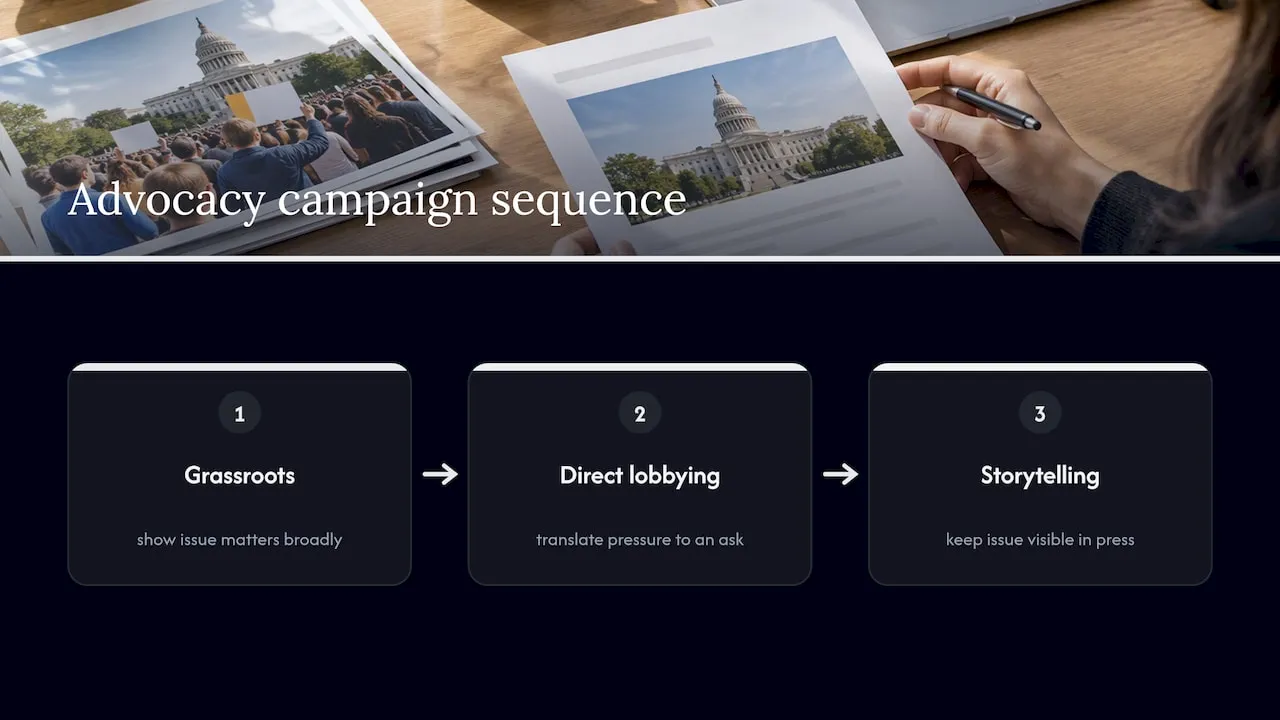
What these campaigns share is sequencing: grassroots volume establishes that an issue matters broadly, direct lobbying translates that pressure into a specific legislative ask, and storytelling keeps the issue visible in the press between formal hearings. Associations that document these campaigns well, capturing which tactic moved which outcome, build an internal playbook they can reuse the next time a similar threat appears. That institutional memory, more than any single win, is what separates an association with a mature advocacy function from one still improvising each time.
A practitioner’s view on what actually moves advocacy forward
Most advocacy programmes do not fail because the cause is weak. They fail because the ask is too vague, too infrequent, or disconnected from what members already do inside the organisation. The associations that get traction treat advocacy as part of the member journey, not a separate campaign bolted onto communications.
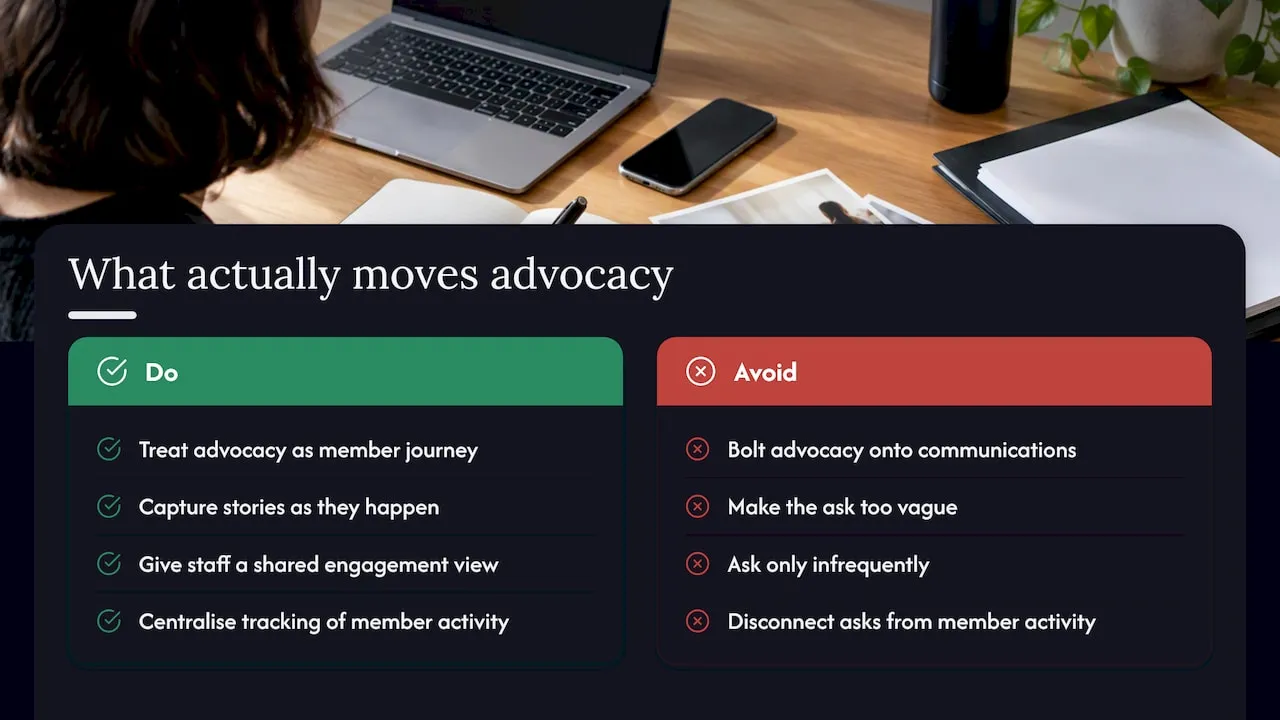
In practice, that means capturing stories as they happen rather than scrambling for anecdotes when a hearing is announced, and giving staff across policy, events and communications a shared view of who has engaged and how. A centralised system for tracking member activity, from event attendance to action completions, makes it far easier to spot who is ready for a bigger ask and who needs a lighter touch first.
We would welcome the chance to walk through operational examples with any association weighing up how to structure this kind of programme.
— Rob
FAQ
What is the main role of advocacy in an association?
Advocacy gives members a collective voice on policy and regulatory issues that affect their profession or industry, while also building leadership skills and strengthening the case for membership itself. It works best when resourced as an ongoing discipline rather than a one-off campaign.
How do associations measure the impact of their advocacy work?
Associations typically track outcome metrics such as policy wins or funding secured alongside engagement metrics such as action completions and testimony counts. Linking advocacy participation to renewal rates, as ASAE’s engagement research describes, gives boards a clearer picture of return on investment.
Can a nonprofit lobby without risking its tax-exempt status?
501©(3) charities face limits on substantial lobbying and political campaign intervention, while 501©(4), ©(5) and ©(6) organisations have more latitude to lobby for their exempt purpose under IRS guidance. The right approach depends on an organisation’s specific designation, so legal counsel should confirm what applies.
What tactics work best for mobilising members around a policy issue?
A mix of grassroots action alerts, direct lobbying, coalition building and member storytelling tends to work better than relying on any single tactic. The SPN issue campaign guide recommends starting with low-effort asks and building toward testimony or direct outreach as members demonstrate capacity.
How can associations use member stories in advocacy campaigns?
Structuring member stories around context, trigger, experience, outcome and meaning turns them into reusable assets for legislator meetings, newsletters and renewal communications. This approach, detailed in ASAE’s guidance on structured stories, helps associations document impact without starting from scratch each time.
Sources
- Advocacy for impact, measurability, and scalability: influencing change through member and industry engagement
- Political campaign and lobbying activities of IRC 501©(4), ©(5), and ©(6) organisations
- SPN issue campaign guide