One KPI Pilot to Prove Industry Group Transparency and Win Trust

Transparency matters because it converts a leadership team’s private judgement into signals that members, regulators and partners can actually observe and verify. It is not without cost: disclosure done badly can dampen motivation or leak competitive information. What follows is the evidence, the trade-offs and the practical governance steps that make transparency work rather than backfire.
TL;DR:
- Transparency improves trust and reduces risk by making leadership actions observable, which increases cooperation and collective earnings in industry groups.
- Full disclosure can backfire if it dampens motivation, reveals sensitive information, or exposes interim mistakes before resolution, creating strategic incentives to hide.
- Implementing staged or aggregated disclosure, with clear objectives and governance, minimizes risks and enhances data credibility through controlled, purposeful transparency.
- Building digital infrastructure with role-based access, audit logs, and standardized reporting is essential to support credible, operational transparency efforts.
- Running a pilot on a single KPI and establishing a governance body before wider rollout ensures transparency initiatives are effective and aligned with organizational goals.
Table of Contents
- Why transparency in industry groups builds trust and reduces risk
- The transparency paradox: when openness backfires
- How to build a purposeful transparency programme
- Governance, metrics and standards that make transparency credible
- What a membership platform actually does for transparency
- A publisher’s take on getting transparency right
- How Colossus Systems supports transparent membership operations
- Sources
Why transparency in industry groups builds trust and reduces risk
Trust between an industry group and its members is not built on reassurance. It is built on evidence members can check for themselves. When a board’s decisions, spending and voting outcomes are visible rather than assumed, members stop relying on faith and start relying on observation, and that shift changes behaviour in measurable ways.
The clearest evidence comes from experimental economics. Research into transparent leadership found that when a group’s leader takes actions other members can observe, cooperation rises, collective earnings increase, and the spread of individual contributions narrows compared with groups operating under opacity. Put simply: when people can see what the leader is actually doing, they stop hedging their own commitment against the fear that others might not be pulling their weight.
That mechanism is really about signalling. Every industry association carries an information asymmetry problem. Members cannot audit every board decision, regulators cannot inspect every internal process, and partners cannot verify every claim a group makes about its own standards. Transparency closes that gap by turning private intent into an observable action. A published budget, a public vote tally, or an open dispute log does the work that a reassuring newsletter never can.
The same logic extends beyond governance into supply chains, and the parallel is instructive for any membership body that certifies, accredits or represents suppliers. A scoping review of supply-chain transparency research found that visibility, traceability and standardised reporting act as the antecedents of trustworthy transparency, and that these factors measurably improve procurement trust and ESG accountability. An industry group that cannot show how its own reporting is validated is asking members to extend exactly the kind of blind trust that traceability standards were built to eliminate.
Transparency also has a quieter benefit: it accelerates organisational learning. Framing data openness as a tool for reducing uncertainty, rather than a compliance burden, helps groups integrate digital transformation and data-driven learning into ordinary governance rather than treating it as a one-off audit exercise.
The practical benefits tend to cluster around four areas:
- Lower perceived risk for members deciding whether to renew, invest time, or refer new members.
- Reduced information asymmetry with regulators, funders and commercial partners who would otherwise price in uncertainty.
- Better collective decision-making, since visible reasoning lets members challenge weak arguments before they become weak policy.
- Stronger reputational insulation, particularly for groups exposed to scrutiny over lobbying or political influence, where undisclosed donor relationships have previously undermined public trust in trade group political activity.
Statistic callout: In controlled group experiments, making a leader’s actions observable to the rest of the group reduced the variance in individual contributions and lifted total group earnings compared with an opaque leadership condition, according to the experimental analysis of transparent leadership. Visible leadership behaviour, not just good leadership behaviour, is what changes group outcomes.
None of this means transparency is a simple dial to turn up. The next section explains where it stops helping and starts hurting.
The transparency paradox: when openness backfires
Full disclosure is not always the safest choice, and there is a recognised body of theory explaining why. The transparency paradox describes situations where institutional openness improves accountability in principle but simultaneously creates strategic incentives for actors to prefer opacity in practice. Research on lobbying transparency and institutional design shows that welfare effects are not monotonic. More disclosure does not always mean a better outcome for everyone the disclosure is meant to protect.
Industry groups feel this paradox directly whenever a board debates how much internal deliberation to publish. Disclosing too much, too early, can change the very behaviour it was meant to make visible, and members may start performing for the audience rather than deliberating honestly.
Research on team-level transparency identifies several concrete failure modes worth naming:
- Motivation dampening: publicising interim setbacks can discourage the people working to fix them before the work is finished.
- Premature disclosure effects: exposing early-stage failures changes how teams behave mid-task, sometimes for the worse.
- Competitive leakage: granular data shared for accountability can double as intelligence for rival associations or commercial competitors.
- Legal and data protection exposure: member-level data, voting records and complaint details often carry privacy obligations that blanket openness ignores.
A review of double-edged transparency in teams found that exposing interim failures can reduce creative performance and motivation, even while the same openness increases knowledge sharing at the aggregate level. The effect depends heavily on what stage of work gets exposed, not simply on how much gets exposed.
The practical resolution most governance literature converges on is staged or aggregated disclosure: publish final outcomes openly, but protect interim experimentation until it has resolved. Aggregated dashboards can satisfy accountability demands without exposing individual missteps that were never meant to be judged mid-process.
Pro Tip: Separate your disclosure calendar into two tracks: outcomes (published on a fixed cadence, no exceptions) and interim progress (shared only with authenticated members, not the public). This single split resolves most of the paradox without sacrificing accountability.
How to build a purposeful transparency programme
Transparency that works is designed, not declared. Groups that publish data without a plan tend to either overexpose sensitive material or underdeliver on the accountability members actually want. A five-step sequence keeps both risks in check.
-
Set objectives before you disclose anything. Decide what outcome the transparency is meant to produce, whether it is renewal rates, dispute reduction, or regulator confidence, before choosing what to publish. Disclosure without a target outcome tends to drift into performative openness that satisfies no one.
-
Establish data governance first. Assign clear roles for who validates data before publication, who approves the release, and who controls access tiers. Practitioner guidance on turning transparency into a competitive advantage consistently points to DataOps-style governance, meaning structured validation and role-based access, as the difference between transparency that builds trust and transparency that creates chaos.
-
Decide scope and granularity deliberately. Choose between publishing final outcomes versus interim progress, and between aggregated statistics versus identifiable individual data. A voting outcome can be public; the private reasoning of any one board member usually should not be, unless your governance rules require it.
-
Publish methodology alongside the metric. A number without context invites misinterpretation. If you report a member satisfaction score, state the sample size, response rate and survey window in the same release. Groups that skip this step often find their own good data used against them by critics who question its validity rather than its content.
-
Pilot, measure, iterate. Run a contained pilot, ideally publishing aggregated outcome metrics publicly while giving members authenticated access to fuller progress dashboards, and measure the effect on trust and dispute frequency over a six to twelve month window before scaling group-wide. This mirrors how visible leadership behaviour is assessed in practical governance guidance, where board actions become genuinely trust-building only once members can consistently observe them.
Pro Tip: Run your pilot on one KPI, not five. A single well-measured metric, like time-to-resolution on member complaints, tells you far more about whether transparency is working than a dashboard with twenty half-tracked indicators.
Governance, metrics and standards that make transparency credible
Transparency without governance is just disclosure, and disclosure without structure erodes trust faster than silence does. Groups that get this right tend to build three things: a standing body responsible for what gets published, an audit trail proving the data wasn’t quietly adjusted, and board-level sign-off on the disclosure calendar itself. Association governance structures that already handle financial oversight are usually the right home for this responsibility, rather than creating a parallel committee with unclear authority.
On measurement, four KPIs cover most of what matters:
- Trust and engagement survey scores, tracked quarterly against the same question set.
- Dispute frequency, since a working transparency programme should reduce, not increase, member complaints over time.
- Traceability coverage, meaning the proportion of claims or certifications backed by checkable data.
- Time-to-resolution, how quickly disclosed issues get addressed once they’re visible.
On standards, the Global Reporting Initiative framework and traceability technologies borrowed from supply-chain practice give industry groups a tested vocabulary for methodology disclosure, rather than inventing reporting formats from scratch.
| Programme phase | Typical duration | Primary cost driver |
|---|---|---|
| Design and governance setup | a few weeks | Staff time; committee formation |
| Pilot (single KPI, limited scope) | several months | Data validation, platform configuration |
| Group-wide rollout | a few months after pilot | Reporting infrastructure, training |
Legal exposure deserves its own line item in this planning. Anything touching member-level data should be checked against relevant compliance requirements before it goes near a public dashboard.
What a membership platform actually does for transparency
Most transparency failures are not strategic. They are operational. A board decides to publish meeting outcomes and then discovers no system exists to control who sees what, or to prove the numbers weren’t edited after the fact.
A platform built for membership organisations addresses this at the infrastructure level rather than the policy level:
- Member portals that separate public-facing summaries from authenticated member detail, resolving the aggregated-versus-identifiable disclosure question structurally.
- Configurable access controls so a board can grant regulators, partners or specific committees different visibility tiers without manual gatekeeping.
- Reporting and audit logs that timestamp when data was published and by whom, giving the audit trail that credible governance requires.
- Secure payment and CRM records that let financial transparency claims be backed by traceable transaction history rather than summarised assurances.
Publishing meeting outcomes, running transparent member votes, or maintaining a public KPI dashboard with role-based depth are not separate projects. They are the same underlying digital infrastructure applied to different disclosure decisions.
A publisher’s take on getting transparency right
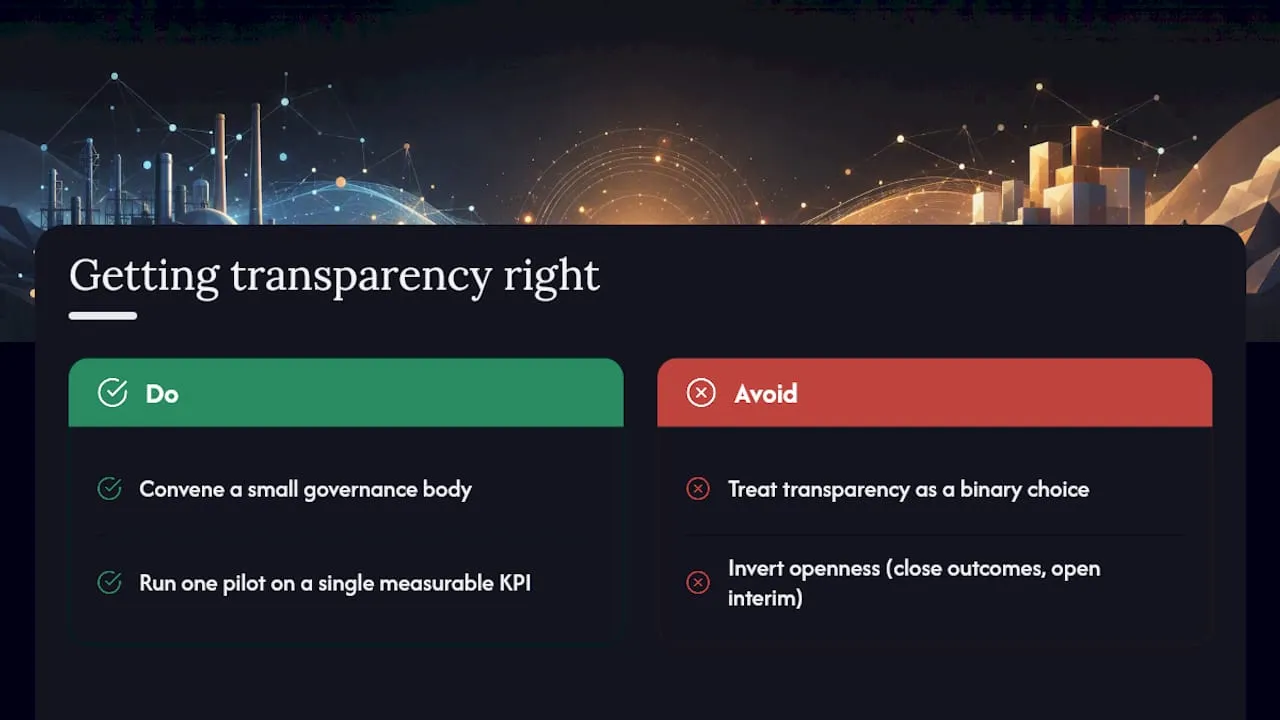
The mistake most boards make is treating transparency as binary: open or closed, disclosed or withheld. It isn’t. It’s a design decision made repeatedly, section by section, disclosure by disclosure. The evidence backs openness on outcomes and caution on interim process, and any group that inverts that gets both the paradox and the trust benefit backwards.
If you lead an industry group, two actions matter more than any policy document. First, convene a small governance body with actual authority over what gets published and when. Second, run one pilot on a single measurable KPI before you attempt anything group-wide. Everything else follows from those two decisions.
— Rob
How Colossus Systems supports transparent membership operations
Publishing outcomes credibly requires infrastructure, not just intent. Colossus gives industry groups the operational layer to do this without building it from scratch: membership management features that separate public summaries from authenticated member data, event tools that let you publish attendance and outcome reports without manual reconciliation, and CRM capabilities for managing role-based member communication.

If your board is planning a KPI dashboard, a public voting record, or a member-facing reporting cadence, the practical question is whether your current systems can support it without adding headcount. Explore the feature set or get in touch to talk through what a transparency pilot would look like on your existing membership data.
Sources
- Raising the price of talk: An experimental analysis of transparent leadership
- IEB Working Paper 2026/04 — lobbying transparency and institutional design
- Double-edged transparency in teams
- Scoping review on supply-chain transparency (Journal of Business Logistics / JBL)