How to manage volunteer members: a guide for membership managers

The most effective way to manage volunteer members is to combine documented role charters, EDI-led recruitment, and a tracked onboarding-to-offboarding workflow — all mapped into a single digital system. Start here:
- Draft a role charter for every volunteer position within 24 hours. Include objectives, term length, expected time commitment, and reporting lines.
- Build a short onboarding checklist (10 items maximum) covering welcome communications, safeguarding briefings, and first-week tasks.
- Add a volunteer tracking field to your CRM so you can segment, report on, and communicate with volunteers separately from general members.
NCVO guidance frames volunteer involvement across five stages: planning, recruiting, supporting, valuing, and ending. The ISOTURE and GEMS models add a programme structure to those stages, covering recruitment, orientation, training, utilisation, recognition, and evaluation. Together, they give you a repeatable framework rather than a series of ad hoc decisions.
Table of Contents
- What does a 30/90/365-day volunteer onboarding plan look like?
- How do you design a volunteer strategy that puts EDI first?
- How do you recruit and onboard UK volunteer members compliantly?
- What training pathways do volunteers actually value?
- How do you keep volunteers engaged and reduce attrition?
- What governance and offboarding steps protect volunteers and your organisation?
- Which digital features should your membership platform provide?
- What KPIs should you track for your volunteer programme?
- Templates you can use immediately
- Key takeaways
- The trade-offs no one tells you about
- Colossus makes this plan operational from day one
- Useful UK sources and further reading
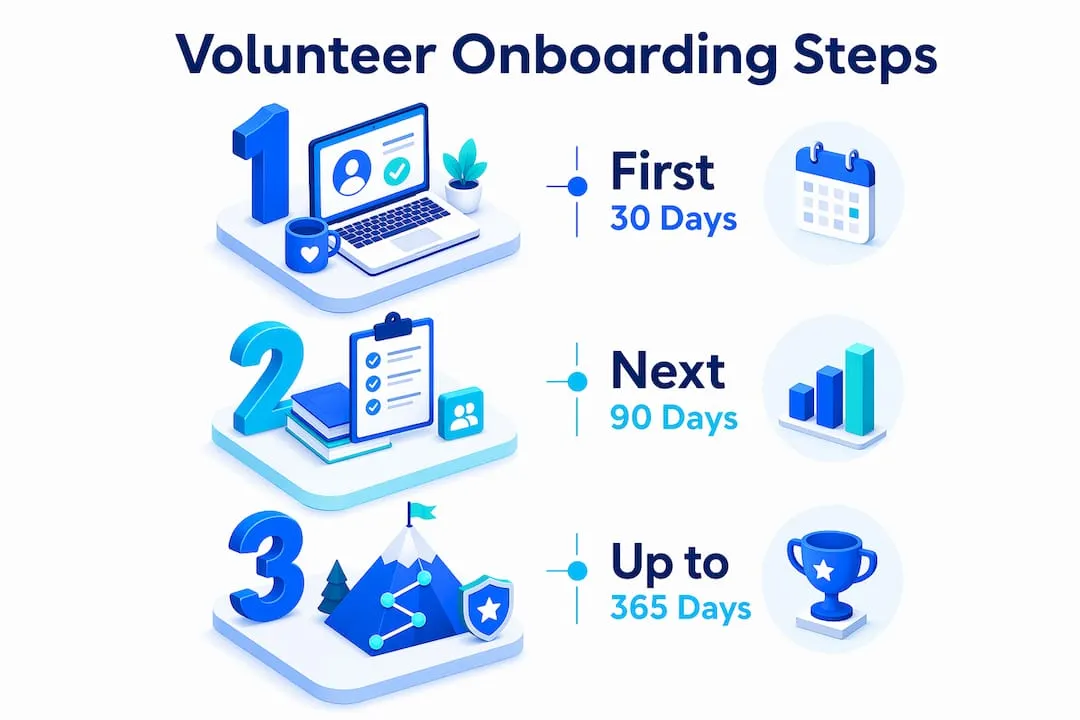
What does a 30/90/365-day volunteer onboarding plan look like?
A phased timeline keeps early momentum high and helps maintain volunteer engagement by providing clear next steps.
| Timeframe | Key activities | Approximate cost indicators |
|---|---|---|
| First 30 days | Welcome pack, safeguarding induction, DBS check (where required), CRM record created, first role briefing | DBS basic check carries a modest fee per person (Gov.uk standard fee); admin time varies per volunteer |
| Days 31 to 90 | Role-specific training, first task assignment, mid-point check-in, GDPR data-processing briefing | Training materials and facilitator time; e-learning licence costs vary by platform |
| Days 91 to 365 | First formal review, progression conversation, recognition milestone, succession or renewal decision | Staff time for reviews; recognition events: variable by format |
Pro Tip: Calculate your true cost per volunteer by adding direct costs (DBS, training materials) to indirect costs (staff hours at average hourly rate). Many organisations underestimate indirect costs by a factor of two or more.
Indirect costs are often invisible until a volunteer leaves. Tracking them from day one gives you an honest picture of return on investment and helps you make the case for a dedicated management platform.
How do you design a volunteer strategy that puts EDI first?
The strategic principle is straightforward: every volunteer role must be designed with documented expectations and an explicit commitment to equity, diversity and inclusion before recruitment opens. Anything less creates structural bias in who applies and who stays.
ISOTURE and GEMS give you the programme architecture. ISOTURE (Identify, Select, Orient, Train, Utilise, Recognise, Evaluate) maps neatly to a membership platform workflow. GEMS adds a governance lens, prompting you to evaluate not just performance but programme design. Use both together.
A role charter should include:
- Purpose: what the role contributes to the organisation’s mission
- Term and renewal: fixed terms with clear renewal criteria reduce ambiguity
- Time commitment: realistic weekly or monthly hours, not aspirational ones
- Governance: who the volunteer reports to and how decisions are escalated
- EDI statement: a sentence confirming the organisation welcomes applicants from all backgrounds and will make reasonable adjustments
Store charters in a governance repository within your CRM so they are version-controlled and accessible to both volunteers and staff. Workplace diversity guidance is worth reviewing when drafting your EDI clause.
Pro Tip: Add one sentence to every role charter confirming that volunteers are included in staff meetings, social events, and recognition programmes on the same basis as paid staff. This single clause, when honoured, is one of the most cost-effective retention tools available.
How do you recruit and onboard UK volunteer members compliantly?
The quickest reliable recruitment funnel is: targeted channel outreach → structured application → brief interview → role match → compliance checks → onboarding. Structured interviews and reference checks should be standard, particularly where volunteers handle funds or work with vulnerable people.
| Stage | Action | UK compliance note |
|---|---|---|
| Application | Collect name, contact, availability, relevant skills | GDPR: collect only what you need; state retention period in privacy notice |
| Screening | Structured interview, two references | Required for roles involving children or vulnerable adults |
| DBS check | Basic, standard, or enhanced depending on role | Gov.uk DBS service; enhanced required for regulated activity |
| Onboarding | Welcome pack, safeguarding briefing, signed role charter | Keep signed copies for duration of relationship plus three years |
| 90-day plan | Assign tasks, schedule training, set first review date | Document in CRM against volunteer record |
Statistic callout: The UK Government sets the DBS basic check fee at £18 per application. Enhanced checks carry a higher fee; confirm current rates at the Gov.uk DBS service page before budgeting.
For recruitment channels in 2026, prioritise your existing member base, sector job boards, and local volunteer centres. Social media works well for awareness; direct member outreach converts better.
What training pathways do volunteers actually value?
Training that connects to personal development and recognised accreditation reduces churn and builds organisational capability at the same time. A three-stage pathway works well for most membership organisations:
- Induction: organisational values, safeguarding, GDPR, role overview (delivered in the first two weeks, ideally via e-learning so it is self-paced)
- Role-specific training: skills and knowledge directly tied to the volunteer’s responsibilities (delivered within the first 60 days via workshops, webinars, or a learning management module)
- Leadership pathway: for volunteers showing progression interest, offer mentoring, committee experience, and where possible, accredited CPD credits or certificates
Record completion against each volunteer’s CRM record. Where you offer accredited learning, issue certificates through your platform and store them digitally. AIAA’s volunteer leadership guidance recommends documented officer manuals and mentoring as annual responsibilities — a model worth adapting for membership associations.
How do you keep volunteers engaged and reduce attrition?
Inclusion with paid staff and visible recognition are the two highest-impact retention levers, and both cost less than most organisations assume. Excluding volunteers from meetings, social events, or recognition is a primary driver of attrition — a finding consistent across UK sector guidance.

| Recognition tactic | Format | Frequency |
|---|---|---|
| Public acknowledgement | Newsletter, social media, AGM mention | Monthly or quarterly |
| CPD credits | Logged against volunteer record | On completion of training |
| Peer recognition | Volunteer-nominates-volunteer scheme | Quarterly |
| Small appreciation event | Informal gathering or virtual social | Annually, minimum |
A short pulse survey (five questions, sent quarterly) tells you more than an annual satisfaction review. Ask about role clarity, workload, inclusion, and one open question. Act visibly on the results. For practical recognition ideas, the volunteer recognition guide from Colossus covers programme design in detail.
Pro Tip: Tie your recognition calendar to your organisation’s existing annual cycle — AGM, annual report, member conference — so recognition moments cost no additional budget and reach the widest audience.
What governance and offboarding steps protect volunteers and your organisation?
Maintain a governance pack for every volunteer: signed role charter, safeguarding policy acknowledgement, DBS record (where applicable), GDPR consent, and a confidentiality agreement. Store everything in your CRM with access restricted to authorised staff.
A policy checklist to keep current:
- Safeguarding policy (review annually; align with UK statutory guidance)
- Data protection policy (GDPR-compliant; state volunteer data retention periods)
- Volunteer expenses policy
- Conflict of interest declaration
- Health and safety briefing record
When a volunteer relationship ends, follow a structured offboarding process: exit conversation, return of any materials or access credentials, final recognition, and a short exit survey. NCVO guidance is explicit that endings should be managed with dignity — a poorly handled exit damages your reputation with the wider volunteer community. For broader compliance obligations, the nonprofit compliance checklist from NPDiva covers ten core areas relevant to UK-registered organisations.
AIAA’s succession planning approach — documented handover notes, mentoring of successors, and officer manuals — translates directly to membership associations and reduces the knowledge loss that often follows a volunteer’s departure.
Which digital features should your membership platform provide?
A unified membership platform with CRM, event workflows, document storage, task automation, and reporting reduces admin and gives you real-time visibility across your volunteer programme.
| Feature | Purpose |
|---|---|
| Role templates | Standardise charters and onboarding tasks across roles |
| Automated onboarding sequences | Trigger welcome emails, task assignments, and training enrolments on sign-up |
| Document storage | Hold signed charters, DBS records, and confidentiality agreements against each record |
| Learning modules | Deliver and track induction and role-specific training |
| Recognition and awards tracking | Log CPD credits, certificates, and public acknowledgements |
| Engagement segmentation | Filter volunteers by role, tenure, training status, or engagement score for targeted communications |
Worked example: When a new volunteer is added to Colossus, an automated sequence can trigger a welcome email, assign onboarding tasks to the volunteer and their manager, enrol them in the induction module, and schedule a 30-day check-in — all without manual intervention. At 90 days, the platform flags the record for a formal review. Charters and DBS documents are stored against the volunteer’s profile, accessible to authorised staff only. Colossus’s membership management features cover this full workflow. For a broader look at available tools, the essential tools overview is a useful reference.
What KPIs should you track for your volunteer programme?
Engagement rate, retention rate, hours contributed per volunteer, training completion rate, and volunteer net promoter score are the five core metrics. Track them consistently and your board reports become straightforward.
- Engagement rate: percentage of active volunteers completing at least one task per month
- Retention rate: percentage of volunteers renewing or continuing past their initial term
- Hours contributed: total and per-volunteer average, reported monthly
- Training completion: percentage completing each pathway stage within the target window
- Volunteer NPS: a single-question survey asking how likely volunteers are to recommend the role to a peer
| Metric | Reporting frequency | Audience |
|---|---|---|
| Engagement rate | Monthly | Operations team |
| Retention rate | Quarterly | Leadership and board |
| Hours contributed | Monthly | Operations team |
| Training completion | Quarterly | Programme managers |
| Volunteer NPS | Bi-annually | Leadership and board |
Templates you can use immediately
Four templates cover the full volunteer lifecycle. Each can be stored in your membership platform and triggered via automated workflows.
| Template | One-line description | How to adapt it |
|---|---|---|
| Role charter | Defines purpose, term, time commitment, governance, and EDI statement | Swap role title, reporting line, and specific responsibilities per position |
| Onboarding checklist | 10-item list from welcome email to 30-day check-in | Add or remove items based on role risk level and DBS requirement |
| 90-day plan | Milestone-based plan with task assignments and review dates | Adjust milestones to reflect role complexity and training pathway length |
| Offboarding script | Structured exit conversation guide with checklist for access removal and final recognition | Adapt tone for voluntary departure vs. end of term vs. early exit |
Store master versions in your platform’s document library, version-control them with a date stamp, and set a calendar reminder to review annually. Workflows can auto-attach the correct template to a new volunteer record based on role type.
Key takeaways
A documented, EDI-led strategy mapped into a unified membership platform is the most reliable way to manage volunteer members, reduce attrition, and demonstrate programme impact to your board.
| Point | Details |
|---|---|
| Document every role | A signed role charter with term, time commitment, and EDI statement reduces ambiguity and attrition. |
| Use a phased onboarding timeline | A 30/90/365-day plan with compliance checkpoints keeps volunteers engaged and your organisation protected. |
| Include volunteers with paid staff | Exclusion from meetings and recognition is a primary driver of attrition; inclusion costs little and retains much. |
| Track five core KPIs | Engagement rate, retention rate, hours contributed, training completion, and volunteer NPS give a complete programme picture. |
| Colossus centralises the workflow | Colossus automates onboarding sequences, stores governance documents, tracks training, and segments volunteers for targeted communications. |
The trade-offs no one tells you about
The conventional wisdom on volunteer management tends to focus on process and tools, as though the right checklist solves everything. It does not. The harder problem is expectation management, on both sides.
Volunteers are not employees. They have chosen to give their time, and that choice can be withdrawn at any point. MindTools is direct on this: managing volunteers requires a different kind of empathy, one that avoids assuming they will meet the same time commitments as paid staff. The organisations that handle this well are the ones that build flexibility into role design from the start, rather than retrofitting it when a volunteer pushes back.
Automation is genuinely useful for onboarding sequences, training reminders, and recognition milestones. But compliance checks — DBS decisions, safeguarding concerns, conflict of interest disclosures — always require human sign-off. No platform replaces that judgement.
If you can only do three things in your first 90 days: write the role charters, set up a basic CRM tracking field, and schedule a quarterly pulse survey. Everything else builds on those foundations.
Colossus makes this plan operational from day one
Most membership managers know what good volunteer management looks like. The gap is execution: keeping documentation current, triggering the right communications at the right time, and having a single view of every volunteer’s status. That is exactly where Colossus delivers.
Our membership management platform brings CRM, automated onboarding sequences, document storage, learning modules, and engagement reporting into one place. You can store signed role charters and DBS records against each volunteer profile, trigger a 30/90-day onboarding workflow automatically, and pull a retention report for your next board meeting in minutes. No spreadsheets, no chasing. Request a demo at colossus.systems and see how quickly your volunteer programme can move from reactive to planned.
Useful UK sources and further reading
| Source | What it contains |
|---|---|
| NCVO — Involving Volunteers | Step-by-step UK guidance on planning, recruiting, supporting, valuing, and ending volunteer relationships |
| Penn State Extension — Volunteer Management Models | Overview of ISOTURE, GEMS, LOOP, and DHHS-SAMHSA models with practical application notes |
| MindTools — Managing Volunteers | Practical management techniques covering expectations, boundaries, and scheduling differences |
| AIAA — Volunteer Leadership Guidance | Role charters, succession planning, officer manuals, and mentoring frameworks |
| Gov.uk — DBS Checks | Current fees, check types, and eligibility criteria for UK organisations |
| NPDiva — Nonprofit Compliance Checklist | Ten core compliance areas for UK-registered nonprofits and voluntary organisations |