Achieve more with membership management best practices

Many membership leaders assume that running a tight ship means focusing on administrative efficiency above all else. That assumption is costly. The organisations that consistently grow their membership base, retain loyal members, and generate sustainable revenue are those that treat management as a strategic discipline, not a back-office function. This guide cuts through the noise and gives you a practical, evidence-based framework for improving engagement, retention, and operational performance. Whether you lead a professional association, a charity, or a trade body, the principles here apply directly to your work.
Table of Contents
- What makes membership management successful?
- Key components of effective membership management
- Practical strategies to boost member engagement and retention
- Communication best practices for member organisations
- Leveraging modern membership management software for growth
- Measuring success and refining your approach
- Take your membership management further
- Frequently asked questions
Key Takeaways
| Point | Details |
|---|---|
| Member-centric strategy | Thriving membership organisations build their practices around what matters most to their members. |
| Modern software advantage | The right technology simplifies management, saves time, and unlocks new opportunities for growth. |
| Engagement drives retention | Active, personalised engagement is the strongest predictor of member loyalty and renewals. |
| Continuous improvement | Consistently tracking performance and acting on feedback keeps your strategy agile and effective. |
What makes membership management successful?
Successful membership management is not a fixed destination. It is a continuous process of listening, adapting, and delivering value. The organisations that thrive are those that align what they offer with what their members actually need, and they revisit that alignment regularly.
Successful membership organisations adapt their practices regularly based on member feedback and industry trends. That adaptability is what separates growing organisations from stagnant ones. Understanding membership management basics is the starting point, but applying them strategically is what drives results.
The core pillars of successful membership management include:
- Engagement: Keeping members actively involved through events, content, and community
- Communication: Delivering timely, relevant, and personalised messages across preferred channels
- Retention: Proactively identifying at-risk members and intervening before they lapse
- Technology: Using integrated tools to automate, analyse, and improve every touchpoint
- Value creation: Continuously demonstrating why membership is worth renewing
“Member-centricity is no longer optional. Organisations that prioritise engagement best practices consistently outperform those that treat engagement as an afterthought.”
Member expectations have evolved significantly. People want personalised experiences, fast responses, and clear evidence that their membership fee is well spent. Meeting those expectations requires strategy, not just good intentions.
Now that we understand why best practices go beyond simple administration, let us explore the essential components that underpin effective membership management.
Key components of effective membership management
Breaking membership management into clear components makes it easier to identify gaps and prioritise improvements. Each component plays a distinct role in the overall health of your organisation.

| Pillar | Purpose | Practical tools |
|---|---|---|
| Data management | Accurate, accessible member records | CRM systems, member portals |
| Communication | Timely, relevant outreach | Email automation, SMS, newsletters |
| Engagement | Active participation and community | Events, forums, recognition programmes |
| Financial controls | Accurate billing and renewals | Payment gateways, automated invoicing |
| Analytics | Informed decision making | Dashboards, reporting tools |
Regular evaluation and adoption of new technology can boost operational efficiency and member satisfaction. Reviewing your core software features annually ensures your tools keep pace with your ambitions.
Here are the top five actions to implement right now:
- Audit your member database and remove duplicate or outdated records
- Segment your membership by interest, activity level, and tenure
- Automate renewal reminders at 60, 30, and 7 days before expiry
- Schedule a quarterly review of engagement metrics and act on findings
- Invest in a platform that integrates CRM, events, and communications in one place
Pro Tip: Automating renewal reminders alone can reduce lapsed memberships by a significant margin. Set up a sequence of personalised messages that remind members of the value they receive, not just the deadline they face.
With these components in mind, it is crucial to apply strategies that keep your members not only joining, but staying engaged for the long term.
Practical strategies to boost member engagement and retention
Engagement is not a single event. It is a pattern of meaningful interactions that build loyalty over time. The good news is that targeted, well-timed actions can produce measurable results quickly.
Organisations employing tailored engagement initiatives report up to 40% higher retention rates. That figure alone makes the case for moving beyond generic communications and one-size-fits-all events.
Practical ways to raise engagement and retention include:
- Offer exclusive content, early access, or discounts tied to membership tier
- Recognise member milestones such as anniversaries, certifications, and contributions
- Use automated follow-up messages after events to maintain momentum
- Deploy engagement software to flag inactive members and trigger targeted outreach
- Create peer-to-peer opportunities such as mentoring schemes and member forums
Exploring proven member engagement strategies and learning how to boost member engagement through software gives you a structured path forward. You can also draw on external strategies for member loyalty to supplement your internal approach.
Pro Tip: Segmenting your audience before promoting events consistently leads to higher attendance. A member who joined for professional development responds differently to an invitation than one who joined for networking. Tailor the message accordingly.
Improving engagement and retention often hinges on communication. Let us examine how best practices in communication can drive results.
Communication best practices for member organisations
Poor communication is one of the leading causes of member attrition. Members who feel ignored or overwhelmed by irrelevant messages quietly disengage and eventually lapse. Getting communication right is not complicated, but it does require discipline and the right tools.
Frequent, value-driven communication is strongly linked to higher renewal rates. Reviewing your communication tips and applying them consistently will build the trust that keeps members renewing year after year.
Four practical communication rules every membership organisation should follow:
- Match the medium to the message: Use email for detailed updates, SMS for urgent reminders, and social media for community building
- Personalise at scale: Use member data to address individuals by name and reference their specific interests or activity
- Be consistent: Establish a regular communication calendar and stick to it so members know what to expect
- Measure and adjust: Track open rates, click-throughs, and unsubscribes to refine your approach over time
“Organisations that communicate with purpose and regularity see measurably stronger renewal rates and higher member satisfaction scores.”
Automation is your ally here. Scheduling communications in advance, triggering messages based on member behaviour, and personalising content at scale are all achievable without adding to your team’s workload.
After mastering communications, the next step is maximising the impact of the technologies and systems that connect your team and members.
Leveraging modern membership management software for growth
The right software does not just save time. It transforms what your organisation can achieve. Modern platforms bring together CRM, event management, email marketing, analytics, and payment processing in a single, joined-up system.
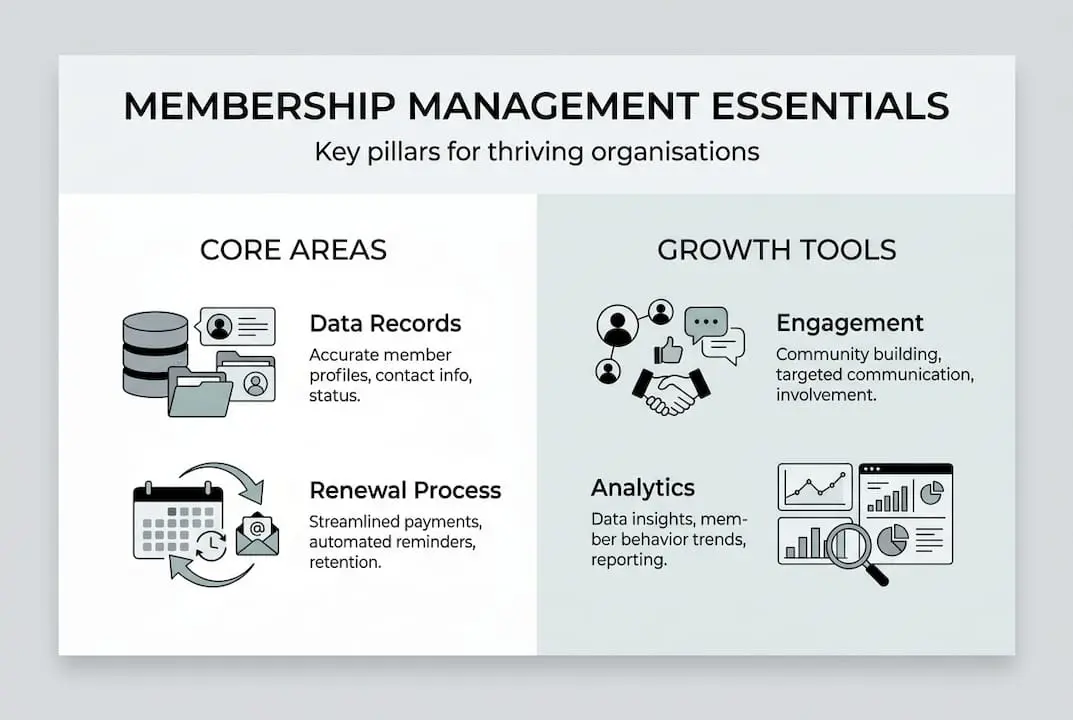
Integrated management platforms reduce admin errors and save significant staff time. Exploring the full range of software features available today will show you how much manual work can be eliminated.
| Feature | Standard platforms | Advanced platforms |
|---|---|---|
| Member database | Basic records | Segmented, searchable, real-time |
| Communication | Manual email sends | Automated, personalised sequences |
| Event management | Basic registration | Full event lifecycle management |
| Analytics | Simple reports | Live dashboards and predictive insights |
| Integrations | Limited | CRM, payment gateways, LMS, and more |
Three compelling reasons to upgrade your technology:
- Efficiency: Automation frees your team to focus on strategy rather than administration
- Insight: Real-time analytics reveal what is working and where members are disengaging
- Scalability: A robust platform grows with your organisation without requiring constant manual intervention
For organisations in the charity and non-profit sector, purpose-built software for non-profits addresses the unique challenges of volunteer management and restricted funding. A strong CRM for growth sits at the heart of any effective membership strategy.
With technology as the backbone of modern membership management, it is time to address how to measure and continuously improve your strategies.
Measuring success and refining your approach
You cannot improve what you do not measure. Establishing a clear set of key performance indicators (KPIs) and reviewing them regularly gives your leadership team the evidence needed to make confident decisions.
Organisations that regularly collect and act on member feedback see marked improvements in satisfaction and retention. Applying structured retention ideas alongside your measurement cycle accelerates progress.
The most valuable KPIs for membership organisations include renewal rate, active engagement levels, event participation, net promoter score, and revenue per member. Track these monthly and compare them quarter on quarter.
Steps to establish a measurement and improvement cycle:
- Define your core KPIs and set realistic targets for the next 12 months
- Choose a reporting tool or dashboard that surfaces data in real time
- Schedule monthly reviews with your leadership team to assess performance
- Collect member feedback through surveys after events and at renewal time
- Identify the top two or three areas for improvement and assign clear ownership
- Implement changes, monitor impact, and repeat the cycle
Pro Tip: Act on feedback within two weeks of collecting it. Members who see their input reflected in real changes become advocates. Those who feel ignored become lapsed members. Speed of response signals that you genuinely value their voice.
Building a culture of learning and iterative improvement takes time, but the compounding effect on retention and satisfaction is substantial. Small, consistent improvements outperform occasional large overhauls every time.
Take your membership management further
If you are ready to put best practices into action, advanced and tailored solutions can help your team achieve outstanding results. Colossus Systems brings together everything your organisation needs in one powerful platform.
Our platform gives membership leaders the tools to automate renewals, personalise communications, manage events end to end, and track performance through live analytics. You can explore software features to see exactly how each capability maps to your operational needs. From event management solutions that handle registration, ticketing, and follow-up, to CRM solutions that keep your member relationships organised and growing, we offer a joined-up system built for organisations like yours. Book a demo today and see the difference a purpose-built platform makes.
Frequently asked questions
What are the most important membership management KPIs?
Renewal rates and engagement levels top the list for membership organisations, alongside event attendance and member satisfaction scores. Tracking these consistently gives your leadership team a clear picture of organisational health.
How does software improve membership management?
Integrated software boosts efficiency and member satisfaction by automating routine tasks, centralising member data, and providing real-time analytics. This frees your team to focus on strategy and relationship building rather than administration.
What is the best way to improve member engagement fast?
Personalise your communication, offer events and content that match member interests, and recognise individual achievements. Targeted, relevant outreach leads to fast improvements in engagement without requiring a large budget.
How often should member feedback be collected?
Regular member feedback improves satisfaction and outcomes, so aim to gather it at least quarterly and after every major event. Consistent collection ensures you always have current data to act on.
Recommended
- Understanding Membership Management Software - Core Features|CS
- Membership Database | Colossus Systems
- 7 Essential Strategies to Maximize Database Membership|CS
- 7 Essential Tips for Optimizing Membership Management SaaS|CS
- Stop Wasting Time on Manual Outreach: Try These 7 AI Sales Automation Hacks – AI Management Agency