How to recruit volunteers for lasting impact in 2026

Recruiting volunteers is one of the most pressing challenges facing nonprofit leaders today. Without a steady stream of committed volunteers, membership organisations struggle to deliver on their mission and serve their communities effectively. Many nonprofits face high turnover rates, mismatched expectations, and difficulty converting initial interest into long-term commitment. This guide provides evidence-backed strategies specifically designed for membership organisations seeking to build sustainable volunteer programmes that drive real community impact. You’ll discover how to define roles clearly, target the right audiences, streamline onboarding, and measure success to continuously improve your recruitment efforts.
Table of Contents
- Understanding Volunteer Recruitment Challenges
- Preparing Your Recruitment Plan: Defining Roles And Targeting Audiences
- Executing Multi-Channel Recruitment And Streamlining Onboarding
- Improving Retention Through Mentoring And Ongoing Engagement
- Measuring And Refining Your Volunteer Recruitment Success
- Discover Powerful Tools To Simplify Your Volunteer Recruitment
- How To Recruit Volunteers: Frequently Asked Questions
Key takeaways
| Point | Details |
|---|---|
| Clear role descriptions boost sign-ups and retention | Detailed volunteer roles with skills, time, and impact information reduce hesitation and improve long-term commitment. |
| Use multi-channel recruitment targeting diverse audiences | Websites, social media, email, and community partnerships simultaneously reach families, professionals, students, and past volunteers. |
| Streamline onboarding and utilise volunteer management software | Simple registration forms and automated scheduling reduce drop-offs and administrative burden. |
| Pair new volunteers with experienced ones to improve retention | Mentoring programmes increase new volunteer retention by up to 71% through guidance and belonging. |
| Track key performance indicators to optimise recruitment efforts | Monitoring retention rates, conversion rates, and satisfaction scores enables data-driven improvements. |
Understanding volunteer recruitment challenges
Volunteer recruitment failures often stem from deeper organisational issues that manifest as high turnover and unfilled positions. Key turnover reasons include conflict, lack of fit, and high demands leading to poor retention. When volunteers leave prematurely, organisations lose institutional knowledge, waste training resources, and damage their reputation in the community.
Retention begins at recruitment. Mismatched roles create early exits because volunteers feel unprepared, overwhelmed, or disconnected from the work they signed up to do. A volunteer recruited for event setup who discovers they’re expected to handle complex donor relations will likely leave quickly. This mismatch wastes everyone’s time and creates negative word-of-mouth that hampers future recruitment.
Membership organisations face unique recruitment dynamics. You can draw from existing members who already understand your mission, but you also need to attract external volunteers to expand capacity and bring fresh perspectives. Balancing these two pools requires different messaging and engagement strategies.
Common recruitment obstacles include:
- Vague role descriptions that fail to communicate expectations
- Limited outreach channels that miss key volunteer segments
- Complicated sign-up processes that create unnecessary friction
- Inadequate onboarding that leaves new volunteers feeling lost
- Failure to recognise and address volunteer motivations
“Recruitment is not just about filling positions. It’s about finding the right people whose skills, availability, and motivations align with your organisational needs and culture.”
Understanding these challenges allows you to design recruitment processes that address root causes rather than symptoms. The following sections provide actionable frameworks to overcome each obstacle systematically. By implementing proven retention strategies from the recruitment stage onwards, you’ll build a volunteer programme that sustains itself through satisfied, committed participants.
Preparing your recruitment plan: defining roles and targeting audiences
Successful recruitment starts with clarity. Clear role descriptions increase sign-ups and retention because potential volunteers can self-assess their fit before committing. Your role descriptions should answer five critical questions: what tasks will I do, what skills do I need, how much time is required, where will I serve, and what impact will I make?
Each volunteer position needs a concise summary that highlights the meaningful outcomes volunteers will help achieve. Instead of “help with events,” write “greet attendees and manage registration tables at monthly community gatherings, helping 200+ families connect with local resources.” This specificity attracts people whose values align with your work.
| Role element | What to include | Example |
|---|---|---|
| Tasks | Specific activities and responsibilities | Coordinate weekly food distribution, manage inventory spreadsheets |
| Skills | Required and preferred qualifications | Basic Excel skills required, event planning experience preferred |
| Time commitment | Hours per week/month and schedule flexibility | 4 hours monthly, flexible weekday evenings |
| Location | Physical or virtual setting | Community centre in Camden or remote via video calls |
| Impact | Measurable outcomes volunteers enable | Help feed 50 families weekly, reduce food waste by 30% |
Audience segmentation transforms generic recruitment into targeted outreach. Target specific audiences with tailored volunteer roles to maximise appeal and conversion. Different volunteer segments respond to different motivations and require different role structures.
Key audience segments for membership organisations:
- Existing members seeking deeper involvement and leadership opportunities
- Families looking for activities they can do together on weekends
- Working professionals wanting skills-based volunteering during lunch breaks or evenings
- University students needing experience and references for career development
- Retirees with time and expertise to share on flexible schedules
- Past volunteers who left on good terms and might return for new opportunities
- Corporate groups seeking team-building through group service projects
Tailor your opportunities to match these segments. Create one-time event roles for busy professionals, ongoing mentorship positions for retirees, and family-friendly activities for parents with children. Flexible, skills-based, and episodic roles increase appeal because they accommodate modern volunteers’ diverse constraints and preferences.
Pro Tip: Survey your current volunteers and members to understand their motivations, availability, and skill sets. Use this data to create volunteer personas that guide role design and recruitment messaging. When you engage volunteers strategically, you’ll attract people who stay longer and contribute more meaningfully.
Executing multi-channel recruitment and streamlining onboarding
Effective recruitment requires simultaneous presence across multiple channels to reach diverse audiences where they already spend time. Multi-channel recruitment including websites, social media, partnerships, and referrals works best because different segments prefer different discovery methods.
Your recruitment channels should include:
- Organisation website with a dedicated volunteer page featuring clear calls to action
- Social media platforms showcasing volunteer stories and upcoming opportunities
- Email newsletters sent to members, donors, and past volunteers
- Community partnerships with schools, businesses, faith organisations, and civic groups
- Volunteer matching platforms like local volunteer centres and online databases
- Member referral programmes incentivising current volunteers to recruit friends
| Channel | Strengths | Best for |
|---|---|---|
| Website | Always available, detailed information, easy application | Serious prospects researching opportunities |
| Social media | Visual storytelling, broad reach, shareability | Raising awareness, attracting younger volunteers |
| Email newsletters | Direct communication, personalised messaging | Engaging existing members and past volunteers |
| Community partnerships | Trusted referrals, access to new networks | Reaching specific demographics like students or professionals |
| Referral programmes | High conversion, pre-vetted candidates | Scaling recruitment through current volunteers |
Referral programmes leverage your most valuable recruitment asset: satisfied current volunteers. People trust recommendations from friends and colleagues more than organisational marketing. Implement a structured referral system where volunteers can easily share opportunities via email or social media, and recognise top recruiters publicly.
Once prospects express interest, streamline sign-up with simple forms and volunteer management software to minimise drop-offs. Every additional form field and every extra step in your process increases abandonment rates. Collect only essential information initially: name, contact details, availability, and interests.
Simplified onboarding checklist:
- Submit brief online application with core information only
- Receive automated welcome email within 24 hours with next steps
- Complete required background checks or training modules if applicable
- Attend short orientation session covering mission, policies, and role expectations
- Meet assigned mentor or team leader for role-specific guidance
- Begin first volunteer assignment with clear instructions and support
Volunteer management software automates scheduling, sends reminders, tracks hours, and facilitates communication without manual administrative work. This technology allows you to manage volunteers efficiently whilst maintaining personal connection through strategic touchpoints.
Pro Tip: Test your sign-up process yourself on a mobile device. If it takes more than three minutes or requires excessive scrolling, simplify it. Most volunteers browse opportunities on their phones during commutes or breaks, so mobile optimisation is essential for conversion.
Pro Tip: Create a volunteer ambassador programme within your membership base. Train enthusiastic members to represent volunteer opportunities at community events, answer questions from prospects, and share their personal experiences. Peer-to-peer recruitment converts better than organisational messaging alone.
Improving retention through mentoring and ongoing engagement
Recruitment success is measured not by initial sign-ups but by long-term retention and sustained contribution. Experienced volunteers boost new volunteer retention by up to 71% for group volunteers through mentoring relationships that provide guidance, social connection, and organisational integration.

Pairing programmes match each new volunteer with an experienced peer who serves as their primary contact during the first three months. This mentor answers questions, provides encouragement, introduces the newcomer to other volunteers, and helps them navigate organisational culture. The relationship reduces the isolation and confusion that often drive early departures.
Structured mentoring includes:
- Initial meet-and-greet before the first volunteer shift
- Side-by-side work during the newcomer’s first few assignments
- Regular check-ins via phone, email, or coffee meetings
- Feedback sessions to address concerns before they become reasons to quit
- Gradual transition to independence as the new volunteer gains confidence
Addressing turnover causes proactively prevents exits. Conflict between volunteers or with staff, role misfit, excessive demands, and feelings of exclusion drive people away. Create clear conflict resolution processes, regularly reassess role assignments, respect time commitments, and foster inclusive team cultures where everyone feels valued.
Ongoing engagement strategies that maintain volunteer satisfaction:
- Continuous learning through skills workshops and training sessions
- Social events that build community beyond work tasks
- Flexible role options allowing volunteers to shift responsibilities as interests change
- Recognition programmes celebrating contributions publicly and personally
- Regular feedback opportunities where volunteers can voice concerns and suggestions
Align your volunteer programme with individual motivations. Some volunteers seek social connection, others want to develop professional skills, and many are driven by alignment with your mission. Understanding these motivations through conversations and surveys allows you to design experiences that satisfy diverse needs.
Maintain clear, consistent communication. Send regular updates about organisational impact, upcoming opportunities, and how volunteer contributions are making a difference. When volunteers see the tangible results of their work, they’re more likely to continue. Avoid communication gaps that make volunteers feel forgotten or undervalued.
Recognise that retention starts at recruitment. When you implement comprehensive retention strategies from day one, you create a culture where volunteers naturally want to stay and contribute. The time invested in mentoring and engagement pays dividends through reduced turnover costs and stronger organisational capacity.
Measuring and refining your volunteer recruitment success
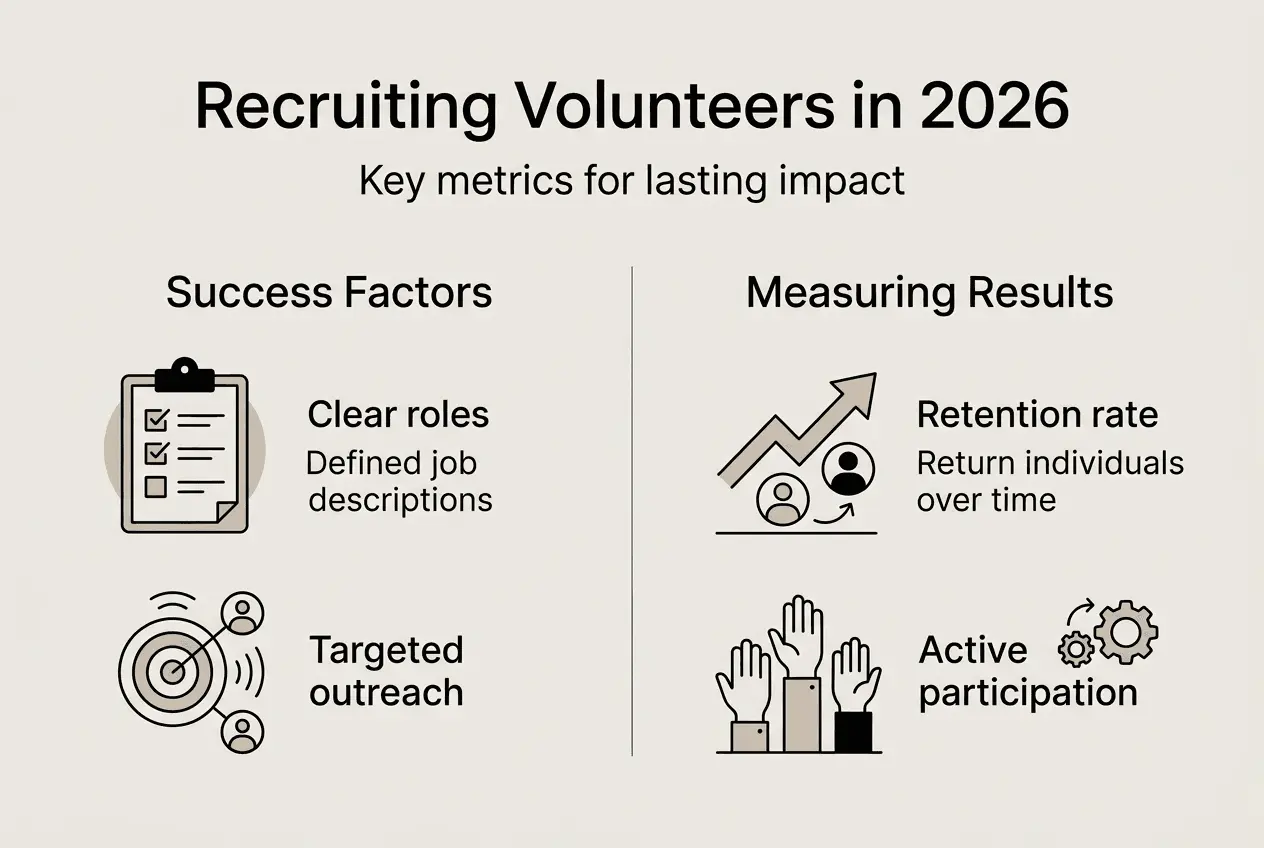
Data-driven recruitment improvement requires tracking specific metrics that reveal what’s working and what needs adjustment. Tracking KPIs like retention rate, conversion rate, and satisfaction helps refine recruitment by identifying high-performing channels, successful role designs, and effective onboarding processes.
| KPI | Definition | Target benchmark |
|---|---|---|
| Retention rate | Percentage of volunteers active after 6 and 12 months | 60-70% at 6 months, 40-50% at 12 months |
| Conversion rate | Percentage of inquiries that become active volunteers | 30-40% from initial contact to first shift |
| Volunteer hours | Total hours contributed monthly and annually | Steady growth or maintenance year-over-year |
| Role fill rate | Percentage of open positions filled within target timeframe | 80-90% of critical roles filled within 30 days |
| Satisfaction score | Average rating from volunteer satisfaction surveys | 4.0+ out of 5.0 or 80%+ satisfaction |
| Referral rate | Percentage of new volunteers from existing volunteer referrals | 20-30% of new recruits from referrals |
Analyse your data to pinpoint problem areas. If retention drops sharply after three months, your onboarding or early engagement is failing. If conversion rates are low, your application process may be too complex or your role descriptions unclear. If certain recruitment channels produce volunteers who stay longer, invest more resources there.
Regularly survey volunteers to understand their experience, motivations, and suggestions for improvement. Ask specific questions about role clarity, training adequacy, team dynamics, and overall satisfaction. Anonymous surveys often yield more honest feedback than face-to-face conversations.
Adjust your recruitment strategy based on insights:
- Revise role descriptions that attract volunteers who leave quickly
- Reallocate budget from low-performing channels to high-performing ones
- Modify onboarding based on common newcomer questions and concerns
- Expand successful role types and retire positions that consistently remain unfilled
- Enhance recognition programmes if satisfaction scores indicate volunteers feel underappreciated
Pro Tip: Create a quarterly recruitment review meeting where staff and volunteer leaders analyse KPI trends together, share qualitative feedback, and collaboratively design improvements. This inclusive approach surfaces insights from multiple perspectives and builds buy-in for changes. When you strengthen organisational resilience through systematic evaluation, your volunteer programme becomes a strategic asset rather than a constant struggle.
Track cohort performance over time. Compare volunteers recruited through different channels, during different seasons, or for different role types. These comparisons reveal patterns that inform future recruitment decisions and resource allocation.
Discover powerful tools to simplify your volunteer recruitment
Implementing these recruitment strategies becomes significantly easier with purpose-built software designed for membership organisations. Comprehensive membership management features help you clearly define volunteer roles, segment your audience, and track recruitment performance through integrated dashboards and analytics.
Streamline your entire volunteer journey with tools that automate onboarding workflows, send personalised communication, and manage scheduling without manual coordination. Event management capabilities allow you to leverage membership events as recruitment opportunities, converting attendees into active volunteers through seamless registration and follow-up processes.
CRM functionality tracks volunteer interactions, preferences, and history, enabling personalised engagement that improves retention. Automated email campaigns nurture prospects through the recruitment funnel whilst freeing your team to focus on relationship building rather than administrative tasks. Discover how integrated solutions can transform your volunteer recruitment from a constant challenge into a sustainable system that grows your organisational impact.
How to recruit volunteers: frequently asked questions
What are the best ways to attract diverse volunteer groups?
Target specific audience segments with tailored role descriptions that match their availability, skills, and motivations. Use multiple recruitment channels including social media, community partnerships, and member referrals to reach different demographics. Offer flexible options like virtual volunteering, one-time projects, and family-friendly activities to accommodate diverse lifestyles and preferences.
How can I keep volunteers engaged after their first event?
Pair new volunteers with experienced mentors who provide guidance and social connection during the critical first three months. Send personalised thank-you messages highlighting their specific contributions and impact. Invite them to upcoming opportunities that match their interests and availability, and create pathways for increased responsibility as they gain experience.
What should I include in a volunteer role description?
Include five essential elements: specific tasks and responsibilities, required and preferred skills, time commitment with schedule details, location (physical or virtual), and measurable impact the volunteer will help achieve. Keep descriptions concise but detailed enough for prospects to self-assess their fit before applying.
How to handle volunteer turnover effectively?
Track turnover patterns to identify common causes such as role misfit, excessive demands, or lack of recognition. Conduct exit interviews to gather honest feedback from departing volunteers. Use insights to improve recruitment targeting, onboarding processes, and ongoing engagement strategies. Focus retention efforts on the first six months when turnover risk is highest.
Can virtual volunteering help recruitment?
Virtual volunteering significantly expands your recruitment pool by removing geographic barriers and accommodating volunteers with mobility constraints, caregiving responsibilities, or demanding work schedules. Offer remote roles like social media management, online mentoring, data entry, or virtual event support to attract tech-savvy volunteers who prefer flexible, location-independent opportunities.