What Is a Sector Workforce Pipeline? A Practical Guide

A sector workforce pipeline is a coordinated system that connects employers, educators and training providers in one industry, so that people are trained for the jobs that sector actually needs and employers can see the talent coming. The word is used in two related ways. In workforce development it means a partnership that builds career pathways into an industry. In government planning, such as the UK Infrastructure Pipeline, it also means a forecast of how many workers a programme of investment will require.
This guide explains both meanings, shows what makes a pipeline work, and sets out how an association, industry group or nonprofit can start building one.
TL;DR
- A sector workforce pipeline aligns employers, training providers and community organisations around the talent needs of one industry.
- It has two faces: a partnership that trains and places people, and a data model that forecasts future labour demand.
- The strongest programmes treat employers as customers from the start, not just as a place to send graduates at the end.
- It cannot be bought off the shelf. It takes upfront coordination, support for trainees and multi-year commitment.
- Membership bodies are well placed to run one, because they already hold the employer relationships and the data.
Table of Contents
- What a sector workforce pipeline actually is
- The two meanings you will meet in the UK
- Does it work? What the evidence says
- What separates a working pipeline from a paper one
- How to build one, step by step
- Why membership organisations are well placed
- Our perspective
- Running a pipeline on one platform
- Common mistakes to avoid
- FAQ
- Sources
What a sector workforce pipeline actually is
The approach is often called a sector strategy or sector partnership. The US Department of Labor’s 2024 Sector Strategies Framework describes these as partnerships of employers, educators, workforce systems and community organisations that create career pathways linking training to high-demand jobs. It names three core components: engaged partnerships, data-informed decision-making, and worker representation and job quality.
The “pipeline” image is useful but slightly misleading. A pipe carries things one way. A good sector pipeline works in both directions: employers tell training providers what skills they need, and providers tell employers what they can realistically produce, and both adjust.
The International Labour Organization explains the logic of a sectoral approach: companies in the same sector tend to share similar skills challenges, so a shared analysis lets them solve short-term vacancies together while also pushing for better vocational curricula.
What it is not
- Not a recruitment campaign. Filling this month’s vacancies is a by-product, not the purpose.
- Not a single course. A course is one step. A pipeline links steps so that each prepares someone for the next.
- Not a product you can purchase. Software can run it, but the alignment between people has to be built.
The two meanings you will meet in the UK
If you searched this phrase in Britain, you probably found government material about infrastructure. That is the second meaning, and it is worth understanding because it shows how forecasting feeds a pipeline.
The forecasting model
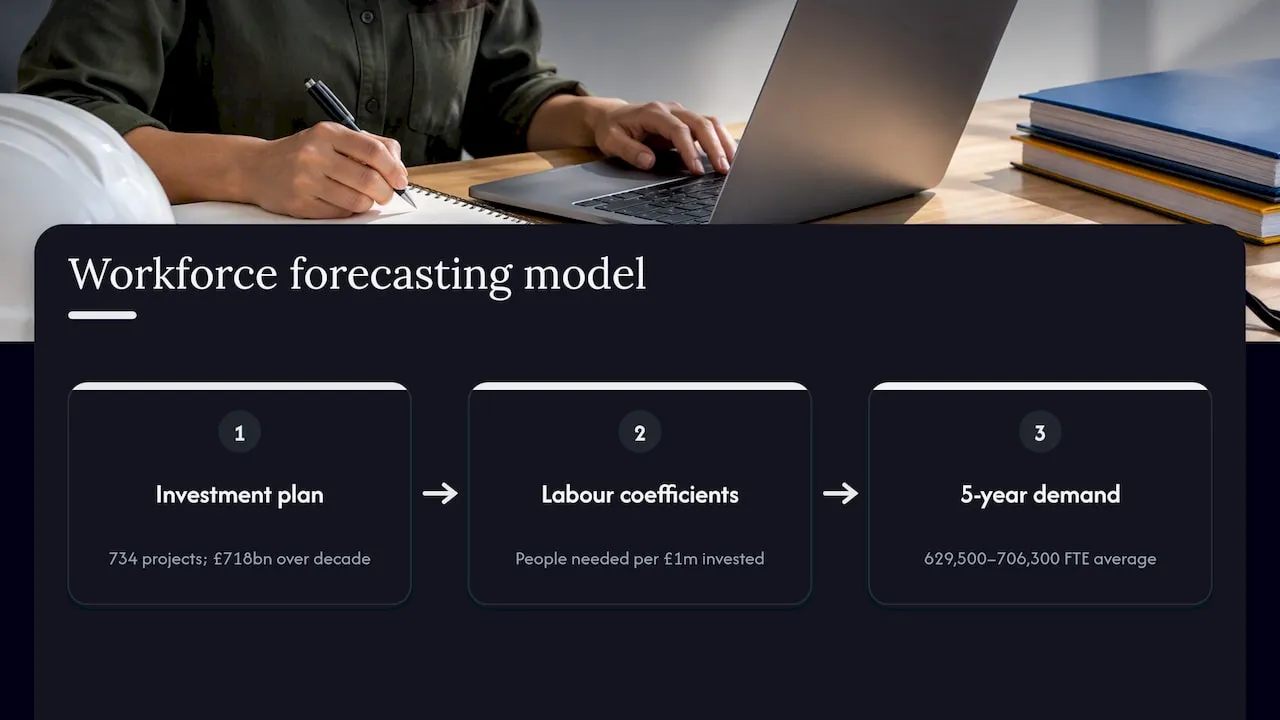
The government’s National Infrastructure and Service Transformation Authority (NISTA) publishes the Infrastructure Pipeline, a list of planned projects. Its updated version details 734 projects covering £718 billion of public and private investment over the next decade, and adds analysis of workforce and skills demand by region and sector.
How does a spending plan become a headcount? NISTA’s workforce forecasting methodology applies labour coefficients, which estimate the number of people needed per £1 million of investment, to the investment schedule. Its model projects an average five-year demand of 629,500 to 706,300 full-time equivalent positions for UK infrastructure.
The lesson for any industry group: a forecast is only as good as the coefficients behind it. If you build your own demand model, the more granular your data on how many people each type of work needs, the more useful the output. Employer-provided historical data is usually the best starting point.
The partnership model
This is the version most membership organisations will build. It starts with a shared picture of demand, then designs training, work experience and support around it. Both meanings meet in the middle: the forecast tells you what to train for, and the partnership does the training.
Does it work? What the evidence says
Sectoral training is one of the better-evidenced areas of workforce policy, though most rigorous studies come from the United States, so treat the figures as indicative rather than as a promise for the UK.
A summary of the evidence reports that long-term randomised trials of Project QUEST show annual earnings gains of 15 to 20% for participants up to 14 years after entry, and that Year Up participants saw earnings 40.3% higher three years after completion. The Brookings Institution has also reviewed the Project QUEST and Year Up evidence for readers who want the detail and the caveats.
These are well-resourced, carefully run programmes. Their results show what is possible when the design is right, not what any loosely organised scheme will deliver.
What separates a working pipeline from a paper one
Treat employers as customers, not end-points
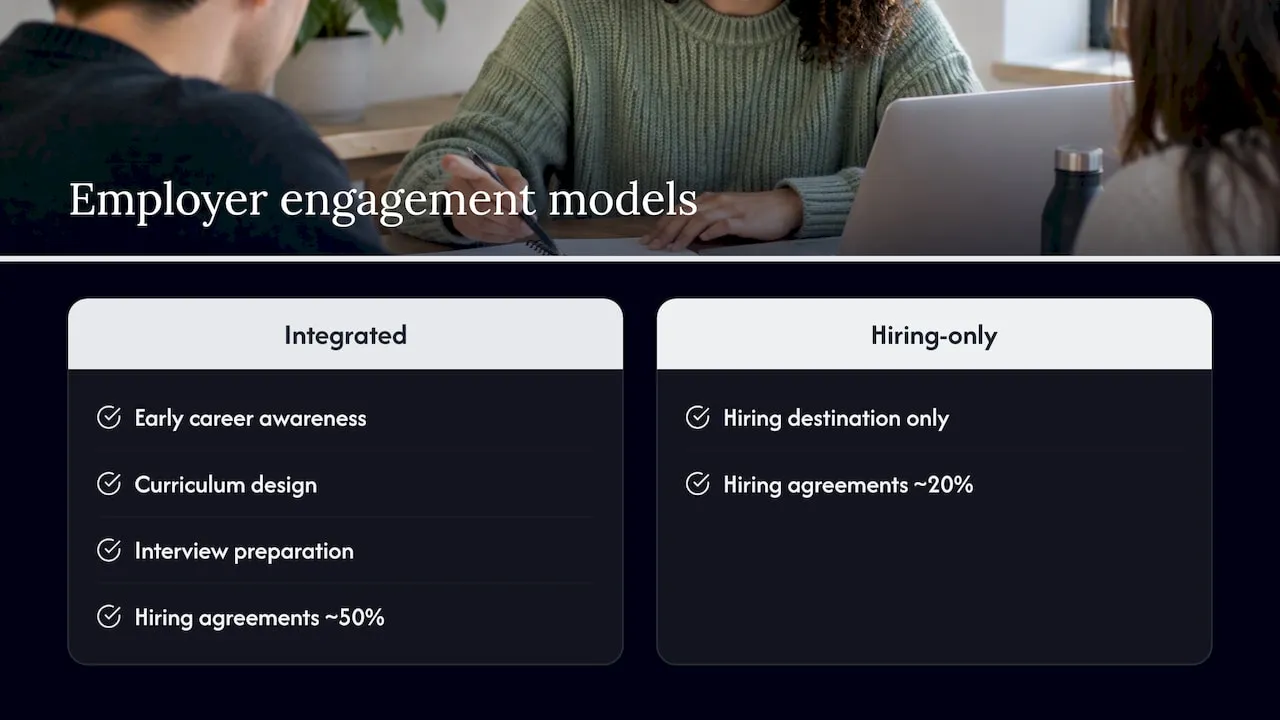
The most useful finding in the literature is the “dual customer” idea: employers’ hiring needs matter as much as the participants’ needs. Research from the American Institutes for Research indicates that programmes engaging employers early, in career awareness, curriculum design and interview preparation, do better than those that only treat employers as a hiring destination. It reports employer hiring agreements at about 50% in more integrated programmes, against about 20% in less integrated ones.
In practice that means employers sit in the room when the curriculum is written, offer work placements, and give honest feedback on whether trainees are interview-ready. Serving workers well while meeting employers’ needs is also a theme in this piece on supporting hospitality employees through shift-aware programmes, which shows how employer constraints shape what workers can realistically take up. For a wider view of how leadership development programmes can draw on employer involvement, see this curriculum-focused academy built around cohort learning and employer-style leadership frameworks.
Build connected steps
The Career Pathways How-To Guide argues that pathways need alignment between secondary and postsecondary education, workforce training and support services. The aim is to make each step prepare the person for the next, reducing the transition points where people drop out. A pathway is designed, not purchased.
Pay for the support, not just the classroom
Many planners underestimate wraparound services. The Year Up case study from Results for America describes a tuition-free model with six months of market-specific technical coursework followed by a six-month internship. Evidence on high-impact programmes points to stipends, childcare, transport help and career coaching as what keeps people from leaving before they finish.
Expect heavy upfront work
The AIR implementation study also flags the hardest hurdle: securing multi-year commitment from employers (for internships and hiring) and from participants (for persistence). Plan for a lot of administrative time aligning stakeholders before any training starts.
How to build one, step by step
- Define the sector and the region. Pick one industry cluster and a geography you can realistically coordinate. Narrow beats broad.
- Gather demand data. Ask member employers for current vacancies, expected hires over three to five years, and the skills they find hardest to source. Where public forecasts exist, such as NISTA’s for infrastructure, use them as a cross-check.
- Convene a core group. Include employers, at least one training provider, and a community organisation that reaches the people you want to recruit.
- Map the pathway. Write down each step from first awareness to a good job, and who is responsible for it.
- Agree employer commitments. Be specific: placements offered, interviews guaranteed, curriculum review dates.
- Add support. Decide what wraparound help you can fund or signpost.
- Track outcomes. Record enrolment, completion, placement and retention, and review the data with employers every quarter.
- Close the loop. Feed what you learn back into the curriculum and the forecast.
Why membership organisations are well placed
Associations and industry groups already have what a pipeline needs most: a trusted relationship with employers, a shared interest across competitors, and a record of members. Our own article on how industry groups can beat the poaching trap explains why collective training can beat each firm competing for the same scarce staff.
Other pieces from our library cover the supporting work: building community partnerships, career development activities and tracking student achievement.
Our perspective
We build software for membership organisations, so we see the same pattern repeatedly. The hard part of a pipeline is rarely the training content. It is keeping track of who is involved: which employer promised which placement, which learner has completed which stage, and which members have not been contacted since the last event.
That is why we think a pipeline run from spreadsheets tends to stall after the first cohort. Employer contacts sit in one place, learner records in another, event sign-ups in a third, and nobody can see the whole picture. When data is unified, you can follow a person from first enquiry through training to a job, and show employers and funders what you achieved.
We are also clear about the limits. Software does not create employer commitment, and it does not replace the human work of building trust. What it does is remove the administrative drag the research warns about, so that your team’s time goes into relationships rather than reconciling lists.
— Rob
Running a pipeline on one platform
If your organisation is building a pipeline, our platform brings membership management, events and virtual training and CRM into one system, with member and learner portals, email marketing and reporting. You can see everything in the feature list.
Plans are published on our pricing page: Core is £349 per month, Growth £699 per month, Scale £1,299 per month, and Enterprise starts from £2,500 per month. A contributor licence is available from £29 per month.
Common mistakes to avoid
- Starting with the curriculum. Start with employer demand, or you will train people for jobs that are not there.
- Engaging employers only at the end. The evidence favours early, intensive involvement.
- Ignoring job quality. The US framework lists worker representation and job quality as a core component, so a pipeline feeding poor jobs will lose participants.
- Skipping support. Without wraparound help, even strong technical training can fail to improve long-term employment.
- Measuring only placements. Retention and progression show whether the pathway really works.
FAQ
What is a sector workforce pipeline in simple terms?
It is a partnership between employers, trainers and community groups in one industry. Together they identify the jobs that will be needed, train people for them and help them get hired. The aim is a steady supply of skilled workers who are matched to real vacancies.
Is it the same as the UK Infrastructure Pipeline?
Not exactly. The Infrastructure Pipeline is a government list of planned projects that now includes estimates of the workforce needed to deliver them. A sector workforce pipeline is the wider effort to supply that workforce, and forecasts like NISTA’s can inform it.
Who should run a sector workforce pipeline?
Anyone able to convene employers and training providers and keep them committed. Industry associations, membership bodies, local partnerships and nonprofits often do this well because employers already trust them. The key is that employers have a real say in the design.
How long does it take to see results?
Expect a long upfront period of aligning stakeholders before any training begins. Programmes with strong evidence, such as Year Up, run for around a year per cohort, and long-term earnings effects are measured over several years. Plan for multi-year commitment rather than quick wins.
Can I buy a ready-made pipeline?
No. The pathways, employer agreements and support services have to be built locally. You can buy software to manage the people and data involved, but the partnership itself is your work.
Sources
- US Department of Labor, 2024 Sector Strategies Framework
- ILO: how a sectoral approach helps skills development
- CIHT: NISTA publishes updated UK Infrastructure Pipeline
- NISTA workforce forecasting methodology
- America Forward: Project QUEST and workforce development
- Brookings: Project QUEST and Year Up evidence
- AIR: Insights from implementation studies of sectoral training programmes
- The Career Pathways How-To Guide
- Results for America: sector-specific job training in Charlotte