What Is a Nonprofit Logic Model? A Practical Guide

A nonprofit logic model is a one-page diagram that shows how your programme is expected to work: what you put in, what you do, what that produces, and the changes you hope to see as a result. The US Centers for Disease Control and Prevention describes it as a graphic showing the relationship between activities and outcomes, with arrows marking the connections. If you can explain your programme to a trustee, a funder or a new volunteer by pointing at one page, you have a logic model.
This guide explains what a logic model contains, what a good one looks like, how to build one in a single working session, and how to keep it useful once it exists.
TL;DR
- A logic model is a visual map from resources and activities to outputs and outcomes, read left to right.
- The core parts are inputs, activities, outputs, outcomes (short, medium and long term), plus assumptions and external factors.
- A good model is clear, concise and detailed enough for an outsider to understand the programme. There is no single required format.
- Build it by working backwards from the change you want, then check that every activity leads to an output and every output to an outcome.
- Treat it as a living document: review it as the programme, funding and evidence change.
Table of Contents
- What a logic model is, in plain terms
- The parts of a nonprofit logic model
- What a good logic model looks like
- Why nonprofits use logic models
- How to build a logic model step by step
- Keeping the model alive
- Our perspective: a logic model is only as good as your data
- Putting the data side in place
- A short template you can copy
- FAQ
- Sources
What a logic model is, in plain terms
Think of a logic model as the story of your programme told in boxes and arrows. Evaluation Support Scotland, which works with voluntary and community projects, describes it as telling the story of a project in a diagram and a few simple words, showing the causal link between the need you have identified and what you do about it.
Different institutions phrase the definition differently, but they agree on the substance:
- Public Health Ontario calls it a visual illustration of resources, activities and expected outcomes that simplifies complex relationships.
- The University of Wisconsin Extension treats it as a graphical illustration of a programme that separates inputs, outputs, outcomes and impact.
- The US Department of Education’s toolkit presents it as a framework for planning, implementation and evaluation.
The common thread is the “if-then” chain. If we have these resources, then we can run these activities. If we run them, then we will produce these outputs. If we produce them, then people will change in these ways.
Logic model, theory of change and strategy
The three terms are often mixed up. A theory of change explains why you believe a change will happen and sets out the wider pathway. A logic model is the more concrete, programme-level diagram of how you will deliver it. Stanford’s Center on Philanthropy and Civil Society places a logic model within a wider strategic framework that also includes mission, goals, progress tracking and a plan for resources. In practice, read a logic model as the implementation view of one programme, not a replacement for your mission or your organisational strategy.
The parts of a nonprofit logic model
The simplest version has three components. The US Family and Youth Services Bureau says the simplest model has inputs, activities and outcomes, with outcomes split into short-term, intermediate and long-term. Fuller versions add more. The US Department of Education’s toolkit lists inputs, strategies or activities, outputs, measurable outcomes, assumptions, and external factors as the essential elements.
| Part | What it answers | Example for a youth mentoring charity |
|---|---|---|
| Inputs | What resources do we have? | Staff time, trained volunteers, grant funding, a venue |
| Activities | What do we do with them? | Recruit and train mentors, match them with young people, run weekly sessions |
| Outputs | What do the activities directly produce? | 60 mentors trained, 120 sessions delivered, 45 young people matched |
| Short-term outcomes | What changes first? | Young people report more confidence and a trusted adult to talk to |
| Intermediate outcomes | What changes next? | Better school attendance, new skills and aspirations |
| Long-term outcomes | What is the lasting change? | More young people in education, training or work |
| Assumptions | What must be true for this to work? | Mentors stay for the full year; schools support attendance at sessions |
| External factors | What is outside our control? | Local youth service cuts, school policy changes, economic conditions |
The example is illustrative, not drawn from a real programme, but the shape is typical.
Outputs versus outcomes
This is where most first drafts go wrong. Outputs count what you did: sessions, workshops, people reached. Outcomes describe what changed for people because of it. AmeriCorps defines outputs as direct products of activities and outcomes as expected changes over short, medium and long terms. “Ran 40 workshops” is an output. “Participants can manage their own budget” is an outcome. Funders usually want to see both, and they care most about the second.
Assumptions and external factors
These two boxes are the most honest part of the diagram. Assumptions are the beliefs you are relying on. External factors are the conditions you cannot control. Writing them down shows funders that you have thought about risk, and it tells your team what to watch.
What a good logic model looks like
There is no single correct format. The CDC’s guidance says a useful model is clear and concise, with enough detail to understand the programme, and that formats and levels of detail vary. Public Health Ontario makes the same point: models vary with the programme, purpose, audience and level of detail.
In practice, a good one has these qualities:
- It fits on one page. The University of Pennsylvania’s Center for Social Impact Strategy presents a one-page, left-to-right model of inputs, activities, outputs, outcomes and impact.
- Every box connects. An activity with no arrow to an output, or an outcome with no activity behind it, signals a gap.
- Outcomes are specific and measurable. “Improved wellbeing” is vague. “Participants report lower isolation after 12 weeks” can be tracked.
- It uses your language. If your beneficiaries or volunteers cannot follow it, it will not be used.
- It is honest about what you control. Long-term outcomes usually depend on more than your programme alone.
The University of Toronto’s Health Communication Unit likens a well-developed model to a road map that defines boundaries and makes pathways visible. That is a fair test: could someone navigate your programme with it?
The Kellogg logic model
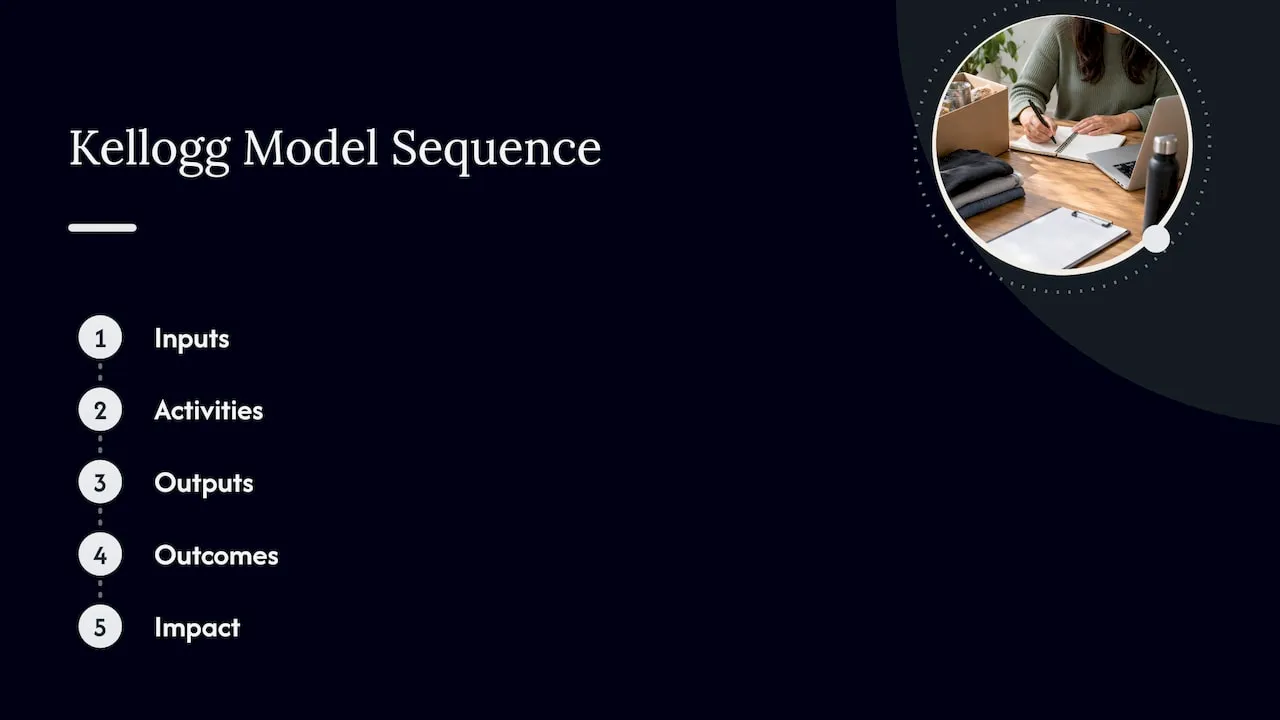
Searchers often ask about the Kellogg model. The W.K. Kellogg Foundation’s development guide presents a programme logic model as a visual way to show relationships among resources, activities and hoped-for changes. Its basic version runs from inputs to activities, outputs, outcomes and impact. The guide itself notes that logic models take different forms and that no single model suits every need, so treat Kellogg as a well-known template rather than a rule.
Why nonprofits use logic models
The benefits fall into three groups: planning, delivery and evaluation.
Planning. Public Health Ontario says logic models help clarify strategies and priorities, expose gaps and negotiate partner and staff roles. A team that disagrees about what a programme is for will find out quickly when it tries to draw the arrows.
Delivery. The same guidance says models support implementation by maintaining accountability and showing whether an initiative is on track, which helps you spot where to adjust.
Evaluation and funding. The Toronto workbook explains that models guide evaluation by matching activities with objectives and indicators, helping you decide what to measure and whether a programme is ready to be evaluated. For grant applications, the model gives a funder a single page that shows the chain from your funding to the change you promise.
Communication. The CDC treats the model as a tool for shared understanding, not merely a reporting diagram. That matters when you are explaining a programme to trustees, partners or new staff. If your team also needs to present findings persuasively, structured-communication training such as logical storytelling for professionals can help turn a diagram into a clear argument.
How to build a logic model step by step
The US Department of Education’s toolkit recommends a five-stage process: Prepare, Map, Cluster, Link and Verify. Here is how that works for a small team in one or two sessions.
- Prepare. Decide which programme the model covers and who should be in the room. The CDC advises engaging stakeholders from the start. Include delivery staff, a volunteer, a trustee and, if possible, someone who uses the service.
- Map. Start with the change you want to see and work backwards. Write the long-term outcome first, then the intermediate and short-term outcomes that must come before it. Then list the activities, outputs, inputs, assumptions and external factors on sticky notes.
- Cluster. Group related notes. Several activities may serve a single outcome, and several notes may turn out to say the same thing.
- Link. Draw arrows to show the if-then connections from activities through outputs to outcomes.
- Verify. Check that every activity leads to an output and every output to an outcome. Ask whether each assumption is realistic and whether anything important is missing.
A few habits make the result stronger:
- Limit yourself to one page. If it spills over, you probably have two programmes.
- Write outcomes as changes in people, not as things you will do.
- Attach an indicator to each outcome, so you know how you will tell whether it happened.
- Test the draft with someone outside the team. If they cannot explain the programme back to you, simplify it.
Common mistakes
- Confusing outputs with outcomes. Counting sessions is not the same as showing change.
- Listing everything you do. A logic model is not a service catalogue. Include only the activities that drive the outcomes.
- Claiming long-term impact with no pathway. If the arrows from your short-term outcomes to the final goal rest on nothing, say so in the assumptions.
- Filing it away. A model written for a bid and never revisited is wasted effort.
Keeping the model alive
What Works Growth, a UK evidence centre, recommends treating a logic model as an evolving part of intervention development and updating it as the intervention changes. Set a review point, for example annually or whenever a funding stream changes, and ask three questions. Did the outputs happen as planned? Are we seeing the early outcomes? Have any assumptions proved false?
This is also where continuous improvement thinking helps. If your data show an activity is not producing the outcome you expected, you adjust the activity rather than waiting for the end of the grant. For a wider look at that mindset, see this piece on continuous improvement in nonprofit organisations.
Our perspective: a logic model is only as good as your data
We work with membership organisations, associations and nonprofits, and the pattern we see is consistent. The logic model is rarely the hard part. The hard part is the next step: collecting the evidence that tells you whether the arrows hold.
A model might say that members who attend two events in their first year are more likely to renew. That is a sensible if-then link. But if attendance sits in one spreadsheet, renewals in another and email engagement in a third, nobody can test it. The diagram stays a hope rather than a hypothesis.
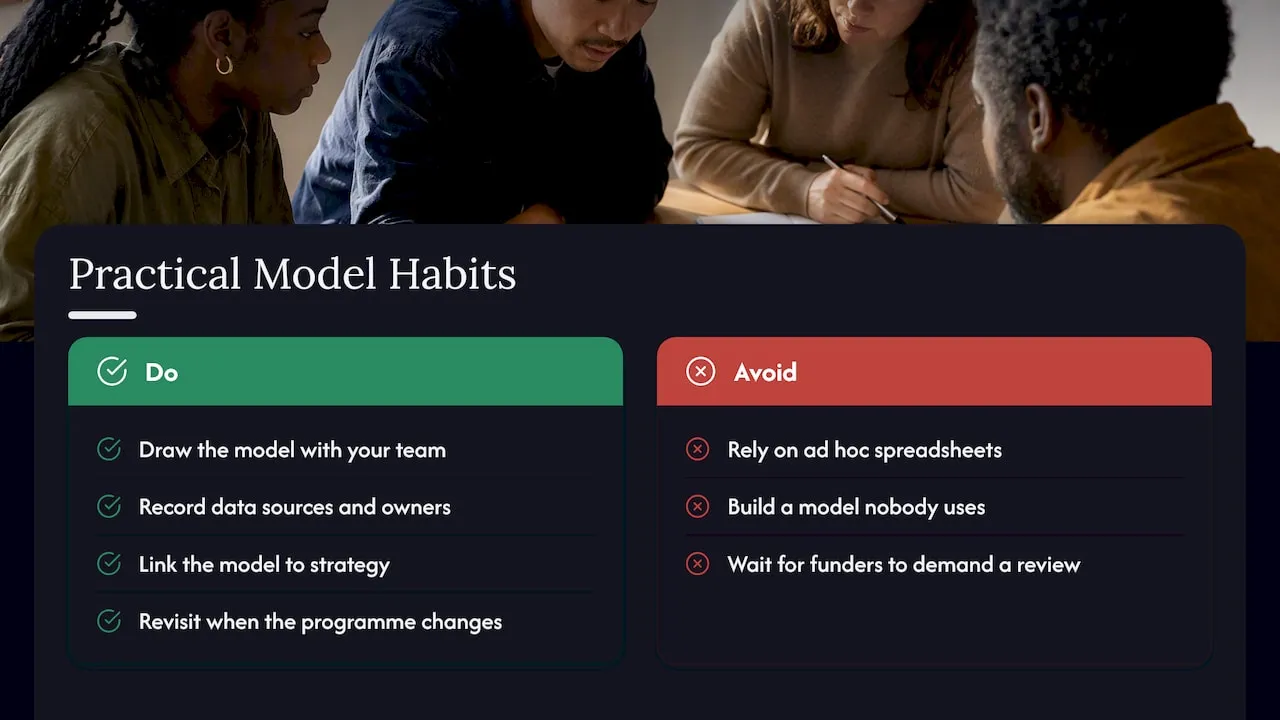
So our advice is practical. Draw the model first, on paper, with your team. Then, for each output and outcome, write down where the data will come from and who owns it. Where the answer is “a spreadsheet someone updates when they have time”, you have found your first improvement. Connected records of members, events, communications and payments make indicators cheap to track, which means you review the model because it is easy, not because a funder demands it.
We would also keep models modest. A one-page model that the whole team can recite beats a beautiful poster nobody uses. Link the model to your wider strategic planning, and revisit it whenever the programme changes. We cover the wider picture in our guide to strategic planning for nonprofits.
— Rob
Putting the data side in place
Once your logic model names the indicators you need, you need somewhere to hold the evidence. Colossus is a single platform for membership management, events, CRM, email marketing, e-commerce and member portals, so the records behind your outputs and outcomes sit together rather than in separate tools. You can see how the pieces fit on our features page.
Plans on our pricing page start at £349 per month for Core, with Growth at £699 per month, Scale at £1,299 per month and Enterprise from £2,500 per month. A Contributor licence is available from £29 per month. If you are choosing between systems, our guides to the best CRM for UK membership organisations and to what a nonprofit technology stack includes are useful starting points.
A short template you can copy
Use this skeleton as the starting point for your own workshop. Fill each line in a sentence or two.
- Need: the problem or opportunity your programme responds to.
- Goal: the long-term change you want.
- Inputs: staff, volunteers, money, partners, premises, data.
- Activities: the main things you do, in verbs.
- Outputs: the counts that result (people reached, sessions run, resources produced).
- Short-term outcomes: changes in knowledge, skills, attitudes or confidence.
- Intermediate outcomes: changes in behaviour or circumstances.
- Long-term outcomes: lasting change for individuals or communities.
- Assumptions: what must hold true for the chain to work.
- External factors: what could help or hinder, outside your control.
- Indicators: how you will know each outcome has happened, and where the data lives.
For a second view of the process, Evaluation Support Scotland’s guide walks through building a basic logic model for voluntary and community projects, and the Department of Education’s toolkit gives a fuller framework.
FAQ
What is a nonprofit logic model in one sentence?
It is a one-page diagram that links a programme’s resources and activities to its outputs and its short-, medium- and long-term outcomes. The arrows show the if-then reasoning behind the programme, so that staff, trustees and funders can see how the work is meant to create change.
What is the difference between a logic model and a theory of change?
A theory of change explains why and how change is expected to happen, often at a broad level. A logic model is a more concrete diagram of how one programme will deliver it, from inputs to outcomes. Stanford’s nonprofit strategy material treats the logic model as part of the wider strategic framework, not a substitute for it.
How long should a logic model be?
Aim for one page. The CDC says there is no fixed format, and the test is that it is clear and concise while giving enough detail. If you cannot fit the programme on a page, consider splitting it into two models.
Do funders require a logic model?
Many funders ask for one or for something similar, such as an outcomes framework, but requirements differ by funder and programme. Check the guidance for each application. Even where it is not required, a model strengthens your case by showing how your activities connect to the outcomes you promise.
How often should we update it?
Review it at least when the programme, funding or evidence changes, and many teams set an annual check. What Works Growth recommends treating the model as something that evolves alongside the intervention.
Sources
- Step 2: Describe the Program, CDC
- Evaluation Support Guide 1.2: Developing a Logic Model, Evaluation Support Scotland
- Logic Models: A Planning and Evaluation Tool, Public Health Ontario
- Section 1: What is a Logic Model?, University of Wisconsin Extension
- Program Evaluation Toolkit, REL Central
- Logic Models: An Overview, Stanford PACS
- Logic Model Tip Sheet, Family and Youth Services Bureau
- Logic Model Toolkit, US Department of Education
- How to Develop a Logic Model, AmeriCorps
- Logic Model, Center for Social Impact Strategy, University of Pennsylvania
- Logic Models workbook, University of Toronto Health Communication Unit
- W.K. Kellogg Foundation Logic Model Development Guide
- Using logic models, What Works Growth
- Implementing Continuous Improvement in Nonprofit Organizations
- Logical Storytelling, High Bridge Academy