What Is a Board of Directors' Role? Duties and Structure

A board of directors governs an organisation. It sets direction, decides who runs the organisation day to day, checks that the work is being done properly and answers for the result. It does not run the organisation itself. That split between governing and managing is the most useful thing to understand about the role, and most boards that struggle have blurred it.
This guide explains what a board does, how the role is divided between chair, directors and committees, and how it changes for a company, a charity and a membership organisation. It is written for new directors and trustees, for executives who report to a board, and for anyone deciding whether to join one.
TL;DR
- The board’s core job is to set strategy, delegate to management, monitor performance and be accountable to owners, members or stakeholders.
- Responsibility is collective. The board decides together and is answerable together, even when work is delegated.
- Good boards separate what they keep for themselves from what they hand to management, often in a written schedule of reserved powers.
- Companies, charities and membership bodies share the same core role, but the legal duties and the people the board answers to differ.
- Committees (audit, finance, nominations, remuneration) let a board examine specialist matters in depth without losing collective responsibility.
Table of Contents
- What a board of directors does
- Governing versus managing
- Roles inside the board
- Directors’ legal duties
- How the role differs by type of organisation
- How an effective board works
- Our perspective: governance runs on information
- Supporting your board with the right tools
- FAQ
- Sources
What a board of directors does
The G20/OECD Principles of Corporate Governance describe the board’s function as providing strategic guidance, monitoring management, overseeing risk management and being accountable to the company and its shareholders. The principles apply to any board structure charged with governing an organisation and monitoring its management.
The UK Institute of Directors breaks this into four areas:
- Establishing vision, mission and values.
- Setting strategy and structure.
- Delegating to management.
- Exercising accountability to shareholders and responsibility to relevant stakeholders.
Put plainly, the board answers four questions. Where are we going? How will we get there? Who is trusted to do the work? And how do we know it is going well?
The main responsibilities in practice
The OECD lists what that looks like in day-to-day board business. Boards should review and guide strategy, major action plans, annual budgets and business plans, set performance objectives, monitor implementation and performance, and oversee major capital expenditure, acquisitions and disposals. The same principles also cover overseeing risk management and compliance, selecting and monitoring key executives, succession planning and oversight of financial operations.
For a listed company in the United States, the regulator FINRA says directors commonly deal with strategic planning, mergers and acquisitions, share repurchases, dividends and future board nominations, and that they hire or fire the chief executive and set senior executive pay. A small association will not face share buybacks, but the pattern is the same: the board holds the decisions that shape the whole organisation.
A useful working list for any board:
- Direction: agree the purpose, strategy and annual plan.
- Resources: approve the budget and keep an eye on financial health.
- Leadership: appoint, support and, if needed, replace the chief executive, and plan succession.
- Oversight: monitor performance against the plan and the risks that could derail it.
- Accountability: report honestly to owners, members, funders and regulators.
Governing versus managing
The board’s role is oversight, not operations. The IoD explains that a board determines policies and objectives, delegates to management and monitors implementation. It recommends that boards distinguish the responsibilities they keep from those properly devolved to senior management, often through a schedule of reserved powers.
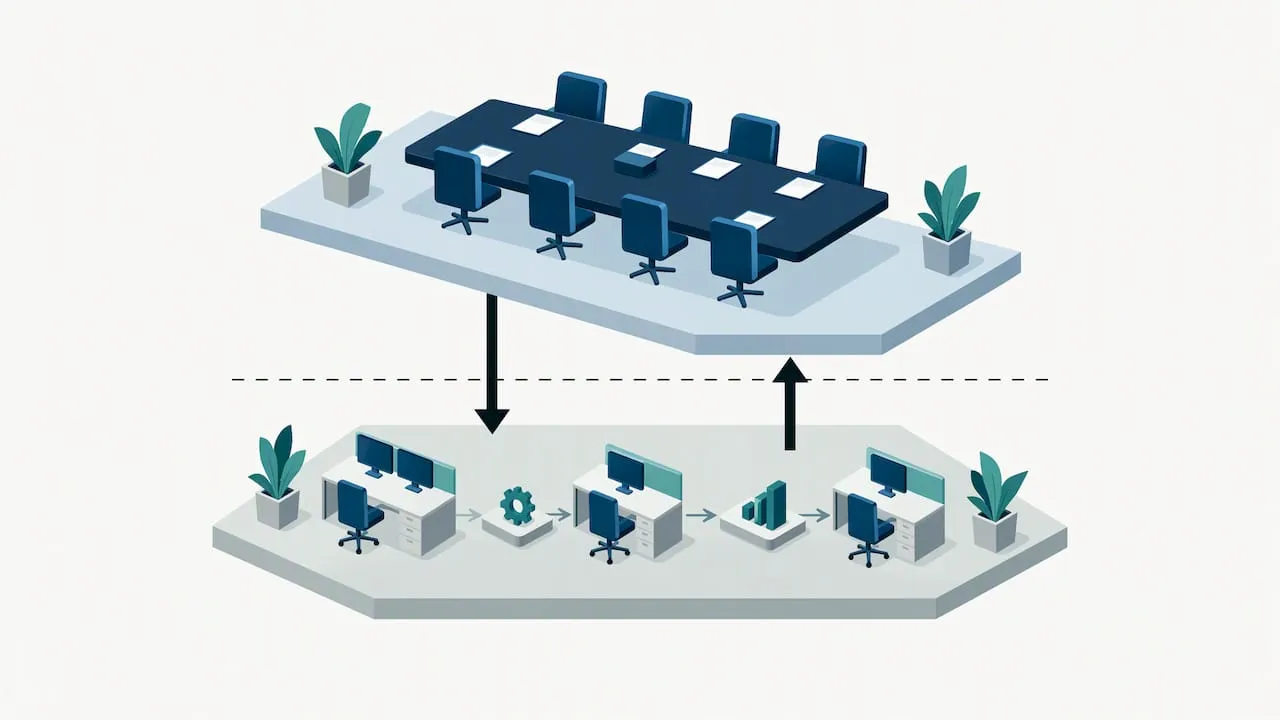
A schedule of reserved powers is a short document listing the decisions only the board can take, such as approving the annual budget, appointing the chief executive, signing off major contracts above a set value and changing the governing document. Everything else is delegated to the executive within agreed limits. It saves arguments later, because nobody has to guess who decides what.
The guide to governance for international NGOs from Bond and Buzzacott draws the line in three layers:
| Layer | What it does |
|---|---|
| Governance | Sets mission, values and the strategic framework, and monitors whether they are achieved |
| Management | Develops detailed plans and monitors delivery |
| Operations | Delivers activities under approved policies and controls |
Delegation does not remove accountability. A Deloitte guide for Canadian not-for-profits makes the point that a board is ultimately responsible even when it delegates operational authority to a chief executive and management team. Its primary role is stewardship and oversight.
Signs a board has drifted into management
- Directors approve individual staff decisions or small purchases.
- Meetings are mostly operational updates, with little time for strategy or risk.
- The chief executive is questioned by several directors separately instead of by the board as one body.
The opposite failure is just as common: a board that rubber-stamps whatever the executive brings. Healthy oversight sits between the two, with informed questions and a willingness to challenge.
Roles inside the board
The chair
The chair runs the board so that it can do its job. According to the IoD, the chair manages board business, facilitates and guides the board and helps clarify the split of responsibility between board and management. The chair does not hold extra power over decisions: responsibility remains collective rather than belonging to individual directors. Guidance for Hong Kong NGOs describes the chair in practical terms too: approving agendas, managing meetings and leading board action so the organisation operates within its governance framework.
The chief executive and other executives
The chief executive is accountable to the board and leads the management team. In many companies the CEO also sits on the board as an executive director. In charities and membership bodies the senior staff member often attends meetings without being a trustee. Either arrangement works if everyone is clear about who votes and who advises.
Non-executive and independent directors
Non-executive directors do not work in the business day to day. Their value is outside perspective: they challenge assumptions, bring specialist experience and protect the interests of owners or members. In larger UK companies, a senior independent director acts as a sounding board for the chair and an alternative point of contact for shareholders.
The company secretary or governance lead
This person keeps the board’s paperwork and process in order: agendas, minutes, registers, filings and advice on procedure. In smaller organisations the role may sit with an administrator or the chair, but the tasks still need an owner.
Committees
Boards use committees to look closely at specialist areas. FINRA notes that audit committees work with the auditors, while compensation committees oversee executive pay, bonuses and share options. Membership organisations and charities often add finance and risk, nominations, fundraising or education committees. A committee prepares recommendations; the full board still decides.
Committees also depend on good information. Organisations that need to evidence their controls to the board increasingly use digital compliance and risk tools to log risks, track actions and report on status in one place, so that committee papers reflect what is actually happening.
Directors’ legal duties
The individual duties differ by country, and the answer to “what must a director do?” depends on where the organisation is registered.
For UK companies, the Chartered Governance Institute lists the statutory duties of a director in its factsheet on what a director is: acting within powers, promoting the success of the company, exercising independent judgement, exercising reasonable care, skill and diligence, avoiding conflicts of interest, not accepting third-party benefits, and declaring interests in transactions.
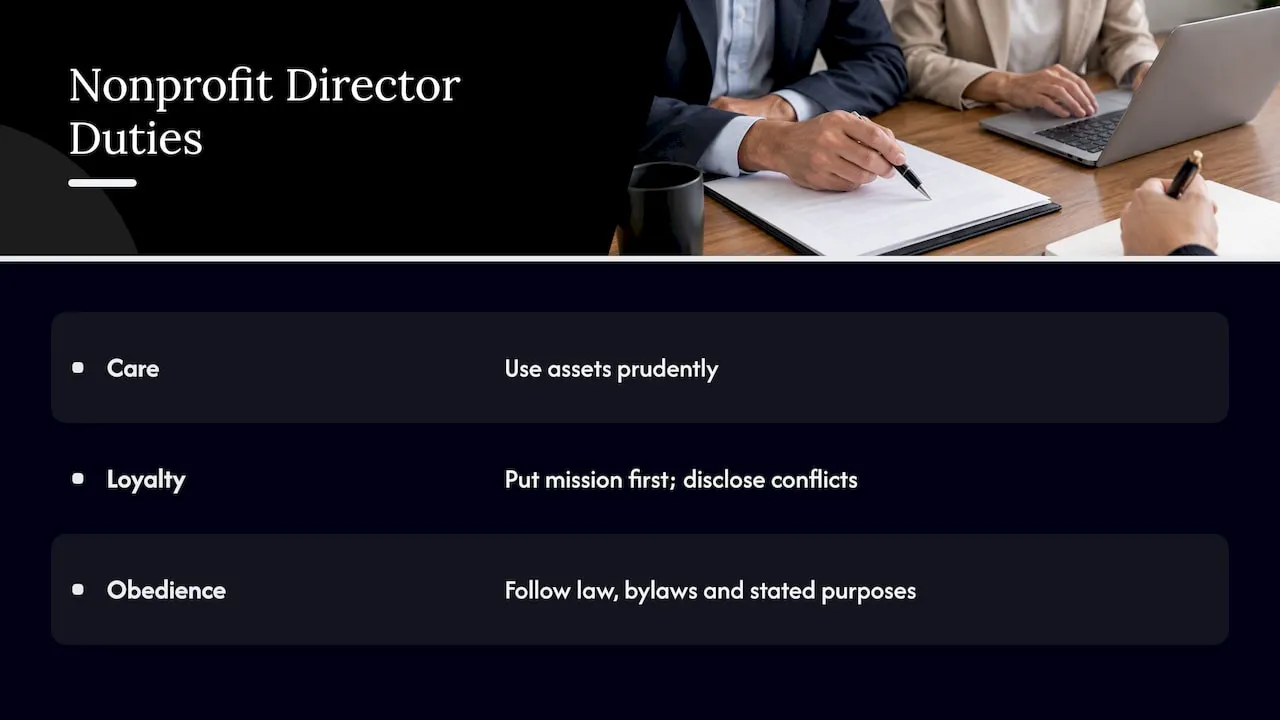
In the United States, the National Council of Nonprofits names three primary legal duties for nonprofit directors. Care, loyalty and obedience cover, respectively, the prudent use of assets, putting the mission first and disclosing conflicts, and complying with law, bylaws and stated purposes.
If you sit on a board in a particular country, read the regulator’s own guidance for your type of organisation. In England and Wales, charity trustees should read the Charity Commission’s guidance for trustees; company directors should read Companies House and the Companies Act duties. Where the stakes are high, take advice from a solicitor.
How the role differs by type of organisation
The core job is the same everywhere. What changes is who the board answers to, what “success” means and how directors are chosen.
| Company | Charity or nonprofit | Membership organisation | |
|---|---|---|---|
| Main accountability | Shareholders, with regard to wider stakeholders | Beneficiaries, funders, regulators | Members |
| Measure of success | Long-term company success, financial results | Mission and impact, financial sustainability | Member value, engagement, financial health |
| Typical board members | Executives and non-executives, often paid | Usually unpaid volunteers | Usually elected from the membership |
| Distinctive pressure | Returns and regulation | Public trust and fundraising | Elections, representation and renewals |
Companies
A company board answers to its shareholders, and must also consider employees, suppliers, the community and its reputation. Directors are typically paid, and the board hires and rewards the executive team.
Charities and nonprofits
The Global Partnership for Education’s governance guide shows how broad a mission-driven board’s remit can be: strategy and high-level policy, major risks, budget approval, performance and impact review, oversight of its institutional model, global leadership, and appointments and performance reviews. The National Council of Nonprofits adds that boards also contribute to culture, strategic focus, financial sustainability and acting as ambassadors and advocates.
That last point matters for fundraising. Many nonprofit boards are expected to open doors and give, and we have written about the board’s role in fundraising and how to activate it. Trust is part of the job too: reporting clearly on the risks a charity manages, even operational ones such as board reporting on water safety, shows funders and the public that trustees are paying attention.
Membership organisations
Professional bodies, trade associations and member-led groups have a board that is typically elected by, and answerable to, the members. That adds duties a company board does not have in the same way. Directors must balance the interests of different member groups, run fair elections, explain decisions openly and keep the membership offer financially sustainable. Our guide to nonprofit compliance requirements covers the regulatory side, and the strategic planning guide shows how a board and its executive can turn priorities into a plan.
How an effective board works
The role on paper is simple. Doing it well takes habits:
- Papers that arrive early and say what is being asked. A board cannot oversee what it cannot read.
- Agendas weighted to strategy and risk, not just reports to note.
- Clear decision records. Minutes should show what was decided, by whom and what happens next.
- An annual look at the board itself: skills, attendance, culture and succession for the chair and key posts.
- Real engagement from every director. We cover this in more depth in our practical guide to improving board engagement.
The 8 skills listed in our piece on nonprofit leadership skills are a handy checklist for the board’s own skills audit.
Our perspective: governance runs on information
We build software for membership organisations, associations and nonprofits, and the boards we see struggle for one reason more than any other: not a lack of goodwill, but a lack of timely, trustworthy information. A treasurer who has to chase three spreadsheets to answer a question about renewals cannot give the board a clear picture. A chair who cannot see event attendance, member numbers and income side by side ends up debating anecdotes.
Good oversight needs the same few facts, in one place, on a regular rhythm: membership trends, financial position, event and learning performance, and the status of key risks. When those come from one connected system rather than from several separate ones, directors spend meetings deciding rather than reconciling. That is why we built our platform around a single record of each member, and why we think boards should insist that their management team can produce board reports without a week of manual work.
The second thing we would tell any new director: keep the line between governing and managing visible. Write down what is reserved to the board, review it yearly, and make sure your executive team knows it. Boards that do this tend to have shorter, better meetings.
— Rob
Supporting your board with the right tools
If your board relies on a patchwork of spreadsheets, inboxes and separate systems, our platform brings membership management, events, CRM, email marketing, e-commerce and analytics together, so your executive can give directors one clear view. Plans are published at our pricing page: Core is £349 per month, Growth £699 per month, Scale £1,299 per month and Enterprise is from £2,500 per month. You can see what the platform covers on our membership management software page, and read how boardroom management software can help nonprofit boards in particular.
FAQ
What is the function of a board of directors?
The board’s function is to govern: set strategy, delegate to management, monitor performance and oversee risk. It is accountable to the owners or members and, increasingly, to wider stakeholders. The OECD Principles summarise this as strategic guidance, monitoring of management and risk oversight.
Does a board run the organisation day to day?
No. The board decides direction and holds management to account, while the chief executive and staff run operations within delegated limits. A schedule of reserved powers makes clear which decisions stay with the board.
What is the difference between a chair and a chief executive?
The chair leads the board and ensures its meetings and decisions work properly. The chief executive leads the organisation’s management and reports to the board. Keeping these roles distinct, and in larger organisations held by different people, protects the board’s ability to challenge.
Are charity trustees the same as company directors?
In practice they do a similar job: trustees are the people with overall control of a charity, and many charities call them directors or board members. The legal duties differ, because trustees must act to further the charity’s purposes for public benefit under charity law. Check your regulator’s guidance for the exact duties where you are.
Sources
- The responsibilities of the board: G20/OECD Principles of Corporate Governance 2023
- What is the role of the board? IoD factsheet
- What is a director? Chartered Governance Institute factsheet
- Get On Board: Understanding the Role of Corporate Directors, FINRA
- Governance: a guide for international NGOs, Bond and Buzzacott
- The Effective Not-for-Profit Board, Deloitte Canada
- Guidelines on Corporate Governance Manual for Hong Kong NGOs
- Board Roles and Responsibilities, National Council of Nonprofits
- Global Partnership for Education board governance guide
- Board reporting for water safety: a governance guide
- Compliance and risk management for CEOs, TrustView