Student stress management: strategies and tools that work

TL;DR:
- Student stress arises from workload social pressures and future uncertainties affecting mental and physical health.
- Evidence-based strategies such as sleep exercise mindfulness and time management effectively reduce stress.
- Digital tools and strong social support systems enhance resilience and help manage ongoing academic pressures.
Student life carries pressure that builds quickly. Deadlines stack up, exams loom, social expectations mount, and sleep becomes a casualty of late-night revision sessions. Core stress management strategies for students include adequate sleep, regular exercise, mindfulness, and strong social support — yet most students never receive formal guidance on applying these effectively. This guide covers the root causes of academic stress, evidence-based techniques you can act on immediately, digital tools worth using, and the mindset shifts that turn pressure into lasting personal resilience. Whether you are approaching exam season or simply feeling overwhelmed by day-to-day demands, you will find practical, structured support here.
Table of Contents
- Understanding the roots of student stress
- Essential evidence-based strategies for stress relief
- Digital tools and resources for student stress management
- Building your supportive environment and mindset
- A fresh perspective: moving beyond quick fixes for real resilience
- How Colossus Systems can support your student wellbeing
- Frequently asked questions
Key Takeaways
| Point | Details |
|---|---|
| Identify stress sources | Recognise what is causing your stress to address it effectively. |
| Use evidence-based strategies | Integrate mindfulness, exercise, and sleep routines shown to reduce student stress. |
| Explore digital tools | Try reputable self-guided or guided apps for quick and lasting stress relief. |
| Build supportive networks | Strengthen your connections to friends, peers, and mental health resources. |
| Normalise and validate stress | Remember that not all stress is harmful and can build resilience when managed well. |
Understanding the roots of student stress
Academic pressure is not simply about having too much to do. It operates on multiple levels at once, making it genuinely difficult to manage without the right understanding.
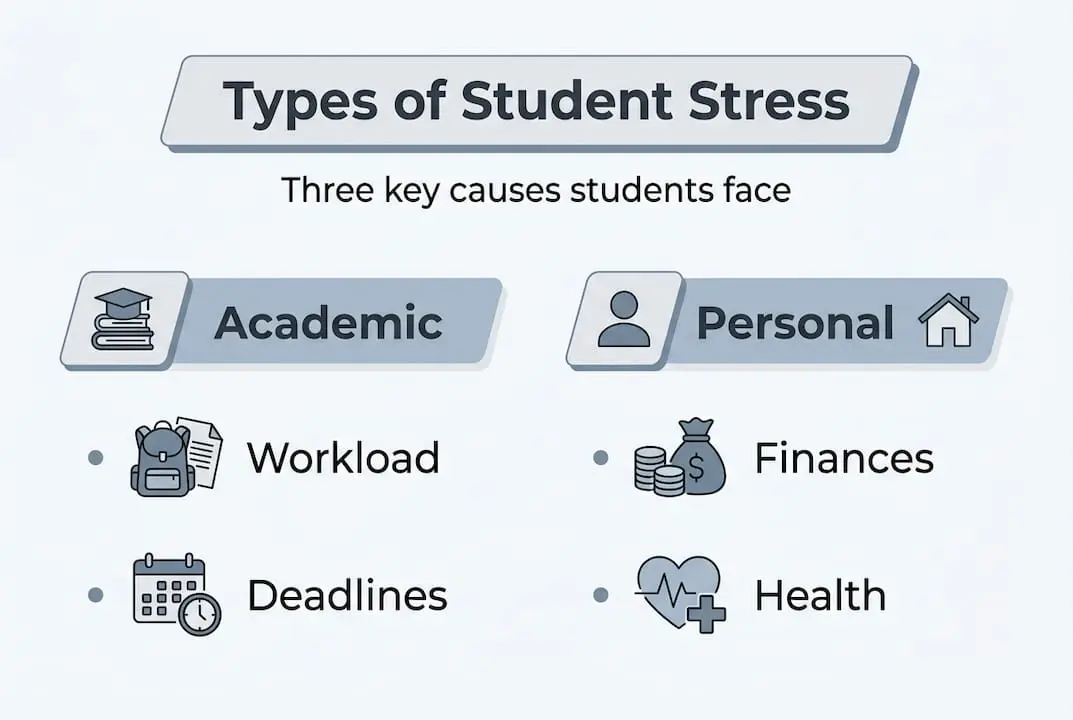
The most common contributors to student stress fall into three broad categories. First, academic workload — the sheer volume of assignments, revision demands, and performance expectations creates a near-constant sense of urgency. Second, social pressures — navigating friendships, romantic relationships, peer comparison, and social media commentary drains mental energy that is also needed for study. Third, future uncertainty — questions about career prospects, financial stability, and personal identity add a deeper layer of anxiety that rarely switches off.
These stressors do not simply make you feel tired. They produce measurable effects on your mental and physical wellbeing. Research finds that academic stress predicts burnout at a significant level (? = 0.43, p < 0.001), with social support and self-esteem playing key roles in moderating that relationship across 428 students. When burnout takes hold, motivation drops sharply, self-esteem falters, and anxiety tends to escalate further.
Understanding the connection between these factors is important. Social support, for example, is not just a comfort. It actively reduces the pathway from stress to burnout. Schools that invest in school wellness programmes tend to see better student outcomes precisely because they address this social dimension directly.
The following table outlines the most common student stressors and their associated symptoms:
| Stressor | Common symptoms |
|---|---|
| Heavy academic workload | Fatigue, inability to concentrate, procrastination |
| Exam pressure | Anxiety, sleep disruption, muscle tension |
| Social conflict | Low mood, withdrawal, irritability |
| Financial concerns | Persistent worry, difficulty relaxing |
| Future uncertainty | Hopelessness, lack of motivation, rumination |
| Poor time management | Overwhelm, last-minute cramming, guilt |
Key warning signs to watch for include:
- Persistent difficulty sleeping or sleeping far too much
- Loss of interest in activities you previously enjoyed
- Feeling unable to complete tasks you once managed easily
- Frequent headaches, stomach upset, or physical tension
- Increased use of alcohol, caffeine, or other stimulants to cope
Recognising these patterns early is the first step. Stress left unaddressed tends to compound, making it harder to intervene the longer it persists. Once you identify your personal stressors and their symptoms, you are far better positioned to choose the right strategies.
Essential evidence-based strategies for stress relief
Once you recognise the roots of stress, it is time to take action. Here are evidence-backed solutions you can use immediately.
The research base here is robust. Mindfulness-based interventions significantly reduce academic stress (Cohen’s d = -1.89), burnout (d = -1.26), and increase resilience (d = 2.02) in an 8-week randomised controlled trial with 153 university students. These are not marginal effects. They are large, practically significant improvements achieved within two months.
Here is a step-by-step approach to building your stress management routine:
- Start with sleep. Aim for 7 to 9 hours every night. Sleep is not a luxury; it is the foundation of cognitive function, emotional regulation, and physical recovery. Reduce screen time at least 30 minutes before bed and keep a consistent sleep schedule even at weekends.
- Schedule physical activity. Even 20 to 30 minutes of moderate exercise three times per week reduces cortisol levels and improves mood. Walking, cycling, swimming, or even a structured home workout all count.
- Practise mindfulness daily. Dedicated sessions of mindfulness in education settings have demonstrated substantial benefits. Start with five minutes of focused breathing each morning and build from there.
- Improve your nutrition. Skipping meals or relying on processed snacks destabilises blood sugar and worsens anxiety. Prioritise regular meals with adequate protein, vegetables, and whole grains.
- Apply structured time management. Break large tasks into smaller chunks using techniques such as time blocking or the Pomodoro method. Attending time management classes or using structured frameworks reduces the sense of overwhelm that drives stress.
- Use progressive muscle relaxation. This technique involves systematically tensing and releasing muscle groups throughout your body. It takes roughly 15 minutes and is particularly effective before sleep or exams.
The distinction between quick-fix and sustained interventions matters enormously:
| Approach | Time to effect | Durability | Best use case |
|---|---|---|---|
| Box breathing | 2 to 5 minutes | Short-term relief | Pre-exam or acute anxiety |
| Single mindfulness session | 10 to 20 minutes | Short to medium term | Daily routine |
| 8-week mindfulness programme | 8 weeks | Long-term resilience | Sustained wellbeing |
| Regular exercise habit | 2 to 4 weeks | Long-term | Overall stress reduction |
| Improved sleep hygiene | 1 to 2 weeks | Long-term | Cognitive performance |
Pro Tip: The most common mistake students make is reaching for stress relief techniques only when they are already overwhelmed. Integrating even two or three of these methods into your daily routine, before stress peaks, builds a buffer that makes difficult periods far more manageable. Consistency matters far more than intensity.
For exam periods specifically, prioritise short mindfulness and breathing exercises. Review school stress relievers that are evidence-grounded and easy to apply without special equipment. These require no special equipment and can be used between revision blocks to reset your focus.
Digital tools and resources for student stress management
While lifestyle changes and in-person strategies are effective, technology also offers useful ways to support stress relief in daily student life.
The digital landscape for mental wellness tools has expanded significantly. Students now have access to a wide range of applications covering mindfulness, sleep improvement, mood tracking, and time management. Research confirms that both self-guided and guided online tools improve wellness outcomes for students, with self-guided options showing quicker initial benefits and high levels of student acceptability. This is important: you do not always need a counsellor or coach to benefit from digital stress management resources.
Recommended categories of digital tools include:
- Mindfulness and meditation apps (such as Headspace, Calm, or Insight Timer): These offer guided sessions ranging from two minutes to 30 minutes, making them easy to fit into any schedule. Many include specific programmes for study focus and sleep.
- Time management and task apps (such as Todoist, Notion, or Google Tasks): Structuring your workload digitally reduces cognitive load, meaning your brain spends less energy trying to remember what needs doing and more energy actually doing it.
- Mood and wellbeing trackers (such as Daylio or Reflectly): Tracking your mood over time reveals patterns you might not notice day to day. You may find that stress spikes on specific days or before particular types of tasks, allowing you to prepare proactively.
- Guided relaxation and sleep tools (such as Pzizz or Sleepio): These use evidence-based audio techniques to help you wind down, reduce racing thoughts, and improve sleep quality.
- Focus and productivity tools (such as Forest or Freedom): These apps reduce digital distraction, one of the most underestimated contributors to student stress and procrastination.
Before committing to any tool, consider these selection criteria:
- Is it grounded in evidence rather than just appealing to look at?
- Does it fit your schedule and learning style?
- Can you use it offline or on limited data?
- Does it offer a free tier or student discount?
You might also consider completing a stress resistance self-test to establish a baseline understanding of your current resilience levels. This gives you a concrete starting point and helps you evaluate whether your chosen tools are actually making a measurable difference.
Pro Tip: The best approach blends digital and offline strategies. Use an app for guided morning mindfulness, but protect one evening per week as completely screen-free. Offline recovery, whether through a walk, a conversation, or reading for pleasure, restores attentional capacity in ways no app can fully replicate.
Building your supportive environment and mindset
Alongside individual strategies, your environment and relationships play a crucial role in lasting stress management.

Social support is not merely helpful. It is a scientifically validated moderator between academic stress and burnout. Research confirms that academic stress predicts burnout, but strong social support and healthy self-esteem significantly weaken that relationship. The practical implication is clear: building and maintaining supportive relationships is one of the most effective things you can do for your mental wellbeing as a student.
The World Health Organisation reinforces this perspective. Its mental health in education guidelines recommend integrating mental health into educational environments through safe spaces, psychosocial support, reduced academic pressures, and curricula that normalise emotional wellbeing. These are institutional responsibilities, but they also point to what you should actively seek out within your own institution.
Practical ways to build a supportive environment include:
- Maintaining regular contact with at least two or three trusted friends or family members. These relationships provide perspective, emotional regulation, and a sense of belonging that academic environments often fail to supply on their own.
- Accessing institutional support early. Most educational institutions offer counselling services, peer support groups, or wellbeing offices. Reaching out before you reach crisis point is not a sign of weakness. It is sensible planning.
- Creating a physical study environment that reduces anxiety. This means adequate lighting, minimal clutter, defined study hours, and a separate space for relaxation where possible.
- Normalising help-seeking conversations with peers. When you speak openly about your own stress, you give others permission to do the same, creating a mutual support culture that benefits everyone.
- Engaging with organised community activities. Being part of a team, a club, or a volunteering group builds identity and belonging beyond academic performance.
The leadership literature also offers useful frameworks. Insights from stress management for leaders reveal that high performers in demanding environments share one common trait: they actively cultivate their support networks rather than waiting for support to appear.
“Resilience is not built in isolation. It grows in the spaces between people — through honest conversations, shared challenges, and the simple act of showing up for one another.”
Consider also the growing body of workplace wellbeing policies that are beginning to influence educational institutions. The direction is clear: structured wellbeing support is not optional. It is a core component of any environment where people are expected to perform consistently under pressure.
A fresh perspective: moving beyond quick fixes for real resilience
You have explored practical strategies. Now consider when stress is actually useful, and how to turn pressure into lasting strength.
Not all academic stress requires intervention. Some stress is genuinely adaptive. It sharpens focus before a presentation, motivates revision before an exam, and signals that something matters to you. The instinct to eliminate all stress can inadvertently prevent you from developing the very coping skills that make you effective over the long term.
As one widely discussed view in higher education argues, not all stress requires clinical intervention. Normalising stress through validation and practical resources, before labelling it pathology, is often the more empowering and accurate response.
This does not mean ignoring serious mental health needs. It means distinguishing between stress that requires clinical support and stress that requires skills, context, and community. Building organisational resilience insights into educational culture helps institutions make that distinction well. At an individual level, the goal is to develop a robust internal toolkit: techniques you return to reliably, relationships you invest in consistently, and the self-awareness to know when to seek professional support. Stress, managed well, is one of the most powerful drivers of personal growth available to you.
How Colossus Systems can support your student wellbeing
Armed with strategies and a deeper understanding of stress management, discover how the right technology can further your wellbeing journey.
At Colossus Systems, we build platforms that help organisations deliver structured wellbeing programmes, manage events, and connect communities at scale. For educational institutions supporting student mental health, our tools streamline event planning for wellness workshops, enable targeted communication to student cohorts, and support the management of wellbeing-focused member portals. Whether your institution is launching a mindfulness programme or scaling peer support networks, our platform provides the operational backbone to make it consistent and measurable. Explore what Colossus Systems offers and take the next step in building wellbeing into your institution’s culture, not just its calendar.
Frequently asked questions
What is the most effective way to manage exam stress?
Mindfulness exercises and structured time management are among the most effective approaches, with research showing mindfulness-based interventions significantly reduce academic stress (Cohen’s d = -1.89) in university students.
Do digital stress management tools really work for students?
Yes. Both self-guided and instructor-guided formats work, with evidence confirming that online stress resources improve wellness outcomes and are highly acceptable to student populations.
How can I reduce stress quickly before a test?
Box breathing and brief mindfulness sessions are among the most accessible and effective quick techniques. Short stress relief methods like these require no equipment and work within minutes.
Does academic stress always require professional help?
Not always. Not all student stress requires clinical intervention; using validation, practical resources, and peer support is often the right first response before seeking professional assistance.
What role does sleep play in student stress management?
Sleep is foundational. Adequate sleep of 7-9 hours per night is consistently identified as one of the core strategies for managing student stress effectively and sustaining academic performance.