Time Management for Students: Master Academic Balance Fast

Juggling classes, part-time work, and club meetings leaves most North American and British college students stretched thin. One bold fact stands out: over half of students report feeling overwhelmed by academic demands during the semester. Managing your workload effectively matters because it impacts not just your grades but your social life and wellbeing. This guide delivers practical steps to help you assess commitments, build efficient schedules, and adopt smart routines that make every day more productive.
Table of Contents
- Stage 1: Assess Existing Priorities and Commitments
- Stage 2: Create an Effective Personal Schedule
- Stage 3: Optimise Daily Routines for Maximum Efficiency
- Stage 4: Implement Proven Study and Work Strategies
- Stage 5: Track Progress and Refine Your Approach
Quick Summary
| Key Point | Explanation |
|---|---|
| 1. Assess Your Current Commitments | Document all academic and personal commitments to understand your time availability and priorities. |
| 2. Create a Flexible Schedule | Use a scheduling tool to block fixed commitments and allocate study time while allowing for changes. |
| 3. Optimize Daily Routines | Conduct a time audit to eliminate unproductive habits and establish consistent morning and evening routines. |
| 4. Implement Active Study Techniques | Use retrieval practice and spaced repetition to enhance learning, focusing on quality over quantity. |
| 5. Track Progress Regularly | Maintain a progress journal to note academic goals, challenges, and improvements for ongoing development. |
Stage 1: Assess Existing Priorities and Commitments
Before diving into time management strategies, you need to understand your current academic landscape. This critical step helps you map out exactly what demands your attention and energy. By conducting a comprehensive systematic review of commitments, you can create a realistic and manageable schedule.
Start by documenting every single academic and personal commitment. List out your course load, including contact hours, assignment deadlines, required readings, and study time. Next, map out additional responsibilities such as part-time work, extracurricular activities, personal obligations, and potential study groups. Use a spreadsheet or dedicated planner to capture these details systematically. Pay special attention to tasks that are both urgent and important. The goal is to understand how much time you actually have available versus how much time you think you have.
As you compile your commitments, categorise them by priority level. High-priority items typically include mandatory coursework, critical deadlines, and activities directly impacting your academic performance. Medium-priority tasks might include optional workshops, supplementary study sessions, or project preparation. Low-priority commitments could be social events or non-essential activities that can be rescheduled or potentially eliminated if your academic workload becomes overwhelming.
Expert Recommendation: Create a colour-coded matrix to visually distinguish between different commitment types and their relative importance, allowing you to quickly assess your academic landscape at a glance.
Here is a quick summary of commitment types and their academic impact:
| Commitment Type | Example Activities | Typical Priority | Academic Impact |
|---|---|---|---|
| Mandatory Coursework | Lectures, exams, key deadlines | High | Direct effect on grades |
| Supplementary Engagement | Workshops, project prep, study sessions | Medium | Improves learning outcomes |
| Social/Non-essential | Social events, casual clubs | Low | Can be reduced if overwhelmed |
Stage 2: Create an Effective Personal Schedule
Building a strategic personal schedule transforms your academic management from reactive to proactive. Consciously planning your time allows you to maximise productivity while maintaining a healthy balance between academic responsibilities and personal well-being.

Begin by selecting a scheduling tool that suits your style. Whether you prefer digital calendars, physical planners, or productivity apps, choose a system you will consistently use. Block out fixed commitments first such as lectures, work shifts, and mandatory activities. Then allocate dedicated study blocks, ensuring you assign realistic timeframes for each task. Consider your natural energy rhythms aim to schedule complex assignments during your peak concentration hours. Reserve buffer time between tasks to prevent overwhelming yourself and allow for unexpected interruptions.
When designing your schedule, prioritise flexibility and adaptability. Group similar tasks together to minimise mental transition time, and include short breaks to maintain focus and prevent burnout. Colour code different activity types academic work, personal commitments, and leisure time to provide a visual representation of how you distribute your energy. Review and adjust your schedule weekly, recognising that effective time management is an ongoing process of refinement and self awareness.
Expert Recommendation: Allocate 15 minutes at the end of each week to evaluate your schedule’s effectiveness and make necessary adjustments for continuous improvement.
Stage 3: Optimise Daily Routines for Maximum Efficiency
Streamlining your daily routine transforms academic performance from chaotic to controlled. Developing strategic productivity habits can dramatically reduce stress and increase your overall effectiveness as a student.
Start by conducting a thorough time audit of your typical day. Track how you currently spend every hour, identifying time wasters and unproductive patterns. Categorise activities into three zones critical tasks, flexible commitments, and personal time. Eliminate or minimise activities that drain your energy without providing substantial value. Implement the two minute rule for small tasks immediately complete anything that takes less than two minutes to prevent task accumulation. Structure your most challenging academic work during your peak energy hours typically morning or early afternoon when your concentration is strongest.
Create a consistent morning and evening routine that primes your brain for productivity. Wake up at the same time daily, include a brief planning session to outline your key objectives, and establish a wind down ritual that signals to your brain it is time to rest. Incorporate regular short breaks using techniques like the Pomodoro method to maintain focus and prevent mental fatigue. Regularly reassess and adjust your routine recognising that efficiency is not about perfection but continuous incremental improvement.
Expert Recommendation: Batch similar tasks together and allocate specific time blocks to reduce mental switching costs and enhance overall productivity.
Stage 4: Implement Proven Study and Work Strategies
Transforming your academic performance requires strategic approaches to studying and working effectively. Goal setting and self regulation are crucial techniques that can dramatically improve your learning outcomes and productivity.
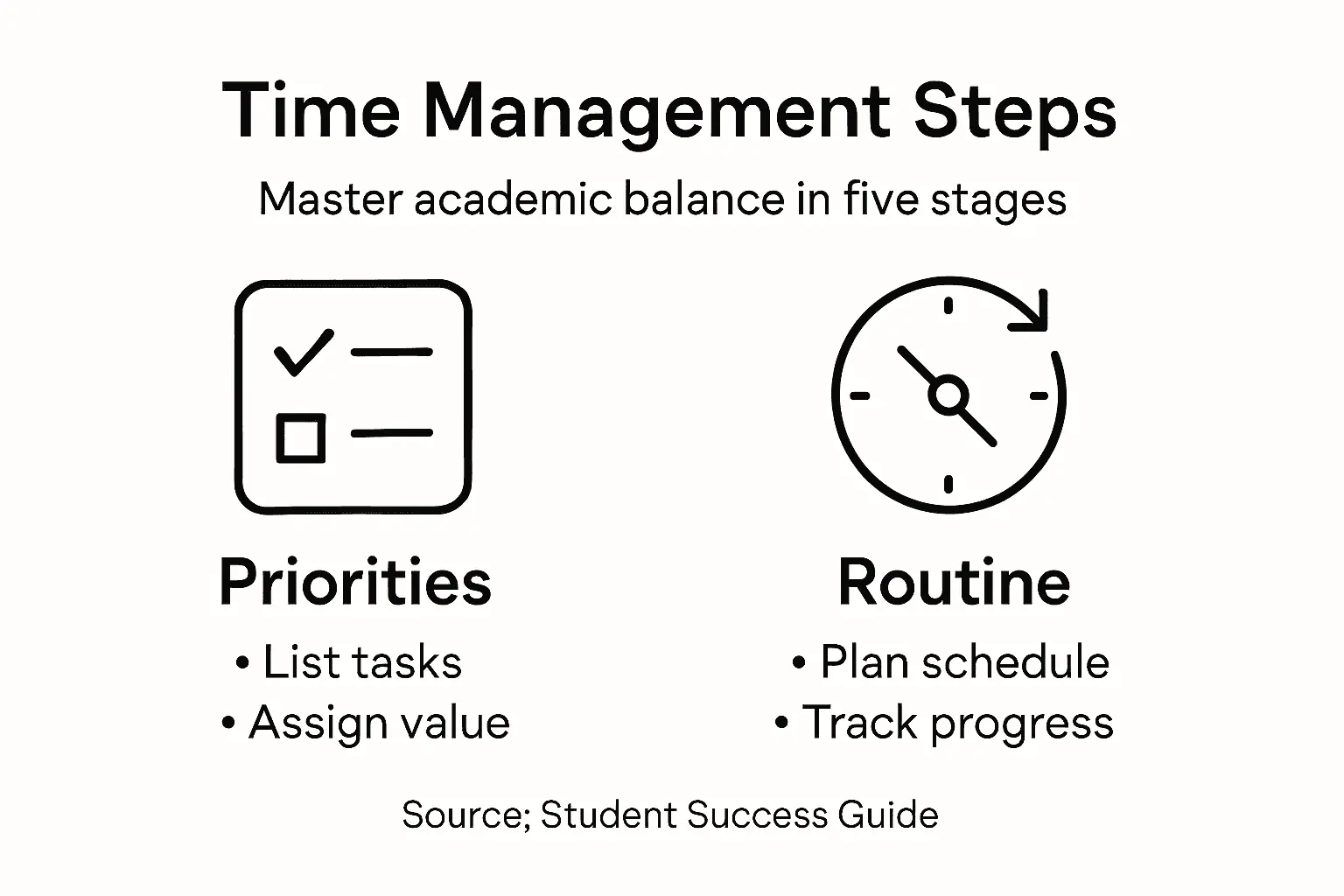
Develop a comprehensive study strategy that moves beyond traditional passive learning methods. Implement active learning techniques such as retrieval practice where you test yourself regularly on material rather than simply re reading notes. Create structured study sessions with clear objectives breaking larger assignments into manageable chunks. Use spaced repetition to review material at increasing intervals which helps transfer information from short term to long term memory. Identify your most productive study environment one that minimises distractions and supports your concentration whether that is a quiet library corner or a specific desk space at home.
Prioritise quality over quantity in your study approach. Integrate diverse learning methods such as group discussions individual research practical applications and teaching concepts to others. These varied techniques enhance understanding and retention more effectively than repetitive rote learning. Track your progress systematically noting areas of improvement and adjusting your strategies accordingly. Remember that effective studying is not about marathon sessions but about intelligent engagement with your academic material.
Expert Recommendation: Create a personalised study toolkit with diverse learning resources and techniques that match your unique learning style and academic requirements.
Compare core study strategies for deeper learning and retention:
| Study Technique | Description | Best Use Case | Benefit |
|---|---|---|---|
| Retrieval Practice | Self-testing on learned material | Exam revision; memory retention | Boosts recall and understanding |
| Spaced Repetition | Reviewing material over intervals | Memorising facts long-term | Improves memory consolidation |
| Active Group Learning | Discussing topics with peers | Complex concepts; clarification | Enhances critical thinking |
Stage 5: Track Progress and Refine Your Approach
Understanding and monitoring your academic journey transforms random efforts into purposeful progress. Systematic progress tracking enables you to identify strengths and address challenges proactively.
Develop a comprehensive tracking system that goes beyond traditional grade monitoring. Create a detailed progress journal where you document not just academic results but learning processes and personal insights. Break down each academic goal into measurable milestones tracking both quantitative metrics like grades and qualitative indicators such as understanding complexity and skill development. Use digital tools or physical notebooks to record weekly reflections noting what strategies worked effectively and which areas need improvement. Compare your current performance against previous benchmarks to understand your learning trajectory and identify patterns in your academic approach.
Regularly schedule personal review sessions typically monthly or at the end of each academic term. During these sessions conduct an honest self assessment examining your learning strategies time management skills and overall academic performance. Be willing to experiment and adapt your methods based on these insights. Treat setbacks as valuable learning opportunities rather than failures recognising that continuous refinement is the key to academic success. Seek feedback from tutors mentors or study groups to gain external perspectives on your progress and potential areas of growth.
Expert Recommendation: Maintain a dynamic learning portfolio that captures your academic evolution documenting not just achievements but the strategic thinking behind your successes and challenges.
Take Control of Your Academic Time with Smarter Organisational Tools
The challenge of managing multiple priorities, tracking progress, and maintaining balance in your academic life can feel overwhelming. This article highlights how effective personal scheduling and strategic study approaches are vital to mastering time management. You need solutions that streamline commitments, simplify scheduling, and help you stay organised to sustain momentum and reduce stress.
Unlock the power of Colossus Systems, a unified platform designed to simplify member management and event planning for organisations. Whether you run study groups, workshops, or subscription services, our tools help you create customised schedules, automate tracking, and maintain seamless communication. Take control of your time by integrating smart management solutions that support your academic and organisational goals. Get started today by reaching out to us at Contact Colossus Systems and discover a new way to focus on what truly matters.
Frequently Asked Questions
How can I assess my current academic commitments effectively?
To assess your commitments, begin by documenting every academic and personal responsibility, including coursework, deadlines, and extracurricular activities. Create a comprehensive list that categorises these tasks by priority level to gain a clear understanding of where to focus your time and energy.
What is the best way to create a personal study schedule?
To create an effective study schedule, choose a format that you will consistently use, such as a digital calendar or physical planner. Start by blocking out fixed commitments and then allocate specific time slots for studying, ensuring that you account for breaks and your natural energy levels to maximise productivity.
How can I optimise my daily routine for studying?
Optimise your daily routine by conducting a time audit to identify where you can improve efficiency. Eliminate time-wasting activities and structure your day around critical tasks during peak energy hours, while also including regular breaks to maintain focus and prevent burnout.
What study strategies can I implement to improve my performance?
Implement active learning techniques such as retrieval practice and spaced repetition, which encourage more engagement with the material. Break down larger assignments into manageable tasks and track your progress to refine your strategies for maximum effectiveness.
How often should I track my progress towards academic goals?
Track your progress monthly or at the end of each academic term. Regularly evaluate both quantitative results, like grades, and qualitative indicators, such as understanding, to stay informed about your academic journey and refine your approach as needed.
Recommended
- Effective Time Management Tips for 2025 Success | Colossus Systems
- Complete Guide to Mindfulness in Education | Colossus Systems
- Master Email Etiquette for Students: Professional Communication|CS
- 7 Essential Leadership Skills for Students to Develop|CS
- Rust in je hoofd: 5 praktische stappen om tot jezelf te komen
- 7 Essential Entrepreneurship Productivity Hacks for Founders