How to Manage Stress Naturally for Nonprofit Leaders

Stress rarely announces itself loudly for Executive Directors guiding American nonprofit membership organisations. As operational pressures rise, subtle signals such as emotional exhaustion, cynicism, or physical fatigue can creep in, threatening to undermine leadership and team morale. Addressing these stress indicators early prevents severe burnout and supports organisational strength. Discover practical methods to recognise your unique stress signals, implement structured routines, and create healthy work boundaries that protect your wellbeing and leadership effectiveness.
Table of Contents
- Step 1: Identify Personal Stress Signals Early
- Step 2: Implement Structured Daily Routines
- Step 3: Establish Healthy Work Boundaries
- Step 4: Integrate Relaxation Techniques Consistently
- Step 5: Evaluate Stress Levels And Adjust Strategies
Quick Summary
| Key Point | Explanation |
|---|---|
| 1. Recognise personal stress signals early | Identifying stress indicators early can prevent burnout and preserve your leadership effectiveness. Monitor physical and emotional changes systematically. |
| 2. Implement structured daily routines | Creating consistent routines can reduce cognitive fatigue and enhance predictability in your challenging work environment, supporting your professional efficiency. |
| 3. Establish healthy work boundaries | Clearly defining work boundaries is crucial for protecting your personal wellbeing, which in turn sustains long-term effectiveness in your leadership role. |
| 4. Integrate relaxation techniques regularly | Consistent practice of relaxation methods can help manage stress effectively, allowing you to reset both your body and mind after intense work demands. |
| 5. Continuously evaluate stress levels | Regularly assessing your stress through qualitative and quantitative measures helps adapt strategies and maintain resilience in your professional life. |
Step 1: Identify personal stress signals early
As a nonprofit leader, understanding and recognising your unique stress signals is crucial for maintaining personal wellbeing and organisational effectiveness. Early recognition of stress indicators allows you to intervene before burnout takes hold, protecting both your mental health and professional performance.
Stress manifests differently for each individual, but common signals include physical symptoms like muscle tension, persistent headaches, disrupted sleep patterns, and digestive issues. Psychological indicators might involve increased irritability, decreased concentration, emotional exhaustion, and a growing sense of cynicism towards work responsibilities. Watch for subtle changes in your energy levels, decision making abilities, and emotional responses to workplace challenges. Track these signals systematically by maintaining a personal journal or using a digital mood tracking tool to help identify patterns and triggers.
Recognising these early warning signs enables proactive stress management strategies. By understanding your unique stress profile, you can develop targeted interventions before symptoms escalate into more serious burnout conditions that could compromise your leadership effectiveness.
Practitioner Tip: Create a weekly self check-in routine where you objectively assess your physical and emotional state, treating it as a professional development practice.
Here is a summary of common nonprofit leader stress signals and recommended tracking tools:
| Stress Signal Type | Example Indicators | Effective Tracking Tool |
|---|---|---|
| Physical | Muscle tension, sleep issues | Mood tracking app |
| Psychological | Irritability, cynicism | Personal journal |
| Behavioural | Poor decision making | Weekly self-check checklist |
| Emotional | Exhaustion, low motivation | Daily reflection log |
Step 2: Implement structured daily routines
Structured daily routines are a powerful strategy for nonprofit leaders seeking to manage stress and enhance professional effectiveness. Consistent daily patterns can significantly reduce cognitive fatigue and create a sense of predictability in your demanding work environment.
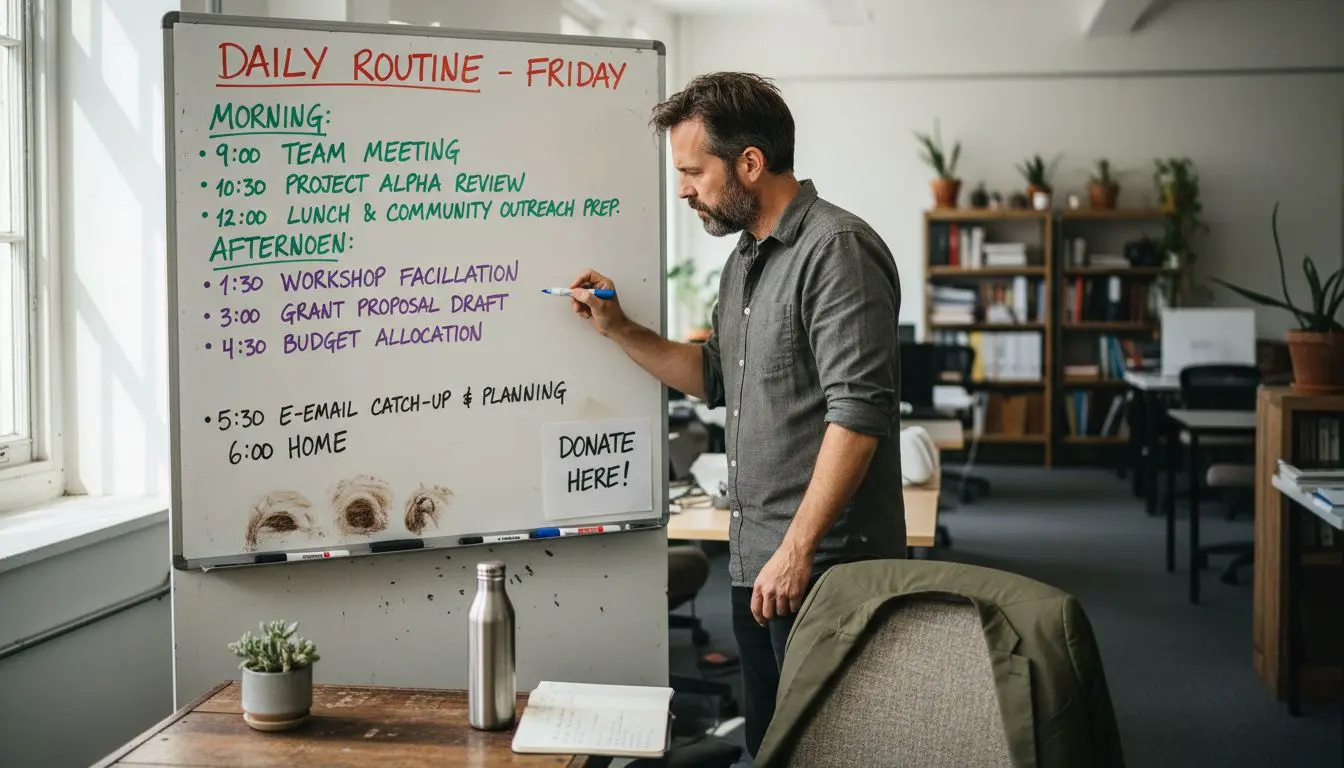
Begin by designing a personalised routine that aligns with your professional responsibilities and personal energy rhythms. Start your day with a consistent morning ritual that might include meditation, light exercise, or journaling to centre yourself before workplace challenges. Block specific times for critical tasks like strategic planning, correspondence, and team communication. Integrate short breaks between intense work periods to maintain mental clarity and prevent burnout. Establish a clear end-of-day routine that helps you transition from work mode, such as reviewing accomplishments, preparing the next day’s priorities, and implementing a digital shutdown protocol.
Remember that routines are not rigid constraints but flexible frameworks. Regularly evaluate and adjust your approach based on your organisational needs and personal wellbeing, ensuring your routine remains supportive rather than restrictive.
Practitioner Tip: Experiment with your routine for at least three weeks before making significant changes, allowing sufficient time to assess its true effectiveness.
Step 3: Establish healthy work boundaries
Healthy work boundaries are essential for nonprofit leaders to maintain their wellbeing and sustain long-term professional effectiveness. Preventing workplace burnout requires intentional strategies that protect your mental and emotional resources while maintaining organisational commitment.
Start by defining clear professional limits that separate your work responsibilities from personal life. Communicate your availability explicitly to colleagues and team members, establishing specific times when you are accessible and when you require uninterrupted focus or personal time. This might involve setting designated email response hours, creating automatic email replies during non working hours, and establishing protocols for urgent communications. Learn to say no to additional tasks that exceed your capacity, and delegate responsibilities effectively. Develop a practice of regularly reassessing your workload and identifying opportunities to redistribute tasks or seek additional support when your current responsibilities become overwhelming.
Remember that boundaries are not about reducing your commitment but about creating sustainable ways of working that preserve your energy and passion for your nonprofit’s mission. By protecting your personal wellbeing, you become a more effective and resilient leader who can consistently deliver meaningful impact.
Practitioner Tip: Schedule a monthly personal review to assess how well your work boundaries are functioning and make adjustments as your professional landscape evolves.
Step 4: Integrate relaxation techniques consistently
Successful nonprofit leaders recognise that managing stress requires deliberate and systematic approaches to relaxation. Relaxation techniques demonstrably reduce physiological stress by helping your body and mind reset from intense professional demands.
Select two or three relaxation methods that resonate with your personal style and schedule. These might include deep breathing exercises, progressive muscle relaxation, mindfulness meditation, or guided imagery. Create specific timeframes for practice during your day such as early morning before work, during lunch breaks, or immediately after your workday concludes. Start with short five to ten minute sessions and gradually increase duration as you become more comfortable. For deep breathing, try techniques like box breathing: inhale for four counts, hold for four counts, exhale for four counts, and pause for four counts. Practice progressive muscle relaxation by systematically tensing and releasing muscle groups from your toes to your head, helping release physical tension accumulated during stressful work periods.

Consistency is key in relaxation practice. Treat these techniques as non negotiable elements of your professional self care routine, understanding that they are investments in your leadership capacity and organisational effectiveness.
Practitioner Tip: Download a reputable meditation app to provide structured guidance and help you maintain a regular relaxation practice.
Step 5: Evaluate stress levels and adjust strategies
Successful nonprofit leaders understand that stress management is an ongoing process requiring continuous self reflection and strategic adaptation. Regular stress level assessment helps you maintain resilience and prevent potential burnout before it significantly impacts your professional performance.
Develop a comprehensive stress tracking system that combines quantitative and qualitative measurements. Use standardised stress assessment tools like the Perceived Stress Scale to quantify your stress levels, complemented by a personal journal documenting your emotional and physical responses to workplace challenges. Schedule monthly review sessions where you critically analyse your stress indicators, examining patterns in your energy levels, emotional reactions, and overall wellbeing. During these reviews, assess the effectiveness of your current stress management techniques. Are your relaxation practices providing meaningful relief? Do your work boundaries feel sustainable? Be prepared to experiment with and modify your strategies based on these insights, recognising that stress management is a dynamic and personalised process.
Consider these key differences when using qualitative vs. quantitative stress tracking methods:
| Method Type | Key Feature | Strengths | Limitation |
|---|---|---|---|
| Qualitative | Subjective reflection | Captures emotional nuance | May lack consistency |
| Quantitative | Standardised scoring scale | Enables easier comparison | Might miss underlying causes |
Remember that adaptability is your greatest asset in managing professional stress. What works today might need adjustment tomorrow, so maintain a flexible and compassionate approach towards your own wellbeing.
Practitioner Tip: Create a digital dashboard or spreadsheet to track your stress levels and management strategies, allowing for easy visual review and pattern recognition.
Manage Stress and Streamline Your Nonprofit Operations with Confidence
Nonprofit leaders face intense pressure balancing organisational goals and personal wellbeing. This article highlights crucial steps like recognising early stress signals, setting healthy work boundaries, and integrating relaxation techniques to prevent burnout and sustain effective leadership. Tackling these challenges requires not only personal strategies but also powerful organisational tools that simplify day-to-day management and reduce cognitive load.
Harness the strength of Colossus Systems to support your mission while protecting your mental clarity. Our platform enables you to streamline member management, automate event planning, and centralise communications so you can focus on what truly matters. With tailored tools for nonprofits, you can build structured routines, delegate tasks efficiently, and maintain sustainable work boundaries. Discover how improved digital engagement can reduce operational stress and increase impact. Start your journey to healthier leadership today by contacting us at Colossus Systems Contact. Make a positive change now and empower your organisation to thrive with less stress.
Frequently Asked Questions
How can I recognise my personal stress signals as a nonprofit leader?
Recognise your personal stress signals by paying attention to physical symptoms like muscle tension and headaches, as well as psychological indicators such as irritability and emotional exhaustion. Keep a personal journal or use a mood tracking app to monitor these signs regularly for better awareness and early intervention.
What daily routines can help me manage stress effectively?
Establish a structured daily routine that includes a consistent morning ritual, scheduled breaks, and a clear end-of-day process. Try blocking specific times for critical tasks and evaluate your routine every few weeks to ensure it supports your productivity and wellbeing.
How do I set healthy work boundaries to prevent burnout?
Define clear professional limits by communicating your availability to colleagues and establishing specific times for focused work. Commit to reassessing your workload regularly and learn to say no to additional tasks that exceed your capacity to maintain your mental and emotional health.
What relaxation techniques can I integrate into my routine?
Integrate relaxation techniques like deep breathing, mindfulness meditation, or progressive muscle relaxation into your daily routine. Aim to practice these techniques for five to ten minutes at a scheduled time daily, gradually increasing the duration to effectively manage stress.
How can I evaluate my stress levels and adjust my strategies?
Regularly evaluate your stress levels by using both quantitative assessments and qualitative self-reflection. Schedule monthly reviews to analyse your stress indicators and assess the effectiveness of your stress management practices, making necessary adjustments to ensure ongoing resilience.
What tools can I use to track my stress and wellbeing?
Utilise a personal journal, mood tracking app, or a digital dashboard to monitor your stress levels and management strategies. Create a consistent tracking method and review it periodically to identify patterns and adjust your approach to stress management.